

Commercial truck financing lets you put revenue-producing trucks on the road now while keeping working capital intact, and it delivers real U.S. tax advantages that reduce your effective cost of ownership. The core commercial truck financing benefits break down into five areas:
- Preserve cash flow: Spread the purchase price over a multi-year term so operating funds stay available for fuel, maintenance, and payroll.
- Accelerate fleet growth: Financing spreads high upfront costs over time so the truck generates revenue while payments are made.
- Predictable monthly payments: Fixed-rate loans lock in a set payment, making budgeting straightforward.
- Tax deductions: Section 179 expensing, bonus depreciation, and interest deductibility can materially lower your first-year tax bill.
- Accessible approval: Because the truck serves as collateral, lenders often offer lower rates and more accessible terms than unsecured business credit.
Immediate next step: Gather your EIN, two years of business tax returns, three months of bank statements, and a bill of sale or dealer quote. Then request pre-qualification from at least three lenders so you can compare APR, term, and fees side by side.
Table of Contents
- How does commercial truck financing actually work?
- Which financing option fits your business goals?
- What U.S. tax advantages can you claim on a financed truck?
- What do lenders actually evaluate before approving you?
- How do you compare truck-financing offers side by side?
- What would a $70,000 truck actually cost per month?
- How do you secure better rates before you apply?
- Key Takeaways
- Why financing is a growth tool, not just debt
- Find your next truck on Sostruckforsale
- Useful sources
How does commercial truck financing actually work?
A commercial truck loan is a secured business loan. The vehicle itself is collateral, the lender places a lien on the title, and payments are amortized over a fixed term. When the loan is paid off, the lien releases and you own the truck outright. A lease works differently: the lender or lessor retains ownership, you pay for use, and at term end you either return the truck, renew, or exercise a purchase option.
Step-by-step funding flow:
- Application: Submit business financials, personal credit authorization, and truck details.
- Underwriting: Lender reviews business revenue, time in business, personal and business credit scores, and collateral condition.
- Approval / pre-approval: Conditional approval issued, often within 24–72 hours for specialty lenders.
- Documentation: Sign loan agreement, provide bill of sale, proof of insurance, and registration.
- Funding and lien placement: Lender funds the dealer or seller directly; lien is recorded on the title.
Lender types and their typical approach:
- Banks and credit unions: Competitive rates for established businesses with strong credit; slower underwriting, often 1–3 weeks.
- Specialty truck lenders (e.g., Truck Lenders USA): Industry-specific underwriting, faster decisions, flexible on credit profile.
- Captive finance programs: Manufacturer-affiliated lenders that may offer promotional rates on new equipment.
- Marketplace lenders (e.g., LendingTree): Aggregate multiple offers in one application; useful for comparison shopping.
Specialty truck lenders and captive programs commonly offer faster decisions and funding than traditional bank lending, with some approvals completing in days rather than weeks.

Which financing option fits your business goals?
Pick a loan when you want to build equity and plan heavy, long-term use. Pick a lease when lower monthly payments and a predictable upgrade cycle matter more than ownership. Here is how each option stacks up:
- Secured commercial loan: You own the truck after payoff, no mileage restrictions, interest is deductible, and Section 179 / bonus depreciation may apply. Best for high-mileage operations and long-term asset holders.
- Finance lease: Structured like a loan in accounting terms (asset on your balance sheet), with a fixed residual buyout at term end. Useful when you want ownership but prefer a lower monthly payment.
- TRAC lease (Terminal Rental Adjustment Clause): Common in trucking; you set the residual value up front, which drives the monthly payment. At term end, you buy at the agreed residual or sell the truck and settle the difference. Flexible for fleet managers who want to control residual risk.
- Operating lease: Off-balance-sheet treatment (under older accounting rules), lower payments, and easy equipment swaps. Mileage caps apply, and penalties for overages can be steep.
- SBA 7(a) or SBA 504: Government-backed options with longer terms and lower down payments, suited to small businesses that qualify. SBA 504 is particularly useful for larger fleet purchases paired with real estate or major equipment.
- Fleet financing packages: Volume-based programs from lenders like Fleet Financial that bundle multiple units, often with structured payment schedules and preferred rates for fleet upgrades.
Businesses that drive more than about 25,000 miles per year generally find loans more economical than leases because lease mileage caps and overage penalties quickly negate the monthly-payment savings.
Pro Tip: If you run a mixed fleet, consider pairing short-term operating leases on lighter-duty or frequently rotated units with term loans on your highest-mileage trucks. This approach manages cash flow on the lease side while building equity on the assets you plan to keep long-term.
What U.S. tax advantages can you claim on a financed truck?
Financing can lower your after-tax cost of ownership through three main mechanisms: interest deductibility, Section 179 immediate expensing, and bonus depreciation. Each has conditions, so confirm eligibility with a tax advisor before filing.

Section 179 allows businesses to expense the full purchase price of qualifying equipment in the year it is placed in service, rather than depreciating it over several years. The IRS Publication 946 governs the rules, including annual deduction limits and business-use percentage requirements. For a truck used exclusively for business, the full purchase price may be deductible in year one, subject to the annual cap.
Bonus depreciation works alongside Section 179. Under current law, bonus depreciation applies to new and certain used equipment placed in service during the tax year. The percentage has been phasing down from 100%, so the applicable rate depends on when the truck is placed in service. Check current IRS guidance for the rate in effect for your tax year.
Interest deductibility applies to the interest portion of each loan payment. For a business loan on a commercial truck used for business purposes, that interest is generally deductible as a business expense.
Key tax benefit: A $70,000 truck fully expensed under Section 179 in year one, combined with deductible loan interest, can reduce your taxable income by the full purchase price plus cumulative interest paid, depending on your business-use percentage and tax situation.
Common caveats to verify with your accountant:
- Business-use percentage: if the truck is used for personal purposes even occasionally, only the business-use portion qualifies.
- Placed-in-service timing: the truck must be in service before year-end for that year's deduction.
- State conformity: not all states follow federal bonus depreciation rules; your state tax liability may differ.
- Leases vs. loans: operating leases typically do not qualify for Section 179 or bonus depreciation because you do not own the asset.
What do lenders actually evaluate before approving you?
Lenders underwriting commercial truck loans look at six core factors. Strong performance in most of them can offset weakness in one.
The six underwriting factors:
- Business credit and personal FICO: Most conventional lenders prefer a personal FICO above 650; specialty programs exist for scores in the 580–649 range, typically at higher rates.
- Time in business: Two or more years is the standard threshold for the best rates. Startups can qualify but usually face higher down payment requirements or specialty programs.
- Business revenue and cash flow: Lenders serving trucking weigh revenue, cash flow, and business history as part of underwriting. Stable, documented revenue can offset a lower FICO.
- Down payment: Loan terms typically range from 24 to 84 months; down payments commonly fall between 10% and 20%, though programs exist with lower or no down payment for qualified borrowers.
- Collateral condition: Truck age, mileage, and condition affect lender risk appetite. Newer trucks with lower mileage are easier to finance at competitive rates.
- Driver and operating history: Some specialty lenders review CDL history, safety records, and freight contract status for owner-operators.
Document checklist before you apply:
- EIN (Employer Identification Number)
- Two years of business tax returns
- Three months of recent business bank statements
- Bill of sale or dealer quote for the truck
- Vehicle registration (if refinancing)
- Driver's license and CDL documentation
- Proof of commercial insurance
Startups and borrowers with challenged credit should expect higher rates or require specialty programs. A trade-in with equity, a co-signer, or a larger down payment can all improve approval odds and rate offers.
How do you compare truck-financing offers side by side?
Always compare APR, term length, down payment, total fees, funding speed, prepayment penalties, and lender specialization before signing. Comparing at least three loan offers typically saves borrowers 1.5 to 2.5 percentage points on their interest rate.
| Comparison Dimension | What to Ask Each Lender | Red Flag |
|---|---|---|
| APR (not just rate) | "What is the full APR including all fees?" | Rate quoted without fees included |
| Term length | "What terms are available: 36, 48, 60, 72, 84 months?" | Only one term offered |
| Down payment | "What is the minimum and how does it affect my rate?" | Vague or verbal-only answer |
| Origination / doc fees | "List all fees charged at closing." | Fees disclosed only at signing |
| Prepayment penalty | "Is there a penalty for early payoff?" | Yes, with no buyout option |
| Funding speed | "How many days from approval to funding?" | No clear timeline given |
| Lender specialty | "Do you specialize in commercial trucks?" | General business lender with no truck experience |
Request-for-quote checklist: When contacting lenders, provide the truck price, year, make, model, mileage, your business revenue range, time in business, and approximate FICO. This gives each lender enough to return a comparable quote.
Which dimensions matter most by buyer profile:
- Startups and owner-operators: Down payment flexibility and lender specialty matter most. A lender like Truck Lenders USA, which focuses exclusively on commercial truck financing, applies industry-specific underwriting that a general bank cannot match.
- Established fleets: APR and prepayment terms drive total cost. Fleet Financial's volume programs can deliver structured pricing across multiple units.
- Businesses comparing multiple structures: LendingTree aggregates offers from multiple lenders in one application, making it practical for side-by-side APR comparison. Taycor Financial offers both loans and leases, useful when you have not yet decided which structure fits your cash flow.
What would a $70,000 truck actually cost per month?
Three scenarios for a $70,000 truck show how APR and term interact with monthly payment and total interest paid.
| Scenario | Truck Price | APR | Term | Est. Monthly Payment | Est. Total Interest |
|---|---|---|---|---|---|
| Excellent credit | $70,000 | 6% | — | — | — |
| Fair credit | $70,000 | 10% | — | — | — |
| Challenged credit | $70,000 | 10% to 20% | — | — | — |
Estimates based on standard amortization. Actual rates depend on lender, credit profile, down payment, and truck condition. These figures assume no down payment for illustration purposes.
How to calculate your own payment:
- Confirm the truck price and subtract your down payment to get the loan amount.
- Get APR quotes from at least three lenders (not just the interest rate).
- Enter loan amount, APR, and term into any standard loan amortization calculator.
- Compare total interest paid across term options, not just monthly payment.
- Factor in fees (origination, documentation) to get the true cost of each offer.
A shorter term reduces total interest but raises the monthly payment. A longer term lowers the monthly payment but increases total interest. For a truck that generates consistent freight revenue, the monthly payment is often the more practical constraint.
How do you secure better rates before you apply?
The fastest path to better terms is a larger down payment, cleaner credit, documented revenue, and multiple competing offers. These steps are worth taking in the weeks before you submit an application.
- Boost your business credit score: Pay down existing revolving balances, resolve any derogatory marks, and verify your Dun & Bradstreet and Experian Business profiles are accurate.
- Increase your down payment: Moving from 10% to 20% down on a $70,000 truck ($7,000 more upfront) typically reduces both your rate and your monthly payment.
- Document revenue thoroughly: Three to six months of bank statements showing consistent deposits strengthen your file, especially if your FICO is below 680.
- Reduce existing debt obligations: A lower debt-to-income ratio signals capacity to service the new loan.
- Ask about seasonal or step-payment programs: Some specialty lenders offer payment structures that ramp up as your new truck starts generating revenue, which is useful for startups adding their first unit.
- Consider trade-in value: If you are replacing an older truck, its trade-in equity can reduce the financed amount and improve your loan-to-value ratio.
Pro Tip: Time your purchase to align with the tax year. A truck placed in service before December 31 qualifies for that year's Section 179 deduction and any applicable bonus depreciation, which can offset a significant portion of the purchase price in your first tax filing.
Manufacturer incentives and dealer end-of-quarter promotions can also reduce the purchase price before financing is applied, lowering the total amount financed and the interest paid over the life of the loan.
Key Takeaways
Commercial truck financing preserves working capital, accelerates fleet growth, and delivers measurable U.S. tax advantages that reduce the effective cost of ownership for most business operators.
| Point | Details |
|---|---|
| Preserve working capital | Financing spreads costs over 24–84 months so cash stays available for operations and growth. |
| Tax advantages are real | Section 179, bonus depreciation, and interest deductibility can reduce first-year taxable income by the truck's full purchase price. |
| Credit is not the only factor | Stable revenue and strong collateral can offset a lower FICO; specialty lenders underwrite on trucking-specific criteria. |
| Shop at least three lenders | Comparing multiple offers typically saves 1.5–2.5 percentage points on APR, which adds up significantly over a 60-month term. |
| Sostruckforsale for sourcing trucks | Once financing is in place, Sostruckforsale's marketplace lets you filter semi trucks and commercial vehicles by price, year, and type to match your approved budget. |
Rule of thumb: Choose a loan when you drive more than 25,000 miles per year or plan to keep the truck long-term. Choose a lease when you prioritize lower monthly payments and plan to upgrade every 3–4 years.
Why financing is a growth tool, not just debt
Most operators frame financing as a necessary cost. That framing undersells what it actually does.
A truck sitting in a dealer lot generates zero revenue. A financed truck on a freight lane generates revenue from day one, often enough to cover the monthly payment and then some. The real question is not whether you pay interest; it is whether the return on that truck exceeds the cost of capital. For most owner-operators and small carriers running consistent freight, it does.
The risk is over-leveraging. Adding trucks faster than your freight contracts or driver capacity can support creates payment obligations that cash flow cannot absorb. The discipline is matching each financing decision to a specific revenue opportunity, not to an optimistic projection. Total cost of ownership matters more than headline APR. A truck with a slightly higher rate that stays productive and on the road outperforms a cheaper truck that sits idle waiting for a load.
Financing also builds business credit when payments are reported to commercial credit bureaus, which lowers the cost of the next truck. That compounding effect is one of the most underappreciated advantages of commercial vehicle loans for growing operations.
Find your next truck on Sostruckforsale
Financing approval in hand is the right moment to start searching inventory. Sostruckforsale's marketplace lists semi trucks for sale across a wide range of makes, years, mileage bands, and price points, so you can match what you find to your approved loan amount rather than the other way around.
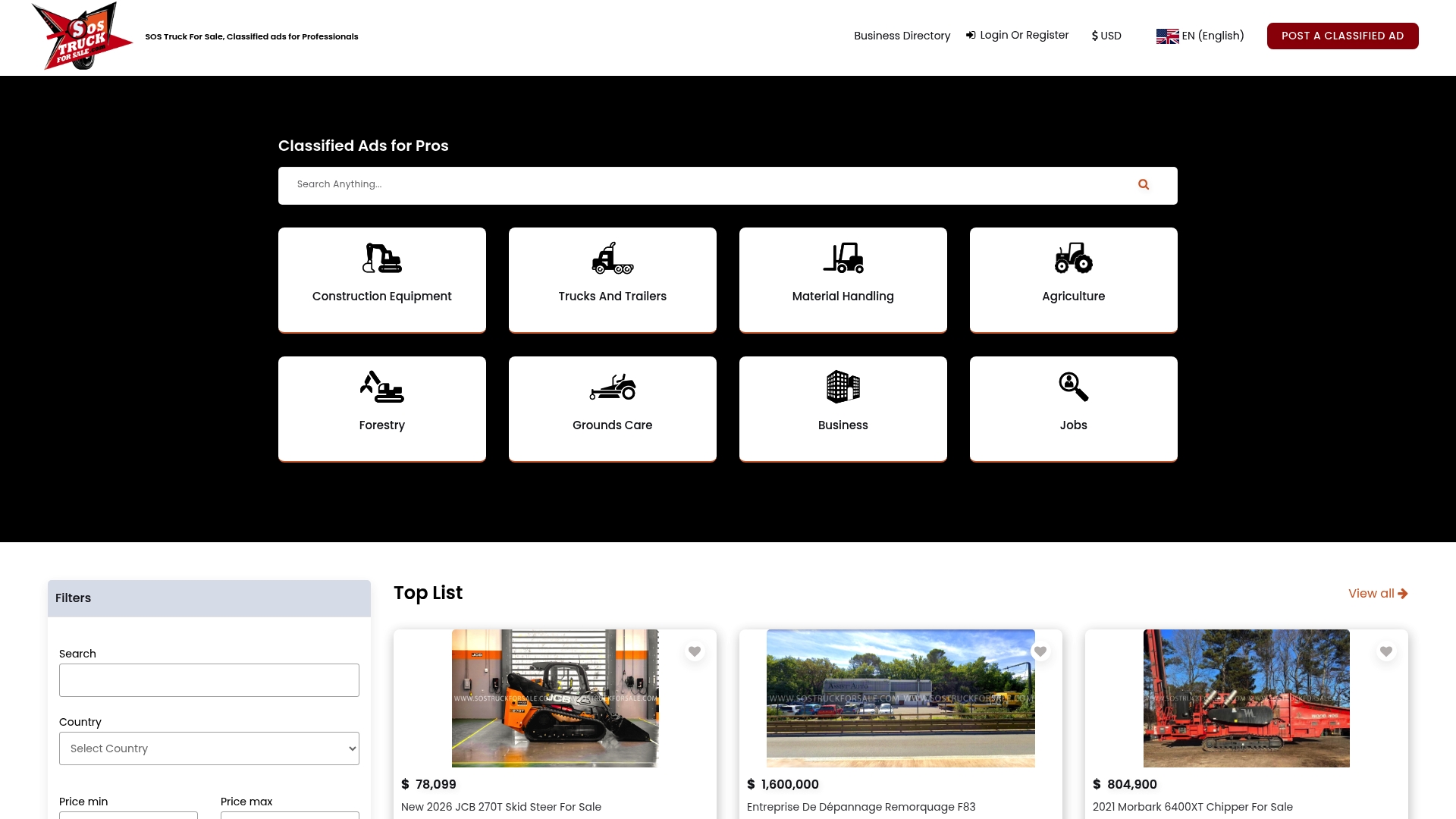
Use the price and vehicle-type filters to narrow listings to your budget. Sort by year and mileage to find trucks that align with your lender's collateral requirements (most lenders prefer trucks under 10 years old and under 500,000 miles for standard programs). When you find a unit, contact the seller directly through the listing to request a bill of sale or dealer quote, which is the document your lender needs to fund.
Browse current inventory at sostruckforsale.com and bring your pre-approval letter to the conversation.
Useful sources
The following resources were used in preparing this article and are worth bookmarking for deeper reading:
- IRS Publication 946: The authoritative source for Section 179 limits, bonus depreciation rules, and depreciation schedules for business equipment. Consult this before filing.
- Bankrate — Semi-truck financing pros and cons: Practical overview of secured vs. unsecured truck financing, rate expectations, and accessibility for startups.
- Crestmont Capital — Commercial vehicle financing guide: Detailed breakdown of loan terms, down payment norms, mileage guidance for loan vs. lease decisions, and lender comparison tips.
- First Capital — Commercial truck financing benefits: Focused on cash flow and TCO arguments for financing over cash purchase; useful for owner-operators evaluating the growth case.
- TruckFinancingGuide — Complete guide: Covers underwriting criteria, documentation requirements, and tax tool basics in one reference.
- American Trucking Associations — Economics and industry data: Industry-level data on fleet composition, operating costs, and freight trends for context on equipment investment decisions.
This article is general information, not financial, tax, or legal advice. Confirm current IRS rules, rate eligibility, and financing terms with a qualified tax advisor and your lender before making decisions.