

Commercial truck insurance is a specialized multi-policy coverage stack that protects any commercial vehicle with a gross vehicle weight rating (GVWR) over 10,001 lbs operating interstate. The Federal Motor Carrier Safety Administration (FMCSA) mandates minimum liability limits ranging from $750,000 to $5 million depending on freight type. For truck owners and fleet operators, this coverage is not optional. It shields your vehicles, cargo, drivers, and business from financial losses tied to accidents, cargo damage, and third-party liability claims. Understanding what is commercial truck insurance, how it works, and what it costs is the first step to running a legally compliant and financially protected operation.
What is commercial truck insurance and what does it cover?
Commercial truck insurance is not a single policy. It is a layered set of coverages, each addressing a distinct category of risk. Essential coverages include Primary Auto Liability, Physical Damage, Motor Truck Cargo, General Liability, Trailer Interchange, Bobtail, and On-Hook insurance. Federal filings like BMC-91 and MCS-90 are also mandatory for carriers operating under FMCSA authority. Each coverage type fills a specific gap that the others do not address.
Primary auto liability
Primary Auto Liability covers bodily injury and property damage caused to third parties when your truck is at fault in an accident. This is the coverage FMCSA requires before you can legally operate. Without it, your operating authority can be revoked immediately.

Physical damage coverage
Physical Damage coverage pays to repair or replace your own truck after a collision, fire, theft, or weather event. It splits into two parts: collision (accidents) and comprehensive (non-collision events). Lenders and lease agreements almost always require this coverage before releasing a vehicle.
Motor truck cargo insurance
Motor Truck Cargo insurance protects the freight you haul against loss or damage during transit. Cargo policies often exclude high-risk commodities such as electronics, alcohol, and pharmaceuticals unless you add specific endorsements. Unendorsed cargo has zero protection in the event of theft or damage, which is a risk no carrier should accept.
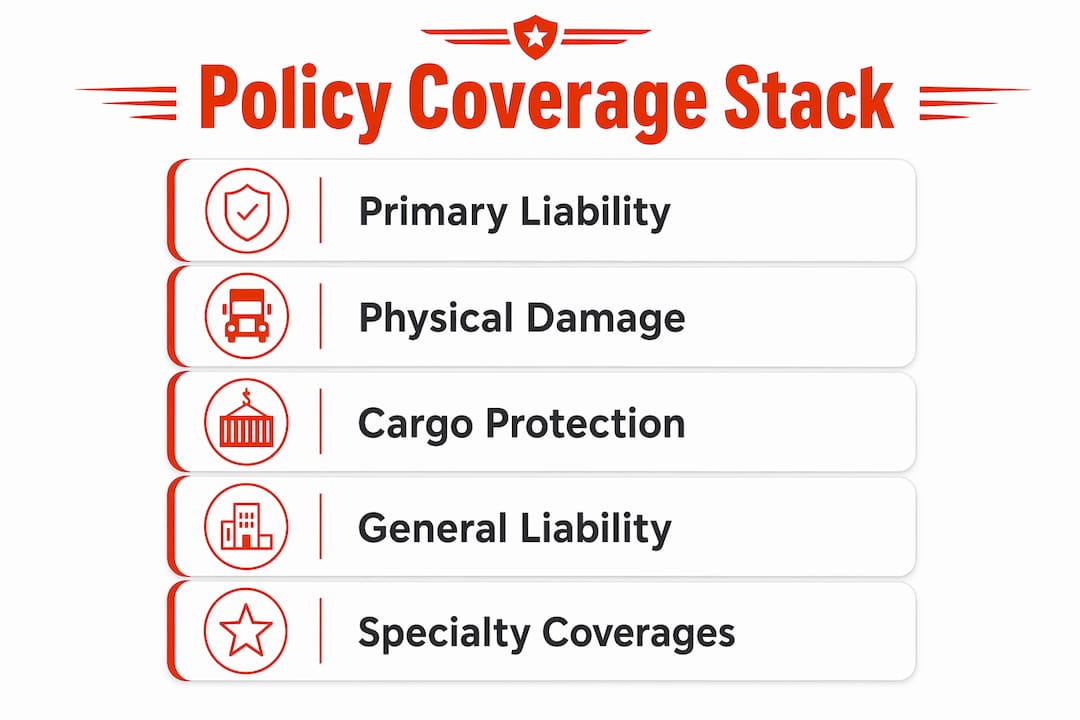
General liability and specialty coverages
General Liability (GL) insurance covers non-driving business risks such as premises liability and loading incidents. It does not replace auto liability. Shippers frequently require GL coverage as a contract condition, independent of FMCSA mandates. Failing to carry GL can disqualify you from contracts entirely.
Specialty coverages fill gaps that standard policies miss:
- Bobtail insurance: Covers your tractor without a trailer while under dispatch.
- Non-Trucking Liability (NTL): Covers your tractor during personal use only, not under dispatch.
- Trailer Interchange: Covers non-owned trailers you are pulling under a trailer interchange agreement.
- On-Hook insurance: Covers vehicles being towed or transported by your truck.
| Coverage Type | What It Protects | Typical Use Case |
|---|---|---|
| Primary Auto Liability | Third-party bodily injury and property damage | All interstate motor carriers |
| Physical Damage | Your own truck (collision and comprehensive) | Financed or leased trucks |
| Motor Truck Cargo | Freight in transit | Carriers hauling general or specialty freight |
| General Liability | Non-driving business risks | Carriers with shipper contracts |
| Bobtail | Tractor without trailer, under dispatch | Owner-operators leased to carriers |
| Non-Trucking Liability | Tractor during personal use | Owner-operators off dispatch |
| Trailer Interchange | Non-owned trailers under agreement | Carriers using shared trailer pools |
| On-Hook | Vehicles being towed | Tow truck and driveaway operators |
Pro Tip: Review your cargo policy's commodity list before accepting a new freight lane. If the commodity is not listed, you are not covered, regardless of what your certificate of insurance says.
How does commercial truck insurance work with federal regulations?
FMCSA sets the legal floor for liability coverage based on vehicle weight and cargo type. Federal minimums start at $750,000 for general freight and climb to $1 million to $5 million for hazardous materials. These numbers represent the minimum to operate legally, not the minimum to stay in business after a serious accident.
The practical industry standard sits at $1 million combined single limit (CSL) for most general freight operations. Shippers and freight brokers routinely require limits at or above this threshold as a condition of doing business. Carriers who only carry federal minimums often find themselves locked out of the most profitable freight lanes.
USDOT, MC authority, and insurance filings
Every interstate carrier must register with FMCSA and obtain a USDOT number and Motor Carrier (MC) operating authority number. Insurance is directly tied to that authority. The BMC-91 form is the standard filing that proves your Primary Auto Liability coverage to FMCSA. The MCS-90 endorsement is attached to your policy and guarantees payment to the public even if your policy would otherwise deny a claim.
| Cargo Type | FMCSA Minimum Liability | Practical Industry Standard |
|---|---|---|
| General freight (under 10,001 lbs GVWR) | $300,000 | $1,000,000 CSL |
| General freight (over 10,001 lbs GVWR) | $750,000 | $1,000,000 CSL |
| Hazardous materials (non-bulk) | $1,000,000 | $1,000,000–$5,000,000 |
| Hazardous materials (bulk) | $5,000,000 | $5,000,000+ |
Pro Tip: Do not wait for a broker to flag a coverage shortfall. Request a copy of every shipper's insurance requirements before bidding on a lane. Align your limits before you submit the rate confirmation.
FMCSA requirements set a baseline. Carriers who customize their coverage to reflect their actual freight and lanes stay both compliant and competitive. Insurance is not just a regulatory checkbox. It is a direct business enabler that determines which contracts you can accept.
What factors drive commercial truck insurance costs?
Annual premiums vary significantly based on operation type. Solo owner-operators pay $9,000–$15,000 per year, mid-size fleets pay $40,000 to $120,000 or more, and hazmat heavy-duty operators pay over $20,000 per truck annually. These ranges reflect the wide variation in risk profiles across the industry.
The primary cost drivers are:
- Driver experience: Drivers with fewer than two years of CDL experience carry significantly higher premiums.
- Vehicle age and type: Older trucks and specialty vehicles cost more to insure due to repair costs and higher loss frequency.
- Cargo mix: High-value or high-risk commodities like electronics or fuel increase cargo and liability premiums.
- Geographic location: Routes through high-traffic urban corridors or states with high litigation rates push premiums up.
- Fleet size: Larger fleets often qualify for volume discounts, but each additional truck adds to total exposure.
- Claims history: A single at-fault accident can raise premiums by a material amount at renewal.
Contract requirements also affect cost. If a shipper requires $2 million in liability coverage and you currently carry $1 million, you must increase limits. That increase shows up directly in your premium. Aligning insurance limits to actual freight values and lane contracts prevents both underinsurance and unnecessary overpayment.
Pro Tip: When comparing quotes, verify that every quote uses identical coverage forms, limits, and endorsements. A lower premium that drops a key endorsement is not a savings. It is a coverage gap disguised as a discount.
Comparing trucking insurance quotes requires ensuring identical coverage forms across all lines of business. A quote that strips out Trailer Interchange or reduces cargo limits to hit a lower price point leaves you exposed on the lanes where you need protection most.
Common premium management mistakes to avoid:
- Carrying only federal minimum liability to save money on high-value freight lanes.
- Skipping General Liability because it is not FMCSA-mandated, then losing a shipper contract.
- Failing to add commodity endorsements before hauling electronics or pharmaceuticals.
- Not reviewing coverage at renewal when your freight mix or lanes have changed.
What are the most common coverage gaps in truck insurance?
The most costly coverage gaps in commercial trucking come from misunderstood policy distinctions. Bobtail and Non-Trucking Liability are the most commonly confused coverages in the industry. Bobtail covers your tractor without a trailer while you are still under dispatch. NTL covers your tractor only during personal use, completely off dispatch. Confusing the two leaves you uninsured during the exact scenario you thought you were covered for.
General Liability is another frequent gap. Many operators assume their auto liability policy covers all business risks. GL covers risks outside vehicle operation, including loading dock incidents, premises liability, and product handling claims. Auto liability does not touch any of these scenarios.
Cargo exclusions create a third category of dangerous gaps. High-risk commodities like electronics, alcohol, and pharmaceuticals require specific endorsements to be covered under a standard cargo policy. Carriers who haul these commodities without endorsements have no cargo protection at all.
- Verify your cargo policy's commodity schedule before every new freight type.
- Confirm whether your policy covers theft, not just physical damage in transit.
- Check endorsement expiration dates. An expired endorsement is the same as no endorsement.
- Confirm whether your GL policy covers loading and unloading operations specifically.
Pro Tip: Ask your insurance broker for a written coverage summary that maps each policy to specific operational scenarios. This single document will reveal gaps faster than reading through full policy language.
Key Takeaways
Commercial truck insurance is a mandatory, multi-policy coverage stack that protects truck owners and fleet operators from liability, cargo loss, and physical damage, with FMCSA minimums serving as the legal floor and contract requirements often setting the real standard.
| Point | Details |
|---|---|
| Coverage is a stack, not one policy | Carriers need multiple policies covering liability, cargo, physical damage, and specialty risks. |
| Federal minimums are a starting point | FMCSA requires $750,000 to $5 million in liability; shippers often demand $1 million CSL or more. |
| Cargo exclusions are a hidden risk | High-risk commodities require specific endorsements or they carry zero coverage. |
| Bobtail and NTL are not interchangeable | Confusing these two coverages creates gaps during off-trailer operations. |
| Insurance enables contracts | Carriers without GL or adequate limits are disqualified from many shipper and broker agreements. |
Why I treat insurance as a revenue tool, not a cost center
Most operators I talk to view insurance as a fixed cost to minimize. That framing is the wrong starting point. The carriers who run the most profitable operations treat their coverage stack as a qualification credential. Every time you increase your liability limit to $2 million or add a GL policy, you open a new tier of freight lanes that lower-covered carriers cannot touch.
The real mistake I see repeatedly is anchoring limits to federal minimums and then wondering why the best-paying brokers keep passing on your bids. Federal minimums exist to protect the public. Contract minimums exist to protect the shipper's freight and legal exposure. Those are two different numbers, and the gap between them is where most small carriers leave money on the table.
My practical advice: review your policy at every renewal against your actual freight mix and lane contracts. If you added a new commodity or entered a new state corridor, your coverage needs to reflect that. A policy that matched your operation 18 months ago may have three gaps today. The cost of closing those gaps is almost always less than the cost of one uncovered claim.
— Dave
Sostruckforsale: resources for truck owners and operators
Truck owners who understand their insurance needs are better positioned to make smart fleet decisions. Whether you are buying your first semi or expanding a fleet, having the right equipment and the right protection go hand in hand.
Sostruckforsale lists semi trucks for sale and heavy duty commercial vehicles from verified sellers across the United States. Each listing includes detailed specifications to help you assess the right fit for your operation and your insurance profile. Operators who know their vehicle type, GVWR, and cargo capacity can approach insurance conversations with accurate data, which leads to better quotes and fewer coverage surprises. Visit Sostruckforsale to browse current inventory and connect with sellers directly.
FAQ
What is commercial truck insurance in simple terms?
Commercial truck insurance is a set of policies that covers your truck, cargo, and liability when operating commercially. FMCSA requires it for any vehicle over 10,001 lbs GVWR operating interstate.
Is truck insurance mandatory for all commercial operators?
Yes. Any carrier operating under FMCSA authority must carry minimum liability coverage and file proof of insurance using the BMC-91 form before receiving operating authority.
How much does commercial truck insurance cost per year?
Solo owner-operators typically pay $9,000–$15,000 annually. Mid-size fleets pay $40,000 to $120,000 or more, and hazmat operators pay over $20,000 per truck per year.
What is the difference between Bobtail and Non-Trucking Liability?
Bobtail covers your tractor without a trailer while under dispatch. Non-Trucking Liability covers your tractor during personal use only, when completely off dispatch.
Does General Liability replace auto liability for truck operators?
No. General Liability covers non-driving risks like loading incidents and premises liability. Auto liability covers third-party injury and property damage from vehicle operation. Both are often required by shippers.