
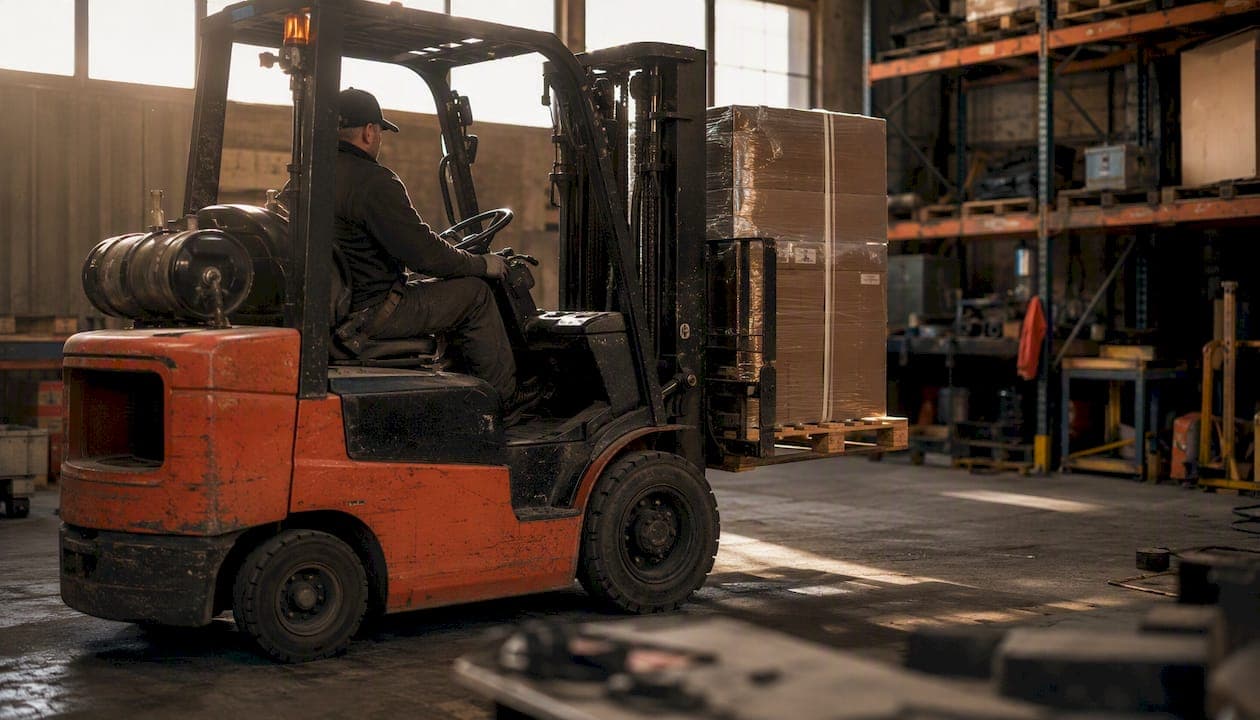
A typical 5,000-lb capacity sit-down forklift has a service weight of roughly 8,000–9,000 lb, nearly double its rated lifting capacity. That gap surprises many buyers and operators. Service weight (also called operating weight) is the total mass of the machine itself, including the counterweight, mast, battery or fuel system, and tires. Rated lifting capacity is the maximum load the machine can safely lift at a specified load center. The two figures are always different, and confusing them causes real safety and transport problems.
Quick benchmarks by class:
-
- Small electric pallet jack forklifts have a relatively low service weight suitable for light warehouse tasks
- Standard sit-down rider forklifts with a 5,000-lb capacity typically have service weights significantly higher than their rated capacity
- Rough-terrain and telehandler machines usually have a substantially higher service weight due to their robust construction and equipment
- Heavy industrial and container handlers can be extremely heavy, reflecting their capability for demanding tasks
Table of Contents
- Why forklift weight matters for stability, floor loads, and transport
- How load center and load moment calculations work
- Common component weights: battery, propane, forks, and attachments
- Operator safety checklist: weight, capacity, and regulatory requirements
- Key Takeaways
- Weight specs are where most forklift buyers go wrong
- Find forklifts with verified specs on Sostruckforsale
- Sources and further reading
Why forklift weight matters for stability, floor loads, and transport
Service weight is not just a shipping concern. It directly governs whether a machine is safe to operate, whether a floor can hold it, and whether a trailer can legally carry it.
Counterweight and the stability fulcrum
A forklift is a lever. The front axle acts as the fulcrum, the load sits on one side, and the machine's own mass sits on the other. Counterweights commonly add 3,000–5,000 lb to the rear of the machine, deliberately making the truck heavy enough to keep the combined center of gravity inside the stability triangle when lifting rated loads. Remove or reduce that counterweight mass and the machine tips forward. This is why service weight is an engineered safety feature, not just a logistics number.
OSHA's powered industrial truck standard, 29 CFR 1910.178, requires operators to handle loads only within the rated capacity shown on the data plate and to account for load center when determining safe lift limits. Exceeding either limit shifts the combined center of gravity outside the stability triangle and creates a tip-over risk.
Floor and structural load limits
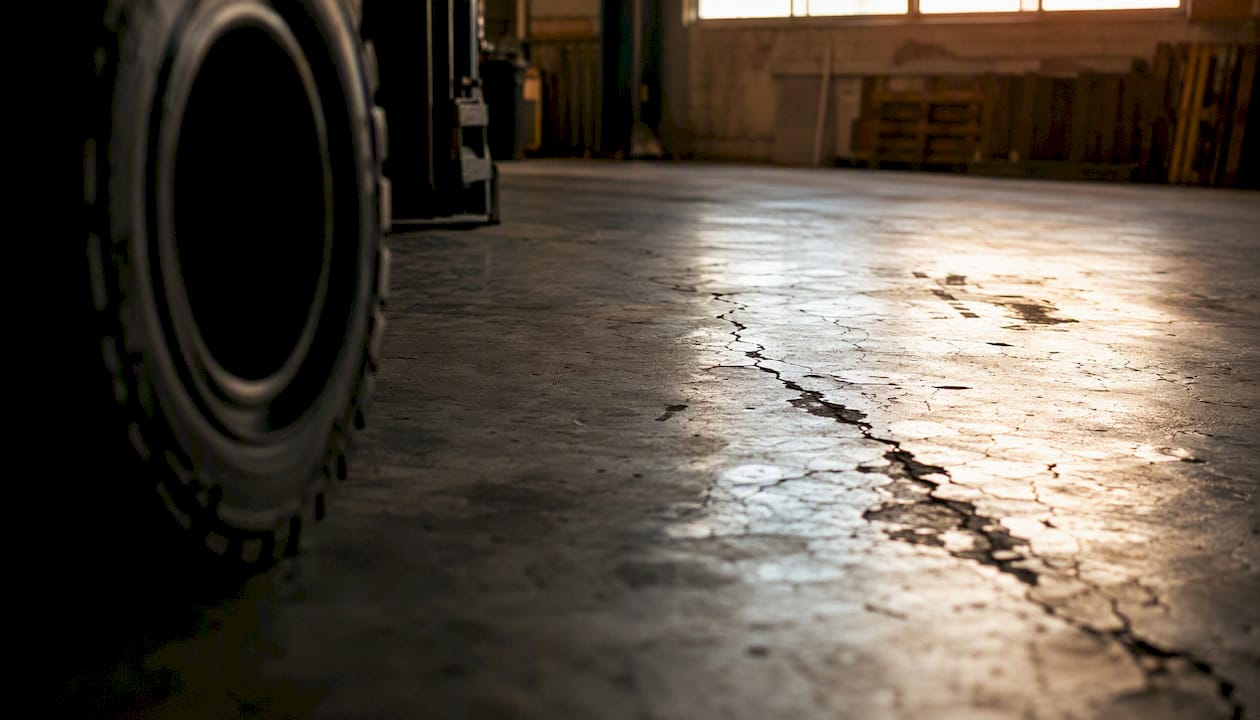
A 9,000-lb forklift carrying an 8,000-lb load puts roughly 17,000 lb on a relatively small contact area. Warehouse slabs, mezzanines, and truck-dock floors each have rated load limits. Before parking or operating a heavy machine on any elevated structure, confirm the floor's load-bearing capacity with a structural engineer or the building's original design documents. Standard warehouse slabs are often rated at 2,000–3,000 lb per square foot, but older or thinner slabs may be rated lower.
Transport and permit thresholds
Moving a forklift by road means adding its service weight to the tow vehicle and trailer. A standard flatbed trailer has a payload capacity of roughly 48,000 lb; a lowboy can carry more, but the combined gross vehicle weight of the tractor, trailer, and load must stay within federal and state limits. Machines above certain weights require oversize/overweight permits from state DOTs before moving on public roads. Always confirm the forklift's service weight before booking a carrier.
Key regulatory reminder: 29 CFR 1910.178(l) requires that operators be trained on load handling, data-plate limits, and stability principles. The data plate is the legal reference for rated capacity and load center.
How load center and load moment calculations work
Rated capacity only applies at the load center printed on the data plate. Move the load farther from the forks' face and the safe capacity drops. The industry standard load center is 24 inches, meaning the data plate assumes the load's center of gravity sits 24 inches back from the fork face.
Load moment is the product of load weight and load distance. The forklift's counterweight and service weight create a counteracting moment. When the load moment exceeds the counteracting moment, the machine tips forward.
The field calculation
Use this formula to find the allowable capacity when your actual load center exceeds the rated load center:
Allowable capacity = (Rated load center ÷ Actual load center) × Rated capacity
Worked example
A sit-down electric truck is rated at 5,000 lb at a 24-inch load center. You need to lift a wide pallet where the load's center of gravity is 28 inches from the fork face.
- Rated load center: 24 in.
- Actual load center: 28 in.
- Rated capacity: 5,000 lb
- Allowable capacity: (24 ÷ 28) × 5,000 = 0.857 × 5,000 = 4,286 lb
The machine can safely lift only 4,286 lb with that load, not the full 5,000 lb. Attempting to lift the full rated load at a 28-inch center creates a load moment the counterweight cannot offset. OSHA's load-composition guidance explicitly covers this calculation and requires operators to apply it whenever the actual load center differs from the rated value.
A simple diagram showing the front axle as the fulcrum, the load distance on one side, and the counterweight distance on the other makes this calculation intuitive. Ask your equipment dealer or safety trainer for one.
Common component weights: battery, propane, forks, and attachments
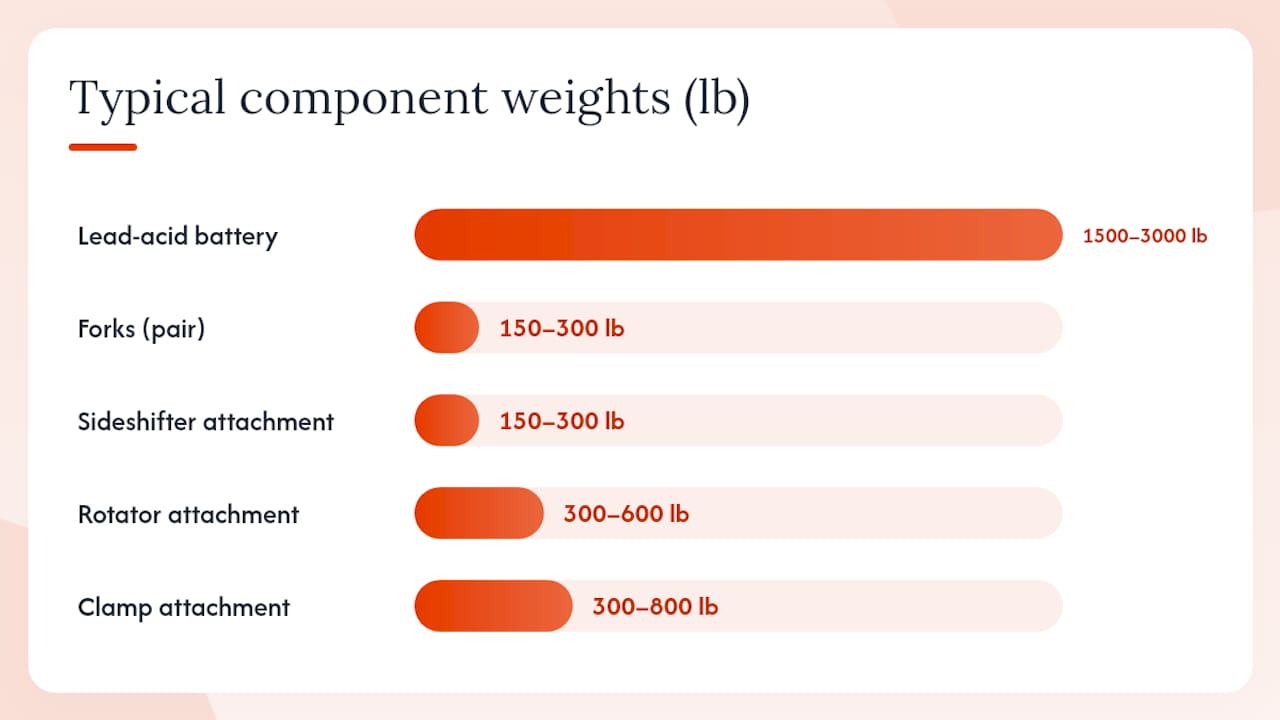
Knowing the weight of individual components helps you estimate how a configuration change affects service weight and transport planning.
| Component | Typical Weight Range | Notes |
|---|---|---|
| Lead-acid battery (standard electric) | 1,500–3,000 lb | Heavier packs for higher-capacity trucks |
| Lithium-ion battery (equivalent capacity) | — | Roughly 20–30% lighter than lead-acid |
| Propane tank (full, 33-lb tank) | — | Empty and larger tanks vary by model |
| Standard forks (pair) vary in length | 150–300 lb | Longer or thicker forks weigh more |
| Sideshifter attachment | 150–300 lb | Adds to service weight; reduces rated capacity |
| Rotator attachment | 300–600 lb | Significant load-center impact |
| Clamp attachment (paper roll, bale) | 300–800 lb | Varies widely by clamp size |
Battery weight note: Lead-acid packs commonly weigh 1,500–3,000 lb on standard warehouse electrics. Switching to lithium-ion for the same machine reduces service weight by several hundred pounds, which can change trailer payload calculations and floor-load assessments.
Every attachment added to the carriage increases service weight and shifts the effective load center forward. That forward shift reduces allowable lift capacity per the load-moment formula above. Always recalculate allowable capacity after adding any attachment, and update the data plate or attach a supplemental capacity placard as required by OSHA 29 CFR 1910.178.
Operator safety checklist: weight, capacity, and regulatory requirements
Safe forklift operation starts before the engine turns on. These checks relate directly to weight, load center, and the regulatory requirements under 29 CFR 1910.178.
- Verify the data plate is present and legible — A missing or damaged data plate is an OSHA violation. Do not operate the machine until it is replaced.
- Never exceed rated capacity — Overloading shifts the center of gravity forward of the front axle, causing tip-over. Conger's capacity guidance identifies overloading as one of the primary causes of forklift tip-overs.
Regulatory note: OSHA estimates that forklift-related incidents cause thousands of injuries and dozens of fatalities in U.S. workplaces each year. Staying within data-plate limits, adjusted for actual load center and attachments, is the single most effective preventive measure.
Key Takeaways
A forklift's service weight typically runs 1.5–2× its rated lifting capacity, and staying within data-plate limits adjusted for actual load center is the single most important safety rule in forklift operation.
| Point | Details |
|---|---|
| Service weight vs. capacity | A 5,000-lb capacity sit-down forklift typically weighs 8,000–9,000 lb; service weight always exceeds rated capacity. |
| Load center calculation | Use (rated load center ÷ actual load center) × rated capacity to find allowable lift when load center exceeds 24 inches. |
| Component weight impact | Lead-acid batteries add 1,500–3,000 lb; lithium-ion packs run roughly 20–30% lighter, changing transport and floor-load figures. |
| Transport and floor checks | Confirm service weight via data plate or certified scale before selecting a trailer or operating on any elevated structure. |
| Find forklifts with specs on Sostruckforsale | Sostruckforsale listings connect buyers with sellers who can provide data-plate photos and confirmed service weights for commercial equipment. |
Weight specs are where most forklift buyers go wrong
Most buyers shopping for a used forklift focus on rated capacity and price. Service weight rarely comes up until there is a problem: the trailer is overloaded, the warehouse floor shows stress cracks, or the machine tips on a dock plate that was not rated for it.
The gap between advertised capacity and real-world operating weight is wider than most people expect, and marketplace listings make it worse. A listing that says "5,000 lb capacity" tells you almost nothing about what the machine actually weighs, what attachments are installed, or whether those attachments have been accounted for in the capacity rating. Sellers often list the original data-plate capacity without noting that a rotator or clamp was added years ago, which reduces the actual safe working capacity by several hundred pounds.
The practical fix is simple: ask for the data-plate photo and the spec sheet before you negotiate. If the seller cannot provide them, that is a signal worth taking seriously. For transport planning, get a certified scale reading with all attachments installed. The 15 minutes it takes to weigh a machine is far cheaper than a permit violation, a floor repair, or a tip-over incident.
Find forklifts with verified specs on Sostruckforsale
Buyers who know their weight and capacity requirements need listings that actually include that information. Sostruckforsale connects buyers with commercial equipment dealers and private sellers listing forklifts, material handling machinery, and heavy industrial equipment across the United States. Sellers can include data-plate photos, service weight figures, and attachment details directly in their listings, giving buyers the specific numbers they need before making contact.
Whether you are sourcing a standard 5,000-lb capacity warehouse electric or a heavy-duty rough-terrain machine for a construction site, the listings on Sostruckforsale let you filter by equipment type and reach sellers directly to request spec sheets and data-plate documentation. Sellers looking to move equipment can list with full specifications to attract serious, informed buyers faster.
Browse current forklift and heavy equipment listings on Sostruckforsale, or post your machine with complete weight and capacity details to connect with buyers who know exactly what they need.
Sources and further reading
The figures, ranges, and regulatory references in this guide draw from the following authoritative sources. Use them to verify specific model data, download manufacturer spec sheets, or review OSHA requirements in full.
- eTool : Powered Industrial Trucks (Forklift) — Load Handling - Load Composition | Occupational Safety and Health Administration
- How Much Does a Forklift Weigh? | BigRentz
- [A Complete Guide to Forklift Weight & Specs [2025]](https://www.totalwarehouse.com/blogs/forklift-weight/)
- Forklift Size Decisions: What Forklift Capacity Do I Need? | Toyota Forklifts Blog
- Forklift Weight Capacity: Everything You Need to Know — Conger Industries Inc.
- Forklift Weight | National Forklift Foundation
- How Much Does a Forklift Weigh? | Certified Lift Specialists Inc
For manufacturer-specific service weights, search the model number on the manufacturer's website or request the PDF spec sheet from an authorized dealer. The data plate on the machine itself remains the single most reliable reference for rated capacity and load center.