
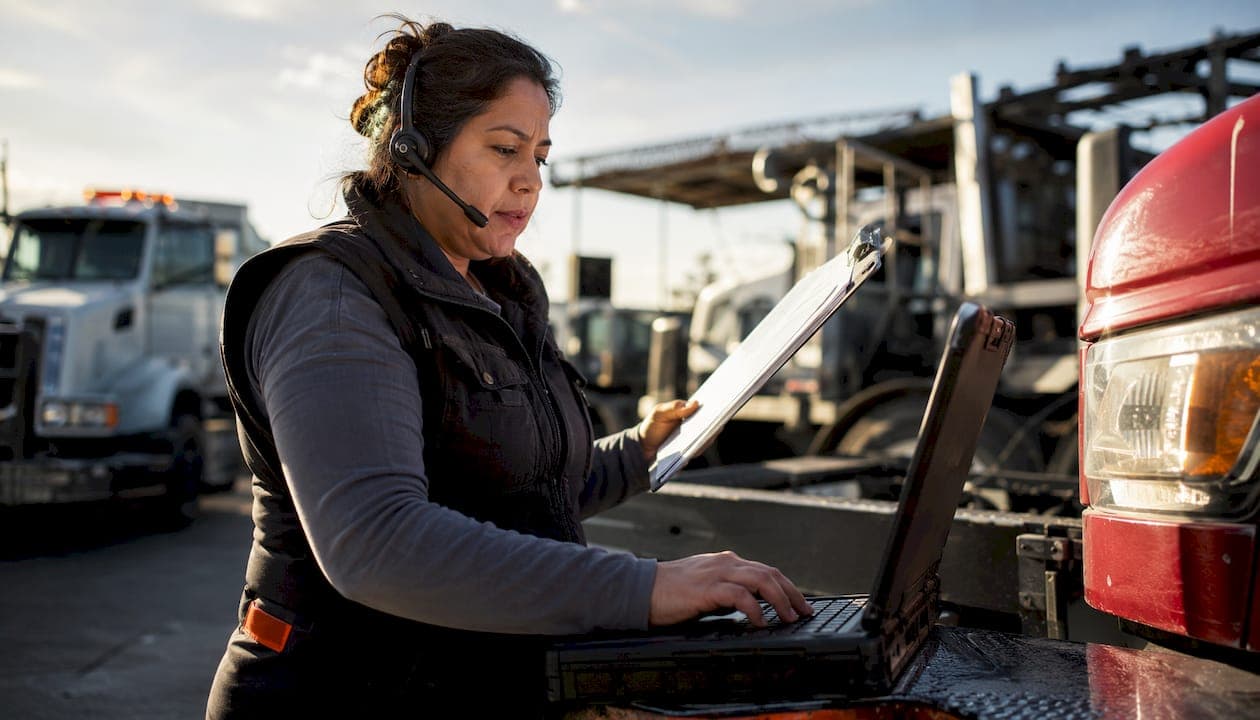
What does a dispatcher actually do in trucking?
The role of dispatch in trucking is to serve as the central coordination point between drivers, carriers, brokers, and customers. Dispatchers find and book loads, negotiate rates, plan routes, monitor trips in real time, and manage the paperwork that gets carriers paid. Without this function, trucks sit idle, drivers miss hours-of-service limits, and revenue leaks through every gap.
Here is what a working dispatcher handles daily:
- Load sourcing: Searching load boards like DAT One, Truckstop, and TruckSmarter, which collectively post over a million daily loads
- Rate negotiation: Countering broker opening prices using market rate data from tools like DAT RateView
- Route planning: Accounting for weight limits, hazmat restrictions, weather, and fuel costs
- HOS compliance: Tracking each driver's available hours via Electronic Logging Device (ELD) data to prevent violations
- Real-time monitoring: Adjusting schedules and communicating updates when delays or breakdowns occur
- Paperwork management: Collecting Bills of Lading (BOL), Proof of Delivery (POD), and rate confirmations to close the payment cycle
Dispatch directly shapes a carrier's profitability, safety record, and ability to keep trucks moving. It compresses what would be five or six separate job titles in most industries into a single, fast-moving role.
How the dispatch process in trucking works step by step
Every load follows a repeatable sequence, though real-world conditions constantly test it.
1. Verify availability and HOS status. Before searching for freight, the dispatcher confirms which trucks are ready and how many hours each driver has remaining. Planning loads around real driver hours, not assumptions, prevents violations and wasted trips.
2. Search load boards and broker networks. Dispatchers use load boards and direct broker contacts to find freight that fits the truck's equipment type, location, and preferred lanes.

3. Negotiate rates and sign the Rate Confirmation. Brokers post starting prices, not final prices. A dispatcher who calls without current lane data is negotiating blind. With DAT RateView or Truckstop's Rate Insights showing what brokers actually paid over the last 7–30 days, the conversation starts from a defensible position. The Rate Confirmation becomes the legal document governing the load.
4. Assign the load and brief the driver. The dispatcher shares pickup location, delivery window, commodity details, and any special instructions before the driver moves.
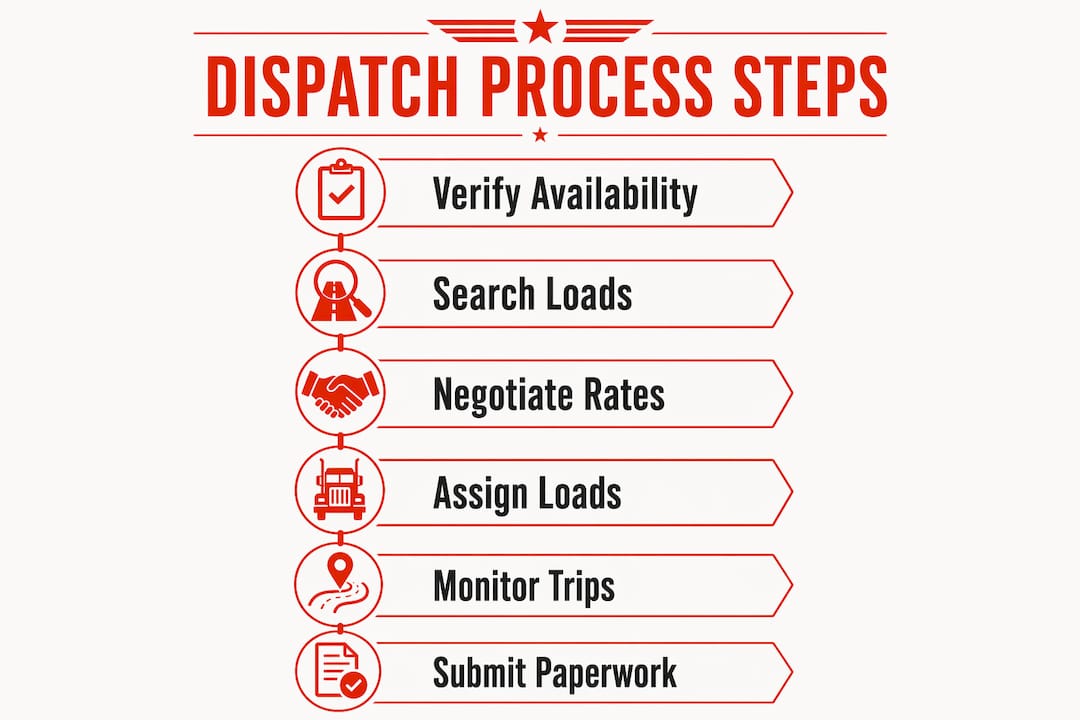
5. Monitor the trip in real time. GPS and ELD data let dispatchers track progress, reroute around traffic or weather, and communicate updates to brokers and receivers.
6. Collect and submit post-delivery paperwork. BOLs, PODs, lumper receipts, and rate confirmations must be organized into a clean invoice packet within 24 hours of delivery. A one-week delay from paperwork errors can cause small fleets to miss payroll.
What are the main types of dispatch structures?
Almost every American carrier operates through one of three models, and most growing fleets move through all three over time.
- In-house dispatcher: Employed directly by the carrier. This person knows the fleet, the drivers, and the preferred lanes deeply. The trade-off is payroll cost and the need to manage that employee.
- Independent or contracted dispatch service: A third-party service handles load sourcing, negotiation, and back-office paperwork for a percentage of gross load revenue. Professional dispatch services offer time savings and better load negotiations, but require vetting. Unethical practices like double-dispatching can damage a carrier's authority and reputation, so due diligence before signing any service agreement is non-negotiable.
- Self-dispatching owner-operator: The driver handles everything. This works when volume is low, but it pulls attention away from the road and limits negotiating leverage with brokers.
Each structure has real trade-offs in cost, control, and capacity. The right choice depends on fleet size, available time, and how much back-office work the owner is willing to absorb.
How dispatch drives profitability and fleet efficiency
Skilled dispatchers improve profitability by prioritizing high rate-per-mile loads and cutting empty miles. Poor dispatching produces inconsistent income, particularly for owner-operators running tight margins.
The revenue levers a dispatcher controls are specific. Rate negotiation on every load compounds over time. Managing detention pay and TONU (Truck Order Not Used) fees defends revenue that would otherwise disappear. Avoiding facilities known for excessive driver delays preserves productive driving time within HOS limits. And converting delivery documents into clean invoice packets within 24 hours keeps cash flowing instead of stalling it.
Pro Tip: Build broker relationships over months of clean pickups and clear communication. Trusted dispatchers get access to private, higher-margin freight that never appears on public load boards. That backdoor channel is where the best loads come from.
How dispatch supports safety and regulatory compliance
Dispatchers track Hours of Service closely to prevent driver fatigue and safety violations, which preserves carrier safety ratings and avoids costly accidents. Fatigued drivers are a documented accident risk, and HOS violations carry fines that compound quickly across a fleet.
Key compliance responsibilities dispatchers manage:
- Monitoring ELD logs to flag drivers approaching their 14-hour window
- Planning routes around hazmat restrictions, bridge weight limits, and weather conditions
- Maintaining driver qualification files (DQFs) with current medical certificates and drug-test records
- Tracking IFTA fuel-tax mileage by state for quarterly filings
- Scheduling vehicle inspections and flagging upcoming license or permit expirations
For carriers operating construction transport equipment, the compliance load is especially dense. Heavy haul loads carry additional permit requirements, and route planning must account for oversize restrictions that vary by state.
Communication protocols between dispatchers and drivers
Clear, consistent communication is what separates a functional dispatch operation from a chaotic one. Dispatchers serve as the driver's primary point of contact from load assignment through delivery, handling broker updates, appointment changes, and delay notifications so the driver stays focused on the road.
Standard protocols include a pre-trip briefing covering pickup location, delivery window, commodity, and any special handling requirements. During the load, the dispatcher monitors progress via GPS and ELD data, relays broker check-call updates, and handles any rerouting decisions. After delivery, the dispatcher coordinates paperwork submission, including BOLs and PODs, directly with the factoring company or broker.
When a breakdown occurs, the dispatcher coordinates repairs or alternate transportation and keeps the broker informed of revised ETAs. That real-time problem-solving is where experienced dispatchers earn their value. Drivers who have reliable dispatcher support report less stress and fewer logistical errors, which contributes to lower driver turnover across fleets.
Challenges dispatchers face and how they overcome them
Dispatchers navigate freight rate volatility, weather disruptions, mechanical breakdowns, and shipper detention simultaneously, often managing multiple drivers at once. The role demands organizational discipline and fast judgment under pressure.
Rate volatility is managed by staying current on lane data through tools like DAT RateView and building broker relationships that provide access to freight above spot-market rates. Weather and breakdown disruptions require pre-planned contingency routes and clear escalation protocols so drivers know exactly who to call and what information to provide. Detention time is controlled by meticulous timestamp documentation at pickup and delivery, giving the dispatcher a defensible record when chasing detention pay from brokers.
Compliance density is the challenge that catches up with disorganized operations. CSA scores, ELD logs, drug-test windows, and IFTA filings each seem manageable alone. Together, they create a background workload that requires a system, not a to-do list. Safety meeting software for trucking and modern Transportation Management Systems (TMS) automate much of this layer, pulling ELD mileage into IFTA reports and flagging expiring medical certificates before they become violations.
How effective dispatch reduces fuel costs and improves margins
Dispatchers optimize routes, reduce idling, and plan loads to maximize truck utilization, which directly lowers fuel and toll expenses. The goal is to minimize deadhead miles by lining up the next load immediately after delivery, keeping the truck earning rather than burning fuel empty.
Load sequencing matters as much as individual route planning. A dispatcher who books a load into a market with strong outbound freight reduces the chance of a deadhead return. Fuel stop planning along optimized routes, combined with avoiding congested corridors during peak hours, produces measurable savings across a fleet over weeks and months.
Real-world examples of dispatch management in practice
A small owner-operator running a flatbed in the Midwest illustrates the compounding value of professional dispatch. By switching from self-dispatching to a contracted service, the operator gained access to broker relationships that consistently produced rates above the spot market, reduced deadhead miles by planning reload sequences, and eliminated the paperwork backlog that had been delaying invoice payments by up to a week.
A regional carrier managing a fleet of heavy-haul trucks demonstrates the safety compliance dimension. The carrier's dispatcher implemented a systematic ELD review each morning, flagging any driver within two hours of their 14-hour limit before assigning new loads. The result was zero HOS violations over a full quarter, protecting the carrier's CSA score and insurance rates.
Both cases reflect the same principle: dispatch is not overhead. It is the operational function that determines whether a trucking business runs profitably or runs ragged.
Key Takeaways
Effective dispatch is the single function that connects load revenue, driver safety, and carrier compliance into one coordinated operation.
| Point | Details |
|---|---|
| Dispatch drives revenue | Skilled dispatchers prioritize high rate-per-mile loads and defend accessorial fees like detention and TONU. |
| Paperwork speed matters | Organizing delivery documents into a clean invoice packet within 24 hours after delivery prevents cash flow gaps that threaten payroll, while a one-week delay from paperwork errors can cause small fleets to miss payroll. |
| HOS monitoring prevents violations | Tracking each driver's ELD data daily protects CSA scores and avoids fines that compound across a fleet. |
| Broker relationships outperform load boards | Trusted dispatchers access private, higher-margin freight that never appears on public boards. |
| Decision speed is the 2026 edge | The competitive advantage of a modern dispatcher is fast judgment under uncertainty, not search volume. |