
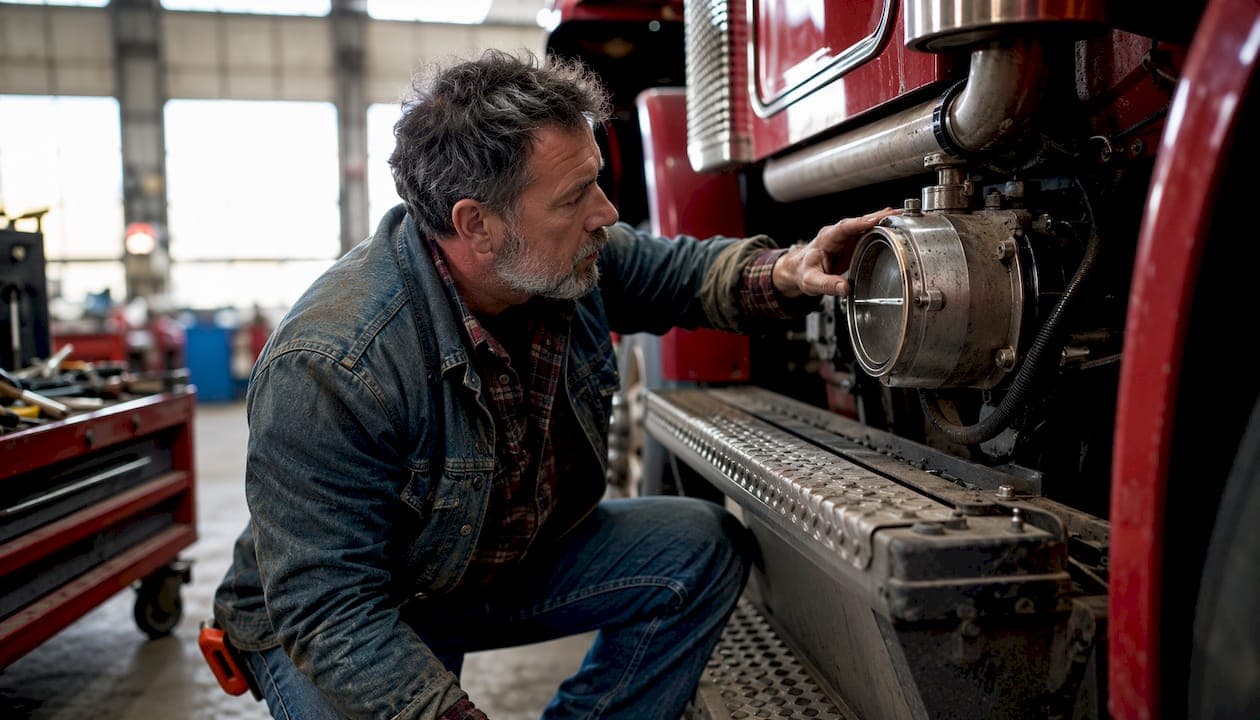
An exhaust brake uses a controllable restriction in the exhaust path to build back pressure that resists piston motion, slowing a diesel engine and the vehicle without touching the wheel brakes. According to UTI, the system works through a butterfly valve that closes off exhaust flow, converting engine compression into retarding torque. Cummins, Banks Power, and Jacobs all document the same core principle: the brake is a supplemental retarding device, not a primary stopping system. The operational rule is straightforward: engage it on long or steep descents and during heavy towing; turn it off on wet or icy roads, and never rely on it as your sole means of stopping.
Table of Contents
- What an exhaust brake actually does in a diesel truck
- How an exhaust brake creates retarding force
- Exhaust brake vs. compression brake: which one do you need?
- When and how to use an exhaust brake effectively
- Benefits of exhaust brakes — and their real limits
- Maintenance checks and common exhaust brake faults
- How exhaust brakes interact with modern emissions systems
- Key Takeaways
- The exhaust brake advantage most drivers underestimate
- Trucks with exhaust brakes, ready to inspect on Sostruckforsale
- Useful sources for drivers and technicians
What an exhaust brake actually does in a diesel truck
An exhaust brake is an inline valve, typically a butterfly-style disc, installed in the exhaust path downstream of the turbocharger. When activated, it partially closes and forces exhaust gases to compress in the manifold and cylinders. That compression resists the upward movement of the pistons on the exhaust stroke, producing negative torque at the crankshaft and slowing the vehicle.
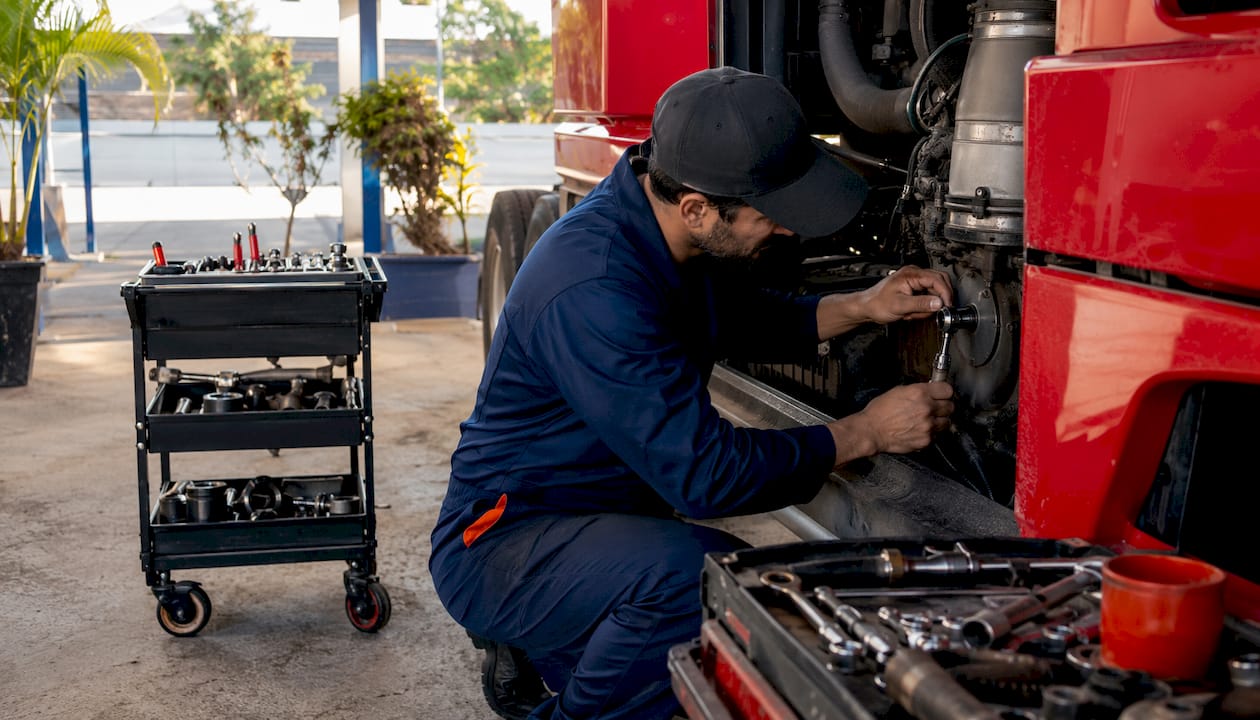
The primary role is supplemental retarding: sharing the braking load with the wheel-mounted service brakes so those brakes run cooler and last longer. Banks Power recommends exhaust brakes as a necessary safety upgrade for any diesel vehicle regularly used for towing or hauling in hilly terrain, noting that reduced brake maintenance can offset the cost of a quality retrofit unit over time.
Common applications include Class 8 semi-trucks, heavy-duty pickup trucks (3/4-ton and 1-ton), motorhomes on diesel chassis, and medium-duty tow vehicles. Many late-model diesel trucks ship with factory-integrated systems; older trucks and some medium-duty applications can accept aftermarket retrofit kits from suppliers such as Banks Power and BD Diesel.
- Supplemental retarding: Reduces reliance on service brakes during sustained descents.
- Brake fade prevention: Keeps wheel-brake temperatures lower on long grades.
- Speed control: Holds a consistent speed downhill without repeated brake applications.
- Retrofit availability: Aftermarket kits fit many diesel platforms where the OEM did not include the feature.
Pro Tip: If your truck came from the factory without an exhaust brake and you regularly tow over mountain passes, a quality aftermarket unit is one of the highest-return safety investments you can make. Not all designs are equal, though — poorly engineered valves can create harmful overpressure, so choose a unit with a documented pressure-relief design.
How an exhaust brake creates retarding force
The exhaust brake slows the vehicle by building back pressure that resists piston motion on the exhaust stroke, converting that resistance into retarding torque at the crankshaft and wheels. When the driver activates the system via a dash switch or the ECU engages it automatically, the butterfly valve closes to a calibrated position. Exhaust gases back up in the manifold, and back pressure can reach significant levels (for example, around typical design maximum pressures) in the exhaust system upstream of the valve. That same pressure acts on the piston crown during the exhaust stroke, pushing back against the piston's upward travel and generating a braking effect proportional to engine speed.
Key components in the system:
- Butterfly valve: The primary restriction element, mounted downstream of the turbocharger to avoid turbo overspeed.
- Actuator: Pneumatic, hydraulic, or electronic servo that opens and closes the valve on command.
- Control input: A dash-mounted switch, an ECU-managed automatic mode, or both.
- Pressure relief: Small holes or calibrated gaps in the valve disc prevent dangerous overpressure.
Retarding force scales with engine RPM and cylinder displacement. A higher RPM means more exhaust strokes per minute, more back pressure events, and stronger retarding torque. This is why gear selection matters so much.
Pro Tip: Match your gear to the grade before you start descending, not after speed builds. Once a loaded truck gains momentum on a long hill, downshifting becomes harder and the exhaust brake has less time to work. Set the gear at the top.

Exhaust brake vs. compression brake: which one do you need?
Both systems slow a diesel truck through engine resistance rather than wheel friction, but they operate on different principles. An exhaust brake builds back pressure in the exhaust manifold; a compression brake (commonly called a Jake brake, after the Jacobs brand) modifies valve timing to release compressed air from the cylinders at top dead center, converting the engine into an air compressor on every power stroke.
| Dimension | Exhaust brake | Compression brake |
|---|---|---|
| Retarding power | Moderate | High |
| Noise level | Low to moderate | Loud — distinctive staccato exhaust note |
| Heavy loads / long descents | Effective for most applications | Preferred for maximum retarding on very heavy rigs |
| Aftertreatment impact | Compatible; some designs aid DPF regeneration | Can cool aftertreatment if used aggressively |
| Maintenance complexity | Moderate — valve, actuator, seals | Higher — valve train modifications, more components |
| Installation cost | Lower; retrofit-friendly | Higher; often requires engine-level work |
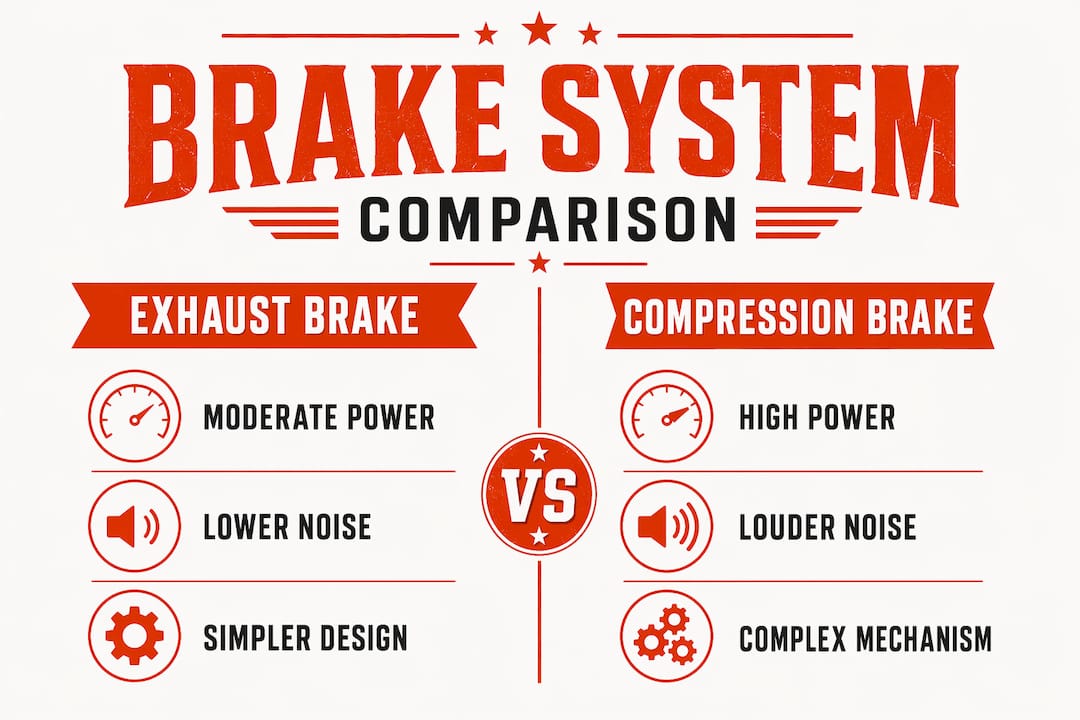
BD Diesel characterizes exhaust brakes as significantly quieter than Jake-style compression braking, which is a meaningful operational advantage in residential areas and on routes where local noise ordinances restrict compression brake use.
Practical decision rules:
- Choose an exhaust brake when you need consistent, quiet retarding for towing or moderate grades, when retrofitting an older truck, or when operating in areas with compression-brake noise restrictions.
- Choose a compression brake when maximum retarding force is non-negotiable, such as on very steep grades with a fully loaded Class 8 rig where the exhaust brake alone cannot hold speed.
Many modern heavy-duty trucks carry both systems. The exhaust brake handles routine descents; the compression brake is reserved for the steepest grades or emergency retarding situations.
When and how to use an exhaust brake effectively
Engage the exhaust brake for long downhill grades, sustained descents, heavy towing, and any situation where repeated service-brake applications would build dangerous heat. Do not use it as a parking brake or as the sole stopping method, and turn it off on wet or icy roads where sudden retarding torque can compromise stability.
Pre-descent checklist:
- Enable the exhaust brake switch before the grade begins.
- Select the same gear you would use to climb that grade.
- Confirm engine RPM is in the OEM-specified retarding range (check your operator manual).
- Monitor coolant and exhaust temperatures during the descent.
- Keep service brakes available for speed corrections and stops.
- Turn the exhaust brake off before extended idling (more than three minutes).
Situations where exhaust brakes work best:
- Long mountain grades with a loaded trailer.
- Sustained highway descents where repeated brake applications would cause fade.
- Towing in hilly terrain where brake temperatures would otherwise spike.
- Maintaining controlled speed in stop-and-go downhill traffic.
Situations to avoid:
- Wet, icy, or loose-surface roads where sudden retarding can cause a skid.
- Low-RPM crawling where back pressure is insufficient to provide meaningful retarding.
- As a substitute for service brakes when a full stop is required.
Note that some exhaust braking modes automatically disengage when the ABS activates or when the driver presses the accelerator or clutch, so the system cannot override traction-control interventions.
Pro Tip: On very long descents, use the exhaust brake to hold most of your speed and apply the service brakes in short, firm intervals to scrub any remaining speed gain. This keeps brake temperatures far lower than riding the pedal continuously, and it keeps the exhaust brake in its effective RPM range.
Benefits of exhaust brakes — and their real limits
Exhaust brakes deliver measurable safety and maintenance advantages, but they are not a universal solution for every retarding need.
Primary benefits:
- Extended brake life: Sharing the braking load with the exhaust system reduces heat and wear on wheel-mounted components, extending pad and drum/rotor service intervals.
- Reduced brake fade: Lower operating temperatures mean brake components stay within their effective range on long grades.
- Quieter operation: Significantly less noise than compression brakes, making them practical on routes with noise ordinances.
- Retrofit availability: Aftermarket kits from Banks Power and BD Diesel fit a wide range of diesel platforms.
- Aftertreatment compatibility: Modern OEM designs are built to work with DPF and SCR systems, and some implementations actively support aftertreatment temperatures.
Limitations to understand:
- Less raw retarding power than a full compression brake on the heaviest loads and steepest grades.
- Low-RPM ineffectiveness: Back pressure drops sharply at low engine speeds, so the system provides little retarding during slow crawls.
- Exhaust system stress: Poorly engineered designs can create harmful overpressure; Banks Power technical notes warn that premium designs balance braking and normal flow with calibrated pressure limits.
- Not a stopping device: The system cannot bring a vehicle to a full stop and must never replace service brakes.
On the legal side, exhaust brakes themselves are generally not restricted by noise ordinances the way compression brakes are, since they operate quietly. Compression brake restrictions (common on city streets and near residential zones) typically do not apply to exhaust brakes, though drivers should confirm local rules on any unfamiliar route.
Maintenance checks and common exhaust brake faults
Start every inspection with the actuator, valve linkage, seals, and the turbocharger interface. Corrosion, carbon soot buildup, and sticking are the most common failure modes, and catching them early prevents a loss of retarding capability on the road.
Maintenance checklist:
- Visual valve travel check: Cycle the exhaust brake switch and confirm the valve opens and closes fully through its range of motion.
- Actuator lines and connectors: Inspect air lines (pneumatic systems) or electrical connectors (electronic actuators) for cracks, corrosion, or loose fittings.
- Mounting bolts and flanges: Check torque on mounting hardware; exhaust heat cycling loosens fasteners over time.
- Exhaust gasket condition: Inspect gaskets at the valve housing and adjacent flanges for leaks, which reduce back pressure and braking effectiveness.
- Valve seat and disc: Look for carbon deposits or soot buildup that can cause the valve to stick in a partially open position.
- Turbocharger interface: Confirm the valve is seated correctly downstream of the turbo; misalignment can damage turbo seals.
Common failure symptoms:
- Loss of retarding: Valve stuck open or actuator not activating.
- No activation: Actuator failure, blown fuse, or broken electrical/air supply.
- Engine warning lights: Excessive back pressure from a stuck-closed valve triggering pressure sensors.
- Exhaust leaks: Failed gaskets at the valve housing.
For commercial truck repair involving exhaust brake components, a qualified diesel technician should perform actuator bench tests and carbon-deposit removal using procedures that protect turbocharger seals.
Pro Tip: To test valve operation without a full road test, connect a shop air supply to the actuator port (on pneumatic systems) and observe valve travel directly. For electronic actuators, use a scan tool to command the valve open and closed. Never use compressed air to blast carbon from the valve seat without first removing the valve assembly — debris can enter the turbocharger.
For broader air brake system maintenance on commercial fleets, integrating exhaust brake inspections into your regular brake service intervals keeps the full retarding system in reliable condition.
How exhaust brakes interact with modern emissions systems
Modern OEMs design exhaust brake systems to be fully compatible with diesel particulate filters (DPF) and selective catalytic reduction (SCR/DEF) aftertreatment. Cummins documents that exhaust braking is integrated into engine thermal management strategies, where maintaining exhaust temperatures during descents helps keep aftertreatment systems in their effective operating range and supports DPF regeneration cycles.
The practical implication: using an exhaust brake on a descent can actually help the DPF stay hot enough to continue passive regeneration, rather than cooling it down the way a long idle would. Components in current OEM systems are built corrosion-resistant and designed to handle DEF chemistry and exhaust gas exposure.
| Operating condition | Exhaust brake role | Aftertreatment effect |
|---|---|---|
| Long descent, high RPM | Active retarding | Maintains exhaust temp; supports passive DPF regen |
| Low-speed crawl, low RPM | Minimal retarding | Minimal thermal effect |
| Extended idle, brake engaged | Not recommended | Can stress seals; turn off after 3 minutes |
| Cold start / warm-up | Off (OEM guidance) | Avoids back pressure before oil is at operating temp |
Advanced systems with variable geometry turbochargers can modulate back pressure more smoothly than a simple butterfly valve. Technicians diagnosing these integrated systems must follow OEM-specific diagnostic procedures, because standard aftermarket test methods designed for simple valves will not correctly exercise or evaluate ECU-managed components.
Should you engage the exhaust brake right now? A quick checklist
Run through these before a descent or heavy tow:
- Grade length: Is the descent long enough that service brakes alone would overheat? If yes, engage.
- Load: Are you towing or carrying a heavy payload? If yes, engage.
- Road surface: Is the road dry and high-traction? If no (wet, icy, loose gravel), leave it off.
- Gear selection: Are you in the correct gear for the grade? Set the gear first, then engage.
- RPM range: Is engine RPM in the OEM-specified retarding window? Confirm before committing to the descent.
- ABS/traction status: Is the traction control system active or warning? If yes, leave the exhaust brake off.
- Idle duration: Will you be idling for more than three minutes after the descent? Turn the brake off before extended idling.
- Full stop needed? Service brakes are always required for a complete stop — exhaust brakes do not replace them.
Key Takeaways
An exhaust brake is a supplemental retarding system that builds exhaust back pressure to slow a diesel engine, reducing service-brake wear and preventing fade on long descents and during heavy towing.
| Point | Details |
|---|---|
| Primary function | Creates exhaust back pressure to retard engine speed; not a primary stopping device. |
| Best use conditions | Long downhill grades, heavy towing, sustained descents where brake heat is a concern. |
| RPM and gear matter | Retarding force increases with engine RPM; descend in the same gear used to climb the grade. |
| Aftertreatment compatibility | Modern OEM systems (Cummins, RAM) integrate exhaust braking with DPF/SCR thermal management. |
| Sostruckforsale listings | Trucks listed on Sostruckforsale can be inspected for factory or aftermarket exhaust brake fitment before purchase. |
The exhaust brake advantage most drivers underestimate
Most drivers learn about exhaust brakes as a brake-wear solution, and that framing undersells the system. The real value shows up on a loaded descent where the service brakes have already absorbed heat from the last grade: the exhaust brake gives you a retarding resource that does not degrade with temperature. A hot rotor or drum loses stopping power; a butterfly valve in the exhaust does not.
The piece of guidance that gets skipped most often is the idle rule. Leaving the exhaust brake engaged during a long idle after a descent is a low-grade way to stress exhaust seals and gaskets over time. The Jacobs/Cummins manual is specific: three minutes is the limit. That detail rarely makes it into driver orientation, but technicians see the consequences in premature seal failures.
One more point worth making: the distinction between a simple mechanical butterfly valve and an ECU-managed Smart braking system matters enormously for diagnostics. A technician who treats an integrated Cummins or RAM system like a standalone valve will miss faults that only appear when the ECU is commanded through its full cycle. The tool and the procedure have to match the system.
Trucks with exhaust brakes, ready to inspect on Sostruckforsale
Knowing how an exhaust brake works is one thing; finding a truck already equipped with one is another. Sostruckforsale lists heavy-duty trucks for sale across the United States, including semi-trucks and diesel workhorses where factory or aftermarket exhaust brake systems are part of the specification. Whether you are sourcing a fleet unit or a single owner-operator truck, you can review listings, check specifications, and contact sellers directly to confirm exhaust brake fitment before you commit. Browse current inventory at Sostruckforsale and filter by the specs that matter for your routes and load requirements.
Useful sources for drivers and technicians
The following references were used throughout this article. Each covers a distinct aspect of exhaust brake operation, maintenance, or OEM guidance.
- UTI — How Do Diesel Exhaust Brake Systems Work?: Clear, accessible explanation of the butterfly valve mechanism and brake-life benefits. Best starting point for drivers new to the system.
- Banks Power — Why Add An Exhaust Brake?: Retrofit economics, design quality considerations, and overpressure warnings. Useful for anyone evaluating an aftermarket installation.
- Cummins — Exhaust Brake Component Guidance: OEM documentation on aftertreatment compatibility and thermal management integration. The authoritative source for emission-compliant engine applications.
- Jacobs Exhaust Brake Operator Manual (Cummins-hosted PDF): Operational cautions including the three-minute idle rule, RPM guidance, and wet-road warnings. Required reading for drivers and fleet managers.
- BD Diesel — Diesel Exhaust Brakes Explained: Noise comparisons, operational differences from compression brakes, and diagnostic notes for advanced integrated systems.
- Mopar/RAM 2500/3500 Owner Manual — Exhaust Brake Section: Smart automatic braking mode description and RPM effectiveness guidance for RAM diesel platforms.
- Mercedes-Benz Business Class M2 Driver Manual: Documents ABS interaction and the rule that exhaust braking does not replace service brakes; relevant for medium-duty operators.
- Wikipedia — Exhaust Brake: Technical overview of valve types, back-pressure physics, and braking effectiveness as a percentage of engine power output.