

Leasing wins on cash flow and risk management; buying wins on long-term cost per mile and asset control. The role of truck leasing vs buying in 2026 is shaped by two forces that did not exist at the same intensity in prior cycles: a mandatory pricing step-up tied to 2027 NOx emissions standards and a widening skilled diesel technician shortage that is quietly eroding the economics of in-house maintenance. Neither option is universally better. The right answer depends on your utilization rate, maintenance capability, cash position, and how much regulatory risk you can absorb.
Here is what separates the two paths at a glance:
- Leasing converts capital expense to operating expense, requires minimal upfront capital, and transfers residual value risk and maintenance burden to the lessor in full-service structures.
- Buying builds equity, allows unlimited mileage and full customization, and delivers the lowest cost per mile once utilization consistently clears 60–70%.
- Utilization rate is the single clearest signal: below 30% favors renting, 30–60% favors leasing, above 60–70% favors buying.
- Residual value risk sits with the lessor in standard leases but shifts partially to your fleet under TRAC structures.
- Hybrid strategies are increasingly common, with fleets owning high-utilization core units while leasing regulation-sensitive or specialized vehicles.
Table of Contents
- How leasing and buying trucks compare financially and operationally
- How truck leasing works and when it makes the most sense for your fleet
- How buying trucks works and why some operations prefer ownership
- Tax and compliance considerations in leasing versus buying
- What 2026 and 2027 regulatory changes mean for your acquisition strategy
- Operational implications of leasing vs. buying for fleet managers
- Sostruckforsale connects you with the right commercial trucks to buy
- Key Takeaways
How leasing and buying trucks compare financially and operationally
The financial gap between leasing and buying is real but context-dependent. Purchasing a new Class 8 sleeper truck carries a price tag around $172,000, plus a 12% Federal Excise Tax on heavy-duty equipment. Financing that purchase at current market rates can add substantial cost of capital over the loan term. Leasing spreads those costs across monthly payments and typically requires a down payment of 0–10% versus the larger cash outlay financing demands.
Total cost of ownership (TCO) is the metric that actually matters. Monthly payment comparisons alone hide fuel, maintenance, downtime, compliance, administration, and disposal costs that accumulate through years three, four, and five of a truck's life. Fleets that run TCO honestly often find the ownership premium is larger than the payment comparison suggests, particularly for mid-size operations without the maintenance scale to capture cost efficiencies.
| Factor | Leasing | Buying |
|---|---|---|
| Monthly payments | Lower, fixed operating expense | Higher loan payments; fixed regardless of revenue |
| Upfront costs | Minimal (0–10% down) | Significant down payment plus FET on new trucks |
| Ownership/equity | None; lessor owns the asset | Full equity builds as loan pays down |
| Mileage limits | Often capped; overages incur penalties | Unlimited |
| Customization | Limited by lease structure | Full control over specs and upfitting |
| End-of-term | Return, purchase at residual, or extend | Sell, trade, or continue operating |
| Maintenance | Bundled in full-service leases | Fully on the fleet; costs rise with age |
| Tax benefits | Payments fully deductible as operating expense | Section 179 and bonus depreciation available |
How truck leasing works and when it makes the most sense for your fleet
Leasing gives your fleet use of a truck for a defined term, typically 3–5 years, in exchange for fixed monthly payments. At term end, you return the vehicle, purchase it at a predetermined residual value, or extend the agreement.
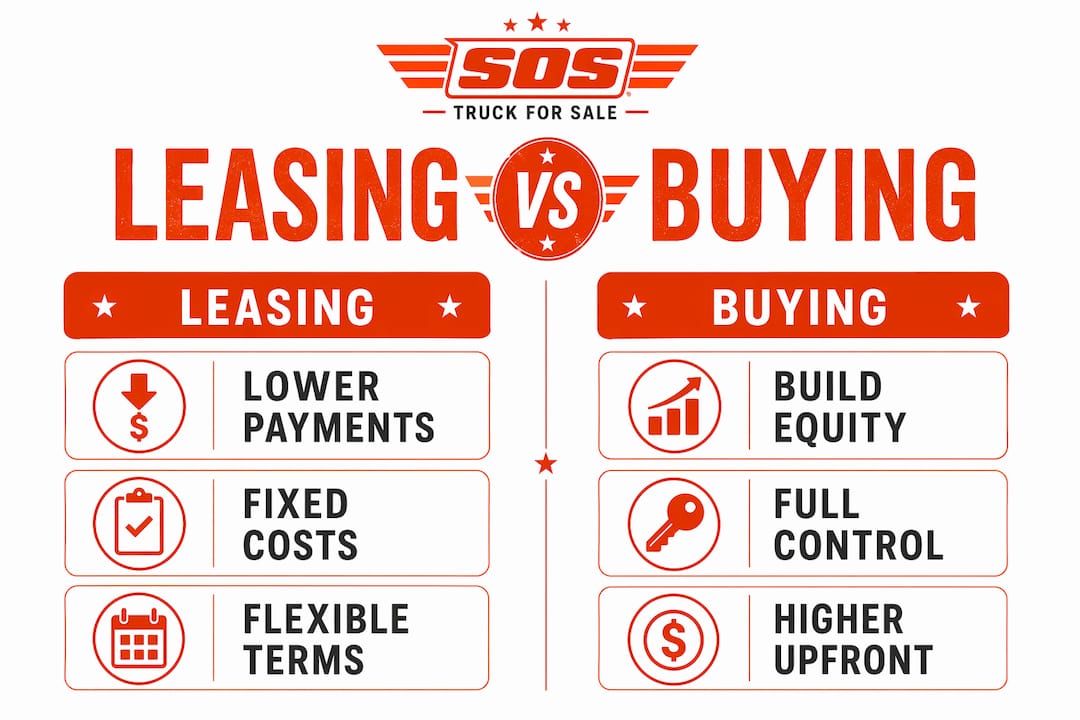
TRAC leases cover a majority of heavy-duty commercial vehicle contracts. Under a TRAC structure, your fleet takes on the residual value risk at term end. If the truck sells above its projected residual, that surplus comes back to your business. If it sells below, your fleet covers the shortfall. That risk-sharing model rewards fleets that maintain their vehicles well and suits custom-built or high-mileage vehicles where standardized valuations are difficult.
Key leasing benefits for fleet operators:
- Preserved capital. Leasing requires minimal upfront capital and keeps credit lines open for revenue-generating investments.
- Predictable budgeting. Fixed monthly payments eliminate the financial shock of major repairs or sudden depreciation.
- Newer equipment. Leased equipment tends to be newer than owned fleets, which generally yields better fuel economy.
- Maintenance transfer. Full-service leases bundle maintenance, compliance, roadside assistance, and disposal, transferring execution risk to the lessor.
- Fleet scalability. Shorter trade cycles, ideally three years, keep your fleet in its best-performing years and allow faster response to freight demand changes.
- Mileage and usage caps. Standard leases include mileage restrictions; exceeding them triggers penalties. TRAC structures accommodate high-mileage routes exceeding 100,000 miles annually where a capped lease would be costly.
Pro Tip: If your fleet operates in the 20–100 truck range and lacks a fully staffed in-house shop, a full-service lease transfers both maintenance execution and residual value risk to a lessor with technician networks and parts pricing you cannot replicate independently. In 2026, that transfer is worth more than the balance sheet treatment alone suggests.
Leasing fits best when you need to conserve capital, when freight demand is volatile or seasonal, when your maintenance capability is limited, or when regulatory uncertainty makes locking capital into long-term ownership a risk you cannot afford.
How buying trucks works and why some operations prefer ownership
Buying means you own the asset outright or through financing. You build equity, control every maintenance and specification decision, and face no mileage restrictions. When the loan is paid off, your only ongoing costs are maintenance and operating expenses.
Ownership delivers its strongest financial case at high utilization. Once a truck runs above a high utilization rate with stable, predictable demand, the fixed costs of ownership spread across enough productive miles to produce the lowest cost per mile of any acquisition model. Fleets with robust in-house maintenance capability and remarketing expertise capture additional savings that leasing companies price into their monthly rates.
Advantages of buying commercial trucks:
- Equity and asset value. Each payment builds ownership stake in an asset you can sell, trade, or continue operating on your own timeline.
- Unlimited customization. Vocational builds, specialized powertrain configurations, and proprietary body upfitting are fully available without lease restrictions.
- No mileage penalties. High-mileage operations running team drivers or slip-seat configurations benefit directly from uncapped usage.
- Tax write-off potential. Purchased trucks qualify for Section 179 deductions and bonus depreciation, enabling aggressive first-year tax strategies over a 5–7 year ownership cycle.
- Maintenance control. Established fleets with 200 or more trucks and invested shop infrastructure can achieve per-repair costs that undercut leasing company rates.
The risks of ownership are equally concrete. Purchasing ties up capital, impacts balance sheet debt ratios, and places the full burden of residual value risk on your operation. Holding trucks past their optimal replacement point, which often happens because disposal feels costly, drives up maintenance expenses precisely when resale value is falling. New trucks can lose 20–30% of their value within the first year, and costs rise sharply in years four and five.
Buying makes the clearest sense for established, financially stable operations with healthy cash reserves, low-mileage or regional applications, and the in-house capability to manage maintenance and remarketing without outside support.
Tax and compliance considerations in leasing versus buying
Tax treatment differs sharply between the two models, and the right choice depends on your growth stage and cash position.
Leasing tax treatment:
- Lease payments are fully deductible as a business operating expense in the year paid, simplifying tax reporting.
- Leased vehicles do not qualify for Section 179 or bonus depreciation because the fleet does not own the asset.
- Leasing generally moves the vehicle off the balance sheet, improving debt-to-equity ratios and making the company more attractive to lenders.
- Insurance costs on leased vehicles tend to be lower than on owned assets of equivalent age, since leased fleets run newer equipment.
Buying tax treatment:
- Section 179 allows purchased trucks to be fully deducted in the year of purchase up to the annual limit, providing a larger first-year deduction than leasing.
- Bonus depreciation adds further accelerated write-off potential over the asset's useful life.
- Ownership increases balance sheet debt, which affects financials reviewed by lenders and investors.
- Administrative burden is higher: title, registration, compliance tracking, and disposal planning all fall on the fleet.
Compliance responsibilities also differ. Lessors in full-service agreements typically handle licensing, regulatory compliance, and disposal planning as part of the bundled service. Owners carry those costs internally, and the administrative overhead is often underreported in self-assessed TCO calculations. For fleets operating across multiple states, that compliance burden adds up quickly.
What 2026 and 2027 regulatory changes mean for your acquisition strategy
Two forces have shifted the structural economics of fleet acquisition more than any prior cycle. The 2027 NOx emissions standards are expected to cause a significant per-unit price increase on compliant trucks, making 2026 a narrow window to acquire pre-compliant equipment at current pricing. Fleets that pre-buy must confirm build slot availability, model the full financing cost over the hold period, and have a credible maintenance plan. Without all three conditions met, the pre-buy calculus deteriorates quickly.
The skilled diesel technician shortage is the second force. Mid-size fleets in the 20–100 truck range increasingly cannot staff their shops reliably. A full-service lease transfers that execution risk to a lessor operating at a scale that provides technician networks and parts pricing most mid-size operations cannot match independently.
A recent industry survey found that a substantial share of private fleets lease a portion or all of their Class 8 vehicles, with many using full-service leases and some combining ownership and leasing. That distribution reflects a market that has already moved toward leasing as a primary strategy, not a fallback.
Industry experts recommend a mixed acquisition approach for most mid-size fleets: pre-buy a defined portion of the fleet for routes where ownership economics are strongest, typically long-haul, high-mileage, equipment-stable lanes, while transitioning remaining equipment to full-service lease arrangements where maintenance variability is highest.
Operational implications of leasing vs. buying for fleet managers
Day-to-day operations feel different depending on which model your fleet runs. Leased fleets cycle equipment on shorter timelines, typically three years, keeping trucks in their best-performing years. Fewer breakdowns, more predictable service intervals, and newer safety technology translate directly into driver satisfaction and customer reliability. Breakdowns tend to be costly and cause significant downtime per incident. Fleets that lease and outsource maintenance reduce exposure to those costs structurally, not just occasionally.
Owned fleets carry more operational control but also more operational weight. Every service decision, parts sourcing call, and compliance deadline sits with your team. For large carriers with invested shop infrastructure, that control is an advantage. For mid-size operations, it often means inconsistent service quality and extended downtime that erodes the cost savings ownership was supposed to deliver.
Fleet scalability is another operational variable. Leasing allows faster fleet expansion or contraction without the planning and market timing that asset disposal requires. Owned fleets offer the lowest disposal flexibility, since selling trucks requires reading the used truck market correctly and timing the exit before the maintenance cliff arrives. Fleets managing on-site fuel logistics alongside their equipment decisions benefit from the predictability leasing provides across multiple cost lines simultaneously.
Exit strategy matters more than most operators plan for. At lease end, you have defined options: return, purchase, or extend. With owned trucks, you control the timing but absorb the full residual value risk. A truck held two years past its optimal replacement point can cost more in maintenance than the equity it retains.
Sostruckforsale connects you with the right commercial trucks to buy
Whether your analysis points toward ownership or a hybrid strategy, finding the right truck at the right price is where the decision becomes real. Sostruckforsale lists semi trucks, heavy-duty trucks, and commercial equipment from sellers across the United States, giving fleet managers direct access to a wide range of pre-owned inventory without the overhead of dealer markups or auction fees.
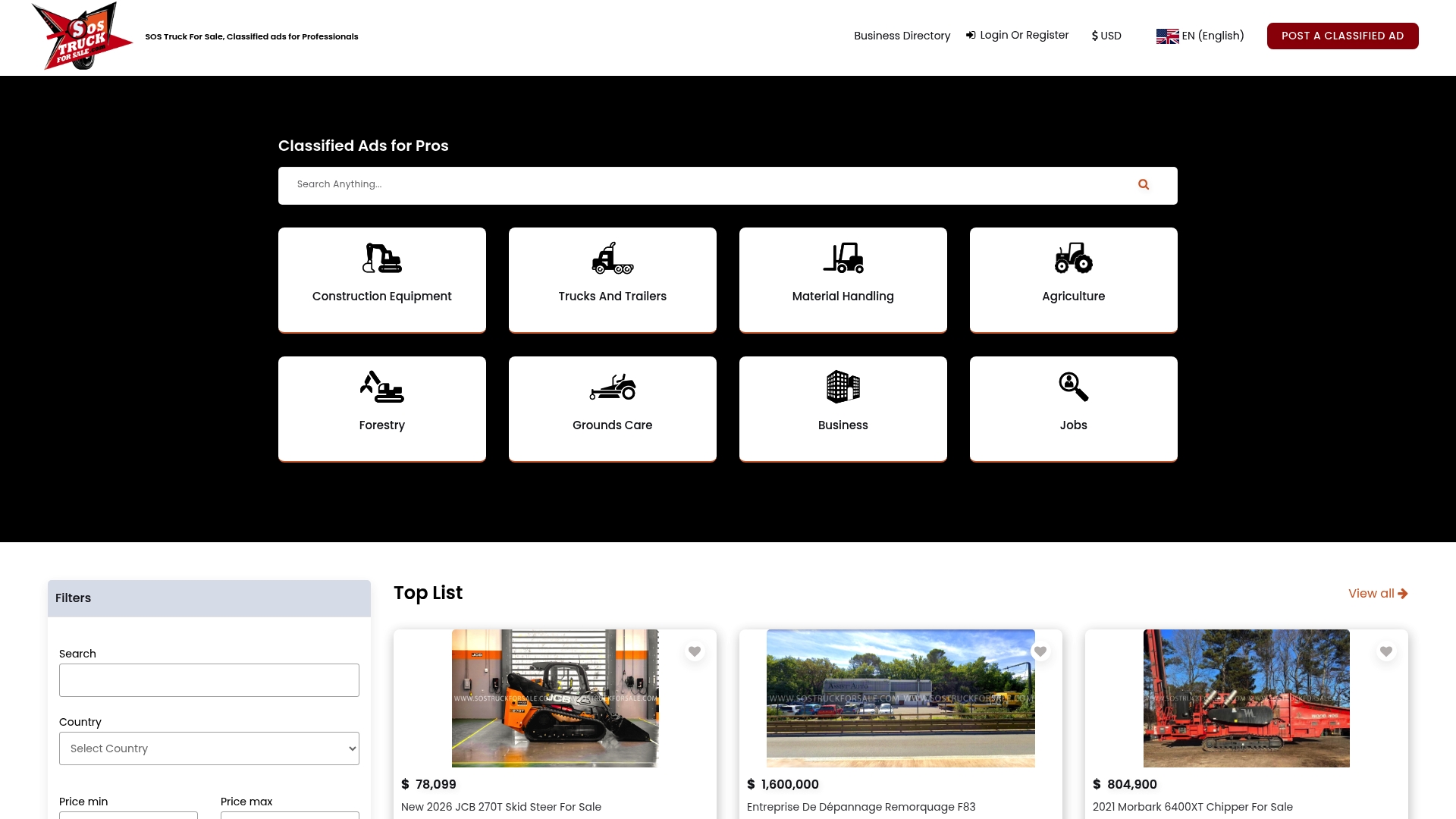
For operations that have run the TCO numbers and determined that buying high-utilization units makes financial sense, Sostruckforsale puts verified listings in front of you quickly. Used commercial trucks depreciate more slowly than new units, carry lower insurance costs, and often come with documented maintenance histories that support confident purchasing decisions. Fleets managing diesel fuel and compliance costs on owned equipment can factor those operational realities directly into their search criteria on the platform. Browse current inventory at Sostruckforsale and request a quote on the units that fit your fleet's duty cycle and budget.
Key Takeaways
Utilization rate, maintenance capability, and regulatory timing are the three variables that determine whether leasing or buying delivers better total cost of ownership for a commercial fleet in 2026.
| Point | Details |
|---|---|
| Utilization drives the decision | Below 30% favors renting; 30–70% favors leasing; above 70% favors buying for lowest cost per mile. |
| Leasing preserves capital and reduces risk | Minimal upfront costs and full-service leases transfer maintenance and residual value risk to the lessor. |
| Buying builds equity and tax advantages | Owned trucks qualify for Section 179 deductions and bonus depreciation; leased vehicles do not. |
| 2027 NOx standards shift the calculus | The $8,000–$15,000 per-unit price increase on compliant trucks makes 2026 a critical acquisition window. |
| Sostruckforsale for purchase decisions | Fleet managers buying high-utilization units can browse verified used commercial truck listings at Sostruckforsale. |