
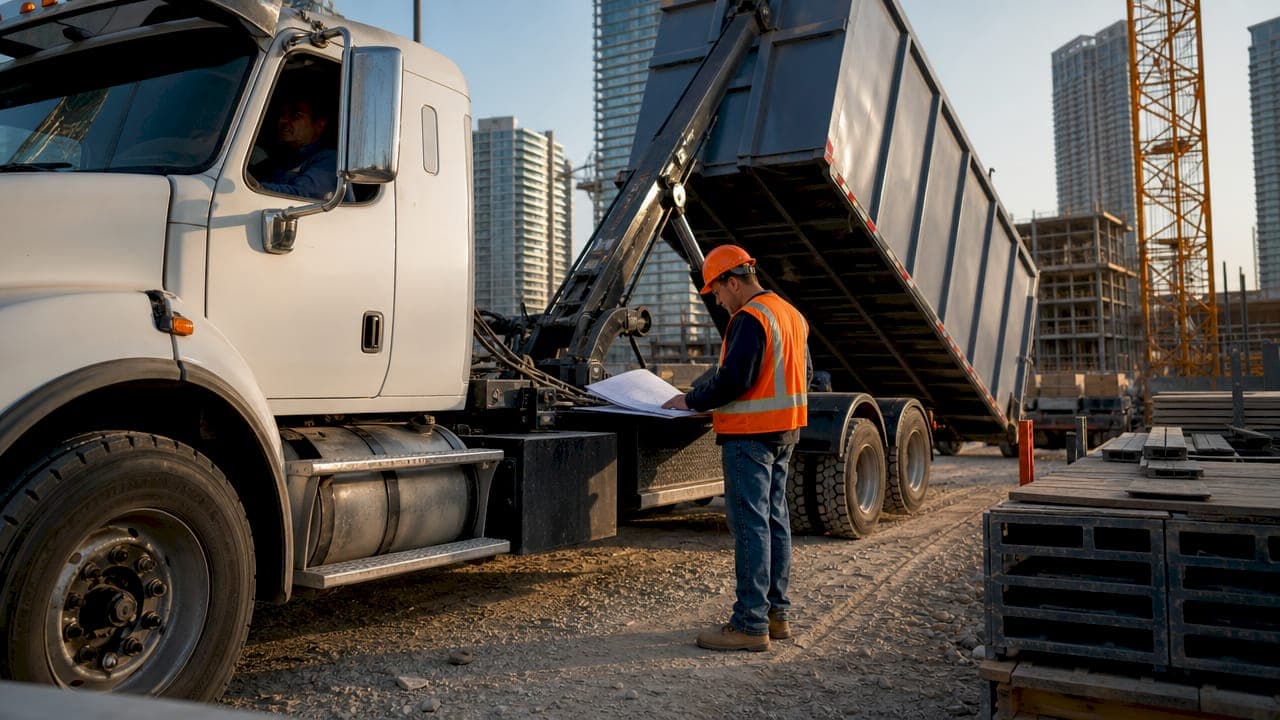
A roll-off truck is a specialized vehicle equipped with hydraulic systems that load, transport, and unload large portable containers by rolling them on and off the truck bed. These trucks serve as the backbone of waste management and construction site logistics, handling materials that standard garbage trucks cannot process. With load capacities reaching 100,000 lbs on heavy-duty models, they operate across construction, demolition, scrap metal, and environmental cleanup. Understanding how they work, what containers they use, and how to deploy them safely gives operators and buyers a clear advantage when selecting equipment.
How does a roll-off truck work?
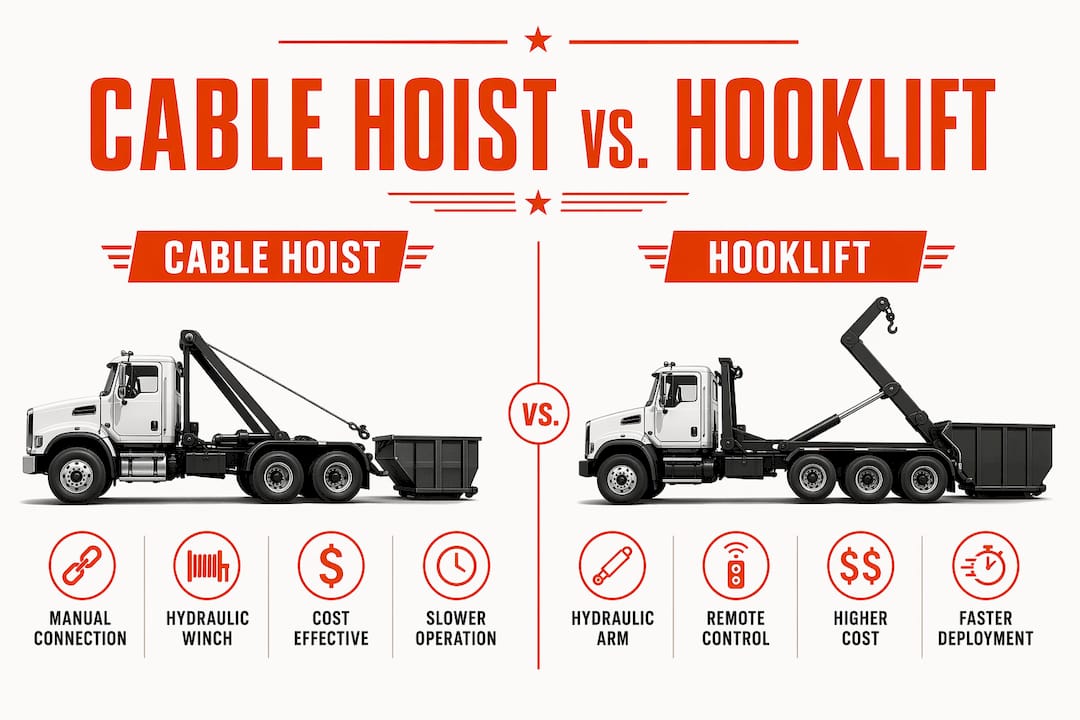
A roll-off truck operates through one of two hydraulic systems: a cable hoist or a hooklift arm. Each system moves containers on and off the truck bed, but they differ significantly in speed, safety, and versatility.
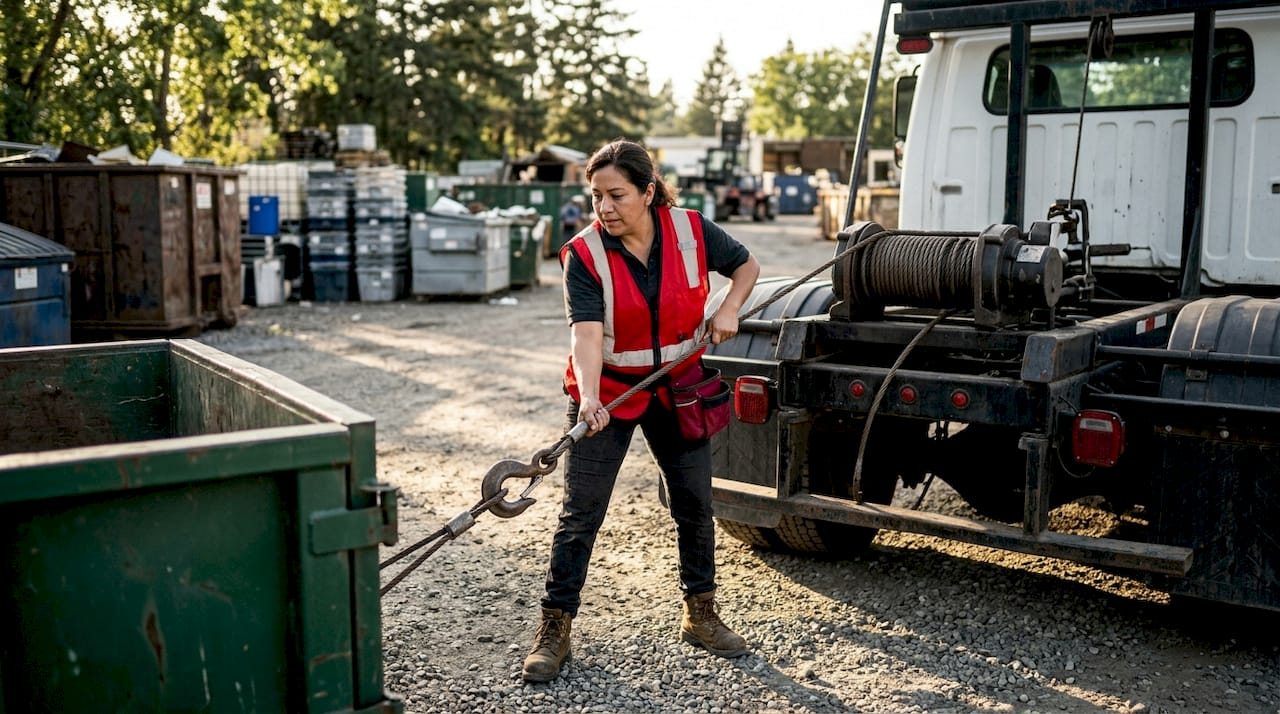
Cable hoist system
The cable hoist system uses a hydraulic winch mounted at the rear of the truck. The driver exits the cab, manually attaches a cable to the container, and the winch pulls the container up onto the truck bed using a tilting subframe. This process works reliably for standard waste containers but requires the driver to work outside the cab, often in hazardous conditions. Cable hoist pickups take 7–10 minutes per stop due to the manual connection steps involved.
Hooklift system
The hooklift system uses a hydraulic arm with a hook that extends from the rear of the truck. The driver controls the entire operation from inside the cab, lowering the arm to engage a bar on the container and lifting it onto the truck bed. Hooklift systems reduce pickup time to about 2 minutes per stop. That speed difference compounds quickly across a full day of pickups, making hooklifts a strong choice for high-volume operations.
Pro Tip: If your routes involve multiple daily stops in urban areas, a hooklift system will recover hours of productive time each week compared to a cable hoist setup.
Load capacity and chassis configuration
Heavy-duty roll-off trucks carry loads up to 100,000 lbs, with most commercial models rated between 75,000 and 100,000 lbs. Tri-axle chassis configurations distribute this weight across more axles, improving stability on public roads and reducing pavement stress. Outside rail hoists paired with tri-axle chassis handle particularly dense demolition and industrial materials that exceed standard truck capacities. This configuration is the preferred choice for fleet managers moving heavy scrap or concrete debris.
| Feature | Cable hoist | Hooklift system |
|---|---|---|
| Connection method | Manual, outside the cab | Hydraulic, from inside the cab |
| Time per stop | 7–10 minutes | About 2 minutes |
| Driver safety exposure | Higher, especially in wet conditions | Lower, cab-only operation |
| Container versatility | Roll-off waste containers | Dump bodies, flatbeds, storage units |
| Best use case | Single-purpose waste hauling | Multi-body, high-volume operations |
What container sizes and types work with roll-off trucks?
Standard roll-off containers range from 5 to 40 cubic yards, with 10, 15, and 20-yard sizes covering the majority of residential and light commercial jobs. Larger 30 and 40-yard containers serve industrial demolition, major construction projects, and commercial facility cleanouts. Selecting the right size directly affects cost control and trip efficiency.
Common container sizes by application
- 5–10 cubic yards: Small home renovation projects, garage cleanouts, minor landscaping debris
- 15–20 cubic yards: Mid-size construction jobs, roofing tear-offs, moderate commercial waste
- 30 cubic yards: Large construction sites, commercial demolition, bulk scrap metal
- 40 cubic yards: Industrial waste, major demolition, high-volume construction debris
Materials commonly hauled
Roll-off containers handle a wide range of materials that compacting garbage trucks cannot accept. The most common loads include:
- Construction and demolition debris (concrete, drywall, lumber)
- Roofing materials (shingles, underlayment, flashing)
- Scrap metal and structural steel
- Household junk and bulky furniture
- Yard waste and landscaping material
- Contaminated soil and environmental cleanup waste
Most containers feature hinged rear doors that swing open for easy loading of heavy or awkward materials. This design also allows a skid steer or mini excavator to load the container directly from the rear, which speeds up site cleanup significantly on larger jobs.
What are the site and operational requirements for roll-off trucks?
Deploying a roll-off truck safely requires more than just driving to a job site. Site conditions, clearance, and local regulations all affect whether a placement goes smoothly or creates problems.
Space and surface requirements
A roll-off truck needs approximately 60 feet of clear, straight access to place a container safely. This straight run allows the truck to back in, tilt the subframe, and roll the container off without obstruction. Paved surfaces are the preferred placement area. On soft ground, placing plywood sheets under the container's wheels prevents sinking and protects lawns or unpaved surfaces from damage.
Overhead clearance and driver safety
Cable hoist trucks require the driver to stand behind the vehicle during connection, which creates slip-and-fall exposure on wet or muddy ground. Manual cable handling carries a higher injury risk than hooklift operation, particularly in adverse weather. Hooklift trucks eliminate most of this risk by keeping the driver inside the cab throughout the entire load cycle.
Pro Tip: Always walk the site before backing in. Check for overhead power lines, tree branches, and soft spots in the ground. A 5-minute site check prevents costly delays and equipment damage.
Permitting and regulations
Placing a roll-off container on a public street typically requires a permit from the local municipality. Requirements vary by city and county, but most jurisdictions require reflective markers or lights on containers placed overnight. Operators working in residential neighborhoods should confirm permit requirements before scheduling a drop to avoid fines or forced removal.
- Confirm permit requirements with the local public works department
- Mark street-placed containers with reflective tape or warning lights
- Check weight limits on residential streets before routing heavy loads
- Verify HOA rules when placing containers in private communities
What are the practical applications and advantages of roll-off trucks?
Roll-off trucks handle bulk, irregular, and dense waste that compacting residential garbage trucks cannot process. This fundamental difference defines where and why operators deploy them. A standard curbside truck compresses household waste into a sealed body. A roll-off truck drops an open container at the site, leaves it for days or weeks, and returns to haul it away when full. That flexibility is the core operational advantage.
Industries that rely on roll-off trucks
- Construction and demolition: Daily use for debris removal, concrete disposal, and site cleanup
- Scrap metal recycling: Hauling ferrous and non-ferrous metals from industrial facilities
- Landscaping: Removing bulk yard waste, tree stumps, and excavated soil
- Environmental services: Transporting contaminated materials and hazardous cleanup waste
- Municipal services: Supporting large-scale community cleanups and event waste management
Hooklift versatility vs. cable hoist focus
Hooklift trucks handle multiple body types including dump bodies, flatbeds, and storage containers on a single chassis. This makes them attractive for businesses that need one truck to serve multiple functions. Cable roll-offs suit operations focused solely on waste containers and benefit from lower upfront costs. The right choice depends on how many container types a business needs to move and how much operational flexibility justifies the higher price of a hooklift setup.
Roll-off trailers offer a third option for businesses that want to separate transport from container placement. A trailer can be left on site while the tractor moves to another job, which improves asset utilization for operations running tight schedules across multiple locations.
Key Takeaways
A roll-off truck's value comes from its hydraulic systems, container flexibility, and ability to handle bulk waste that no other truck type can manage efficiently.
| Point | Details |
|---|---|
| Two core systems | Cable hoists require manual connection; hooklifts operate fully from the cab. |
| Load capacity | Heavy-duty models handle up to 100,000 lbs on tri-axle chassis configurations. |
| Container range | Standard sizes run from 5 to 40 cubic yards to match job scale and material type. |
| Site requirements | 60 feet of straight access and a firm surface are the minimum for safe placement. |
| System selection | Cable hoists lower upfront costs; hooklifts deliver speed and multi-body versatility. |
Why the hooklift vs. cable decision matters more than most buyers realize
Most buyers focus on price when choosing between a cable hoist and a hooklift truck. That is the wrong starting point. The real question is how many stops your drivers make per day and what conditions they work in.
I have seen operations run cable hoist trucks for years without major problems, but those were typically single-route businesses with predictable, dry job sites. The moment you add wet weather, multiple daily stops, or a driver who is newer to the work, the cable system's weaknesses become real liabilities. Slip-and-fall injuries from manual cable handling are not rare events. They are a predictable outcome of putting drivers outside the cab repeatedly in variable conditions.
The hooklift's speed advantage is also underestimated. Cutting 5–8 minutes per stop sounds minor until you run the math across 10 stops a day and 250 working days a year. That is a significant block of recovered time that either becomes additional revenue or reduces driver fatigue.
My honest recommendation: if you are building a business that will grow, buy the hooklift. If you are running a tight, single-purpose waste hauling operation with a fixed customer base and controlled sites, the cable hoist remains a proven, cost-effective tool. Match the equipment to the actual work, not to the lowest sticker price.
— Dave
Roll-off trucks available on Sostruckforsale
Finding the right roll-off truck means matching hydraulic capacity, chassis configuration, and container compatibility to your specific operation.
Sostruckforsale lists heavy-duty roll-off trucks across a range of configurations, from cable hoist models on standard chassis to tri-axle hooklifts built for industrial loads. Each listing includes specifications so you can evaluate load ratings, axle setup, and hoist type before contacting a seller. Whether you need a single truck for a growing waste hauling business or want to add capacity to an existing fleet, Sostruckforsale gives you direct access to verified commercial equipment listings without the guesswork of dealer negotiations.
FAQ
What is a roll-off truck used for?
A roll-off truck loads, transports, and unloads large portable containers at construction sites, demolition projects, scrap yards, and waste management facilities. It handles bulk, irregular materials that compacting garbage trucks cannot process.
How does a roll-off truck differ from a dump truck?
A roll-off truck drops a detachable container at a job site and retrieves it when full, while a dump truck carries a fixed bed and unloads by tilting. Roll-off trucks are better suited for extended on-site waste collection.
What is the maximum weight a roll-off truck can carry?
Heavy-duty roll-off trucks carry loads up to 100,000 lbs, typically mounted on tri-axle chassis for stability. Standard commercial models are rated between 75,000 and 100,000 lbs depending on the hoist and chassis configuration.
How much space does a roll-off truck need to place a container?
A roll-off truck requires approximately 60 feet of clear, straight access to safely place or retrieve a container. Soft ground requires protective measures such as plywood sheets under the container wheels to prevent sinking.
Which is better: a cable hoist or a hooklift system?
Cable hoists cost less upfront and work well for single-purpose waste container operations. Hooklift systems are faster, safer for drivers, and handle multiple body types, making them the better choice for high-volume or multi-purpose operations.