
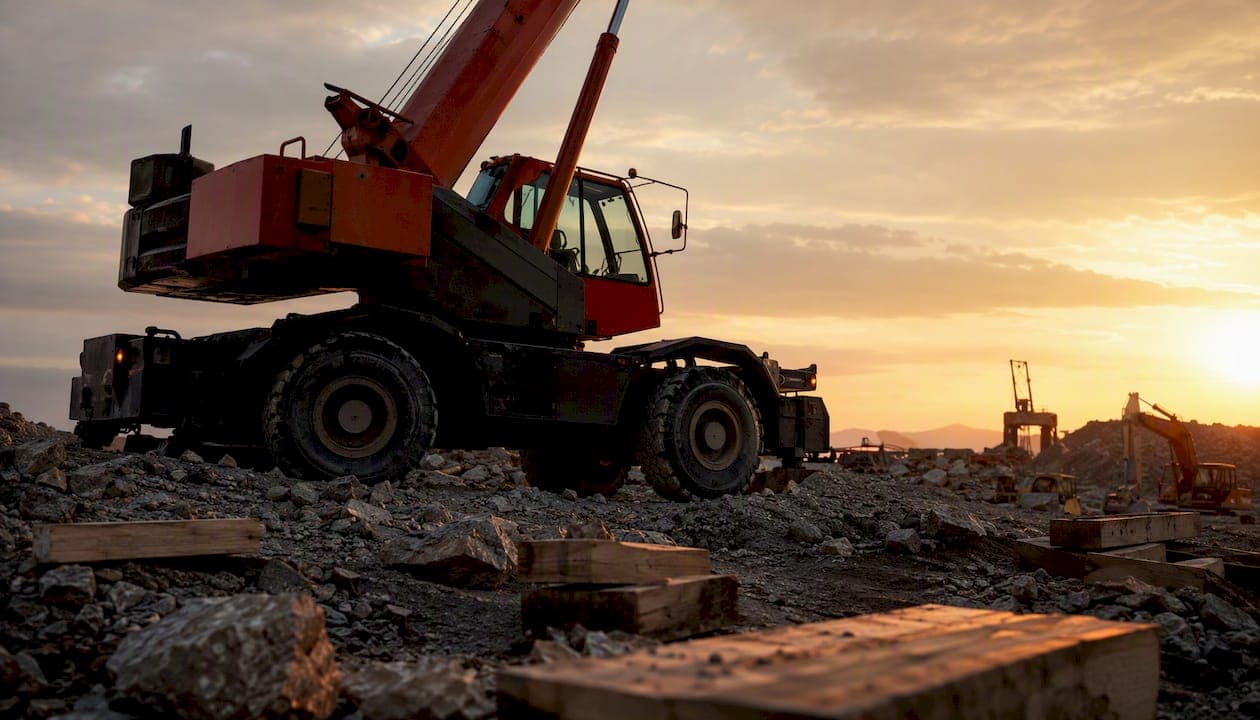
A rough-terrain crane (RT crane) is a self-propelled, four-wheel-drive mobile crane built specifically to lift on unprepared, soft, or uneven ground. Governed by OSHA crane safety standards and operator certification programs like NCCCO, RT cranes are the standard choice when a jobsite lacks paved or graded surfaces. Manufacturers such as Grove and Tadano produce RT models across a wide capacity range, from compact units suited to tight utility sites up to heavy-lift configurations for pipeline and industrial work.
- Use an RT crane when: the ground is unpaved, soft, or frequently repositioned across; early-stage construction before site prep is complete; pipeline, oil and gas, or remote utility work where ground conditions are variable.
- Choose an all-terrain or crawler instead when: lifts require highway travel between sites without a transport step, or when required capacity exceeds what RT classes offer for a given radius.
Note: RT cranes are not street-legal for highway travel in the United States. Moving one between sites requires a lowboy trailer, and oversized loads may need permits and escort vehicles — factor that into your mobilization schedule and budget.
Key Takeaways
RT cranes are the right choice for unpaved, soft, or frequently repositioned jobsites, but rated capacity at working radius, transport logistics, and certified operation are the three factors that determine whether a specific machine fits a specific job.
| Point | Details |
|---|---|
| Match capacity to working radius | Rated capacity drops with radius; always verify the load chart at your actual lift radius, not the nameplate maximum. |
| Plan transport early | RT cranes require lowboy transport and may need oversize permits; mobilization cost can exceed a day's rental rate. |
| Require certified operators | NCCCO certification or equivalent is mandatory under OSHA standards; confirm before the crane arrives on site. |
| Inspect before accepting delivery | Verify wire rope, outriggers, LMI, tires, and hydraulic hoses; request the current inspection record in writing. |
| Sostruckforsale for listings | Browse and compare RT crane listings by capacity, boom length, and seller location at Sostruckforsale. |
Table of Contents
- What are the core features of a rough-terrain crane?
- How does a rough-terrain crane lift and move on site?
- What specs and capacity ranges should you expect?
- How do rough-terrain cranes compare with other crane types?
- What attachments and options extend RT crane capability?
- Which industries and job types use RT cranes most?
- How are RT cranes transported, rented, and maintained?
- What safety rules apply to RT crane operation?
- How do you choose the right RT crane for a job?
- Which manufacturers make RT cranes available in the US?
- An operator's perspective on what actually matters
- Find RT crane listings on Sostruckforsale
- Sources
What are the core features of a rough-terrain crane?
The defining characteristic of an RT crane is its two-axle, rubber-tired carrier built for off-road performance rather than highway speed. Every major system on the machine flows from that design priority.
Undercarriage and tires
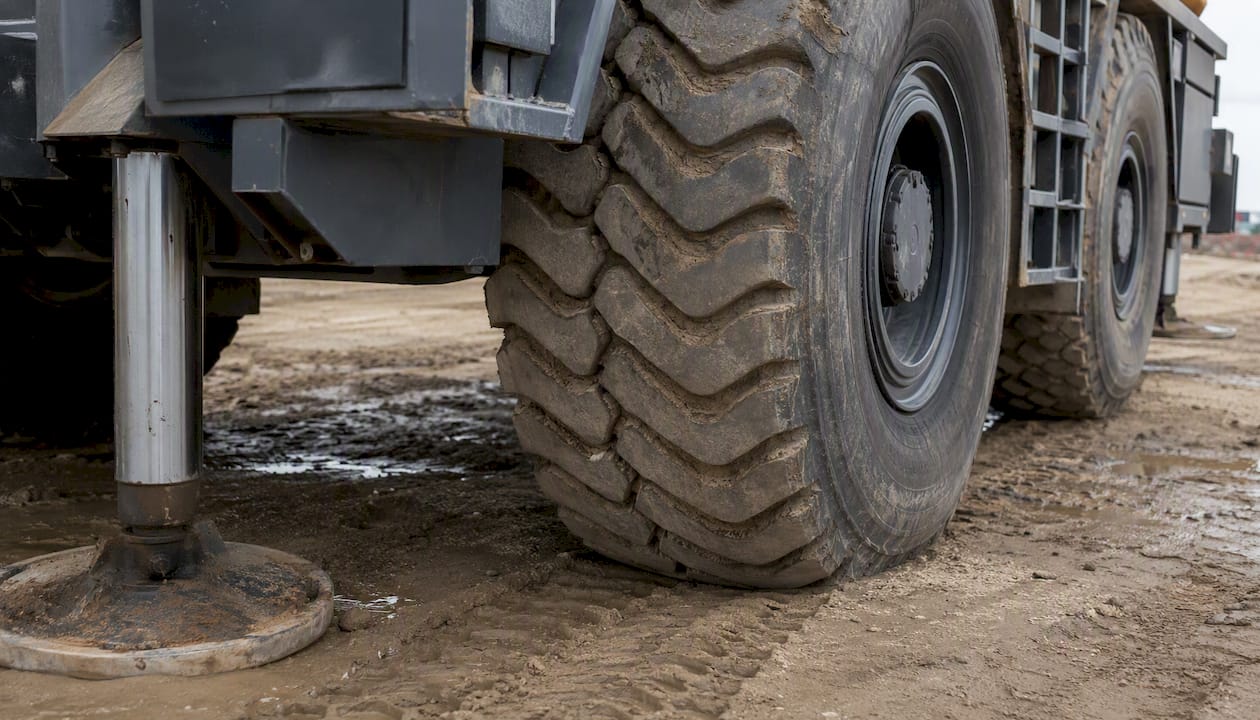
RT cranes ride on large-section, low-pressure tires mounted on a compact two-axle frame with high ground clearance. The wide tires spread the machine's weight across a larger contact area, reducing ground bearing pressure on soft or wet surfaces. That matters on jobsites where a conventional truck crane would sink or lose traction. The short wheelbase keeps the overall footprint tight, which is why RT cranes can navigate confined sites that would stop a longer truck-mounted unit.
Single superstructure and cab layout
Unlike all-terrain cranes, which often use separate carrier and superstructure engines, most RT cranes run a single engine powering both travel and crane functions. The operator works from one cab that rotates with the superstructure, giving full 360-degree visibility during lifts without switching positions. That single-cab, single-engine layout simplifies maintenance and reduces the number of systems a field technician must diagnose.
Telescopic boom and jib options
The boom is a hydraulic telescoping unit, typically extending from a base section to full length without manual pin changes on modern machines. Jibs, both fixed and hydraulic power-tilt types, attach at the boom tip to extend reach or change lift geometry. Counterweights bolt to the rear of the superstructure and are sized to the lift; adding or removing counterweight plates changes the rated capacity at a given radius.
Drive and steering modes
- 4×4 all-wheel drive: powers all four wheels simultaneously for traction on loose or wet ground.
- Front-wheel steer: standard road-style steering for open travel lanes on site.
- All-wheel steer: reduces turning radius for tight maneuvering between obstacles.
- Crab steer: all four wheels turn the same direction, letting the machine move diagonally — useful for repositioning along a trench or pipeline without a full turn.
- Hydrostatic drive: found on many modern RT cranes, it gives smooth, stepless speed control and precise inching at low speeds during pick-and-carry moves.
Pro Tip: Check the spec sheet for all available steering modes before renting. A crane without crab steer can cost significant repositioning time on a linear pipeline or utility project.
Spec callout: Typical RT crane capacities run from roughly 15 to 165 US tons, with boom lengths from approximately 60 feet to 205 feet depending on model and class. Exact figures vary by manufacturer and counterweight configuration.
How does a rough-terrain crane lift and move on site?
RT cranes travel under their own power across the jobsite but are not designed for public highway travel. That distinction shapes every operational decision from mobilization through final lift.
Hydraulic systems
A single hydraulic circuit, driven by the main engine, powers boom extension and retraction, the hoist drum, slewing (rotation of the superstructure), and outrigger deployment. The operator controls all functions from the cab using joysticks and foot pedals. Because everything runs from one power source, the operator must manage engine load carefully during simultaneous functions like booming up while slewing.
Outrigger deployment and leveling
Before any rated lift, the operator extends the outriggers. The sequence matters:
- Park the crane on the firmest available ground.
- Extend outrigger beams fully (or to the configuration specified in the load chart).
- Lower outrigger pads to the ground and apply pressure until the tires lift clear.
- Verify level using the cab bubble level or electronic level indicator.
Outriggers transform the narrow tire footprint into a wide, stable lift base, and the rated capacity on the load chart assumes full outrigger extension unless a specific "on rubber" chart entry is provided. Pick-and-carry lifts, where the crane travels with a load suspended, are only permitted within the "on rubber" capacity limits and at low speed on firm, level ground.
Steering modes in practice
Front-wheel steer handles most open-site travel. All-wheel steer cuts the turning circle significantly when threading between equipment or structures. Crab steer is the mode most operators underuse — it lets the machine track sideways along a wall or trench line without repositioning the entire crane.
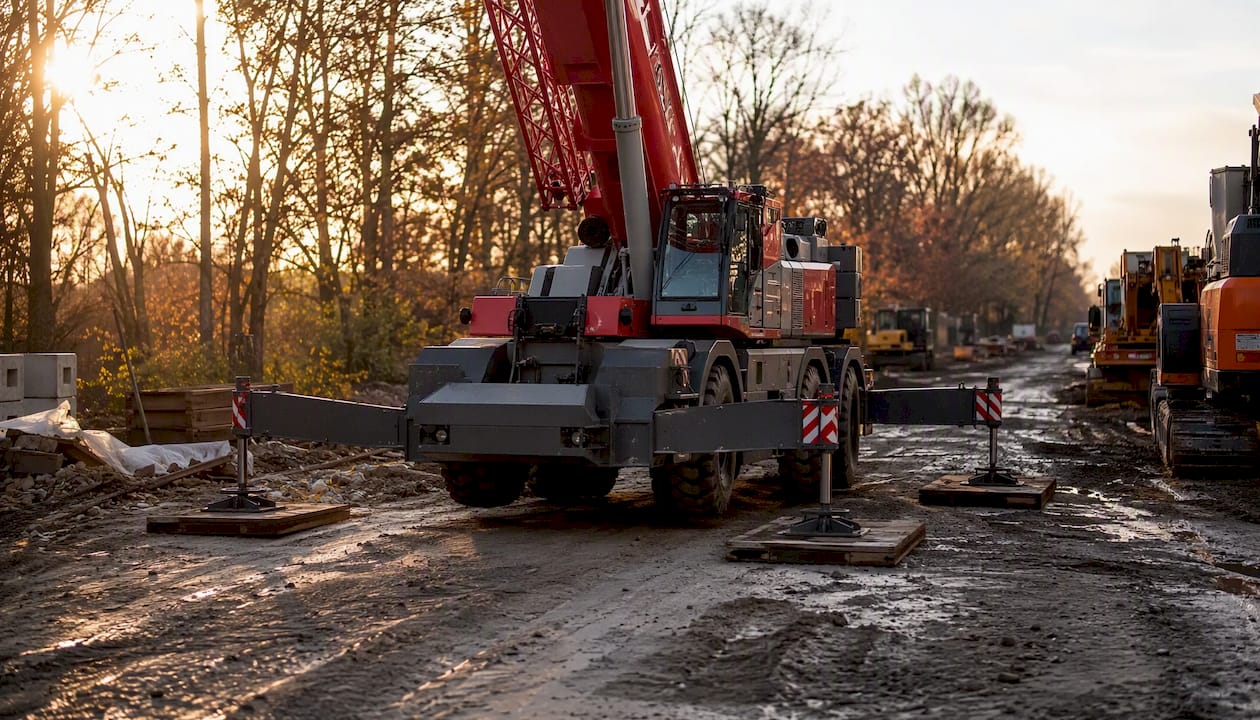
Pro Tip: On soft ground, use timber mats or engineered outrigger pads under the outrigger floats. A pad that doubles the float contact area roughly halves the ground bearing pressure, which can be the difference between a safe set and a tip-over on saturated soil.
What specs and capacity ranges should you expect?
Manufacturer load charts are the authoritative source for rated capacities at specific radii. No spec sheet summary replaces the actual chart for a given machine, counterweight, and jib configuration. That said, the table below gives the practical ranges buyers and renters encounter across the three common RT capacity classes.
| Specification | Light class | Medium class | Heavy class |
|---|---|---|---|
| Typical max capacity | 15–40 US tons | 40 US tons | 90 US tons |
| Typical max boom length | moderate lengths | longer lengths | longest lengths |
| Jib length range | shorter jib options | mid-range jib options | longer jib options |
| Transport width (approx.) | typical narrow widths | medium widths | wider widths |
| On-site travel speed | low speeds for pick-and-carry activity | comparable low speeds | slow speeds during pick-and-carry moves |
Rated capacity drops as working radius increases. A 50-ton crane lifting at 10 feet of radius may be rated at only 20 tons at 30 feet. Always pull the load chart for the specific counterweight configuration in use, not the machine's maximum nameplate rating. Lifting supervisors should require the exact chart that matches the machine's setup before any lift begins.
Spec callout: Capacity figures above reflect typical ranges across major US-available models. Exact ratings depend on boom angle, outrigger configuration, and counterweight; consult the manufacturer's load chart for every lift plan.
How do rough-terrain cranes compare with other crane types?
RT cranes excel where site ground is soft, uneven, or unprepared and where multiple repositionings are needed. They are not a universal substitute for all-terrain, crawler, or truck-mounted cranes when highway mobility or very large capacity is the priority.
One-line verdicts:
- All-terrain (AT): road-legal, multi-axle, higher highway speed — better when the crane must self-travel between sites or serve multiple locations in a day.
- Crawler crane: tracks instead of tires, highest stability and capacity — better for long-duration, high-capacity lifts on a single location where mobility is secondary.
- Truck-mounted crane: fastest highway travel, lowest mobilization cost — better when the site is paved and lifts are infrequent or light.
Top three decision triggers:
- Site access and transport: if the crane cannot reach the lift point without a lowboy, an AT crane's self-travel advantage disappears — both need transport logistics.
- Ground conditions: soft, wet, or ungraded ground favors RT over truck-mounted; very soft ground with long-duration lifts may favor a crawler with mats.
- Lift radius and capacity: if the required capacity at the working radius exceeds the RT class ceiling, step up to an AT or crawler rather than overloading the machine.
What attachments and options extend RT crane capability?
Attachments extend reach, change lift geometry, or improve site adaptability. Knowing which options are available on a specific machine before you rent or buy prevents gaps in capability on the day of the lift.
Common attachments and options include:
- Fixed jib: a non-articulating extension bolted to the boom tip; adds reach at a fixed angle, reduces rated capacity.
- Hydraulic power-tilt jib: adjusts angle from the cab without manual repositioning; useful when lift geometry changes between picks.
- Lattice swing-away jib: a lattice-section extension that folds alongside the boom for transport and swings into position on site; adds significant reach with lower weight penalty than a solid jib.
- Auxiliary winch: a second hoist drum for two-block rigging or dual-line lifts; adds flexibility for long-reach picks.
- Load moment indicator (LMI): an electronic system that monitors boom angle, radius, and load weight in real time and alerts the operator when approaching rated capacity; required on most US jobsites.
- Remote control system: allows the operator to control basic crane functions from ground level; useful for precision picks where cab visibility is limited.
- Float pads and outrigger matting: engineered timber or composite mats placed under outrigger floats to spread ground bearing pressure on soft or uneven surfaces.
Adding a jib increases reach but reduces rated capacity at that radius. A lattice jib also adds rigging and setup time, typically 30–60 minutes depending on configuration. Factor that into your lift plan schedule.
Which industries and job types use RT cranes most?
RT cranes are the standard choice for construction sites with unpaved ground, pipeline and utility work, oil and gas facilities, remote maintenance, and small-scale infrastructure projects. The common thread is a site where ground conditions are variable and the crane needs to move frequently.
Concrete use cases where RT outperforms alternatives:
- Early-stage structural steel: setting columns and beams before a site is graded or paved; a truck crane cannot access soft ground, and a crawler takes too long to set up for short lifts.
- Pipeline spool lifts: picking and placing pipe sections across soft or uneven terrain along a right-of-way; the RT's pick-and-carry capability and tight turning radius keep pace with the crew.
- Equipment installation on uneven pads: setting compressors, generators, or process vessels on unprepared concrete pads at oil and gas facilities where ground around the pad is rough.
- Tower and pole erection in unpaved yards: utility and telecom work where the crane must reposition dozens of times along a route without a paved surface.
- Plant maintenance shutdowns: repositioning inside a facility yard between multiple lift points in a single shift; faster repositioning reduces overall project time compared with a crawler that must be tracked and re-leveled at each point.
Pro Tip: For pipeline work, confirm the crane's on-rubber capacity before planning pick-and-carry moves along the right-of-way. Many operators assume the full rated capacity applies when traveling with a load — it does not. The on-rubber chart entry is always lower.
How are RT cranes transported, rented, and maintained?
RT cranes require lowboy trailer transport between job sites because they are not designed for highway travel. That logistics step affects mobilization cost, lead time, and scheduling in ways buyers and renters often underestimate.
Transport and mobilization
- Arrange a lowboy trailer rated for the crane's transport weight, which can range from 40,000 to over 100,000 lbs depending on class.
- Check state and local oversize/overweight permit requirements; wide loads (over 8.5 feet) typically need a permit and may require escort vehicles or travel time restrictions.
- Confirm site access: the lowboy needs a clear path to the set location, and the crane must be able to drive off the trailer onto the ground surface.
- Lead times for permitted transport can run 2–5 business days in many US states; plan accordingly.
Rental vs. purchase decision factors
- Rent when project frequency is low (fewer than 3–4 projects per year), when capital is better deployed elsewhere, or when the required capacity class changes project to project.
- Buy when the machine will work continuously, when owning the maintenance history matters for safety compliance, or when long-term total cost of ownership beats repeated rental rates.
- Maintenance cost drivers include tire replacement (large-section off-road tires are expensive), hydraulic hose and seal service, boom wear pads, wire rope inspection and replacement, and LMI calibration.
Pro Tip: For many projects, total mobilization cost — transport, permits, mats, and pads — can exceed a day's rental rate. Negotiate who covers mobilization, fuel, and insurance before signing the rental agreement. Getting those terms in writing prevents disputes when the lowboy arrives.
Common inspection items to verify before accepting a rental:
- Wire rope condition (kinks, broken wires, corrosion)
- Hook block and safety latch
- Outrigger beam and pad condition
- Hydraulic hoses for leaks or chafing
- LMI calibration and function test
- Tire pressure and tread condition
- Steering and brake function check
What safety rules apply to RT crane operation?
Mandatory safety practices for RT crane operation include pre-start inspections, strict load-chart compliance, and a certified operator — either NCCCO-certified or holding an equivalent qualification recognized under OSHA 29 CFR 1926 Subpart CC. No lift should begin without confirming all three.
The 3-3-3 rule
The 3-3-3 rule is a common site safety practice used before and during crane lifts. The specific formulation varies by company and rigging supervisor, but the core principle covers three checks at three stages with three parties involved: the operator, the rigger, and the lift supervisor each verify load weight, rigging condition, and ground stability before the hook goes up. Confirm the version your site uses with the rigging supervisor before the lift begins.
Daily inspection checklist
- Tires: pressure, tread depth, sidewall condition
- Steering and drivetrain: function test in all steering modes
- Hydraulic hoses and fittings: visual inspection for leaks, chafing, or damage
- Outriggers and pads: extension function, pad condition, locking pins
- Wire rope: inspect for kinks, broken wires, bird-caging, or corrosion
- Hook block: condition, swivel function, safety latch engagement
- LMI and safety interlocks: power-on self-test, calibration check
- Boom sections: wear pad condition, pin and locking mechanism function
Safety callout: Manufacturer load charts and NCCCO operator certification are the two non-negotiable trust signals on any US jobsite. A crane without a current load chart on board or an uncertified operator is a compliance and liability exposure regardless of machine condition.
Pro Tip: If the ground feels soft or the crane begins to list during outrigger deployment, stop the lift immediately. Ground instability is the leading cause of RT crane tip-overs. Add mats, reposition to firmer ground, or get a geotechnical assessment before proceeding.
How do you choose the right RT crane for a job?
Start by identifying the minimum required capacity at the working radius, then confirm transport and site constraints before comparing prices. Overspecifying wastes money; underspecifying creates a safety and compliance problem.
Selection checklist:
- Required capacity at working radius: pull the lift plan, calculate the load weight plus rigging, and identify the radius from the crane center pin to the load.
- Boom length and jib options: confirm the boom reaches the pick point at the required angle; add a jib if the geometry requires it.
- Outrigger spread and ground bearing pressure: verify the outrigger footprint fits the available space and that the ground can support the pad loads.
- Steering and drive modes: confirm crab steer or all-wheel steer if the site has tight repositioning requirements.
- Engine and transmission type: hydrostatic drive is preferred for pick-and-carry work; check fuel type (diesel is standard).
- Transport dimensions and weight: confirm the lowboy and permit requirements for the crane's transport configuration.
- Service support and parts availability: ask the seller or rental company about local service coverage and parts lead times.
- Operator certification: confirm the operator holds a valid NCCCO or equivalent certification for the crane class.
Questions to ask a rental company:
- Who arranges and pays for mobilization (transport, permits, escort)?
- What outrigger pads or mats are included?
- What is the fuel policy (full-to-full or included)?
- When was the last full inspection, and can you provide the inspection record?
- Has the counterweight or load chart configuration changed from the factory spec?
Match the machine class to the lift plan. An RT crane selected for its off-road capability but then used exclusively on a paved yard is an expensive choice compared with a truck-mounted unit. Conversely, selecting a truck crane to save money on a soft-ground site often results in ground preparation costs that exceed the crane class difference.
Which manufacturers make RT cranes available in the US?
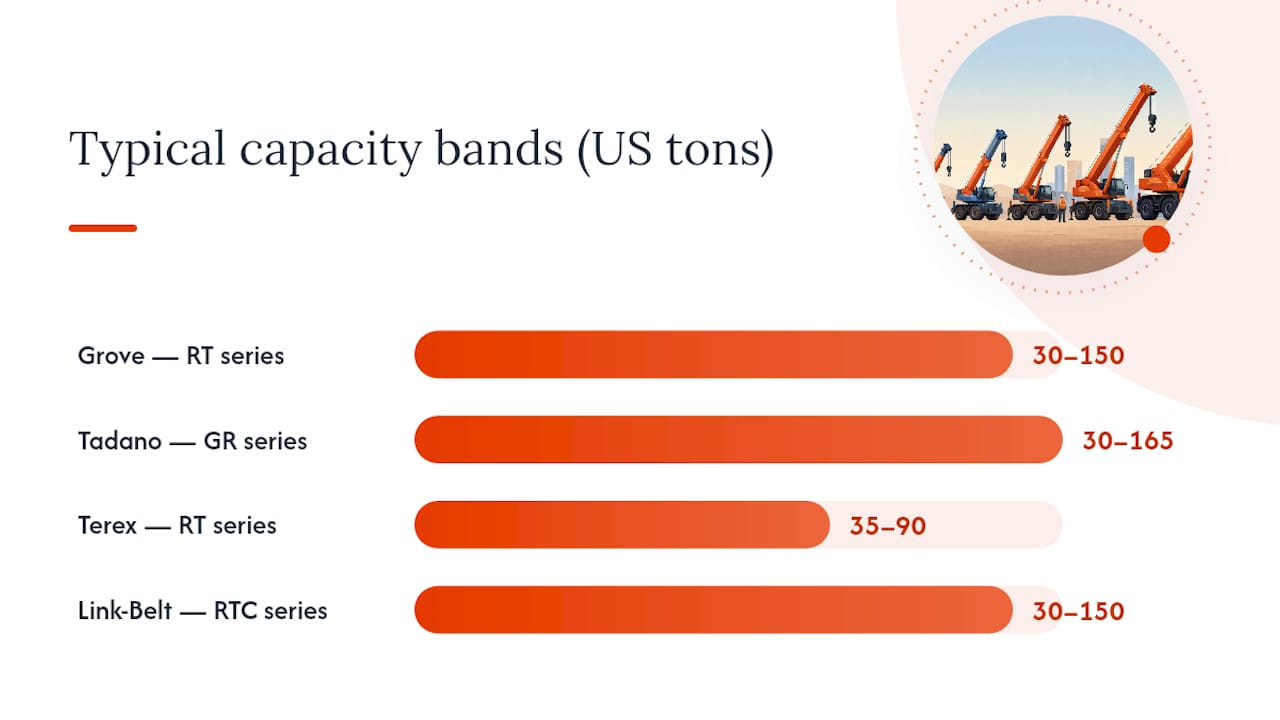
The four major RT crane manufacturers with broad US market presence are Grove, Tadano, Terex, and Link-Belt. Each offers multiple model families across the light, medium, and heavy capacity classes.
| Manufacturer | Example RT model family | Typical capacity band | Key spec items to verify |
|---|---|---|---|
| Grove | RT series | 30–150 US tons | Boom length, outrigger spread, LMI type, transport width |
| Tadano | GR series | 30–165 US tons | Counterweight options, jib availability, steering modes |
| Terex | RT series | 35–90 US tons | Hydrostatic drive availability, boom wear pad condition |
| Link-Belt | RTC series | 30–150 US tons | Outrigger configuration, LMI calibration, service history |
When reviewing a listing for any of these models, verify rated capacity at working radius, boom and jib lengths, transport dimensions, outrigger spread, and LMI availability — not just the nameplate maximum capacity. A machine listed as "150-ton" may only be rated at 40 tons at your required radius with the counterweight configuration on site.
Pro Tip: Reading a load chart takes about two minutes once you know the method. Find the column for your boom length, locate the row for your working radius, and read the rated capacity at the intersection. Then confirm which counterweight configuration that chart entry assumes — it is usually noted at the top of the chart page. If the machine on site has a different counterweight setup, you are reading the wrong chart.
For equipment selection guidance on challenging terrain projects, resources like construction equipment selection guides can help frame the broader site-access and crane-type decision before you narrow to a specific model.
An operator's perspective on what actually matters
Operators who work RT cranes regularly tend to prioritize three things above everything else on the spec sheet: reliable mobility across the site, straightforward hydraulic systems that a field mechanic can diagnose without a factory technician, and readily available spare parts that do not require a two-week lead time.
Operator priorities in practice:
- Predictable transport time: knowing the lowboy can be arranged within 24–48 hours matters more than marginal capacity differences between models.
- Simple hydraulic architecture: machines with well-documented, single-circuit hydraulic systems get repaired faster in the field than complex multi-circuit designs.
- Standard tire availability: large-section off-road tires on uncommon rim sizes can strand a machine for days; check that the tire spec is a common size before committing to a purchase.
- Outrigger pad logistics: many rental units arrive without adequate mats; operators who carry their own engineered pads avoid the most common setup delay.
The most frequent surprise in rentals is a mismatch between the listed transport dimensions and the actual crane configuration on delivery day. A counterweight that was not listed, an extra jib section still attached, or a boom that was not fully retracted can push the load over permit limits. Confirm the exact transport configuration in writing before the lowboy is dispatched, and require a current inspection record before accepting delivery.
Find RT crane listings on Sostruckforsale
Sostruckforsale aggregates RT crane listings from dealers and private sellers across the United States, letting buyers filter by capacity class, boom length, transport dimensions, and seller location in one place.
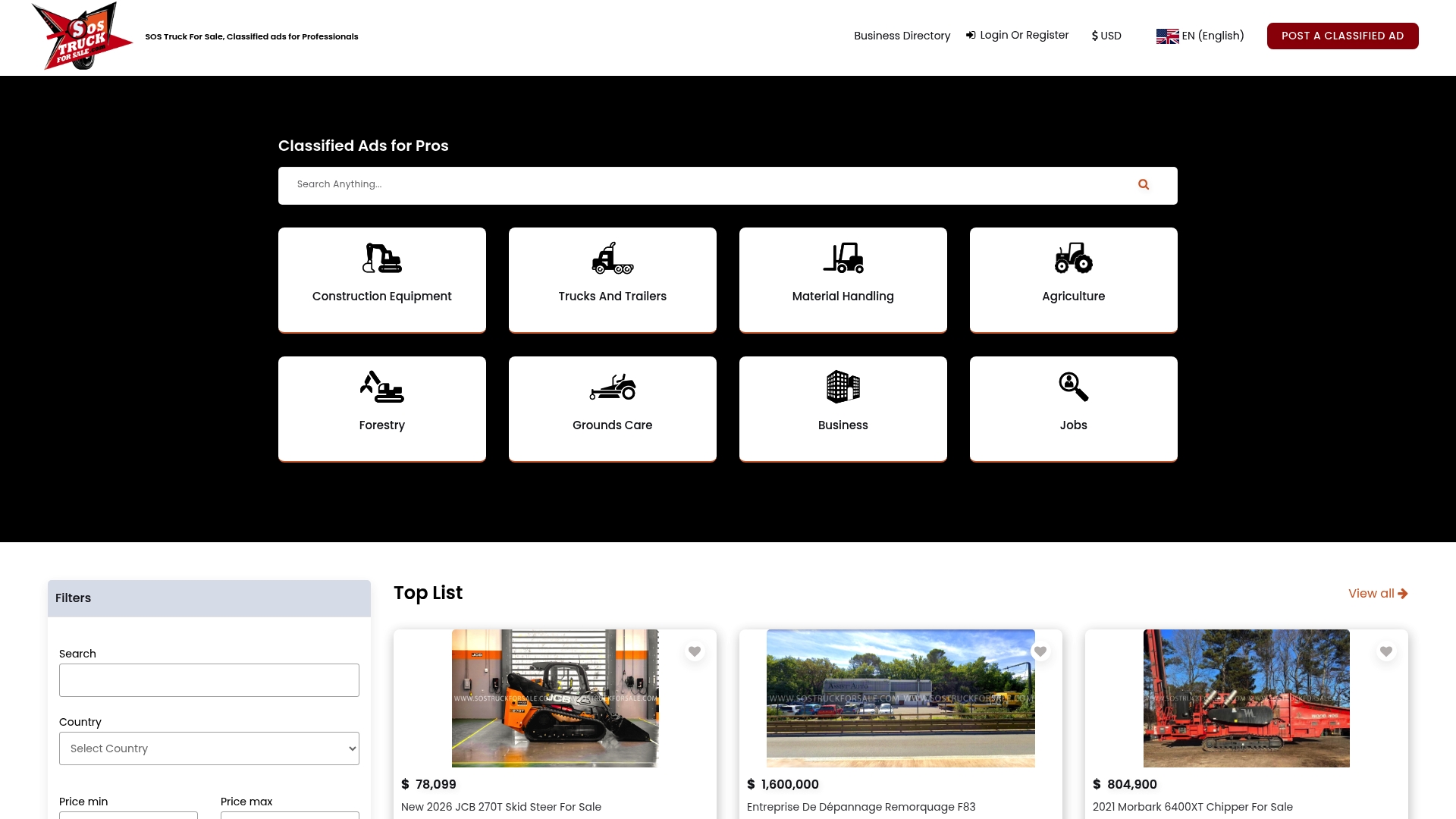
Listings on Sostruckforsale include specification details, inspection history notes, and seller contact information so you can verify the key items from the selection checklist above before making a call. Use the capacity and category filters to narrow results to the RT class that matches your lift plan, then check each listing for transport dimensions, LMI availability, and service records. Dealer listings include business directory information for direct verification. Browse current rough terrain crane listings on Sostruckforsale to compare available inventory and connect with verified sellers.
Sources
Use these sources to verify specifications, download load charts, and confirm operator certification requirements before renting or purchasing an RT crane.