

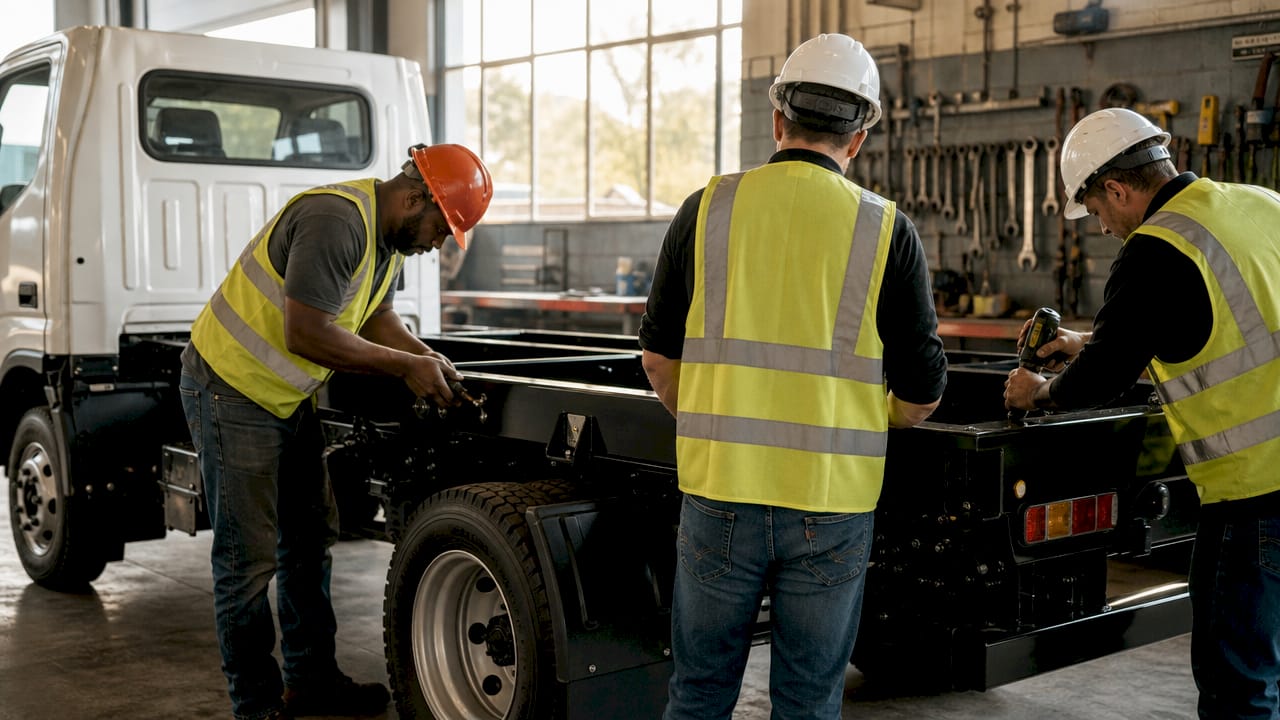
A chassis cab truck is defined as a cab plus bare chassis rails and powertrain without a factory-installed cargo body, making it the foundation for virtually any vocational upfit a business requires. Ford, Ram Trucks, and Chevrolet/GMC all produce chassis cab platforms specifically for fleet buyers who need more than a standard pickup can deliver. The role of a chassis cab truck is not hauling in the traditional sense. It is providing a certified, engineered base that body builders and upfitters transform into purpose-built commercial vehicles. Fleet managers and business owners who understand this distinction make smarter purchasing decisions from day one.
What functional advantages do chassis cab trucks offer over regular trucks?
A chassis cab truck gives fleet managers something a standard pickup cannot: a blank slate rated for mission-specific loads. The absence of a factory bed means the entire rear of the vehicle is open for any aftermarket body, from a flatbed to a refrigerated box to a utility service body. That flexibility is the core chassis cab truck benefit that separates it from conventional pickups.
Chassis cab trucks also carry higher Gross Vehicle Weight Ratings (GVWR) than comparable pickups. A higher GVWR means the chassis can legally and safely carry heavier upfits and payloads without compromising brake or suspension performance. Fleet managers who try to replicate this with a standard pickup often find themselves overloaded and out of compliance.
The chassis cab truck features that matter most in fleet operations include:
- Frame mounting provisions: Pre-drilled frame rails and standardized mounting patterns allow body builders to attach virtually any vocational body without custom fabrication.
- Electrical architecture: Factory-installed wiring provisions support auxiliary lighting, PTO controls, and upfitter-specific circuits.
- Powertrain options: Diesel and gasoline engine choices are matched to expected payload and duty cycle, not just towing convenience.
- Cab configurations: Regular, extended, and crew cab options let fleet managers balance crew capacity with body length.
- Serviceability: Chassis cabs are designed for high-mileage commercial use, with easier access to drivetrain components than body-on-frame pickups.
Pro Tip: Consult a certified body builder before purchasing the chassis. Buying the truck first and hoping the body fits creates costly mismatches and delays that could have been avoided in a single planning meeting.
What are the primary commercial applications and upfits for chassis cabs?
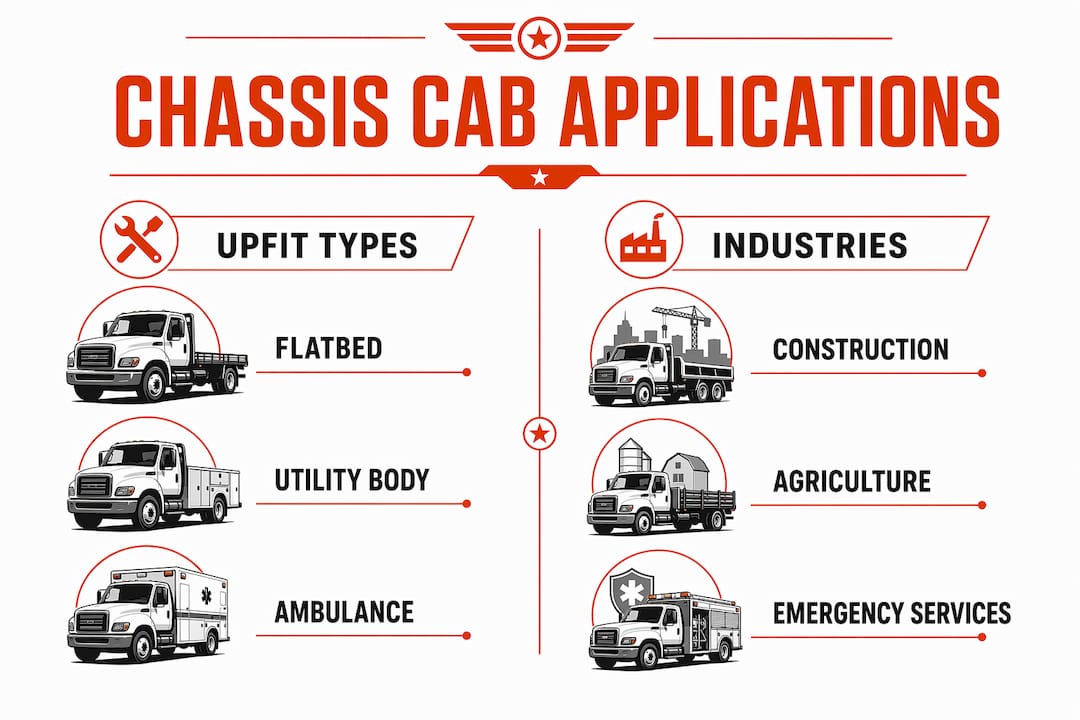
The chassis cab platform supports a wider range of industries than most fleet managers initially realize. Construction, emergency response, utilities, and last-mile delivery all rely on chassis cab trucks as their primary work vehicles. The upfit installed on the chassis defines the vehicle's function entirely.
Common upfit types and their associated industries are listed below.
| Upfit Type | Primary Industry | Key Function |
|---|---|---|
| Flatbed body | Construction, agriculture | Open cargo transport, equipment hauling |
| Service/utility body | Utilities, telecom, HVAC | Organized tool and parts storage |
| Box truck body | Delivery, logistics | Enclosed cargo transport |
| Ambulance body | Emergency medical services | Patient care and transport |
| Fire apparatus body | Fire departments | Hose storage, pump equipment |
| Dump body | Landscaping, excavation | Loose material hauling |
| Crane/mechanics body | Heavy equipment service | On-site repair and lifting |
Fire apparatus purchasing illustrates how specific chassis cab applications become. NFPA 1900 Table 8.1 requires 37 cubic feet of hose storage for pumper fire apparatus. That requirement directly influences which chassis platform a fire department selects, because the body dimensions must fit within the chassis wheelbase and frame length. No standard pickup can accommodate that specification.
Ambulance builders face similar constraints. The chassis must support the weight of the medical module, onboard oxygen systems, and full crew without exceeding GVWR. Chassis cab trucks from Ford, Ram, and Chevrolet/GMC are the standard platforms for Type I and Type III ambulance builds precisely because they are engineered to accept these loads.
Vocational upfitting now functions as strategic engineering, not just bolt-on modification. Body builders treat the chassis as a mobile workstation foundation, designing the upfit around regulatory compliance, weight distribution, and operational workflow simultaneously.
How should fleet managers plan chassis selection and upfitting?
Fleet managers who treat chassis selection as a platform project rather than a vehicle purchase consistently achieve better outcomes. The planning process starts with total payload math: chassis weight, upfit weight, occupants, fuel, and cargo must all fit within the GVWR before a single bolt is turned.
Exceeding GVWR by 500 lbs increases suspension wear by approximately 25%, accelerates brake pad degradation, and raises safety risk. That figure translates directly into higher maintenance costs and shorter vehicle lifecycle. Fleet managers who ignore GVWR compliance pay for it in repair bills and liability exposure.
Effective chassis cab selection and upfitting planning follows a clear sequence:
- Define the mission first: Identify exactly what the vehicle must carry, access, and operate before contacting a chassis dealer.
- Calculate total payload early: Add chassis curb weight, upfit weight, maximum crew, and full fuel load before selecting a GVWR tier.
- Coordinate with the upfitter before purchase: Body builders need chassis specifications to confirm frame length, wheelbase, and electrical provisions match the intended body.
- Use virtual modeling: CAD modeling reduces the risk of body and chassis mismatches by optimizing weight distribution and component placement before any hardware is ordered.
- Verify regulatory compliance: Confirm the completed build meets applicable federal, state, and industry standards for the intended use.
Pro Tip: Standardizing upfit configurations across your fleet improves technician productivity. When every vehicle of the same type has identical equipment placement, your crew can operate any unit without relearning the layout.
What technical factors affect chassis cab performance in specialized builds?
The chassis cab serves as a complex integration platform, not simply a hauling base. Frame mounting patterns, electrical architecture, and PTO provisions define compatibility between the chassis and the intended body. Fleet managers who evaluate chassis cabs only on payload ratings miss the technical factors that determine whether a build actually works in the field.
Four technical areas demand attention in any specialized vocational build:
-
PTO driveline alignment: Remote pump mounting via power take-off requires precise angle and parallelism between the PTO output and the driven component. Misalignment in PTO drivelines causes vibration, accelerated wear, and hydraulic system failures that sideline the vehicle.
-
Electrical integration and grounding: Upfitter circuits must connect to clean, low-resistance chassis ground points. Poor grounding causes dimming lights, slow charging, blown fuses, and intermittent faults that are difficult to diagnose and expensive to repair.
-
PTO control wiring: Factory prep packages and upfitter electronic modules must be correctly configured. Wiring errors in PTO controls disable critical functions or trigger false fault codes, creating safety risks in vehicles like aerial lifts or refuse trucks.
-
Axle weight distribution: After the body is installed and loaded, front and rear axle weights must stay within rated limits. Body builders review manufacturer drawings and weigh the completed vehicle at each axle before delivery to confirm compliance.
These technical factors explain why pre-purchase virtual modeling has become standard practice among professional fleet managers. Catching a weight distribution problem in a CAD model costs nothing. Catching it after the body is bolted on costs time, money, and potentially the entire chassis purchase.
Key Takeaways
A chassis cab truck is the most flexible commercial vehicle platform available, but its value depends entirely on disciplined planning, accurate payload math, and coordination with qualified upfitters before the chassis is purchased.
| Point | Details |
|---|---|
| Definition matters | A chassis cab is a cab plus bare chassis rails without a factory body, built for custom upfits. |
| Plan before you buy | Consult body builders before purchasing the chassis to avoid costly mismatches and delays. |
| GVWR compliance is non-negotiable | Exceeding GVWR by 500 lbs increases suspension wear by 25% and raises safety risk. |
| Grounding drives electrical reliability | Connect upfitter circuits to clean chassis ground points to prevent faults and component failures. |
| Standardize across the fleet | Identical upfit configurations across similar vehicles improve technician efficiency and reduce errors. |
Why chassis cab planning is the decision most fleet managers get wrong
Fleet managers consistently underestimate how much the chassis selection decision locks in every downstream cost. I have seen operations purchase a chassis based on price alone, then spend more correcting the upfit than the chassis itself cost. The vehicle sits idle during modifications, the body builder charges for rework, and the fleet manager explains to ownership why a truck that was supposed to be operational in six weeks took four months.
The chassis cab truck is not a commodity purchase. It is the foundation of a mobile work system, and every component of that system depends on the chassis being right. The frame length determines what body fits. The electrical architecture determines what equipment can be powered. The GVWR determines what the vehicle can legally carry. Getting any one of those wrong cascades into problems across all three.
What I find most underappreciated is the value of virtual modeling before hardware commitment. Experienced upfitters now use CAD tools to simulate the completed build, check axle weights, and confirm component clearances before ordering a single part. Fleet managers who require this step from their upfitters consistently receive vehicles that perform as specified from day one. Those who skip it are the ones calling the body builder six weeks after delivery with complaints.
Treat the chassis cab as a long-term asset. The upfit you specify today will define how productive that vehicle is for the next eight to twelve years. Spend the time upfront to get it right.
— Dave
Chassis cab trucks available through Sostruckforsale
Fleet managers who know what they need can move fast when the right chassis cab is listed.
Sostruckforsale lists commercial chassis cab trucks across multiple configurations, from light-duty platforms suited for service body upfits to heavy-duty units ready for specialized vocational builds. Whether you are sourcing a single unit or expanding an entire fleet, the listings at Sostruckforsale cover a wide range of makes, models, and specifications. Fleet buyers can browse current inventory, compare configurations, and connect directly with sellers to negotiate terms that fit their operational budget and timeline.
FAQ
What is the role of a chassis cab truck?
A chassis cab truck provides a cab, chassis rails, and powertrain without a factory cargo body, serving as the base platform for custom vocational upfits like flatbeds, ambulances, and service bodies.
How does a chassis cab differ from a regular pickup truck?
A chassis cab has no factory-installed bed and typically carries a higher GVWR than a comparable pickup, giving fleet managers full control over the rear body configuration and payload capacity.
Which brands make chassis cab trucks?
Ford, Ram Trucks, and Chevrolet/GMC are the primary manufacturers of chassis cab trucks in the United States, offering multiple cab configurations and GVWR tiers for commercial buyers.
Why does GVWR matter when upfitting a chassis cab?
Exceeding GVWR by as little as 500 lbs increases suspension wear by approximately 25% and raises brake wear and safety risk, making accurate payload calculation before upfitting a critical step.
When should I consult a body builder during chassis selection?
Consult a certified body builder before purchasing the chassis. Confirming frame length, wheelbase, and electrical provisions before the purchase prevents costly mismatches and build delays.