

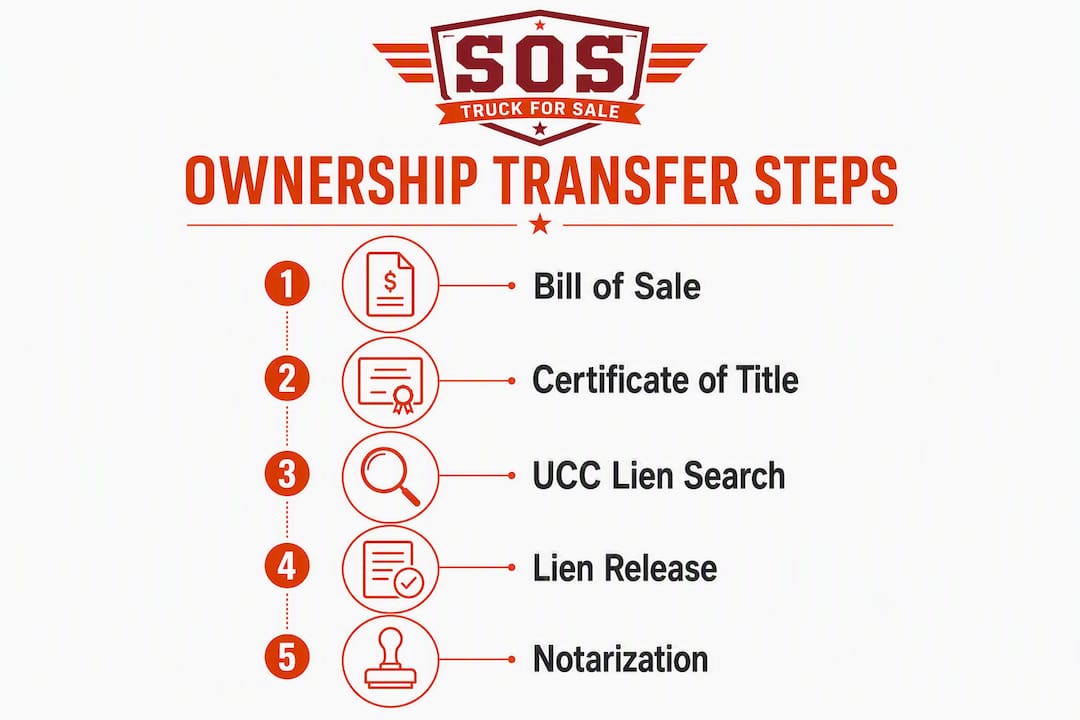
To transfer excavator ownership in the United States, you need five core documents: a signed Bill of Sale, a Certificate of Title (when the unit is titled in your state), a UCC lien release or payoff letter from any lender, a photo of the serial/VIN plate, and any state-specific transfer form your DMV requires. Before you move funds or sign anything, verify the serial number against service records and run a UCC lien search through the relevant state Secretary of State portal.
The transfer process for heavy equipment is not uniform across the country. Some states require a formal title transfer through the DMV; others recognize a properly executed Bill of Sale as sufficient proof of ownership change. Knowing which rules apply to your state, and the buyer's state if they are out of state, is the single most important preparation step you can take.
Minimum documents to collect before any transfer:
- Bill of Sale (signed by both parties, notarized when required)
- Certificate of Title, if the unit is titled in your state
- UCC-1 financing statement termination or written lien release from the lender
- Close-up photo of the serial/VIN plate
- State-specific transfer or registration form (check your state DMV)
- Proof of identity for both buyer and seller; business authorization letter if a company is selling
Table of Contents
- What paperwork do you need before buying or selling an excavator?
- Step-by-step: how to complete the transfer from start to finish
- How do you run a UCC lien search and what happens if you find one?
- When do you need a formal title versus just a bill of sale?
- How to clear an outstanding loan and get a clean lien release
- How to complete a bulletproof bill of sale and when to notarize
- Inspection checklist and how to verify serial numbers
- What fees and timelines should you expect?
- What should you do immediately after the transfer?
- Common red flags and how to handle them
- Key Takeaways
- The paperwork step most buyers skip (and why it costs them)
- List your excavator on Sostruckforsale and reach serious buyers
- Where to find official forms and authoritative guidance
What paperwork do you need before buying or selling an excavator?
Transferring ownership of heavy equipment requires more documentation than a typical vehicle sale because the asset value is high, lien structures are common, and state rules vary. Assembling the right documents before negotiations close protects both parties and prevents delays at closing.
Bill of Sale
A construction equipment Bill of Sale is the foundational legal document that shifts liability and records the transfer. It must include full legal names of buyer and seller, sale date, purchase price, make/model/year, serial/VIN number, hour meter reading, a description of any included attachments, and signatures from both parties. Think of it as a receipt that also carries legal weight: it documents who owned the machine, when ownership changed, and at what price.

Certificate of Title
When the state has issued a title for the unit, the seller must sign the title over to the buyer. The title shows the registered owner's name and any recorded lienholder. A clean title with no lienholder listed is the strongest proof of unencumbered ownership.
UCC-1 financing statement / lien release
Buyers should run a UCC lien search through the relevant state Secretary of State before any funds change hands. If a lender has filed a UCC-1 against the equipment, the seller must provide either a UCC termination filing or a signed lien release letter before the transfer is complete.
Supporting documents
- Serial/VIN plate photos (close-up and full-side)
- Maintenance and service records
- Road registration certificate, if the machine is road-capable
- Proof of identity (government-issued ID) for individuals; corporate resolution or officer authorization for business sellers
- Prior purchase invoices or prior title, to establish chain of ownership
Pro Tip: Sellers should assemble a "sale packet" before listing: serial plate photos, service history, a draft Bill of Sale, and lien payoff information. Buyers who receive this packet upfront close faster and with greater confidence.
Step-by-step: how to complete the transfer from start to finish
The sequence below applies to most U.S. excavator sales. Timing estimates are typical ranges; your state and lender may differ.
- Seller: prepare the sale packet. Photograph the serial/VIN plate, compile service records, locate the title, and contact your lender for a current payoff statement if a loan is outstanding.
- Buyer: obtain the serial/VIN. Request it from the seller early, then run a UCC lien search through the state Secretary of State and check available theft registries.
- Buyer: request documentation. Ask for the title, prior invoices, and seller ID. If a business is selling, request a corporate authorization letter confirming the signer's authority.
- Negotiate and record terms. Agree on price, payment method, and any conditions. For high-value units, use an escrow service to hold funds until all conditions are met.
- Resolve any lien. Coordinate lender payoff or obtain a written lien release before final payment is made. Do not accept verbal confirmation.
- Close the transaction. Both parties sign the Bill of Sale. The seller signs the title over to the buyer if a title exists. Exchange payment and physical possession. Notarize signatures where required.
- Buyer: file state forms. Submit title transfer or registration paperwork to the state DMV or relevant agency, pay transfer fees, and update insurance.
- Both parties: retain copies. Keep signed Bill of Sale, lien release, title assignment, and proof of payment for at least five years.
Estimated timeline by step:
| Step | Typical Duration |
|---|---|
| UCC lien search | Same day to 2 business days |
| Lender payoff and lien release | 3 days or more (lender-dependent) |
| Closing and document signing | Same day |
| State DMV title/registration filing | Same day (in-person) to several weeks (mail) |
| Total preparatory phase | 1–7 days if no lien; longer with active lien |
How do you run a UCC lien search and what happens if you find one?
A UCC (Uniform Commercial Code) lien search is the buyer's primary tool for confirming that the excavator is not pledged as collateral on an outstanding loan. Skipping this step is one of the most common and costly mistakes in equipment purchases.
- Locate the correct portal. Go to the Secretary of State website for the state where the seller's business or residence is registered. Most states offer a free or low-cost online UCC search. Search by debtor name (the seller's legal name or business name) and, where the portal allows, by the equipment's serial/VIN number.
- Read the financing statement. A UCC-1 financing statement lists the secured party (lender), the filing date, and a collateral description. Watch for blanket filings, where the collateral description covers "all equipment" or "all assets." These can encumber your excavator even if the machine is not named individually.
- Distinguish active from terminated filings. A UCC-3 termination amendment means the lien has been released. An active UCC-1 with no termination on record means the lien is still in force.
- Check cross-state filings. If the seller operates in multiple states or recently relocated, run searches in each relevant state. Equipment liens follow the debtor's jurisdiction at the time of filing.
- If you find an active lien: request a written payoff letter from the lender showing the exact payoff amount and date. Use an escrow service to route payment directly to the lender, and delay transfer of possession until the Secretary of State record shows the termination filing.
Pro Tip: Document every communication with the lender in writing. Retain a copy of the released UCC filing or signed lien release letter for at least five years after the transaction closes.
When do you need a formal title versus just a bill of sale?
Documentation requirements vary by equipment capability. Road-capable heavy equipment typically requires a formal state title transfer, while stationary or non-titled machinery may transfer with a Bill of Sale alone.
- Titled equipment: Motorized units that travel on public roads, or any machine the state has issued a title for, require a formal title transfer through the state DMV. The seller endorses the back of the title, and the buyer files for a new title in their name.
- Non-titled equipment: Many excavators, particularly those used exclusively on job sites and never registered for road use, are not titled in most states. A properly executed Bill of Sale is the primary ownership document in these cases.
- Out-of-state sales: If the buyer will register the machine in a different state, follow the buyer's state requirements at registration. Some states will issue a new title based on a Bill of Sale and prior title; others require additional documentation. State DMVs publish specific title-transfer guidance with required forms and signature rules.
Action: Search "[your state] DMV title transfer heavy equipment" and "[your state] Secretary of State UCC" to locate the correct forms and portals for your transaction.
How to clear an outstanding loan and get a clean lien release
An active lien means the lender has a legal claim on the machine. The seller cannot convey clean ownership until that claim is resolved.
- Request a payoff statement. Contact the lender in writing and ask for a payoff statement that specifies the exact dollar amount and the date through which it is valid. Payoff amounts change daily as interest accrues.
- Confirm the release procedure. Ask the lender whether they will file a UCC-3 termination directly with the Secretary of State or provide a signed release letter for the buyer to retain. Both are acceptable; the UCC-3 filing is the stronger protection because it is a public record.
- Use directed payoff or escrow. Route the payoff funds directly to the lender at closing, not to the seller. An escrow service can coordinate this so the buyer's funds pay off the lender and the remaining balance goes to the seller only after the release is confirmed.
- Sample bill-of-sale lien clause: Include language such as: "Seller represents that all outstanding liens and encumbrances on the equipment described herein will be satisfied in full at or before closing, and Seller agrees to provide Buyer with written confirmation of lien release within [X] business days of closing."
Pro Tip: Require the lender's release in hard copy and verify the Secretary of State record shows the termination filing before you accept physical possession of the asset.
How to complete a bulletproof bill of sale and when to notarize
A Bill of Sale for construction equipment is a critical legal document for both parties. Getting the fields right the first time avoids corrections, delays, and disputes.
Required fields and why they matter:
| Field | Why It Matters |
|---|---|
| Full legal names of buyer and seller | Identifies the parties; must match government-issued ID |
| Business name and authorization | Required when a company is the seller or buyer |
| Sale date | Establishes when liability transferred |
| Purchase price | Needed for tax calculation and legal record |
| Make, model, year | Identifies the specific machine |
| Serial/VIN number | Ties the document to the physical unit |
| Hour meter reading at sale | Documents condition and usage at transfer |
| Included attachments | Prevents disputes over what was sold |
| Condition statement / "sold as is" clause | Limits seller liability post-sale |
| Lien statement | Confirms seller's representation of clean title |
| Signatures of both parties | Makes the document legally binding |
| Notary block | Required by some states and lenders |
On notarization: Not every state requires notarized signatures for equipment Bills of Sale, but notarization significantly reduces the risk of a later dispute about authenticity. For any excavator sale above a few thousand dollars, notarization is a practical standard. Both parties sign before a licensed notary public, who stamps and signs the document.
Retention: Keep copies in both digital and hard-copy formats. Buyers, sellers, and lenders should each retain a signed copy for at least five years.
Inspection checklist and how to verify serial numbers
Verifying the machine's identity before closing is non-negotiable. Mismatched serial numbers are a frequent reason to halt a sale and a primary indicator of a stolen or tampered unit.
- Photograph the serial/VIN plate at close range, capturing every character clearly.
- Photograph the hour meter, full-side profile, and all attachment serial plates.
- Look for signs of plate tampering: fresh welds, paint overspray around the plate, or misaligned mounting holes.
- Compare the serial number on the physical plate to the number on the title, prior invoices, and service records. All three should match exactly.
- Contact the manufacturer or an authorized dealer to verify the serial number when records are inconsistent or unavailable.
- Check available stolen-equipment databases and, where applicable, run the serial number through local law enforcement or industry theft registries.
- Request a written explanation and supporting documents if the seller claims a serial plate was replaced or the number was altered for any reason.
Pro Tip: Stop the transaction immediately if the serial/VIN on the machine does not match the paperwork. A mismatch with no documented explanation is grounds to walk away.
What fees and timelines should you expect?
Costs and processing times vary by state, lender, and transaction complexity. The figures below are typical ranges, not guarantees.
- State title and transfer fees: Vary widely by state; check your state DMV fee schedule directly.
- UCC search fees: Many state Secretary of State portals offer free or low-cost searches; professional search services typically charge a modest per-search fee.
- Notary fees: Generally range from a few dollars to around $15 per signature, depending on state law.
- Escrow fees: Typically a percentage of the transaction value or a flat fee; confirm with your escrow provider.
- Lender payoff: The outstanding loan balance plus any prepayment fees; request the exact figure from the lender.
For planning purposes, build in an extra 7–14 days beyond your target closing date to account for lien releases and cross-state paperwork. Lender payoff and UCC termination filing can take anywhere from a few days to three weeks depending on the lender's internal process.
What should you do immediately after the transfer?
The transfer is complete when both parties have signed and funds have changed hands. Several administrative steps remain before the buyer can legally operate the machine and protect the asset.
- Update insurance. Contact your insurer the same day. The new owner's policy must list the equipment with the correct effective date of coverage. Operating an excavator without current coverage exposes the owner to significant liability.
- File title and registration. Submit the signed title assignment and any required state forms to the DMV or relevant agency. Pay applicable sales or use tax; rules vary by state and equipment category, so check your local tax authority.
- Update internal records. Revise asset registers, maintenance logs, and any telematics system credentials to reflect the new owner. If the machine carries a GPS or fleet management device, transfer or reset access credentials promptly.
- Store all documents. Keep the signed Bill of Sale, lien release, title assignment, and proof of payment in both digital and physical formats for at least five years.
Common red flags and how to handle them
Most equipment transfer problems are preventable. The issues below appear frequently enough that every buyer and seller should know how to respond.
- Missing or mismatched serial/VIN: Stop the transaction. Request the seller's explanation in writing and verify with the manufacturer. If the mismatch cannot be resolved with documentation, do not proceed.
- Seller cannot produce a title or prior ownership proof: Require additional documentation such as prior invoices, tax records, or a chain-of-custody letter. If the seller cannot establish ownership, refuse the sale. Ownership can pass through sale, gift, inheritance, or business transfer, and each path requires its own documentation.
- Undisclosed lien discovered after negotiation: Request a payoff letter immediately and use escrow to protect your funds. Do not accept verbal assurances that the lien will be paid off after closing.
- Errors on submitted forms: Contact the state DMV or Secretary of State immediately. Most agencies have a correction process that involves submitting an amended form with supporting documentation. Acting quickly reduces the risk of a rejected filing or a gap in the ownership record.
- Signer authority unclear: If a business is selling, verify that the person signing the Bill of Sale has written authorization from the company. A corporate resolution or officer authorization letter is standard practice.
Key Takeaways
Completing excavator ownership transfer paperwork correctly requires a signed Bill of Sale, a UCC lien search, a written lien release, serial/VIN verification, and state-specific filing with the DMV or Secretary of State.
| Point | Details |
|---|---|
| Verify serial and run UCC search | Match the serial/VIN across the machine, title, and records; search the state Secretary of State before funds move. |
| Assemble a complete sale packet | Include serial plate photos, service records, prior ownership documents, and a draft Bill of Sale before listing or closing. |
| Require written lien release | Obtain a UCC-3 termination or signed lien release letter; use escrow to route payoff funds directly to the lender. |
| Sign a complete Bill of Sale | Include all required fields, notarize when required, and retain copies for at least five years. |
| Sostruckforsale for listings | Buyers and sellers can list and browse verified excavator listings on Sostruckforsale to connect with document-ready counterparties. |
The paperwork step most buyers skip (and why it costs them)
The UCC lien search is the most consistently skipped step in equipment transfers, and it is the one that causes the most expensive problems. A buyer who takes possession of an excavator without confirming lien status can inherit the seller's debt. The lender's security interest travels with the machine, not with the seller.
The conventional advice is to "do your due diligence," but that phrase obscures what due diligence actually means in a heavy equipment transaction. It means running the UCC search before you agree to a price, not after. It means requesting the payoff letter before you wire funds, not as a condition of closing. And it means verifying the serial number against at least three independent records, not just the seller's word.
Serial number verification deserves equal attention. A machine with a tampered plate is either stolen or has had its identity obscured for a reason. Neither scenario ends well for the buyer. The inspection step is not a formality; it is the point where you confirm that the asset you are paying for is the asset you will receive.
For sellers, the practical lesson is equally direct. Preparing a complete sale packet before listing shortens the negotiation cycle, builds buyer confidence, and reduces the chance of a deal falling apart over missing paperwork. Buyers who receive organized documentation close faster.
List your excavator on Sostruckforsale and reach serious buyers
Sellers who list excavators on Sostruckforsale connect directly with buyers who are actively searching for verified heavy equipment. The marketplace is built for commercial and industrial equipment transactions, including excavators, cranes, semi trucks, and construction machinery, so the buyers browsing your listing already understand the asset class and the documentation involved.
Post your listing with serial plate photos, service records, and your prepared sale packet to give buyers the documentation they need to move quickly. Buyers can browse current excavator listings, contact sellers directly, and use the platform's dealer directory to find verified commercial equipment sources across the United States. Whether you are selling a single unit or managing a fleet disposal, Sostruckforsale provides the listing infrastructure to reach the right audience.
Visit sostruckforsale.com to post a listing or browse available excavators today. This article is general information only and does not constitute legal advice. Confirm current transfer requirements with your state DMV, Secretary of State, or a qualified attorney before closing.
Where to find official forms and authoritative guidance
- State DMV or equivalent agency: The primary source for title transfer forms, registration requirements, and fee schedules. California DMV's title transfer guidance is one example; search "[your state] DMV title transfer" for your state's equivalent.
- State Secretary of State: The official portal for UCC lien searches, UCC-1 filings, and UCC-3 termination records. Search "[your state] Secretary of State UCC search" to locate the correct portal.
- Your lender or title company: Contact the lienholder directly for payoff statements, release procedures, and confirmation of UCC termination filings.
- Manufacturer or authorized dealer: The best source for serial/VIN verification and equipment-specific records when physical plates are unclear or service records are incomplete.
- Law enforcement and theft registries: Local police departments and industry theft registries can confirm whether a serial number has been reported stolen. Check available databases before closing on any used excavator.