

To transfer a semi truck title properly, you need a correctly assigned title certificate, a completed Application for Title form, proof of insurance, and any required lien release documents, all submitted to your state DMV or county tax office within the state-mandated deadline, typically 30 days from the sale date. For commercial semi trucks over 55,000 pounds gross vehicle weight, proof of IRS Form 2290 filing is also required before the state will process the transfer. Missing any required element can halt the process entirely or expose the seller to ongoing legal liability.
The semi truck title transfer process follows the same legal framework as any vehicle title transfer, but with added layers for commercial vehicles. Federal weight-based tax compliance, lienholder notifications, and state-specific commercial registration rules all apply. Getting the paperwork right the first time prevents costly delays, duplicate title applications, and potential liability for violations committed by the new owner after the sale.
Here is a quick summary of what every title transfer requires:
- A properly signed and dated title certificate assigned to the buyer
- Completed Application for Title form (such as Form 130-U in Texas)
- Odometer disclosure for vehicles under 20 years old
- Bill of Sale or proof of purchase price
- Lien release documentation if the truck carries a lien
- Proof of IRS Form 2290 for trucks at or above 55,000 lbs
- Proof of liability insurance in the buyer's name (if registering)
- Valid government-issued ID for both parties
- Payment of applicable title, registration, and sales tax fees
Pro Tip: Go to the county tax office with the buyer on the day of sale. A tax office representative can confirm on the spot whether the title is correctly signed and free of salvage or legal issues, protecting you from liability the moment the vehicle changes hands.

How to transfer a semi truck title properly: the step-by-step process
Transferring ownership of a semi truck follows a clear sequence. Skipping or misordering steps is the most common reason applications get rejected.
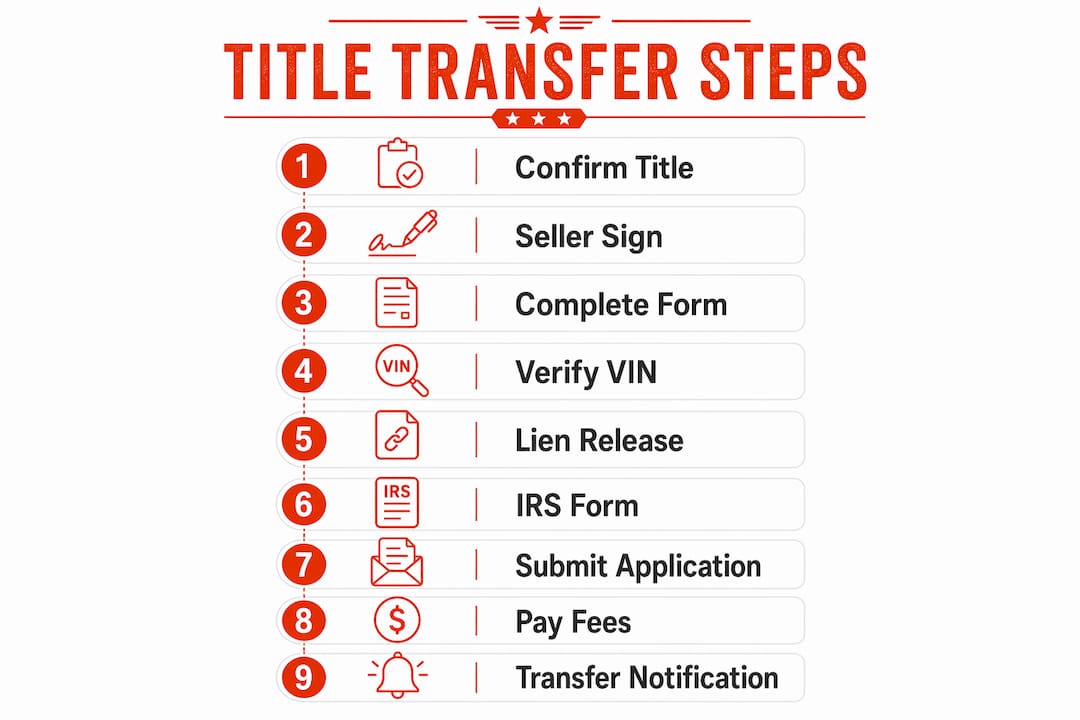
1. Confirm the title is clean and properly assigned
Before anything else, verify the title is in the seller's name, free of active liens, and has no salvage or rebuilt branding. If a lien exists, the lienholder must release it in writing before the title can be reassigned. A title with unresolved liens will be rejected at the DMV, and the buyer will have no legal recourse until the release is secured.
2. Seller signs and completes the title assignment
The seller must sign the title in the designated seller's section, enter the sale date, odometer reading, and sale price. Every name listed on the title must sign. For a business-owned truck, the authorized representative signs with the format: "ABC Trucking LLC by John Smith." Do not make corrections, cross out entries, or alter any printed field on the title document.
3. Complete the Application for Title form
Both buyer and seller must complete and sign the state's Application for Title form. In Texas, this is Form 130-U, which requires the vehicle description, VIN, odometer reading, and sale price. The odometer and sales price sections must be filled in without errors. An incomplete or incorrectly completed form causes delays and outright rejection of the application.
4. Verify the VIN against the physical vehicle
Match the VIN on the title and the application form to the VIN plate on the truck itself, typically located on the driver's side door frame or dashboard. Any discrepancy between the physical VIN and the paperwork will stop the transfer. For commercial semi trucks, also confirm the gross vehicle weight rating listed on the title matches the actual vehicle configuration.
5. Secure lien release documentation
If the truck was financed, the lienholder must formally release the lien before the title can transfer. This release must appear on the face of the title or be provided as a separate lien release letter from the lender. The lienholder's authorization is not optional; without it, the county or DMV will not process the transfer regardless of how complete the rest of the paperwork is.
6. Gather IRS Form 2290 proof for commercial trucks
For semi trucks at or above 55,000 pounds gross vehicle weight, the buyer must provide proof of IRS Form 2290 filing, which covers the Heavy Vehicle Use Tax. The IRS issues a stamped Schedule 1 as proof of payment. States including Georgia require this document before issuing plates or completing registration, and many other states follow the same requirement.
7. Prepare all supporting documents
Collect every required document before going to the tax office or DMV:
- Signed and assigned title certificate
- Completed Application for Title form
- Bill of Sale showing the purchase price
- Lien release (if applicable)
- IRS Form 2290 stamped Schedule 1 (for trucks 55,000 lbs and above)
- Proof of liability insurance in the buyer's name
- Valid government-issued ID
8. Submit the application within the state deadline
Submit the title application in person, by mail, or online depending on your state's available options. In Texas, the application must be filed in the county where the sale occurred, where the lienholder is located, or where the buyer resides. Most states require submission within 30 days of the sale date. Late submission triggers penalty fees and, in some states, can create legal complications for both parties.
9. Pay all applicable fees
Title fees, registration fees, and sales tax are due at the time of submission. Late payment penalties apply if the application is filed after the deadline. Keep all payment receipts as proof of timely filing.
10. File a Vehicle Transfer Notification as the seller
After the sale, the seller should file a Vehicle Transfer Notification with the state DMV. In Texas, this updates the motor vehicle record to show the vehicle as sold and protects the seller from liability for parking tickets, toll violations, or crimes committed with the truck after the sale date. File within 30 days of the sale.
What documents and fees does a semi truck title transfer require?
Every document in the transfer package serves a specific legal purpose. Missing one item holds up the entire application.
| Document / Fee Category | Details |
|---|---|
| Signed title certificate | Seller signs in the designated section; all listed owners must sign; no alterations permitted |
| Application for Title form | State-specific form (e.g., Form 130-U in Texas); buyer and seller both sign; odometer and price required |
| Bill of Sale | Documents purchase price; required when the title assignment section has no price field |
| Proof of insurance | Must be in the buyer's name; required when registering the vehicle simultaneously |
| Lien release documentation | Required for any financed truck; must be signed by the lienholder and presented with the title |
| IRS Form 2290 stamped Schedule 1 | Required for trucks at or above 55,000 lbs gross vehicle weight; proof of Heavy Vehicle Use Tax payment |
| Vehicle Transfer Notification | Seller files this to update DMV records and remove post-sale liability |
| Government-issued ID | Required for buyer, seller, or both depending on who submits the application |
| Title application fee | Varies by state; Nebraska sets this at $10.00 |
| Registration fee | Due when applying for title and registration simultaneously; amount varies by state and vehicle weight |
| Sales tax | Calculated on the purchase price; rate and exemptions vary by state |
| Late transfer penalty | Applies when the application is filed after the state deadline; Texas charges 5% or 10% of the tax amount depending on how late |
Proof of insurance in the buyer's name is required to register the vehicle at the same time as the title transfer. If the buyer is not yet insured, a "title only" application may be available in some states, but registration will remain incomplete until insurance is provided.
The Form 130-U in Texas covers both title and registration in a single application. The sales price section and odometer reading section must be completed without errors. Any mistake on these fields requires an affidavit of fact from the seller to correct, which adds time and cost to the process.
Timing, deadlines, and legal responsibilities you need to know
Deadlines in the title transfer process are not suggestions. They carry real legal and financial consequences for both the buyer and the seller.
- 30-day rule for buyers: Most states require the buyer to complete the title transfer within 30 days of the sale date. Failure to meet this deadline results in delinquent transfer penalties and, in some states, can constitute a criminal violation.
- Seller liability before official transfer: Until the DMV officially records the new owner, the seller remains legally tied to the vehicle. Any parking tickets, toll violations, or crimes committed with the truck during that window can be traced back to the seller.
- Vehicle Transfer Notification protects the seller: Filing a Vehicle Transfer Notification within 30 days of the sale shifts responsibility to the new owner in the DMV's records. Without this filing, the seller has no documented proof that the vehicle changed hands.
- California's 10-day rule: California requires any change in ownership or lienholder to be reported to the DMV within 10 days, a stricter deadline than most other states.
- Oklahoma's 2-month window: Oklahoma gives buyers up to two months to apply for a title after obtaining ownership, one of the more lenient timelines in the country.
- Nebraska's criminal penalties: In Nebraska, a consumer who transfers ownership without first obtaining a certificate of title, registering the vehicle, and paying sales tax commits a Class IV felony. Licensed motor vehicle dealers are exempt from this requirement.
- Dealer vs. private sale timelines: When a dealer handles the sale, the dealer files the title application on the buyer's behalf. In a private sale, the buyer and seller share responsibility for timely filing, which is why going to the tax office together on the day of sale is the safest approach.
- IRS Form 2290 deadline: The Heavy Vehicle Use Tax filing period runs from July through June of the following year, with the return due by the last day of the month following the first month the vehicle is used on public highways. Late filing delays registration and title processing.
Common mistakes to avoid when transferring a semi truck title
Most title transfer problems are preventable. The errors below account for the majority of rejected applications and post-sale legal disputes.
- Accepting an open title: An open title is one where the seller has signed but left the buyer's information blank. This is illegal in many states and will be confiscated by the county official, DMV, or law enforcement. Never accept a title without your name, address, and signature already completed in the buyer's section.
- Alterations or corrections on the title: Any erasure, mark-through, or alteration on the title document voids it. If an error is discovered, the seller must obtain a duplicate title before the sale can proceed. This adds days or weeks to the process.
- Incomplete odometer disclosure: For vehicles under 20 years old, the odometer reading must be completed on the title and on the application form. Missing this field causes automatic rejection.
- Failing to verify lien release: Buyers sometimes assume a paid-off loan means the lien is automatically cleared. It is not. The lienholder must provide a formal written release, and that release must accompany the title application.
- Not filing the Vehicle Transfer Notification: Sellers who skip this step remain exposed to liability for violations committed after the sale. Filing takes minutes and provides documented protection.
- Skipping IRS Form 2290 for heavy trucks: Buyers of semi trucks at or above 55,000 pounds who arrive at the DMV without a stamped Schedule 1 will leave without plates. This is a federal requirement that state offices cannot waive.
- Submitting to the wrong county or office: In Texas, the application must be filed in the county where the sale occurred, where the lienholder is located, or where the buyer resides. Submitting to the wrong jurisdiction causes delays and may require resubmission.
- Missing signatures from all listed owners: Every name on the title must sign in the seller's section. A title with two listed owners and only one signature is incomplete and will be rejected.
Pro Tip: If you are the seller, accompany the buyer to the county tax office on the day of the sale. A tax office representative can review the title on the spot and confirm it is correctly signed and free of issues before you hand over the keys. This single step eliminates most post-sale disputes.
State-specific regulations and out-of-state title transfers
Title transfer rules vary by state, and commercial semi trucks often cross state lines, which adds complexity to the ownership transfer process.
How state rules differ
Texas requires the Application for Texas Title (Form 130-U) to be filed within 30 days, with late penalties calculated as a percentage of the tax owed. Nebraska requires the buyer to complete the transfer within 30 days and treats non-compliance as a criminal matter in certain circumstances. California sets a 10-day reporting window for any ownership change, which is among the shortest in the country. Oklahoma allows up to two months. Kansas law prohibits delivering or accepting a title that is not completely and properly assigned, and failure to show a complete chain of ownership is a violation of state law.
Out-of-state title transfers
When a semi truck is purchased across state lines, the buyer must title the vehicle in their home state. This typically requires the out-of-state title to be surrendered and a new title issued by the buyer's state DMV. Most states require a physical VIN inspection before issuing a new in-state title for a vehicle previously titled elsewhere. Oklahoma, for example, requires buyers who move to the state or purchase from out of state to visit a Service Oklahoma location to process the tag, title, and tax together.
Commercial vehicle registration requirements by state
Commercial semi trucks are subject to state-level commercial vehicle registration rules in addition to standard title transfer requirements. Georgia requires all commercial vehicle titles to be applied for at the county tag office where the business is located or the individual resides. Weight-based fees, apportioned registration under the International Registration Plan (IRP), and International Fuel Tax Agreement (IFTA) credentials may also be required depending on the truck's operating profile. These requirements sit alongside, not instead of, the standard title transfer process.
Electronic title transfer options
Some states offer electronic title transfer for qualifying vehicles. Arizona's eTitle Transfer system through AZ MVD Now allows sellers and buyers to complete the transfer online without visiting an office. However, this option is currently limited to non-commercial passenger vehicles. Commercial vehicles, including semi trucks, are explicitly excluded and must be processed at an MVD or third-party office in person.
IRS Form 2290 and commercial compliance requirements
Semi trucks carry federal obligations that standard passenger vehicle transfers do not. Getting these right is not optional.
What IRS Form 2290 covers
IRS Form 2290 is the Heavy Vehicle Use Tax return. It applies to trucks with a gross vehicle weight of 55,000 pounds or more that operate on public highways. The IRS issues a stamped Schedule 1 as proof of payment, and this document is required by state DMVs when processing title and registration for qualifying vehicles. Without it, the state will withhold plates and refuse to complete the registration.
Key commercial compliance requirements
- Gross vehicle weight threshold: IRS Form 2290 applies to vehicles at or above 55,000 lbs. Trucks below this threshold are not subject to the Heavy Vehicle Use Tax but may still face state-level commercial registration fees based on weight.
- Proof of filing accompanies the title application: The stamped Schedule 1 must be presented at the time of title and registration filing. A photocopy is generally accepted, but the IRS stamp must be clearly visible.
- Filing period and deadlines: The Form 2290 filing period runs from july 1 through june 30. The return is due by the last day of the month following the first month the vehicle is used on public highways in the tax period. Newly purchased trucks must file promptly to avoid delays at the DMV.
- State commercial registration rules: States may require additional documentation for commercial vehicles, including proof of apportioned registration, weight certificates, or carrier authority documentation. Check with the specific state DMV or department of revenue before filing.
- Interaction with title transfer: The title transfer itself is a state process, but IRS compliance is a federal prerequisite. Both must be satisfied simultaneously when the buyer registers a qualifying semi truck. Attempting to register without the stamped Schedule 1 results in an incomplete application.
- Business entity considerations: When a business entity purchases a semi truck, the title application must reflect the legal business name exactly as registered. The authorized representative's name and title must appear alongside the business name on all signature lines.
Key Takeaways
Properly transferring a semi truck title requires a correctly assigned title, a completed state application form, lien release documentation, IRS Form 2290 proof for trucks at or above 55,000 lbs, and submission to the state DMV within the required deadline, typically 30 days.
| Point | Details |
|---|---|
| Meet the 30-day deadline | Most states require title transfer within 30 days of sale; late filing triggers penalties and seller liability. |
| File a Vehicle Transfer Notification | Sellers must file this form within 30 days to remove post-sale liability from DMV records. |
| IRS Form 2290 is mandatory | Trucks at or above 55,000 lbs require a stamped Schedule 1 before the state will complete registration. |
| Never accept an open title | A title with blank buyer information is illegal in most states and will be confiscated by the DMV or law enforcement. |
| Errors void the title document | Any alteration or erasure on the title requires a duplicate title before the transfer can proceed. |
Ready to buy or sell a semi truck?
Sostruckforsale connects buyers and sellers of commercial semi trucks, heavy-duty trucks, and industrial equipment across the United States. Whether you are purchasing your next long-haul rig or listing a truck for sale, the listings on Sostruckforsale give you the vehicle details you need to move forward with confidence. Browse available semi trucks for sale and find your next commercial vehicle today.