
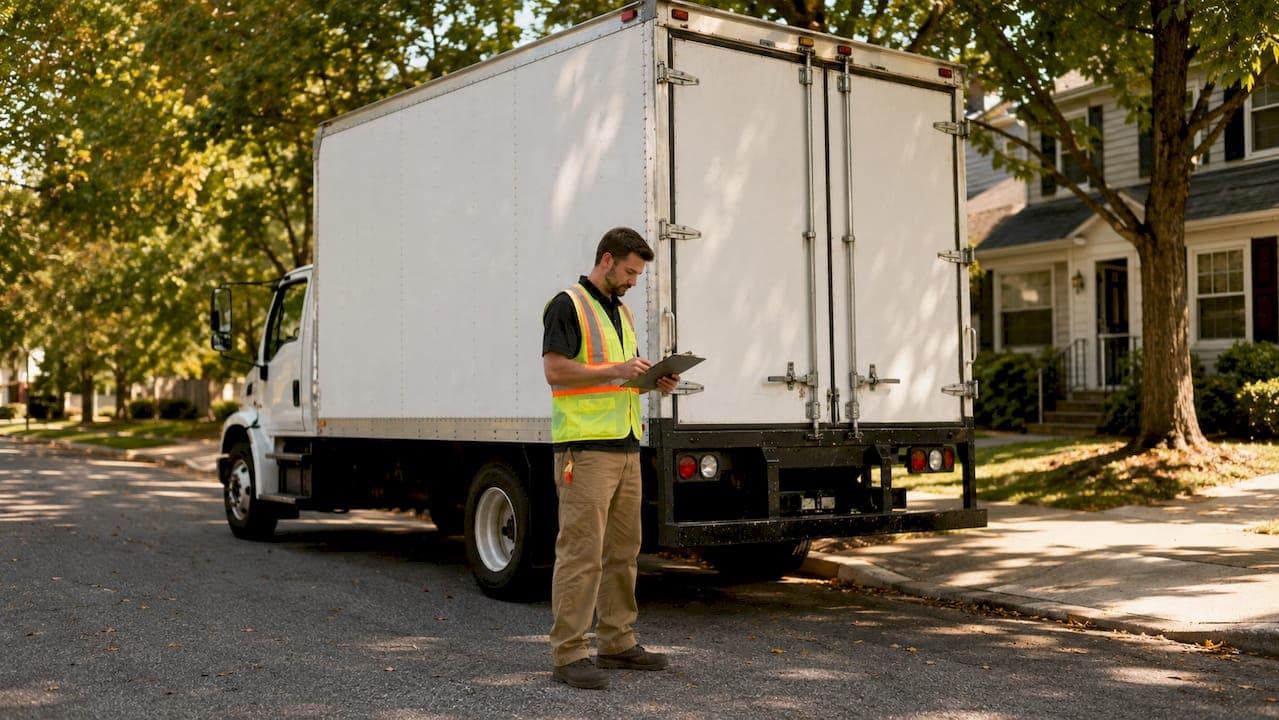
A box truck is an enclosed cargo vehicle with a permanent cargo box mounted on a chassis, used widely for local delivery, moving services, and last-mile logistics. The types of box trucks range from compact 10-foot units suited for urban runs to full-size 26-foot models built for commercial freight. Understanding the differences in length, weight class, and configuration is the fastest way to match the right vehicle to your operation. This guide covers every major classification so you can make a confident purchase decision.
1. Types of box trucks by size and weight class
Standard box trucks range from 10 to 26 feet in length and fall within Class 3 to Class 7, with GVWRs spanning 12,500 to 33,000 lbs. That range covers everything from a single-person delivery route to a full commercial freight operation. Choosing the wrong size class is the most common and most costly mistake buyers make.
Small box trucks (10–16 feet)
Small box trucks carry light loads and work best in dense urban environments. Their compact footprint fits standard parking spaces and narrow loading docks. Typical GVWR sits between 12,500 and 19,500 lbs, placing them in Class 3 and Class 4. Florists, courier services, and small appliance delivery companies favor this size.

Medium box trucks (17–24 feet)
Medium box trucks handle mid-size cargo and regional freight routes. GVWR typically falls between 19,501 and 26,000 lbs, covering Class 5 and Class 6. This size is the most popular choice for furniture delivery, catering supply runs, and retail restocking. The 24-foot version offers the most cargo volume without requiring a commercial driver's license in most states.
Large box trucks (26 feet)
The 26-foot box truck is the largest single-unit box truck available without a trailer. GVWR reaches up to 33,000 lbs in Class 7. Moving companies, wholesale distributors, and large-scale retail operations rely on this size for high-volume loads. The tradeoff is reduced maneuverability in tight urban areas.
| Size Class | Length | GVWR Range | Common Uses |
|---|---|---|---|
| Small | 10–16 ft | 12,500–19,500 lbs | Urban delivery, courier, florist |
| Medium | 17–24 ft | 19,501–26,000 lbs | Furniture, catering, retail |
| Large | 26 ft | Up to 33,000 lbs | Moving, wholesale, commercial freight |
Pro Tip: If your routes stay within city limits and involve frequent stops, a 16-foot or 20-foot truck will save you more in fuel and parking costs than the extra cargo space of a 26-footer ever will.
2. Specialized configurations and box truck options
Primary box truck types include standard dry cargo, refrigerated (reefer), and customized specialty builds. Each configuration serves a distinct operational need. Buying the wrong configuration forces expensive retrofits later.
Refrigerated (reefer) box trucks
Refrigerated box trucks maintain controlled temperatures for perishable goods such as food, pharmaceuticals, and flowers. The refrigeration unit adds weight, which reduces effective payload. Operators running grocery delivery or medical supply routes treat this configuration as non-negotiable.
Liftgate-equipped box trucks
Liftgate selection is critical: the type and size must match truck dimensions to avoid operational inefficiencies. The two most common liftgate styles are tuck-under and railgate. A tuck-under liftgate folds beneath the truck bed when not in use, preserving ground clearance. A railgate offers a larger platform and higher weight capacity, making it the better choice for heavy appliances or palletized freight.
Pro Tip: Always verify the liftgate's rated weight capacity against your heaviest single load before purchasing. A liftgate rated for 1,500 lbs will bottleneck any operation that regularly moves 2,000-lb pallets.
Cab-over versus conventional cab
Cab type impacts maneuverability: cab-over designs allow tighter turning for urban routes, while conventional cabs offer better comfort and serviceability. Cab-over trucks place the driver directly above the front axle, shortening the overall vehicle length and improving sight lines in tight spaces. Conventional cabs extend forward of the front axle, giving the driver more crash protection and a smoother ride on highway routes.
Custom and specialty builds
Custom box trucks add shelving, interior lighting, ramps, or full workshop fit-outs to serve niche industries. Mobile tool distributors, utility crews, and trade show operators commonly order these builds. The key consideration is whether the added equipment weight stays within the truck's GVWR limit.
3. Box trucks versus alternative commercial vehicles
Box trucks combine a chassis cab and permanent cargo box, which separates them from cargo vans and semi-trailers in both design and operation. Cargo vans use a unibody construction with no separation between cab and cargo area. Semi-trailers use a detachable trailer pulled by a separate tractor unit. Knowing these differences prevents buyers from purchasing a vehicle that cannot legally or practically handle their load requirements.
Box trucks versus cargo vans
Box trucks offer significantly more cargo volume and weather protection than cargo vans. A standard cargo van tops out around 250–300 cubic feet of cargo space. A 16-foot box truck delivers roughly 800–1,000 cubic feet. For organized, weather-protected freight, box trucks are the clear choice over cargo vans.
Box trucks versus tractor-trailers
Box trucks are preferred for last-mile and local deliveries due to their maneuverability and enclosed cargo protection. Tractor-trailers require more space to turn, cannot access many urban loading docks, and carry higher operating costs. For routes under 200 miles with multiple stops, a box truck outperforms a tractor-trailer on cost and practicality.
| Vehicle Type | Cargo Volume | Maneuverability | Best Use Case |
|---|---|---|---|
| Cargo Van | Low (250–300 cu ft) | High | Small parcels, tight urban routes |
| Box Truck | Medium to High (800–2,000+ cu ft) | Medium | Local delivery, moving, freight |
| Tractor-Trailer | Very High | Low | Long-haul, high-volume freight |
4. How to choose the right box truck for your needs
Selecting the right box truck starts with two numbers: your maximum payload weight and your required cargo volume. Every other decision flows from those two figures. Buyers who skip this step routinely purchase trucks that are either too small for their loads or too large for their routes.
Assess GVWR and CDL requirements
Box trucks under 26,000 lbs GVWR often do not require a CDL, which lowers the barrier for owner-operators and small businesses. If your operation can stay within that threshold, you open your driver pool significantly. Crossing into Class 7 territory above 26,000 lbs GVWR triggers CDL requirements in most states.
Match cab style to your route profile
Cab-over trucks suit dense city routes where turning radius matters most. Conventional cabs suit highway-heavy routes where driver comfort and serviceability reduce long-term costs. Choosing the wrong cab style for your primary route type adds fatigue and operating costs over time.
Account for equipment weight in payload calculations
Payload capacity is affected by the weight of the box and equipment, not just cargo weight. A liftgate, refrigeration unit, or interior shelving system all count against your GVWR. Longer boxes often carry lower effective payloads despite their larger volume because the box itself weighs more.
Evaluate customization potential
Fleet managers prioritize chassis customization potential, rear door styles, and liftgate configuration as key factors in loading efficiency. A truck that accepts modular shelving or a custom ramp system gives your operation more flexibility as your cargo mix changes. Buying a truck with a fixed interior that cannot be reconfigured limits your long-term options.
Pro Tip: Request the truck's curb weight and subtract it from the GVWR before you calculate payload. That number, not the advertised "cargo capacity," is what you can actually load.
Key takeaways
The most effective box truck selection matches vehicle size, cab type, and cargo configuration directly to your route profile and payload requirements.
| Point | Details |
|---|---|
| Size drives use case | Match truck length and GVWR class to your actual cargo volume and weight needs. |
| CDL threshold matters | Trucks under 26,000 lbs GVWR typically do not require a CDL, expanding your driver options. |
| Liftgate fit is critical | Mismatched liftgates cause loading delays; verify rated capacity against your heaviest load. |
| Cab type affects route efficiency | Cab-over designs suit urban routes; conventional cabs suit highway and long-distance runs. |
| Equipment weight reduces payload | Liftgates, refrigeration units, and shelving all count against GVWR before cargo is loaded. |
What I've learned from watching buyers get box trucks wrong
Most buyers walk into a box truck purchase focused on the wrong number. They ask about cargo volume first and payload capacity second. That order gets people into trouble fast.
The real mistake I see repeatedly is buying a 26-foot truck because it holds the most. Then the buyer adds a liftgate, a refrigeration unit, and interior shelving. By the time the truck is configured, the effective payload has dropped well below what a 22-foot truck with no extras would have delivered. The larger box costs more to fuel, harder to park, and the driver needs more experience to handle it safely in city traffic.
The second mistake is ignoring the CDL question until after the purchase. A truck that crosses the 26,000-lb GVWR threshold changes your hiring requirements overnight. If you run a small operation and your drivers do not hold CDLs, that single oversight can shut down your route.
My honest recommendation: start with your heaviest single load and your tightest delivery location. Build your truck selection around those two constraints. Everything else, including volume, cab comfort, and customization, is secondary to those two factors. The right truck for a dense urban pharmacy route looks nothing like the right truck for a regional furniture delivery operation, even if both buyers think they need "a medium box truck."
— Dave
Find your next box truck on Sostruckforsale
Sostruckforsale lists a wide selection of commercial box trucks for sale, from compact 16-foot units to full-size 26-foot models ready for delivery operations. Whether you need a refrigerated build, a liftgate-equipped truck, or a standard dry cargo unit, the listings cover multiple configurations and price points.
Browse the current inventory at Sostruckforsale to compare models, specifications, and seller contact details in one place. New listings are added regularly, so checking back frequently gives you the best chance of finding the right truck at the right price. Contact sellers directly through the platform to ask about configuration details, maintenance history, and availability.
FAQ
What is a box truck?
A box truck is an enclosed cargo vehicle with a permanent cargo box mounted on a chassis. It differs from cargo vans and semi-trailers in that the box is fixed to the truck frame as a single unit.
What are the standard box truck sizes?
Box trucks range from 10 to 26 feet in length, with GVWRs from 12,500 to 33,000 lbs across Class 3 to Class 7. The most common sizes for commercial delivery are 16, 20, 22, and 26 feet.
Do box trucks require a CDL?
Box trucks under 26,000 lbs GVWR typically do not require a CDL in most states. Trucks above that threshold, including most Class 7 models, require a commercial driver's license.
What is a refrigerated box truck used for?
A refrigerated box truck, also called a reefer truck, maintains controlled temperatures for perishable cargo such as food, pharmaceuticals, and flowers. The refrigeration unit adds weight, which reduces the truck's effective payload capacity.
How does cab type affect box truck performance?
Cab-over box trucks offer a tighter turning radius, making them better suited for dense urban delivery routes. Conventional cab models provide better driver comfort and easier engine access, which suits highway routes and long-distance operations.