
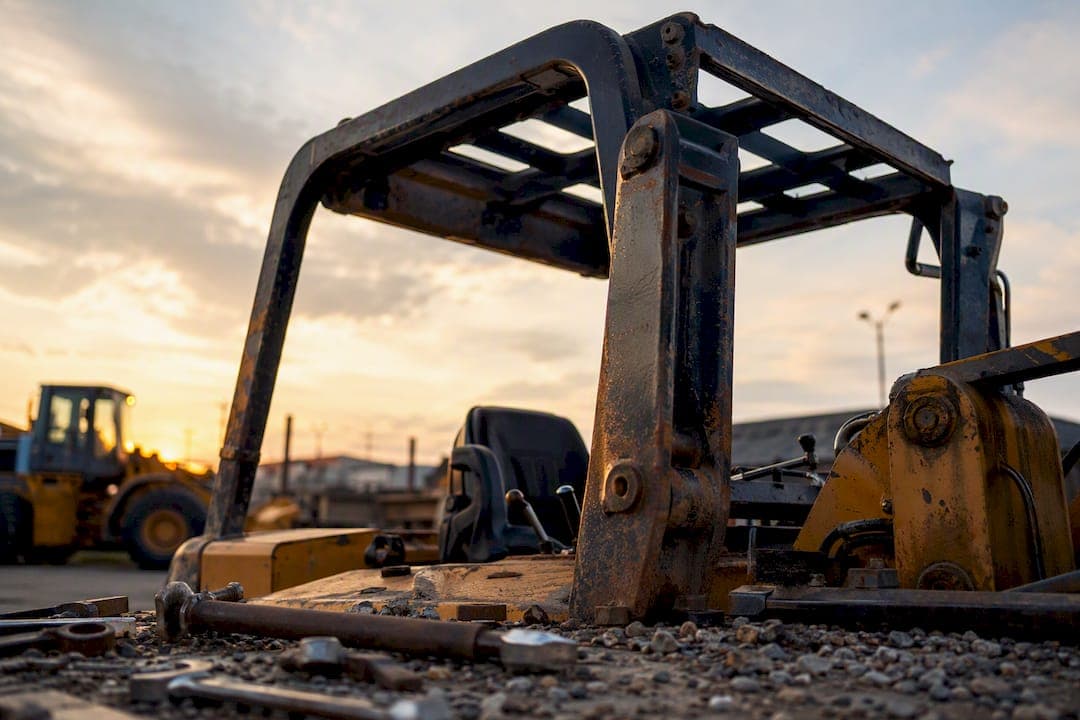
ROPS stands for Roll-Over Protective Structure, an engineered frame or cab built onto tractors, loaders, and other heavy equipment to protect the operator if the machine tips over. The critical fact every buyer and operator needs to remember: a ROPS does not prevent a rollover from happening. It creates a survival zone around the operator during one. According to Ohioline's operator safety guidance, a ROPS combined with a seatbelt is 99.9% effective at preventing death or serious injury in a tractor overturn. Sostruckforsale put this guide together because that distinction, protection versus prevention, changes how you should evaluate any used machine.
- ROPS = Roll-Over Protective Structure, certified to SAE and OSHA performance standards
- Effectiveness depends on the seatbelt being worn every time
- A ROPS without a fastened seatbelt is an incomplete safety system
Key Takeaways
A certified ROPS paired with a fastened seatbelt is the single most effective defense against death or serious injury during equipment rollovers.
| Point | Details |
|---|---|
| ROPS protects, doesn't prevent | The structure creates a survival zone during a rollover but cannot stop the tip over itself. |
| Seatbelt is mandatory | Without a fastened seatbelt, an operator can be thrown clear of the ROPS survival zone. |
| Check the label | A genuine ROPS has a permanently affixed plate matching the machine's make, model, and serial number. |
| Recertify after incidents | Any rollover or abnormal loading requires recertification by the manufacturer or a qualified engineer. |
| Know your equipment's age | Machines built before the 1960s to 1980s window often lack factory ROPS entirely. |
Table of Contents
- How Does a ROPS Protect an Operator During a Rollover?
- What Are the Common Types of ROPS?
- ROPS vs. Roll Bar vs. FOPS: What's the Difference?
- When Are ROPS Required by Law?
- How Do You Maintain and Recertify a ROPS?
- What Won't a ROPS Do, and What Should Operators Do Instead?
- How Do You Identify a Certified ROPS on a Machine?
- What Do People Get Wrong About ROPS?
- Why This Matters When You're Buying or Selling Equipment
- Frequently Asked Questions
- Sources
How Does a ROPS Protect an Operator During a Rollover?
A ROPS works by creating a survival zone, a defined space around the operator's seat that the structure is engineered to keep clear even as the rest of the machine collapses or rotates onto its side or roof. The frame absorbs and redirects the energy of the tip over, carrying the load through its posts into the chassis rather than letting the weight crush down onto the operator.
Picture the machine rolling: the frame's posts hit the ground first, the roof or crossbar spans the gap above the seat, and the operator's body stays inside that spanned pocket instead of being pinned underneath the cab or frame rail.
The main jobs a ROPS performs during an overturn:
- Prevents the cab or frame from crushing down onto the operator
- Preserves a defined survival space even as the machine continues to roll
- Reduces intrusion from the ground, tree limbs, or nearby structures
Pro Tip: A ROPS only protects what stays inside its survival zone. If you're not belted in, momentum can throw you outside that zone in the first half second of a rollover, which is exactly why Penn State Extension treats the seatbelt as part of the structure itself, not an accessory.
What Are the Common Types of ROPS?
Most certified ROPS fall into a few recognizable designs, and knowing them helps you spot the right structure on a listing or a lot.
- Two-post frame: the simplest design, common on smaller utility tractors and compact loaders
- Four-post frame: adds lateral stability and is typical on mid-size and larger tractors
- Folding or low-clearance ROPS: hinges down for orchard work, low barn doors, or overhead obstructions, then locks upright during field operation
- Rollover protective enclosure (cab): a fully enclosed cab that adds weather protection and comfort but only counts as a ROPS if it carries its own certification
Ohioline's trainer guidance groups these into essentially three engineering categories: open frames (two or four post), folding frames for tight clearance, and enclosed protective structures. Factory-installed ROPS and retrofit kits are not interchangeable. Some implements and attachments are flatly incompatible with certain ROPS geometries, which is worth confirming before you pair a machine with new equipment.
ROPS vs. Roll Bar vs. FOPS: What's the Difference?
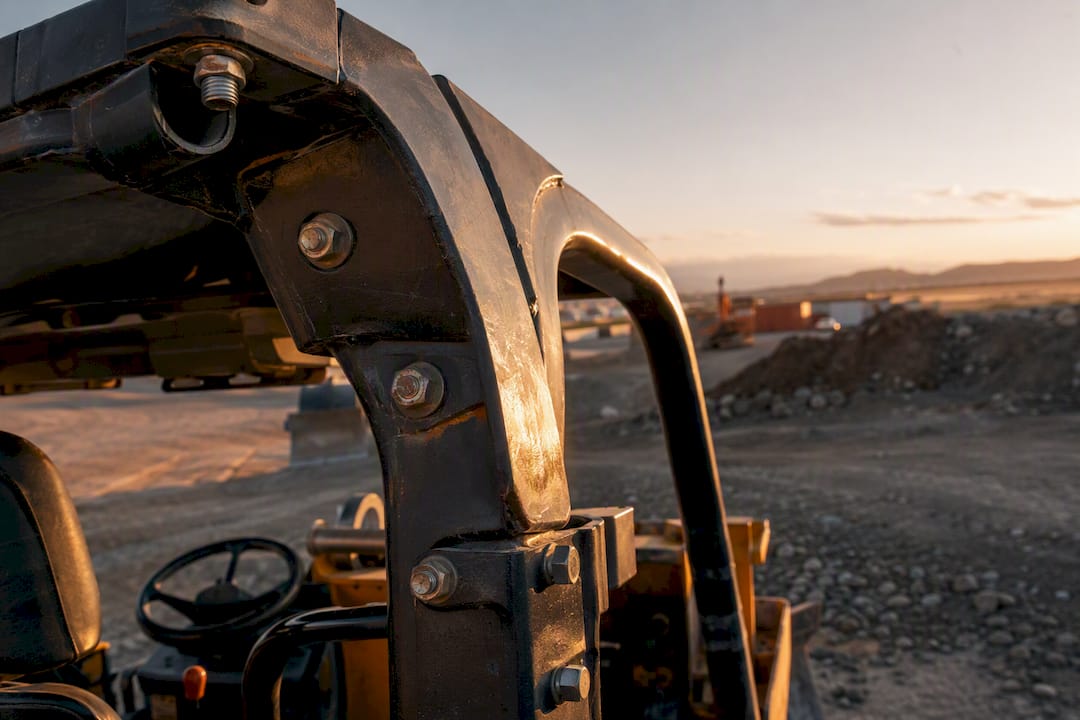
People use "roll bar" and "ROPS" interchangeably, but they are not the same thing. A roll bar is a physical shape, a hoop or frame. ROPS is a certified performance category. A roll bar only counts as a ROPS once it has been engineered, tested, and labeled to SAE and OSHA standards, according to Ohioline. FOPS (Falling Object Protective Structure) is a different animal entirely: it guards against objects dropping from above, not tip overs.
| Feature | Roll Bar (generic) | Certified ROPS | FOPS |
|---|---|---|---|
| Definition | Any hoop-style frame | Tested, labeled protective structure | Tested overhead protection |
| Primary threat addressed | None guaranteed | Rollover / overturn | Falling debris or objects |
| Common equipment | Aftermarket, uncertified builds | Tractors, loaders, skid steers | Forestry machines, demolition loaders |
Machines working under tree canopies or handling overhead material, log skidders, some wheel loaders, frequently need both ROPS and FOPS certification stacked on the same cab.
When Are ROPS Required by Law?
Federal rules set the floor here, and they vary by equipment category. OSHA's 1928.51 standard requires ROPS and seatbelts on agricultural tractors over 20 engine horsepower when operated by employees, and it references specific test and performance requirements the structure must meet. Surface mining and related heavy equipment fall under a separate rule: 30 CFR §57.14130 requires ROPS and seatbelts on listed categories of surface equipment and points directly to SAE test and performance publications for construction standards. OSHA's Federal Register interpretations add further guidance on how these performance requirements apply across different machine classes.
A genuine certification label matters more than appearance. Look for:
- A permanently affixed plate or tag, not a sticker that could be swapped
- Manufacturer name and model number matching the machine it's mounted on
- Reference to the SAE or OSHA standard the structure was tested against
Here's useful context if you're shopping older iron: ROPS became standard equipment across most tractor and heavy equipment lines roughly between the 1960s and 1980s. A machine built before that window may have no ROPS at all, and no factory retrofit path either, which directly affects resale value and safe usability today.
How Do You Maintain and Recertify a ROPS?
Treat ROPS inspection like you'd treat brakes: routine, not optional. A quick field check should cover:
- Mounting bolts and bracket integrity, no looseness or missing hardware
- Visible cracks, bending, or deformation anywhere on the frame
- Weld condition at every structural joint
- Certification label still attached and legible
- Seatbelt webbing, buckle, and anchor points in good condition
Recertification becomes mandatory after a rollover or any abnormal structural loading, and it has to be done by the original manufacturer or a registered professional engineer experienced in ROPS design, per 30 CFR §57.14130. Cutting, drilling, or welding on a factory ROPS without authorization is a hard no. Penn State Extension notes these modifications can materially reduce protective performance, even when they look structurally harmless.
Pro Tip: Keep inspection dates and any recertification paperwork stored with the machine's other records. A buyer down the road will want to see that history, and so will you if the equipment ever gets inspected on a jobsite.
What Won't a ROPS Do, and What Should Operators Do Instead?
A ROPS will not stop a machine from tipping in the first place, and it cannot protect an operator who gets thrown clear of its survival zone. Those two limits should shape how you operate on a slope or uneven ground, not just how you shop for equipment.
Concrete habits that actually matter:
- Wear the seatbelt every single time, no exceptions for "quick" jobs
- Slow down on grades and reduce speed before you need to
- Avoid sharp turns on side slopes or soft, uneven terrain
- Only use ROPS-compatible implements, mismatched attachments can shift the center of gravity
The 99.9% effectiveness figure from Ohioline's ROPS research only holds when the seatbelt is fastened. Skip the belt, and you're relying on the structure alone to save you, which it was never designed to do by itself.
How Do You Identify a Certified ROPS on a Machine?
Before you buy or operate anything with a rollover risk, run this quick check:
- Find the certification plate, it should be riveted or bolted on permanently, not a peel-off decal
- Confirm the make, model, and serial number on the plate match the machine itself
- Check for a manufacturer-supplied seatbelt anchored to the ROPS structure, not the seat pan alone
- Inspect mounting hardware for the correct, unmodified bolts
A legitimate label typically lists the manufacturer name, the SAE or OSHA standard referenced, and model fitment details confirming which machines the structure was tested for. If the label is missing or illegible, contact the manufacturer or a dealer directly. University of Illinois Extension recommends checking for an available retrofit kit rather than continuing to operate a tractor with no ROPS at all.
What Do People Get Wrong About ROPS?
The biggest misconception is treating ROPS as rollover insurance. It isn't. Safety guidance is consistent on this point: the structure manages what happens after a tip over begins, it does nothing to stop the tipping itself.
Two more corrections worth remembering: a ROPS without a fastened seatbelt is incomplete protection, since the operator can be thrown clear of the survival zone entirely, per Penn State Extension. And not every enclosed cab qualifies as a ROPS. Plenty of older comfort cabs were built for weather protection alone, with no rollover certification behind them, according to Cabs ROPS & Attachments. A ROPS is engineered for the specific weight and dynamics of one machine, which is why a mismatched or homemade structure can fail exactly when it's needed most.
Why This Matters When You're Buying or Selling Equipment
I've spent enough time around used equipment lots to know that a missing or unverifiable ROPS label gets glossed over more than it should. It's not a cosmetic detail, it's a structural safety claim. When you're listing or shopping equipment on Sostruckforsale, treat ROPS certification the same way you'd treat a clean title: confirm it, document it, don't assume it.
Frequently Asked Questions
What does ROPS mean on equipment? ROPS stands for Roll-Over Protective Structure, a certified frame or enclosure engineered to protect the operator if a machine tips over.
Does a ROPS stop a machine from rolling over? No. A ROPS manages what happens during a rollover by preserving a survival zone. It does not prevent the tip over from occurring.
Is a roll bar the same as a ROPS? Not automatically. A roll bar is a physical shape, while ROPS refers specifically to a certified structure tested and labeled to SAE and OSHA standards.
Do all tractors legally require ROPS? Under OSHA 1928.51, agricultural tractors over 20 engine horsepower operated by employees must have ROPS and seatbelts. Requirements for surface mining equipment fall under separate federal rules.
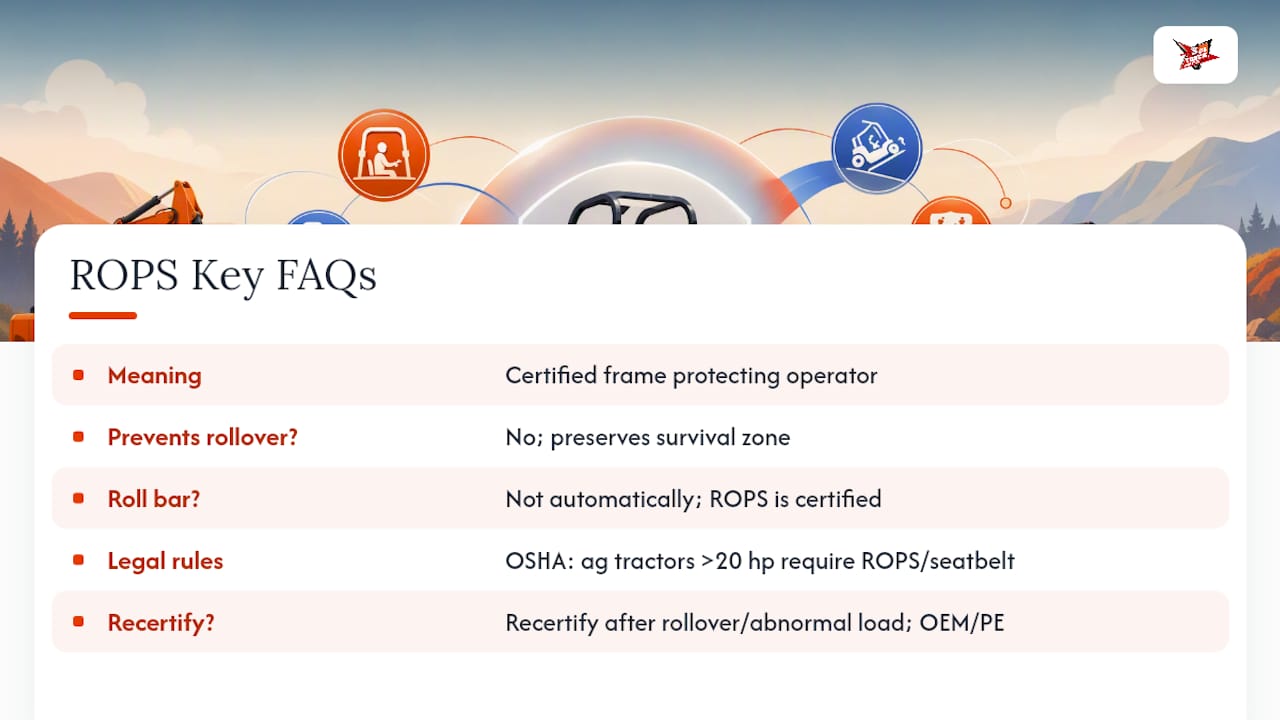
How do I know if my ROPS needs recertification? Recertification is required after any rollover or abnormal structural loading, and must be performed by the manufacturer or a registered professional engineer.
Sources
- Rollovers and Rollover Protective Structures (ROPS) for Trainers and Supervisors | Ohioline
- Rollover Protection for Farm Tractor Operators
- 1928.51 - Roll-over protective structures (ROPS) for tractors used in agricultural operations. | Occupational Safety and Health Administration
- 30 CFR § 57.14130 - Roll-over protective structures (ROPS) and seat belts for surface equipment. | Electronic Code of Federal Regulations (e-CFR) | US Law | LII / Legal Information Institute