A truck spec sheet is a formal document that records every major technical and functional detail about a specific truck. It tells you the engine model, horsepower, torque rating, transmission type, drive configuration, payload capacity, gross vehicle weight rating (GVWR), fuel system, and body dimensions. Experienced owner-operators know that year, make, and mileage tell you almost nothing about whether a truck will earn money. The spec sheet does.
Here is what a typical truck spec sheet covers at a glance:
- Engine model and displacement — identifies the power unit and its cubic capacity
- Rated horsepower and torque — defines the truck's performance envelope
- Transmission type — manual, automated manual (AMT), or automatic
- Drive system — 4x2, 6x4, or other axle configurations
- Maximum payload and GVWR — the legal and structural load limits
- Fuel type and tank capacity — diesel, CNG, or electric, plus total fuel range
- Body type and dimensions — cab style, wheelbase, and overall length
What are the key sections on a truck spec sheet?
Every truck spec sheet follows a recognizable structure. Knowing which sections carry the most weight helps you move through the document without getting lost in secondary details.
- Model code — a manufacturer's alphanumeric string that encodes cab type, chassis class, and engine family. A Freightliner Cascadia model code, for example, tells a trained reader the GVW class and cab configuration before any other line is read.
- Engine model and displacement — lists the engine family (e.g., Detroit DD15, Cummins X15) and displacement in liters. Displacement alone does not define performance; always cross-reference with rated horsepower and torque figures.
- Transmission type — specifies whether the truck runs a manual, AMT, or fully automatic unit. Automated manual transmissions dominate the modern market because they deliver better fuel economy and reduce driver fatigue.
- Drive system — the axle configuration (4x2 for standard highway, 6x4 for heavy haul or off-road). This directly affects traction, payload distribution, and tire wear.
- Maximum payload and GVWR — payload, GVWR, and towing capacity are the variables that confirm whether a truck matches your duty cycle. Never skip these lines.
- Fuel type and tank capacity — combined tank capacity determines route flexibility. Larger dual tanks reduce planned fuel stops on long hauls.
- Body type and dimensions — cab style (day cab vs. sleeper), overall length, and height. Wheelbase affects fifth-wheel placement, turning radius, and yard maneuverability.
- Rear axle ratio — the axle ratio controls the relationship between engine RPM and road speed. A numerically low ratio (e.g., 2.47) favors fuel economy on flat highway runs; a high ratio (e.g., 3.91) favors pulling power for vocational or heavy-haul work.
What optional details can you find on a spec sheet?
Beyond the core fields, many spec sheets include secondary details that sharpen your picture of the truck's real-world fit. These are not always present, but when they are, they add genuine value.
- Suspension type — air ride is standard on most sleepers and preferred for general freight. Spring or walking-beam rear suspension appears on vocational trucks where durability outweighs ride quality.
- Tire and rim specifications — tire size, load rating, and rim material (aluminum vs. steel). Check the date code on tires, not just tread depth; tires older than six years are approaching the end of their safe service life regardless of remaining rubber.
- Sleeper configuration — bunk dimensions, headroom, inverter wattage, and climate control matter for over-the-road operators. A 72-inch sleeper is a working bedroom; a 60-inch is a rest stop.
- Electrical system details — total alternator output and auxiliary power provisions. Work trucks with liftgates, refrigeration units, or tool power draws need sufficient electrical capacity listed on the sheet.
- Emission control systems — DPF (diesel particulate filter) and SCR (selective catalytic reduction) configurations affect maintenance schedules and operating costs in emissions-regulated states.
- Special upfits or body modifications — any factory or post-factory additions such as crane mounts, utility bodies, or fifth-wheel hitches. Effective spec sheets remove ambiguity by clearly defining electrical needs, corrosion exposure, and service access requirements for upfitters.
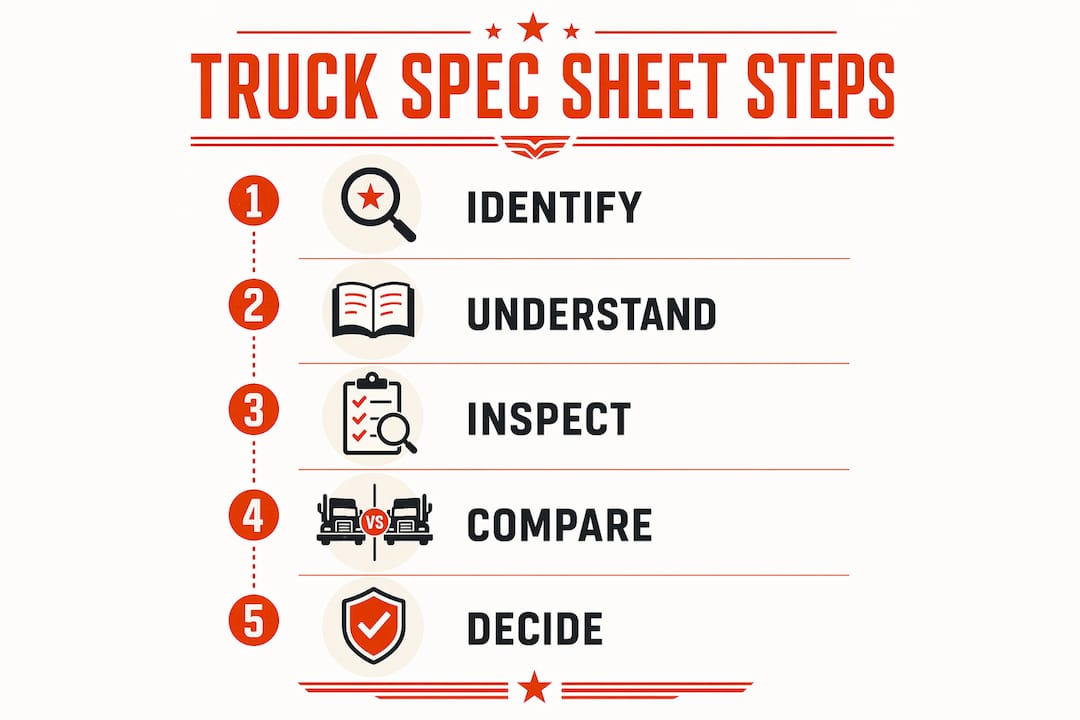
How do you read and use a truck spec sheet effectively?
Reading a spec sheet is a skill. The numbers only mean something when you hold them against the actual work the truck will do.
- Match specs to your duty cycle first. A truck spec'd for light highway work will struggle on heavy haul routes, and a vocational spec wastes fuel on flat interstate runs. Define your typical load weight, terrain, and stop frequency before opening the sheet.
- Verify specs against physical tags. Post-factory modifications can make spec sheet data outdated. Check the differential gear tag and match the VIN against OEM dealer records to confirm what is actually installed.
- Check transmission service history on used AMTs. Clutch wear is a real cost on automated manual units. Verify software is current and ask for clutch replacement records on high-mileage trucks.
- Avoid over-spec'ing and under-spec'ing. The right spec balances fuel efficiency, torque, and payload to minimize lifecycle costs. Over-spec'ing wastes capital upfront; under-spec'ing drives up maintenance costs and downtime.
- Talk to drivers and technicians. Spec'ing a truck requires dialogue with the people who operate and maintain it. Their input on real-world conditions catches mismatches that a document review alone will miss. For fleet managers, this step is especially critical when evaluating trucks for specialized or construction-related duty cycles.
- Cross-reference wheelbase with your yard and routes. A long wheelbase suits highway efficiency but creates problems in tight loading docks or urban delivery environments.
Pro Tip: The spec sheet does not reveal mechanical history or accident damage. Always inspect the cab interior. A clean dash, organized sleeper, and intact trim usually signal a careful operator. A neglected cab often points to neglected maintenance.
Why does understanding truck specs matter for your bottom line?
Getting the spec right is a financial decision, not just a technical one. A mismatched truck costs money every week it runs.
- Fuel efficiency depends on correct gearing and powertrain spec. A truck with the wrong axle ratio for its route burns excess fuel on every load. Over a full operating year, that gap compounds into a measurable cost difference.
- Downtime is directly tied to spec accuracy. Under-spec'd trucks work harder than they were built to, accelerating wear on the engine, transmission, and drivetrain. A truck in the shop earns nothing.
- Resale value tracks with spec desirability. AMT-equipped trucks with highway-optimized specs hold stronger resale value in the current used market than manual or vocational-spec units in general freight applications.
- Correct spec'ing aligns the truck with fleet operational realities. Matching specs to actual business needs requires collaboration among fleet managers, drivers, and technicians. That alignment reduces both unplanned repairs and driver turnover from fatigue or discomfort.
- Over-spec'ing is an immediate capital loss. Paying for a 505-horsepower engine when a 455-horsepower unit handles the route means spending more on the purchase price, more on fuel, and more on heavier drivetrain components, with no operational return. For construction fleets evaluating compliance documentation, spec accuracy also affects regulatory and insurance requirements.
The spec sheet is where the buying decision actually starts. A truck that matches its spec to its work earns money. One that does not loses it slowly, week by week.
Key Takeaways
A truck spec sheet is the single most reliable document for evaluating whether a truck will perform profitably in its intended role.

| Point | Details |
|---|---|
| Spec sheet defines the truck | It records engine, transmission, payload, GVWR, fuel system, and dimensions in one document. |
| Axle ratio affects fuel cost | A mismatched rear axle ratio wastes fuel on every run, compounding costs over a full operating year. |
| Verify specs physically | Post-factory modifications can make spec sheet data outdated; always check component tags and VIN records. |
| Spec accuracy reduces downtime | Under-spec'd trucks wear faster; over-spec'd trucks waste capital. The right spec minimizes lifecycle costs. |
| Inspect beyond the document | The spec sheet does not reveal maintenance history; a physical cab inspection fills that gap. |
Browse current listings of semi trucks for sale on Sostruckforsale and filter by the specs that match your operation.