

A bill of sale is a written legal document that records the transfer of ownership of an item from a seller to a buyer. It works for a private car sale, a used excavator changing hands between contractors, or a boat sold between neighbors. A solid bill of sale should always include:
- The buyer's and seller's full names
- A description of the item (with VIN or serial number for equipment)
- The sale price and date
- Both parties' signatures
Key Takeaways
A bill of sale legally protects both parties only when it includes exact item identification, price, date, and signatures, matched against the title and any lien records.
| Point | Details |
|---|---|
| Match the VIN exactly | A mismatched serial number is one of the most common causes of registration rejection. |
| Use "as-is" language carefully | Disclose known defects specifically instead of relying on vague boilerplate wording. |
| Check state notary rules | Some DMVs reject unnotarized bills of sale, delaying registration for weeks. |
| Keep signed copies | Both buyer and seller should retain a copy for tax, insurance, and dispute purposes. |
| Verify liens before paying | Run a lien check on high-value vehicles and equipment before finalizing payment. |
Where to Learn More
- Cornell Law's overview of bill of sale law for legal definitions and terminology
- FindLaw's drafting guide for step-by-step writing help
- Your state DMV or official state website for vehicle-specific forms and notarization rules
Table of Contents
- What Is a Bill of Sale Used for, and When Do You Need One?
- What Does a Bill of Sale Include?
- What Types of Bills of Sale Exist?
- How Do You Write a Bill of Sale?
- Does Every State Require the Same Bill of Sale Rules?
- How Do "As-Is" Clauses and Warranties Affect Liability?
- Bill of Sale vs. Receipt vs. Title: What's the Difference?
- What Extra Steps Apply to Heavy Equipment and Commercial Vehicle Sales?
- Who Keeps the Bill of Sale, and What Happens Next?
- Ready to List or Find Heavy Equipment?
- Frequently Asked Questions
- Sources
What Is a Bill of Sale Used for, and When Do You Need One?
You need a bill of sale any time personal property changes hands outside a dealership, especially vehicles, boats, ATVs, heavy equipment, or livestock. Many state DMVs require one to complete title transfer or registration, and without it, a buyer can get stuck at the counter with no proof of purchase.
Beyond paperwork, a bill of sale protects both parties from future disputes. Sellers get documented proof they gave up ownership and liability. Buyers get a record that shows what they paid and what they were promised.
- Private sale of a car, truck, trailer, or motorcycle
- Transfer of heavy equipment, boats, or ATVs between individuals
- Sale of large animals, valuable tools, or collectibles where no formal title exists
Pro Tip: Even when your state doesn't require a bill of sale for registration, write one anyway. It's the cheapest insurance you'll ever buy against a "we never agreed to that" argument six months later.
What Does a Bill of Sale Include?
A usable bill of sale doesn't need a lawyer, but it does need specific fields. Leave one out and you risk a rejected registration or a dispute with no paper trail to back you up.
Required fields:
- Full legal names and contact information for buyer and seller
- Exact description of the item, including VIN or serial number for vehicles and equipment
- Sale price and date of transfer
- Payment terms (cash, check, financing)
- Signatures from both parties
Recommended additions:
- Odometer reading for vehicles
- "As-is" or warranty language
- Witness or notary lines
- A statement confirming no outstanding liens
A short template covers this in one paragraph: "This bill of sale confirms that [seller name] sold to [buyer name] one [item description, VIN/serial] for $[price] on [date], paid via [method], sold as-is with no warranties expressed or implied, [witness/notary line]."
What Types of Bills of Sale Exist?
Not every bill of sale works the same way legally. The two primary categories are absolute and conditional. An absolute bill of sale transfers ownership outright, with no strings attached. It's the standard form for most private vehicle and equipment sales.
A conditional bill of sale is different: ownership transfers only after certain terms are met, often payment installments. In some legal systems, a conditional bill of sale functions similarly to a chattel mortgage, giving the seller a security interest until the buyer pays in full.
- Absolute: unconditional, immediate transfer of ownership
- Conditional: transfer tied to a condition, often creating a security interest
- Quitclaim or vehicle-specific forms: state-issued templates for DMV registration
- "As-is" vs. warranty: language that determines whether the seller remains liable after the sale
How Do You Write a Bill of Sale?
Drafting one takes three steps and about ten minutes once you have the details in hand.
- Gather identifying information. Full names, addresses, phone numbers, and for vehicles or equipment, the VIN or serial number, plus odometer or engine hours.
- State the sale terms. Price, payment method, date, and any conditions, warranties, or "as-is" language.
- Add signatures and store copies. Include witness or notary lines if your state requires them, then keep signed copies for both parties.
Here's a compact template you can copy directly:
"On [date], [seller name] sold to [buyer name] the following: [item description, year, make, model, VIN/serial]. Sale price: $[amount], paid via [method]. Item sold as-is / with the following warranty: [details]. Odometer reading: [number]. Seller signature: __________ Buyer signature: __________ Witness/Notary: __________"
Fill in the blanks, print two copies, sign both, and you're done.
Does Every State Require the Same Bill of Sale Rules?
No, and this trips up a lot of first-time sellers. Some states require a bill of sale before a DMV will process title transfer or registration. Others treat it as optional, though still strongly recommended for the paper trail alone.
Notarization rules vary too. Skipping a required notary signature can mean the buyer gets turned away at registration and has to track the seller down to redo the paperwork weeks later.
- Check your state DMV or official state website before finalizing the sale
- Confirm whether witness or notary signatures are mandatory for your item type
- Bring the signed bill of sale, title, and ID to registration to avoid delays
Pro Tip: Call your local DMV office before the sale, not after. A five-minute phone call beats driving back home to get a signature notarized.
How Do "As-Is" Clauses and Warranties Affect Liability?
An "as-is" clause means the buyer accepts the item in its current condition and gives up the right to demand repairs or refunds later. It's standard practice for used vehicles and heavy equipment, where "no surprises" isn't realistic.
A seller's warranty or written representation works the opposite way. It creates ongoing liability. If you tell a buyer the transmission was rebuilt last year and it wasn't, that statement can come back on you even with an "as-is" clause elsewhere in the document.
Vague language is the real risk here. A bill of sale that just says "sold as-is" without noting known defects leaves both sides guessing what was actually disclosed at the time of sale.
Document known issues specifically. "Sold as-is, seller discloses a cracked windshield and 40,000 miles until next service" protects you far better than silence.
Bill of Sale vs. Receipt vs. Title: What's the Difference?
These three documents get confused constantly, but they serve different legal functions.
| Document | Purpose |
|---|---|
| Receipt | Proof of payment only; usually brief with no item detail |
| Bill of sale | Private contract confirming transfer of ownership, with item description and terms |
| Title | Government-issued certificate of ownership, required for most vehicle registrations |
A receipt records payment while a bill of sale establishes transfer of ownership as a contract. A title is the official record the government keeps. You often need all three at different points in a transaction.
What Extra Steps Apply to Heavy Equipment and Commercial Vehicle Sales?
Heavy equipment sales carry higher stakes than a used sedan. List exact serial numbers, engine hours, and current lien status rather than approximate descriptions. Financing and registration both depend on that precision, and errors here are harder to fix after the sale closes.
Marketplaces and dealer directories, including listing platforms like Sostruckforsale, typically expect more detailed disclosures than a casual driveway sale because buyers are financing larger amounts and lenders want a clean paper trail. Reviewing conditional bill of sale terms is worth doing before you sign, particularly when security interests factor into equipment financing.
- Confirm engine hours and serial numbers match the equipment itself, not just the listing
- Run a lien search before finalizing payment
- Get a notarized bill of sale for high-value machinery, even if your state doesn't strictly require it
Pro Tip: A $15 notary fee is nothing compared to discovering a lien on a $40,000 excavator after the check has cleared.
Who Keeps the Bill of Sale, and What Happens Next?
Both buyer and seller should keep a signed copy. The buyer typically needs it for registration and insurance; the seller needs it as proof of relinquished liability.
Keep it for at least as long as your state's title dispute window or tax record requirement, whichever is longer, and store a digital copy alongside the paper one.
- Check the item's title status before finalizing
- Complete any required DMV forms promptly
- Notify your insurer of the ownership change
- Disclose or clear any liens before the sale closes
Ready to List or Find Heavy Equipment?
A clean bill of sale is only half the job. Finding the right buyer or a trustworthy seller in the first place matters just as much, especially for trucks and industrial machinery where private listings can be hard to verify. Sostruckforsale connects commercial equipment dealers and private sellers with buyers actively searching for semi trucks, trailers, excavators, and construction equipment, with listings organized by category, price, and location so you're not sorting through irrelevant ads. Whether you're posting a listing or hunting for your next machine, start on Sostruckforsale.
A Practical Lesson From Equipment Sales
The most common mistake I see sellers make is treating the bill of sale as an afterthought, scrawling a price on a napkin instead of recording the serial number. Skip the shortcut. Write down the VIN or serial number every single time, even for a quick private sale. It takes thirty seconds and saves weeks of headaches later.
Frequently Asked Questions
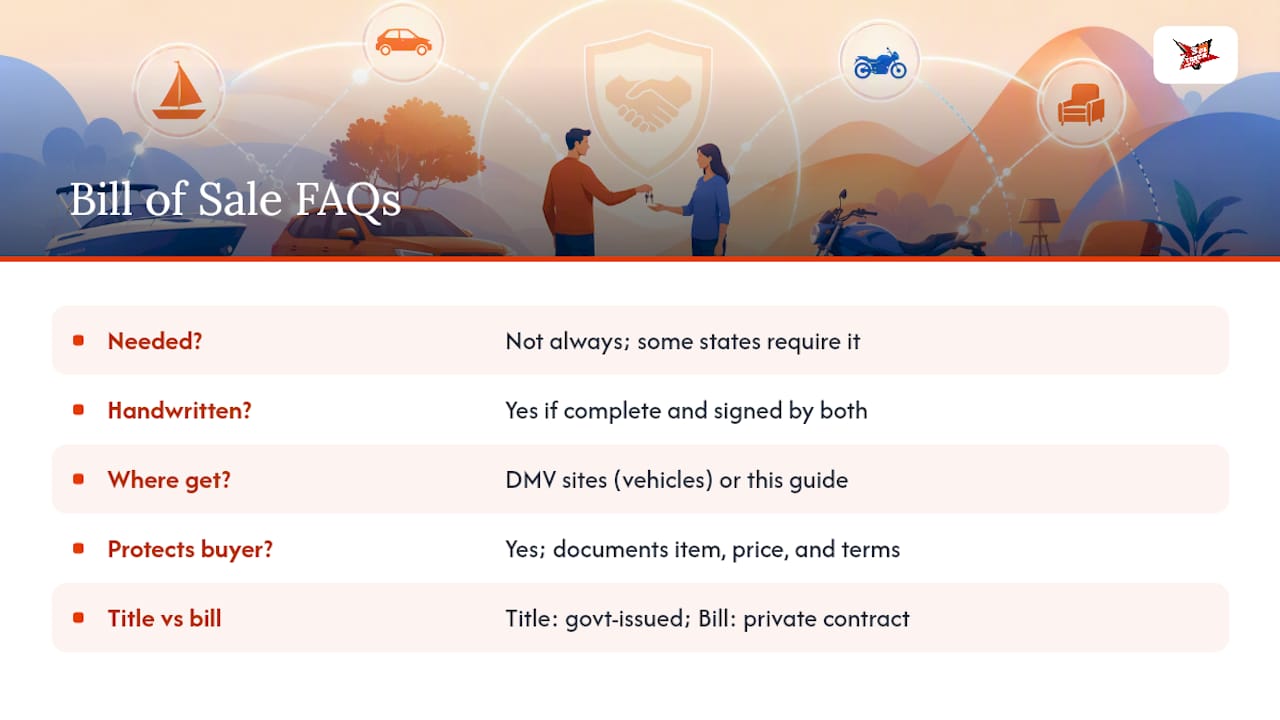
Is a bill of sale necessary for every private sale? Not always legally, but it's practically necessary. Some states require one for title transfer, and even where it's optional, it's your main proof of the transaction if a dispute arises later.
Can a bill of sale be handwritten? Yes, as long as it includes the required fields (names, item description, price, date, signatures). A handwritten bill of sale holds up legally if it's complete and signed by both parties.
Where do I get a bill of sale template? Many state DMV websites provide free vehicle-specific forms. For general personal property, a simple one-paragraph template like the one in this guide works fine.
Does a bill of sale protect the buyer? Yes. It documents what was purchased, at what price, and under what terms, which is your primary evidence if the seller later disputes the sale or the item's condition.
What's the difference between a bill of sale and a title? A title is a government-issued ownership certificate. A bill of sale is a private contract recording the transaction details. You often need both to complete a vehicle registration.
This article is general information, not a substitute for advice from a qualified lawyer. Consult a qualified legal professional about your own circumstances before acting on anything here.