
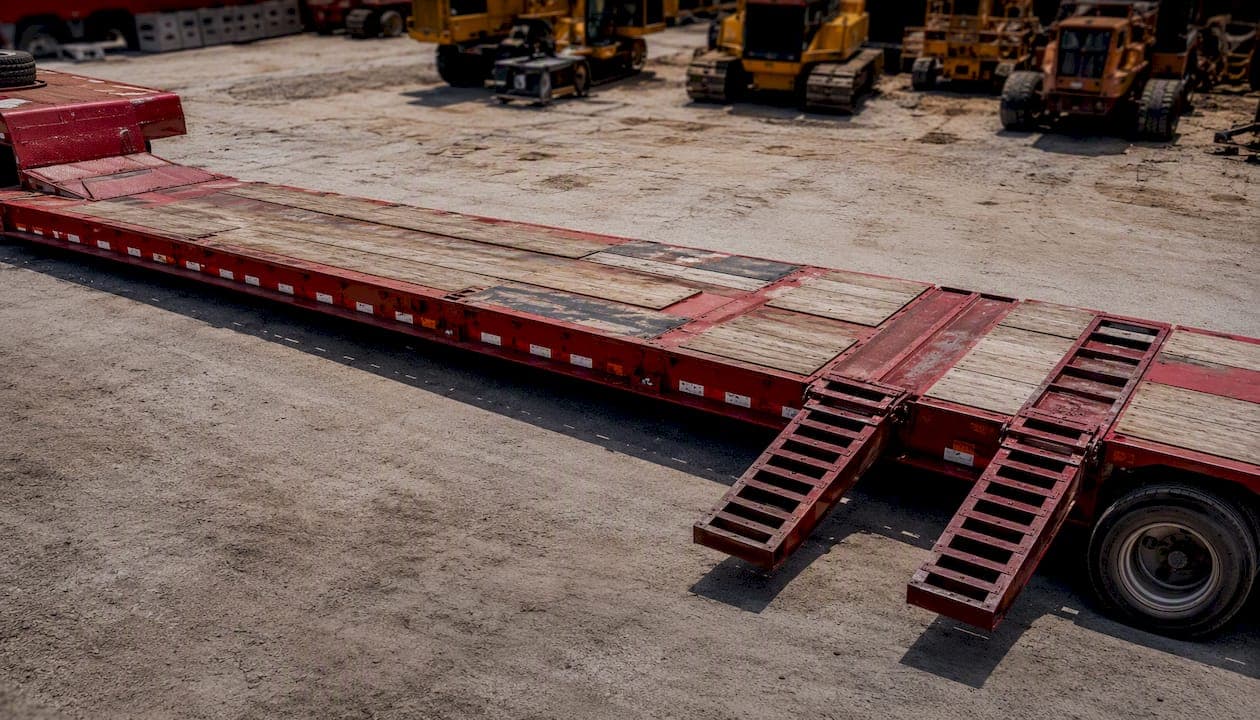
A drop deck trailer is a flatbed semi-trailer with two deck levels: a shorter upper deck near the cab and a lowered main deck (the well) behind it. That stepped design lets you carry taller cargo while staying within the standard 13'6" height limit enforced across most U.S. states, often without triggering an oversize permit. Industry documents formally describe it as a low-height load platform that steps up to a higher platform over the tractor turntable.
Common situations where a drop deck is the right call:
- Hauling excavators, bulldozers, or wheel loaders that stand too tall for a standard flatbed
- Moving agricultural machinery such as combines or large tractors between fields or dealers
- Transporting oversized industrial components like generators, boilers, or wind-turbine nacelles
When cargo exceeds roughly 10 feet in height, or when gross weight pushes past federal axle limits, a lowboy or an oversize/overweight permit is still required regardless of trailer type.
Key Takeaways
A drop deck trailer's two-level deck design is the single most practical tool for hauling tall freight legally without a permit in most U.S. states.
| Point | Details |
|---|---|
| Core definition | A step-deck trailer lowers the main deck to 34–42 inches, gaining usable cargo height under the 13'6" legal limit. |
| Best cargo match | Construction equipment, agricultural machinery, and industrial components that stand too tall for a standard flatbed. |
| Key specs to check | Length (48 or 53 ft), lower deck height, axle configuration, and payload capacity before booking or buying. |
| Material trade-off | Aluminum saves 1,200–1,500 lbs vs. steel but raises the lower deck about 1 inch and requires specialized repairs. |
| Permit reminder | Oversize permits are required when height exceeds 13'6", width exceeds 8'6", or gross weight exceeds 80,000 lbs. |
| Sostruckforsale | Search or list step-deck trailers by length, axle config, and condition at Sostruckforsale. |
Table of Contents
- What is a drop deck trailer, and how is it built?
- What are the standard specs and axle configurations?
- What cargo and industries rely on drop deck trailers?
- How do you load and secure a drop deck trailer safely?
- Steel, aluminum, or combination: which frame material is right?
- Pros, cons, and cost drivers for drop deck trailers
- Industry considerations and operator tips: transition stresses, flip axles, and permits
- When to rent a drop deck vs. when to buy
- Find drop deck trailers for sale on Sostruckforsale
- Sources
What is a drop deck trailer, and how is it built?
The trailer gets its name from the physical drop between its two deck levels. Starting at the front, the gooseneck (or neck) connects the trailer to the fifth wheel of the tractor. The upper deck sits at roughly 60 inches off the ground. A sloped or stepped transition drops down to the lower deck (the well), which typically rides at 34–42 inches above the road surface. Rear ramps fold down to allow drive-on loading of wheeled equipment, and axles run under the rear section to carry the load.
Main design variants
Single-drop (step deck): One transition step from upper to lower deck. The most common configuration for general oversized freight.
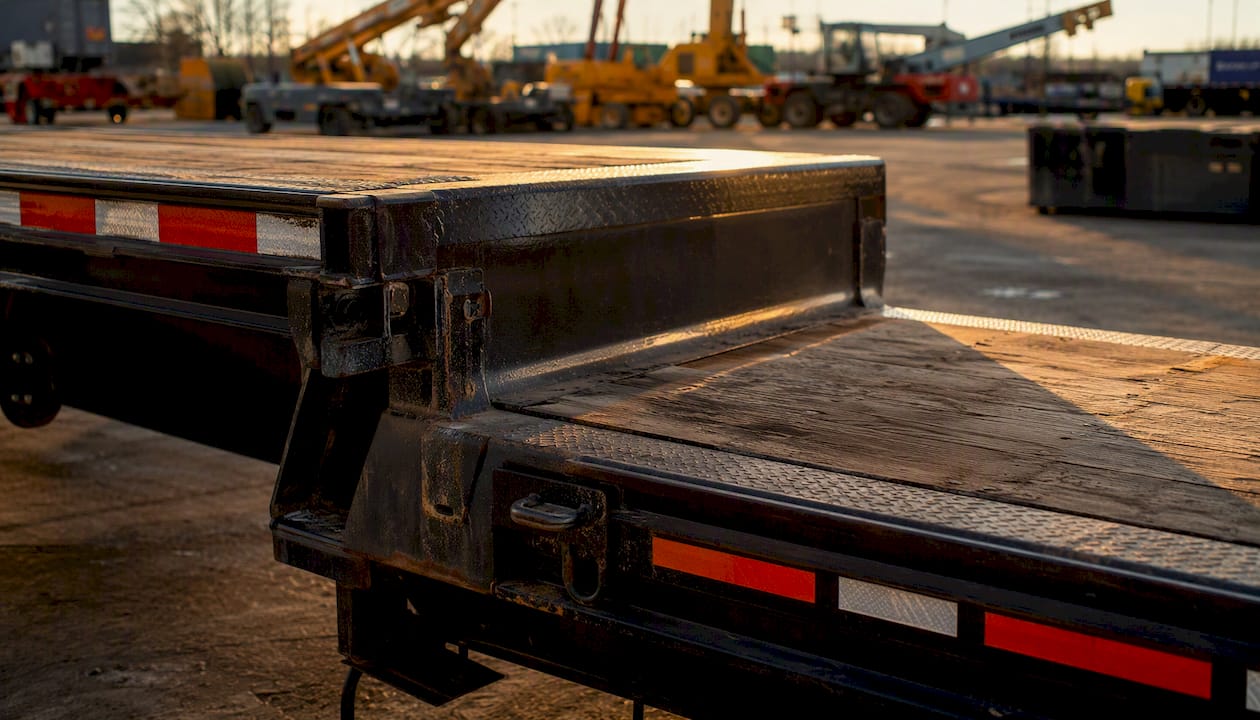
Double-drop (lowboy): Two transitions create a very low center well, sometimes as low as 18–24 inches. Used for the tallest, heaviest equipment such as large cranes or mining machinery.
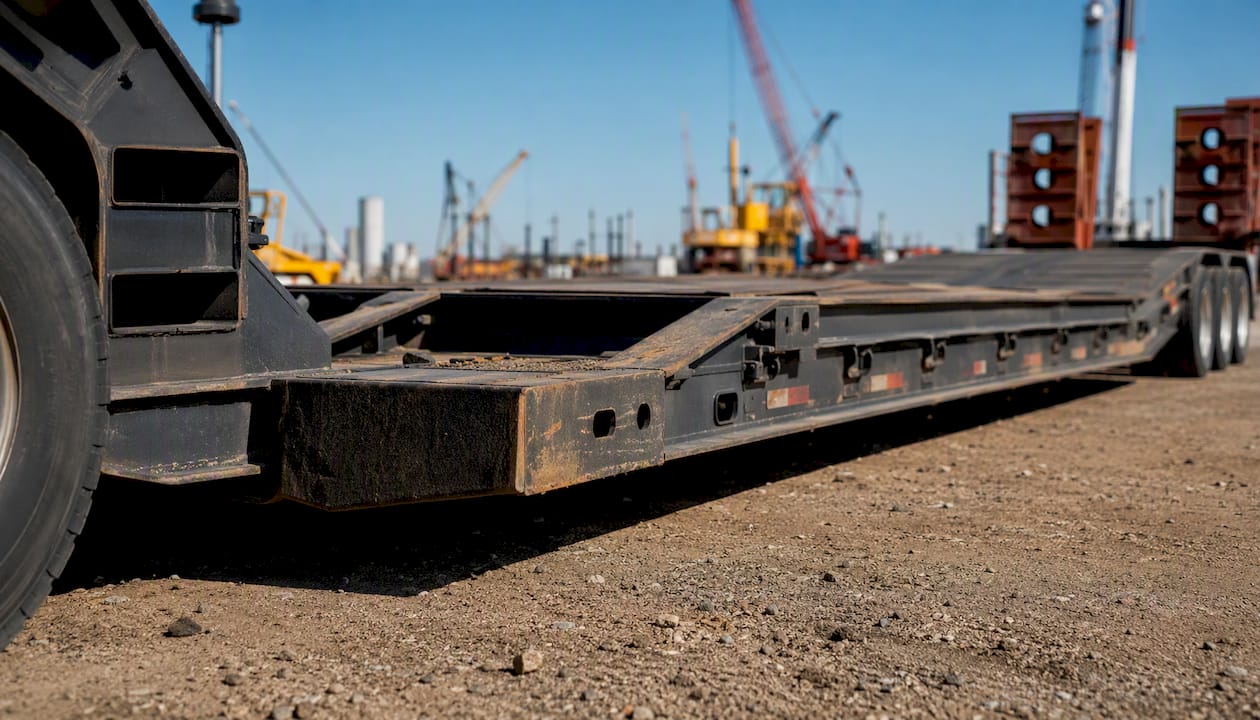
Lowboy: Technically a subset of double-drop designs, optimized for extreme height and weight. Chosen when a step deck's lower deck still puts cargo over legal height.
| Trailer type | Lower deck height | Best use case | Permit likelihood |
|---|---|---|---|
| Standard flatbed | ~60 inches | Palletized, flat cargo | Low |
| Step deck (single-drop) | ~34–42 inches | Tall construction/ag equipment | Moderate |
| Double-drop / lowboy | ~18–24 inches | Cranes, mining equipment, extreme height | High |
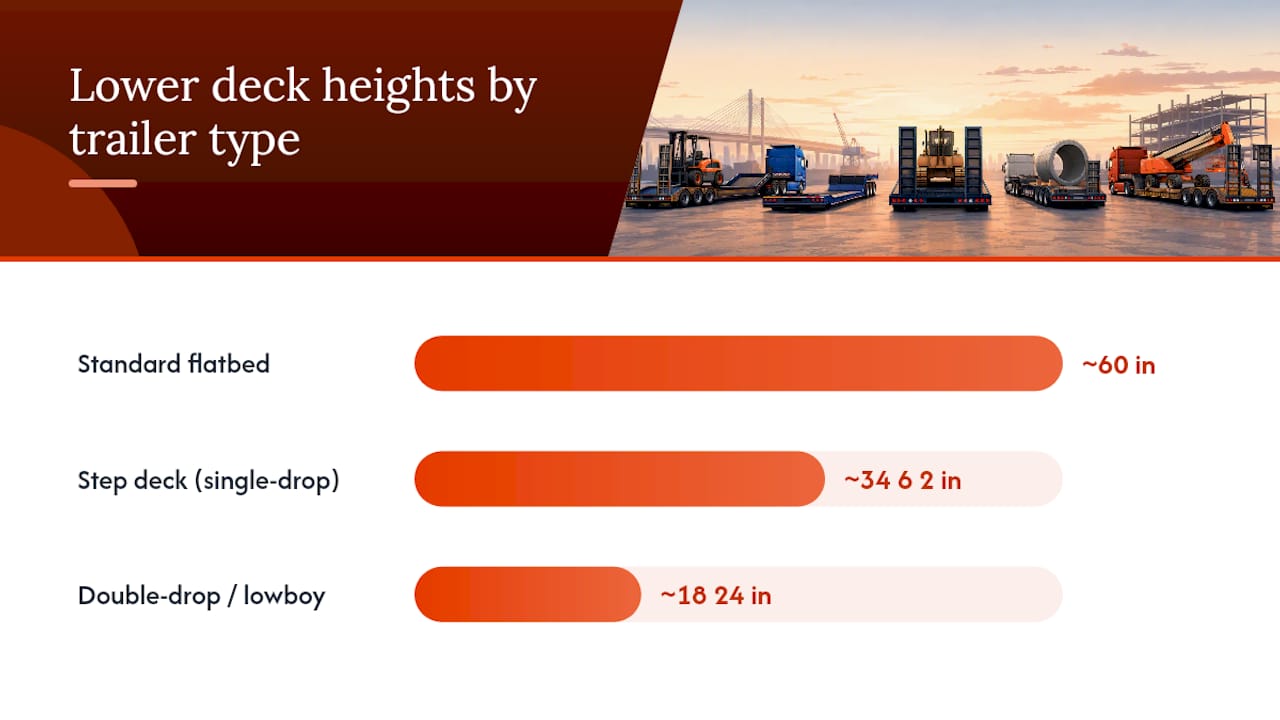
A standard flatbed works well for cargo that fits within height limits at 60 inches off the ground. A step deck is chosen when that extra 18–26 inches of clearance makes the difference between a legal move and a permit run. A lowboy takes over when even the step deck's well is not low enough.
What are the standard specs and axle configurations?
Most drop deck trailers run in two standard lengths: 48 feet and 53 feet. The 48-foot unit is more maneuverable in tight yards and job sites; the 53-foot version maximizes cargo space for longer equipment or multiple pieces.
Axle configuration directly controls legal payload. A standard tandem-axle rear setup handles most loads within federal bridge-formula limits. Tri-axle configurations spread weight across three axle groups, raising the legal payload ceiling for heavier freight. Flip axles are the most operationally flexible option: operators deploy them under heavy loads to increase axle count and spread weight legally, then fold them up when running lighter to reduce rolling resistance and improve fuel economy. Frame material also matters here. An aluminum frame shaves roughly 1,200–1,500 pounds off trailer weight compared to steel, which translates directly to additional legal payload capacity.
What cargo and industries rely on drop deck trailers?
The lowered well is the key. It creates usable vertical space that a flatbed simply cannot offer, which is why construction equipment and agricultural machinery dominate step-deck freight lanes.
Typical cargo that fits well:
- Excavators and bulldozers: Track height and cab height together often exceed flatbed limits; the lower deck solves both.
- Agricultural tractors and combines: Wide and tall, frequently moved between farms and dealers on step decks.
- Wind-turbine nacelles and tower sections: Heavy and awkward; the lower deck reduces overall height and simplifies permitting.
- Generators and industrial boilers: Dense, heavy equipment that benefits from lower center-of-gravity loading.
- Oversized vehicles: RVs, specialty trucks, and mobile equipment that stand too tall for a standard trailer.
Poor fits and workarounds: Very long straight loads, such as pipes or structural beams, can be problematic because the deck step interrupts a flat load surface. Operators sometimes add wood or metal risers to bridge the step and carry these loads safely, though a dedicated flatbed or extendable trailer is often the cleaner solution.
Industries that use step decks most: construction, agriculture, industrial heavy manufacturing, oil and gas, equipment rental, and wind energy. Licensed demolition contractors moving high-reach demolition equipment between sites are also regular users, since that machinery is tall, tracked, and rarely fits on a standard flatbed.
How do you load and secure a drop deck trailer safely?
Safe loading on a step deck follows a clear sequence. Skipping steps, especially the center-of-gravity check, is where most incidents originate.
- Inspect the trailer. Walk the full deck, check ramp hinges, verify all tie-down anchor points are rated and undamaged, and confirm the transition area shows no visible cracking or deformation.
- Position the trailer on level ground. Uneven surfaces shift load balance during drive-on loading and can cause tip-overs.
- Deploy ramps or position the forklift. Fold-down ramps handle wheeled and tracked equipment; a forklift or crane is used for lifted cargo placed on the lower deck.
- Drive or lift cargo onto the lower deck. Center the load laterally and position the heaviest point over or between the rear axles.
- Check center of gravity. Tall loads with a high center of gravity need lower deck placement and additional lateral tie-downs.
- Place wheel chocks immediately behind and in front of all wheels before releasing any drive controls.
- Apply tie-downs. Use rated chains, binders, and winch straps anchored to rated D-rings or stake pockets. Federal Motor Carrier Safety Administration (FMCSA) regulations require a minimum number of tie-downs based on cargo weight and length; tall or unstable loads warrant additional points beyond the minimum.
- Conduct a final walkaround. Confirm all binders are tight, all ramps are secured or removed, and no part of the load overhangs unsafely.
Pro Tip: Inspect the transition area during every pre-trip walkaround, not just during scheduled maintenance. Stress concentrates at that step, and a crack caught early costs far less than a structural failure on the road.
Oversize/overweight permits are triggered when cargo height exceeds 13'6" (varies by state), width exceeds 8'6", or gross vehicle weight exceeds 80,000 lbs on interstate highways. Check state-specific thresholds before each move, as limits vary.
Steel, aluminum, or combination: which frame material is right?
Frame material affects payload, maintenance cost, deck height, and how long the trailer holds up in demanding conditions. There is no universal answer; the right choice depends on what you haul and how often.
Steel frames:
- Higher tensile strength; better suited for heavy-duty applications like oil and gas or wind energy
- Heavier, which reduces available payload
- Easier and cheaper to repair in the field; most welding shops can work with steel
- Gussets at the transition area reinforce the stress concentration point
Aluminum frames:
- Roughly 1,200–1,500 lbs lighter than steel equivalents, directly increasing legal payload
- Aluminum members must be built thicker and taller to match steel's strength, so the lower deck sits about 1 inch higher than a comparable steel trailer. That inch matters when you are already close to height limits.
- Radius-arch reinforcement at the transition replaces steel gusseting; repairs require specialized aluminum welding
- Better corrosion resistance, lower long-term maintenance cost in wet or coastal environments
Combination (steel main rails, aluminum crossmembers):
- Balances weight savings with structural strength at the most stressed points
- Popular with fleets that want payload gains without fully committing to aluminum repairability challenges
Statistic: Aluminum builds reduce trailer weight by roughly 1,200–1,500 pounds versus steel, a savings that translates directly to higher legal payload for weight-sensitive freight.
Fleets running general construction or agricultural freight often choose aluminum or combo builds to maximize payload per trip. Operations in oil and gas, mining, or wind energy, where loads are consistently at or near maximum weight limits and field repairs are common, tend to stay with steel.
Pros, cons, and cost drivers for drop deck trailers
| Factor | Advantage | Limitation |
|---|---|---|
| Height clearance | Carry taller freight without permits in many cases | Still limited; extreme heights need a lowboy |
| Loading access | Ramps and lower deck height ease forklift and drive-on loading | Ramp setup adds time vs. flatbed crane loading |
| Versatility | Handles construction, ag, industrial, and energy freight | Stepped deck complicates very long straight loads |
| Initial cost | Strong resale demand for quality used units | Higher purchase price than a standard flatbed |
| Operating cost | Flip axles reduce fuel cost on lighter runs | Extra axles and ramps add maintenance items |
Cost drivers beyond the base trailer price include axle configuration (each additional axle adds cost and complexity), ramp and winch options, reinforced transition engineering, and specialized insurance for oversize moves. Step-deck loads also tend to command higher per-mile rates than standard flatbed freight, which partially offsets the higher equipment cost for carriers.
Industry considerations and operator tips: transition stresses, flip axles, and permits
Practitioners who run drop decks regularly know that the trailer's design strength is also its maintenance liability.
Transition area inspection:
The 90-degree step between upper and lower decks concentrates stress with every loaded mile. Engineering guidance identifies this as a fatigue-prone zone. During every inspection, check for:
- Cracking at welds along the transition bend
- Fatigued or cracked gussets (steel trailers) or deformation at radius-arch joints (aluminum)
- Any visible separation between crossmembers and the main rail at the step
Flip axle operation:
- Deploy flip axles when gross load weight requires additional axle groups to stay within federal bridge-formula limits
- Fold them when running light to cut rolling resistance and fuel consumption
- Inspect flip-axle pivot hardware and air lines at each pre-trip; a stuck or partially deployed axle creates uneven weight distribution
U.S. permit triggers (check state-specific rules before each move):
- Height over 13'6" (some states set lower limits)
- Width over 8'6"
- Gross vehicle weight over 80,000 lbs on interstate
- Length over state-specific maximums (varies from 48 to 65+ feet depending on state and route)
Operator maintenance checklist:
- Inspect transition welds and gussets at every pre-trip
- Check ramp hinge pins and locking mechanisms weekly
- Verify flip-axle air lines and pivot hardware before each heavy haul
- Confirm all tie-down anchor points are rated and free of deformation
- Lubricate gooseneck kingpin and landing gear per manufacturer schedule
When to rent a drop deck vs. when to buy
Buying a drop deck makes financial sense when you move oversized freight regularly, at least several times per month, and your team has the maintenance capability to keep the trailer in DOT-compliant condition. The capital outlay is higher than a flatbed, but the per-trip economics improve quickly when the trailer is working consistently. Strong resale demand for quality step-deck units also limits downside risk if your freight mix changes.
Renting is the smarter call for occasional moves, one-off project hauls, or when your operation lacks the space or staff to maintain a specialized trailer. Rental also lets you match the exact trailer configuration (length, axle count, ramp type) to each job without owning multiple variants.
Quick buyer checklist:
- Required payload capacity and maximum cargo height
- Typical cargo types and whether a single-drop or double-drop fits the profile
- Regional permit frequency and whether your routes cross states with lower height limits
- Frame material preference based on freight weight and repair infrastructure
- Resale market conditions in your region for the axle configuration you need
Find drop deck trailers for sale on Sostruckforsale
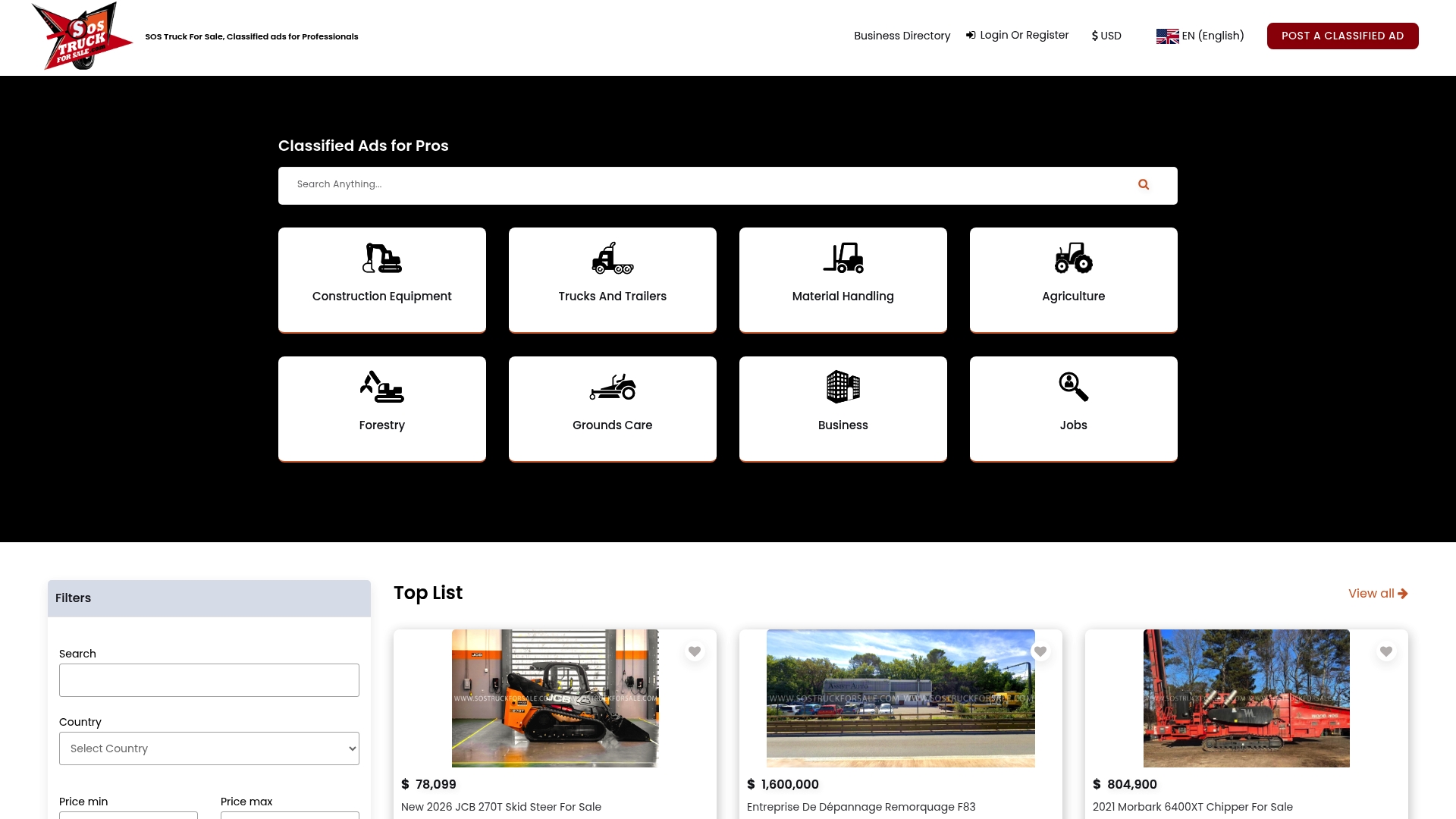
Sostruckforsale is a direct-access marketplace for buyers and sellers of commercial vehicles and heavy equipment across the United States. If you need a step-deck trailer, the listings cover a range of configurations: 48-foot and 53-foot units, tandem and tri-axle setups, steel and aluminum frames, and trailers with or without ramps and flip axles. Filters by category, length, condition, and price let you narrow results quickly without scrolling through irrelevant inventory.
Sellers and dealers post directly, so you are looking at real available units, not aggregated data. To get started, visit Sostruckforsale and search under the trailer category, or post your own listing if you have a unit to sell. The process takes minutes, and listings reach buyers actively searching for commercial equipment.