

A truck recall notice is an official safety notification issued by the manufacturer and tracked by the National Highway Traffic Safety Administration (NHTSA) confirming that a specific safety defect or federal safety standard violation affects your vehicle and that a free remedy is required by law. When one arrives, your immediate actions are straightforward.
Act within the first hour:
- Confirm your VIN. Enter your 17-character Vehicle Identification Number at NHTSA's recall lookup to verify the recall applies to your specific truck.
- Read the remedy line. Determine whether the fix is available now or still pending parts.
- Follow any "Do not drive" instruction immediately. If the notice uses that language, do not attempt to drive the truck to a dealer. Contact the dealer or manufacturer and request towing arrangements.
- Schedule the free repair. Call an authorized dealer with your VIN and the campaign number from the notice. The remedy is free regardless of vehicle age or who currently owns it.
Manufacturers are legally required to notify registered owners by first-class mail within 60 days of reporting a recall to NHTSA, and to provide the remedy at no charge. If your notice arrived in an alarming envelope, Consumer Reports notes that many owners mistake these letters for junk mail. Treat it as safety-critical regardless of how it looks.
Table of Contents
- What is a truck recall notice, and why do trucks get recalled?
- What does an official recall notice look like?
- Step-by-step actions after you receive a recall notice
- How to check whether your truck is affected
- What remedies are manufacturers required to provide?
- What to do if there's no fix yet or the dealer won't cooperate
- Should you buy a truck with an open recall?
- Why recall repair records protect your resale value and limit liability
- Parts delays and follow-up cadence: operational guidance for fleet managers
- Key Takeaways
- Why acting fast on a recall is the right call for truck owners
- Official resources for truck recall information
What is a truck recall notice, and why do trucks get recalled?
A recall is triggered when a manufacturer or NHTSA determines that a vehicle contains a safety-related defect or fails to meet a Federal Motor Vehicle Safety Standard. Manufacturers initiate many recalls voluntarily; others result from NHTSA investigations or a direct NHTSA order. Under the National Traffic and Motor Vehicle Safety Act, NHTSA has recalled more than 935 million vehicles and equipment items since 1966, a figure that reflects how broadly the agency monitors the vehicle fleet.
Trucks are recalled for a wide range of defects. The most common categories include:
- Braking system failures (hydraulic leaks, ABS module faults, brake booster defects)
- Steering component failures (tie rod ends, power steering pump issues)
- Fuel system defects (fuel line leaks, fuel pump failures that create fire risk)
- Airbag and restraint system faults (inflator defects, seat belt pretensioner failures)
- Electrical and software issues (wiring harness shorts, ECU calibration errors)
- Trailer hitch and attachment components (fifth-wheel coupling defects, gooseneck failures)
NHTSA's role extends beyond issuing recalls. The agency investigates alleged defects, notifies the public of open investigations, monitors manufacturer corrective actions, and maintains the VIN lookup database that owners use to confirm status.
What does an official recall notice look like?
Federal regulations require the envelope to be marked "SAFETY RECALL NOTICE" in capital letters larger than the address text. The letter itself must open with "IMPORTANT SAFETY RECALL" at the top. Recall notices are written for legal completeness, which means they can run several pages. Focus on the campaign numbers and remedy instructions and skip the legal boilerplate for your operational next steps.
The fields that matter most:
| Field | What it means | Why you care |
|---|---|---|
| NHTSA Campaign Number | The federal tracking ID for this recall | Use it when calling the dealer or NHTSA |
| Manufacturer Recall Number | The OEM's internal reference | Speeds up dealer lookup |
| Affected VINs / Build Dates | The range of trucks covered | Confirms whether your unit is included |
| Defect Description | What is wrong and the safety risk | Tells you how urgent the hazard is |
| Remedy Description | Repair, replacement, or refund | Tells you what the dealer will do |
| Remedy Availability Date | When parts are expected | Helps you plan scheduling |
| "Do Not Drive" Language | Instruction to stop operating the vehicle | Requires immediate non-driving action |
| Manufacturer Contact Info | Phone and address for disputes | Use if the dealer is uncooperative |
Watch for scams. Legitimate recall notices never ask for payment, credit card numbers, or personal financial information. Confirm any notice by cross-referencing the NHTSA campaign number at SaferCar.gov before taking any action requested in the letter.
Step-by-step actions after you receive a recall notice
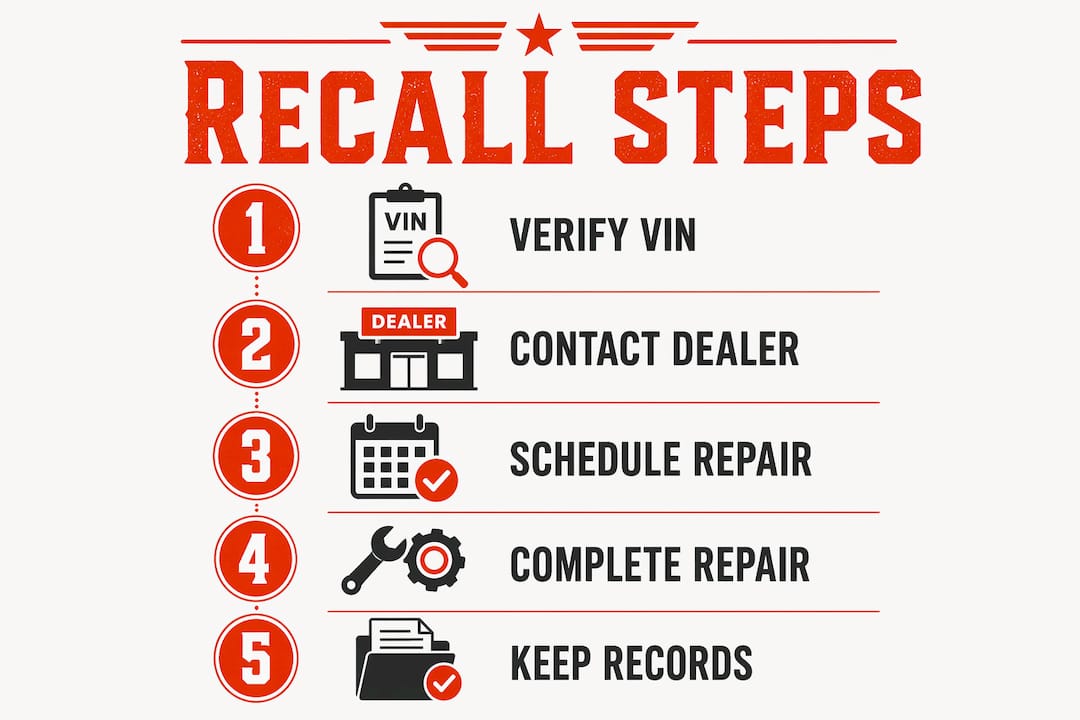
Follow these steps in order. Skipping the VIN verification step is the most common mistake truck owners make, since a recall campaign may cover thousands of VINs but not every unit in that model year.
- Verify your VIN at NHTSA. Go to SaferCar.gov's VIN lookup, enter your full 17-character VIN, and confirm the recall shows as open and incomplete on your specific truck.
- Read the remedy status and urgency language. If the remedy is available, proceed to scheduling. If it shows "remedy not yet available," note the expected date and set a follow-up reminder. If the notice says "Do Not Drive," stop here and call the dealer before moving the vehicle.
- Contact an authorized dealer. Give the service advisor both your VIN and the NHTSA campaign number. Ask specifically whether parts for your VIN are in stock before you schedule a trip.
- Schedule the free remedy. Confirm the appointment in writing (email or text). Ask whether the dealer provides a loaner vehicle or covers rental costs during the repair. For commercial operators, ask about towing reimbursement if the truck cannot be driven.
- Document everything. Save the original recall letter, all emails, and the completed repair order. Log each interaction with a date, contact name, and outcome.
Pro Tip: Give the dealer your NHTSA campaign number before you book the appointment. Dealers can check parts availability for your specific VIN in seconds using that number, which prevents a wasted trip if parts haven't arrived yet.
How to check whether your truck is affected
Not every truck owner receives a mailed notice before the recall becomes public. Checking proactively is straightforward.
- NHTSA VIN lookup: Go to SaferCar.gov and enter your 17-character VIN. The results page shows open recalls, the defect description, and whether the remedy is currently available. The tool covers safety recalls from the past 15 calendar years.
- SaferTruck: NHTSA's SaferTruck resource provides VIN search, reporting tools specific to commercial trucks, and options to sign up for recall alerts by email or through the SaferCar app.
- Authorized dealer lookup: Call any authorized dealer for your truck's brand, provide your VIN, and ask the service department to run a recall check. Dealers have direct access to the manufacturer's recall database.
- Manufacturer customer service: The phone number on the recall notice connects to a dedicated recall line. Have your VIN ready.
- Email alerts: Sign up for NHTSA recall alerts at SaferCar.gov to receive notifications when new campaigns are announced for your VIN.
When reading lookup results, two phrases are decisive: "remedy available" means you can schedule the repair now; "remedy not yet available" means parts are still in production and you need to monitor the status.
What remedies are manufacturers required to provide?
Under the National Traffic and Motor Vehicle Safety Act, manufacturers must offer one of three remedies at no charge to the owner. The choice of remedy is typically the manufacturer's, not the owner's, though the law gives NHTSA authority to review the adequacy of the remedy offered.
| Remedy | What it means for you | Who pays | Typical timeline |
|---|---|---|---|
| Repair | Dealer fixes the defect using OEM parts | Manufacturer (free to owner) | Days to weeks depending on parts |
| Replacement | Manufacturer provides an identical or comparable vehicle | Manufacturer (free to owner) | Rare; used when repair is not feasible |
| Refund / Repurchase | Purchase price refunded minus reasonable depreciation | Manufacturer | Very rare; typically ordered by NHTSA |
Recall repairs are free at authorized dealerships regardless of vehicle age, warranty status, or whether you are the original owner. If a dealer attempts to charge you, reference the National Traffic and Motor Vehicle Safety Act and file a complaint with NHTSA if the issue is not resolved.
For commercial operators, parts shortages are the most common source of downtime. Ask the dealer about loaner vehicles or rental reimbursement when scheduling. Some manufacturers cover these costs during active recall campaigns, but coverage varies by brand and campaign.
What to do if there's no fix yet or the dealer won't cooperate
A "remedy not yet available" status means parts are still being manufactured or distributed. This does not mean you can ignore the recall.
- Confirm your VIN is logged. Ask the dealer to note your VIN in their system so you receive priority notification when parts arrive.
- Ask the dealer to place a parts order for your VIN. Some dealers can pre-order parts tied to a specific VIN, which moves you to the front of the queue.
- Set a 30-day follow-up cadence. Call the dealer every 30 days and log each contact with the date, representative name, and status update.
- Escalate to the manufacturer. If the dealer is unresponsive, call the manufacturer's customer relations line using the number on your recall notice.
- File a report with NHTSA. If the manufacturer is also uncooperative, contact NHTSA's Vehicle Safety Hotline at 888-327-4236 or submit a report online. These reports support NHTSA investigations and can prompt manufacturer action.
Sample escalation email to a dealer or manufacturer:
Keep a copy of every email and note every phone call in your log.
Should you buy a truck with an open recall?
An open recall does not automatically disqualify a used truck from purchase, but it does require due diligence. Checking open recalls is a quick signal of fleet condition, and recall service is always free at OEM dealers, so a documented open recall can actually be a negotiating point rather than a dealbreaker.
Before completing any used-truck purchase, verify the following:
- Run the VIN at NHTSA. Confirm how many open recalls exist and whether parts are currently available.
- Request documentation of completed recall repairs. Ask for repair orders showing campaign numbers, parts replaced, and dealer stamps.
- Confirm dealer appointment for open recalls. If a recall is open, ask the seller to schedule the repair before closing, or negotiate a price adjustment that accounts for your time and any operational downtime.
- Check parts availability. If parts are backordered, factor potential downtime into your purchase decision, especially for commercial applications.
- Get written proof of repair. Any completed recall repair should be documented on a dealer repair order, not just a verbal confirmation.
For commercial buyers, an unresolved recall on a safety-critical system (brakes, steering, fuel) creates both operational risk and potential liability exposure. Construction fleet operators in particular should review construction zone safety considerations when evaluating trucks with open brake or steering recalls, since those defects carry elevated risk in active work zones.
Why recall repair records protect your resale value and limit liability
Keeping thorough recall documentation is one of the lowest-effort, highest-return maintenance habits a truck owner can build. Buyers and fleet managers increasingly request recall completion records as part of pre-purchase inspections, and a clean paper trail removes doubt.
What to store for each recall repair:
- Original recall notice (physical copy and scanned PDF)
- Dealer repair order showing campaign number, parts replaced, and labor performed
- Date of repair and dealer name
- Service advisor name and contact information
- Any manufacturer correspondence (emails, letters)
Sample record-log fields:
| Field | Example |
|---|---|
| Dealer name and location | ABC Truck Center, Dallas, TX |
| Parts replaced | Fuel pump assembly |
| Technician sign-off | J. Martinez |
Pro Tip: Store scanned copies of all recall repair orders in a VIN-labeled folder on cloud storage. If you sell the truck, you can share the folder link instantly, which builds buyer confidence and supports a stronger asking price.
Documented recall completion also protects you from future liability disputes. If a buyer later claims a defect was present at the time of sale, a dated dealer repair order tied to the NHTSA campaign number is clear evidence the issue was resolved. Driver compliance records that include recall documentation are a standard expectation in commercial operations; maintaining those records supports both regulatory compliance and resale credibility.
Parts delays and follow-up cadence: operational guidance for fleet managers
Parts constraints are a documented reality in recall campaigns, particularly for high-volume recalls affecting popular truck platforms. When a manufacturer announces a large campaign, dealer parts allocations can run short within days of the announcement.
The recommended approach is a structured follow-up cadence rather than a single call and wait.
- Call the dealer every 30 days. Each call should confirm your VIN is still flagged, ask for an updated parts ETA, and request the name of the service advisor you spoke with.
- Log every contact. Record the date, advisor name, status given, and any reference numbers provided.
- Ask about towing reimbursement. If a "Do Not Drive" notice applies, dealers and manufacturers are often required to arrange or cover towing costs. Request this in writing before arranging transport.
- Escalate at 90 days. If three follow-up calls produce no resolution, move to the manufacturer's customer relations line and reference your contact log.
Pro Tip: When calling about a delayed remedy, always open with the NHTSA campaign number before your VIN. Dealers route calls by campaign, and leading with that number gets you to the right service queue faster.
Fleet managers running multiple units should maintain a single spreadsheet tracking VIN, campaign number, parts status, last contact date, and next follow-up date for every open recall across the fleet.
Key Takeaways
A truck recall notice is a legally required safety alert, and the free remedy at an authorized dealer is your right under federal law regardless of vehicle age or ownership history.
| Point | Details |
|---|---|
| Verify by VIN first | Enter your 17-character VIN at NHTSA/SaferCar before taking any other action. |
| Remedy is always free | Authorized dealers must fix safety recalls at no charge under the National Traffic and Motor Vehicle Safety Act. |
| "Do Not Drive" means stop now | If the notice uses that language, contact the dealer for towing before moving the vehicle. |
| Follow up every 30 days | When parts are delayed, a monthly follow-up cadence keeps your VIN flagged for priority service. |
| Keep all repair documentation | Dated dealer repair orders protect resale value and limit liability in future disputes. |
Why acting fast on a recall is the right call for truck owners
Most truck owners treat a recall notice as a low-priority administrative task. That's a mistake, and the consequences show up in two ways: safety incidents that could have been prevented, and resale situations where missing documentation costs real money.
The recall system is designed to work in the owner's favor. The repair is free, the dealer is obligated to perform it, and NHTSA provides a direct escalation path when the system breaks down. What the system cannot do is force you to schedule the appointment. That part is on you.
For commercial operators, the calculus is even clearer. A truck with an open brake or steering recall operating in a construction zone or on a long-haul route is a liability exposure, not just a safety risk. The downtime to fix it is almost always shorter than the downtime from an incident. Proactive communication with dealers, a structured follow-up log, and clean documentation are not bureaucratic overhead. They are the operational habits that separate well-run fleets from reactive ones.
Use NHTSA's tools. Schedule the repair. Keep the paperwork. Those three steps cover the vast majority of what a truck owner needs to do.
Official resources for truck recall information
- NHTSA Recalls Lookup: The primary tool for VIN-based recall verification, open recall status, and manufacturer remedy information. Also the starting point for filing a safety complaint.
- SaferCar VIN Search: Enter your 17-character VIN to see all open, incomplete safety recalls from the past 15 years. Sign up for email alerts to receive notifications when new campaigns are announced for your vehicle.
- SaferTruck (NHTSA): Commercial truck-specific resources including VIN search, reporting tools for heavy-duty vehicles, and guidance for fleet operators.
- NHTSA Vehicle Safety Hotline: Call 888-327-4236 or submit an online report to escalate dealer or manufacturer non-compliance and to report suspected safety defects.
- Consumer Reports Recall Guide: Practical explainer on how to read a recall notice, what the urgency language means, and how to avoid mistaking a safety-critical letter for junk mail.