
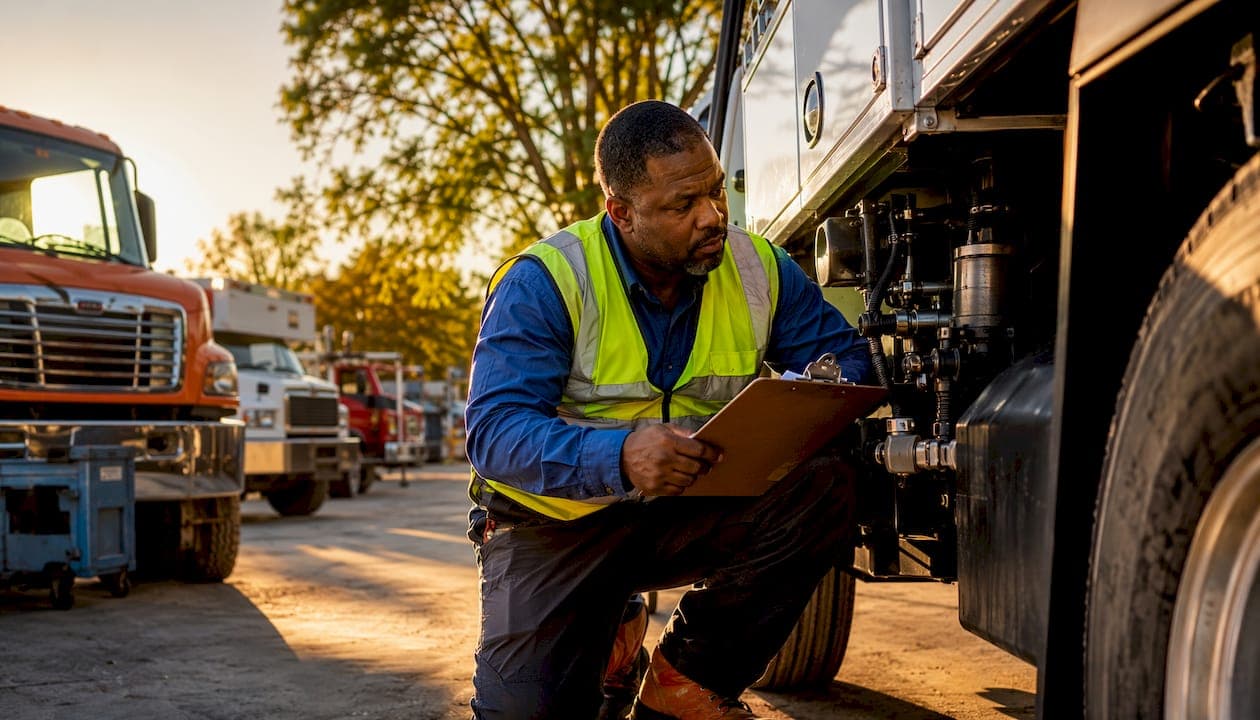
A truck upfitter is a specialist company that installs bodies, equipment, and systems onto a bare commercial chassis to make it job-ready for a specific industry. The single most important thing to understand at the procurement stage: the upfitter you choose directly affects GVWR compliance, weight distribution, warranty continuity, and the long-term resale value of every unit in your fleet.
Before you finalize any chassis purchase, three facts matter most:
- A plain chassis cab from an OEM is an incomplete vehicle by design. It requires a certified upfitter or final-stage manufacturer to become road-legal.
- The final upfitter is legally responsible for the finished vehicle meeting all applicable safety and regulatory standards, including DOT lighting rules and OSHA-relevant worker safety requirements.
- Engaging an upfitter before you order the chassis prevents the most expensive mistakes: GVWR overloads, mount-point mismatches, and PTO conflicts that force costly rework after delivery.
Table of Contents
- What does a truck upfitter do?
- How does the upfitting process work from order to delivery?
- What drives upfitting costs and how long does it take?
- Why should you treat your upfitter as a strategic partner?
- How do you choose the right upfitter for your fleet?
- What compliance and safety requirements apply to upfitted trucks?
- How should you specify chassis to simplify upfitting?
- What should you check at final delivery and acceptance?
- Key Takeaways
- The upfitter relationship most buyers underestimate
- Find chassis-ready trucks for upfitting on Sostruckforsale
- Useful sources and further reading
What does a truck upfitter do?
An upfitter modifies vehicles for specific industry tasks by adding purpose-built components and integrating them with the chassis's electrical, hydraulic, and mechanical systems. The scope goes well beyond bolting on a body.
Common physical upfits by component type:
- Service bodies and utility beds for field technicians
- Dump beds and hydraulic systems for construction and landscaping
- Cranes, booms, and aerial lifts for utilities and telecom
- Ladder racks, shelving, and partition systems for delivery and trades
- Liftgates for freight and municipal operations
- Specialized DOT-compliant lighting and marking packages
- Power take-off (PTO) systems and telematics/GPS integration
Services beyond installation typically include design and engineering, weight distribution studies, wiring integration, paint and finish work, functional testing, and title/licensing assistance. Some upfitters also offer vocational upfit components such as vacuum and crane systems for municipal and industrial fleets.
The component mix varies sharply by vocation. A construction contractor needs a steel service body with heavy-duty drawers and a crane. A utility company needs an aerial lift with insulated controls. A landscaping fleet needs a dump bed with a tarp system. Matching the upfit to the actual job is where upfitter expertise earns its value.
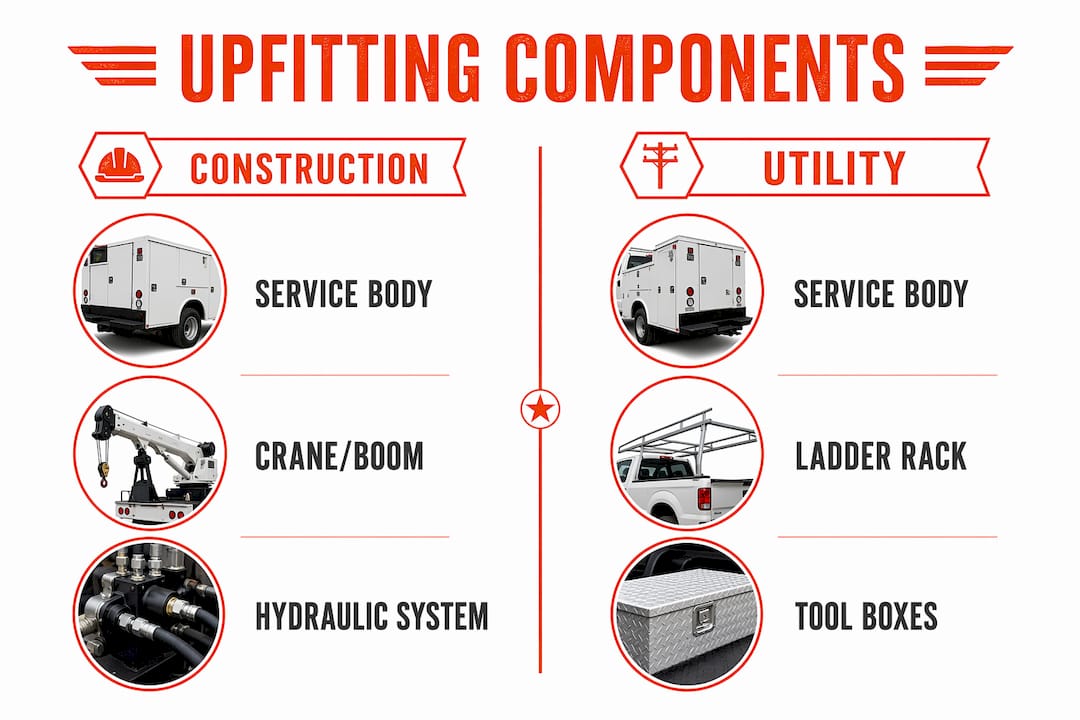
| Industry | Typical Upfit Components |
|---|---|
| Construction | Service body, crane/boom, hydraulic system |
| Utilities | Aerial lift, insulated controls, DOT lighting |
| Landscaping | Dump bed, tarp system, trailer hitch |
| Field service | Shelving, partitions, liftgate, telematics |
| Municipal fleets | Specialized lighting, plow mounts, utility bodies |
How does the upfitting process work from order to delivery?
The upfitting process involves three parties: the buyer, the truck dealer, and the upfitter. Getting all three aligned before the chassis order is placed is what separates smooth projects from expensive ones.
High-level process flow:
- Define vocational requirements and target GVWR with your upfitter before selecting a chassis.
- Order the chassis through your dealer with upfitter-specified options (PTO provisions, cab controls, electrical capacity, mounting points).
- Choose a routing method: ship-thru or ship-to.
- Upfitter completes installation, wiring integration, and functional testing.
- Final inspection, compliance documentation, and delivery acceptance.
Ship-thru vs. ship-to: Ship-thru routing sends the unfinished chassis directly from the OEM to a certified upfitter before it ever reaches the dealer. This shortens transit time, helps preserve warranty validity when the upfitter holds OEM program certification, and reduces handling. Ship-to routes the chassis to the dealer or buyer first, then to the upfitter. Ship-to gives more flexibility for buyers who already have an upfitter relationship, but it adds transit legs and can complicate warranty documentation.
Pro Tip: Involve your upfitter before you sign the chassis purchase order. Confirming GVWR compatibility and mount-point requirements at that stage costs nothing. Fixing a mismatch after delivery can cost thousands.

For timeline planning, track these milestones: chassis order date, OEM build and release date, shipment arrival at upfitter, installation window start and end, QA and inspection, and final delivery.
What drives upfitting costs and how long does it take?
Cost and lead time vary widely depending on the complexity of the build. Simple service bodies on a standard chassis cab are the fastest and least expensive. Complex vocational builds with hydraulics, aerial lifts, or custom electrical systems take significantly longer and cost more.
Primary cost drivers:
- Body type and material (aluminum vs. steel, standard vs. custom dimensions)
- Hydraulic and electrical system complexity
- PTO installation and integration
- Telematics and GPS hardware
- Paint, finish, and branding requirements
- Certification and compliance testing
- Regional labor rates and upfitter shop capacity
Fleet standardization and bulk ordering reduce per-unit costs by allowing upfitters to batch fabrication, pre-stage materials, and apply consistent wiring templates across multiple units. A fleet of 20 identically spec'd service trucks will cost less per unit than 20 one-off custom builds.
Lead time reality check: Simple service body installations can be completed in a matter of weeks. Complex vocational builds with custom hydraulics, aerial systems, or specialized lighting packages can extend lead times to several months, particularly when OEM chassis supply is constrained. Ship-thru programs shorten total project time by eliminating redundant transit legs.
Why should you treat your upfitter as a strategic partner?
The most successful upfit projects involve upfitters as strategic partners with design input before the chassis is ordered. That early involvement reduces compatibility failures and rework. An upfitter who understands your vocational requirements can specify the right axle ratings, electrical capacity, and mounting provisions from the start.
Standardizing upfits across a fleet improves technician productivity, simplifies maintenance and parts procurement, and reduces inspection complexity. When every truck in a service fleet carries the same body configuration, your mechanics know exactly where every component is located, spare parts inventory is consolidated, and training time drops.
Upfitters also act as gatekeepers for vehicle safety and legality. Robust documentation and final compliance marks are critical for insurance coverage and long-term liability control. If a vehicle is involved in an incident and the upfit documentation is incomplete, your fleet's insurance position is exposed.
Pro Tip: Make final compliance documentation a contract deliverable, not an afterthought. Require weight certificates, wiring diagrams, and the final compliance label before you sign off on any unit.
How do you choose the right upfitter for your fleet?
Vetting upfitters before awarding work is a procurement discipline, not a formality. The checklist below gives you a structured starting point.
Must-check credentials:
- OEM accreditation or certification program participation
- Current liability insurance and safety certifications
- Documented quality assurance process and inspection records
- References from fleets in your industry or vocation
Questions to ask every upfitter:
- What is your current lead time for this body type and chassis?
- What are your warranty terms for parts and labor, separately?
- How do you handle change orders after fabrication begins?
- What documentation do you deliver with each completed unit?
- Do you offer mobile service or preventative maintenance programs?
Red flags to watch for:
- No final compliance mark or documentation process
- Vague or verbal-only warranty terms
- No vocational experience in your industry
- Inability to provide sample build sheets or weight studies
- No references from fleet accounts
What compliance and safety requirements apply to upfitted trucks?
Regulatory requirements for upfitted commercial vehicles in the United States are non-negotiable. The final upfitter is legally responsible for ensuring the completed vehicle meets all applicable standards and must affix a final compliance mark before delivery.
Key compliance items every buyer should verify:
- GVWR calculations confirm the chassis rating is not exceeded by the body, equipment, payload, and fluids combined
- Weight distribution meets front and rear axle ratings
- DOT lighting and marking requirements are met for the vehicle class and operation type
- OSHA-relevant safety features are installed for worker access and operation
- State title and registration rules are satisfied, including any rebuild or modified-vehicle requirements
Documentation to collect at delivery:
- Weight certificates and axle load calculations
- Wiring diagrams for all installed electrical systems
- Inspection reports from the upfitter's QA process
- Final compliance label and certification paperwork
How should you specify chassis to simplify upfitting?
OEMs deliver incomplete vehicles — chassis cabs, cutaways, and stripped chassis — that require upfitters to complete. Specifying the chassis correctly from the start prevents the most common and costly mismatches.
Decide these specs before ordering:
- Target GVWR and axle ratings for the intended body and payload
- PTO provisions (wet kit, hydraulic prep, or electric PTO)
- Electrical capacity for lighting, telematics, and auxiliary systems
- Cab controls and switches for upfit-operated equipment
- Frame mounting points and body length compatibility
Standardization across vocational roles pays dividends throughout the vehicle lifecycle. Spare parts consolidation, simplified technician training, and lower inspection overhead all follow from a single spec per role.
Pro Tip: Create one spec sheet per vocational role and use it for every purchase order sent to your dealer and upfitter. Consistency at the order stage is the cheapest form of fleet cost control.
What should you check at final delivery and acceptance?
A structured acceptance process protects you from hidden defects and documentation gaps that surface later as liability.
Physical inspection checklist:
- Body fit, weld quality, and paint finish
- All hardware torque points verified
- Crane, dump, or liftgate function tested under load
- Wiring, lights, and DOT markings confirmed operational
- Telematics and GPS validated and connected
| Inspection Item | Pass/Fail | Responsible Party |
|---|---|---|
| Body fit and weld quality | Pass / Fail | Upfitter |
| DOT lighting and markings | Pass / Fail | Upfitter |
| Hydraulic/PTO function test | Pass / Fail | Upfitter |
| Telematics/GPS validation | Pass / Fail | Buyer + Upfitter |
| Weight certificate received | Pass / Fail | Upfitter |
| Warranty documents received | Pass / Fail | Upfitter |
| Title and registration paperwork | Pass / Fail | Dealer |
Assign one person on the buyer side to sign off on each unit. Record any defects in writing before accepting the vehicle. Many upfitters offer follow-up maintenance and mobile service programs that can be negotiated as part of the upfit contract.
Key Takeaways
Treating your upfitter as a strategic partner from the chassis order stage is the single most effective way to protect GVWR compliance, control costs, and reduce fleet downtime.
| Point | Details |
|---|---|
| Engage upfitters early | Confirm GVWR and mount-point compatibility before signing the chassis purchase order. |
| Choose ship-thru when possible | Ship-thru routing shortens lead times and helps preserve OEM warranty validity. |
| Standardize fleet specs | One spec sheet per vocational role reduces per-unit cost and simplifies maintenance. |
| Require full documentation | Weight certificates, wiring diagrams, and compliance labels are contract deliverables, not optional extras. |
| Use Sostruckforsale to source chassis | Search chassis cab and vocational truck listings on Sostruckforsale before contacting your upfitter. |
The upfitter relationship most buyers underestimate
The conventional wisdom treats upfitting as a post-purchase step: buy the truck, then figure out the body. That sequence is exactly backwards, and it costs fleets real money every year.
The buyers who get the best outcomes are the ones who bring the upfitter into the conversation before the chassis order is placed. Not after. Not during. Before. That single shift changes the entire project. The upfitter can flag a GVWR problem before it becomes a rework order. They can specify the right PTO prep so the hydraulic system integrates cleanly. They can tell you whether ship-thru is available for your chassis model and body combination, which can shave weeks off your deployment timeline.
Documentation is the other thing most buyers treat as paperwork rather than protection. Weight certificates and final compliance labels are not bureaucratic formalities. They are your legal defense in a DOT inspection, your evidence in an insurance claim, and your leverage in a warranty dispute. Require them the same way you require a signed contract.
Find chassis-ready trucks for upfitting on Sostruckforsale
Procurement moves faster when you can identify compatible chassis before you call your upfitter. Sostruckforsale lists commercial and industrial trucks across the United States, including chassis cabs, heavy-duty work trucks, and vocational units ready for upfitting.
Search by GVWR rating, chassis cab configuration, and model year to surface units that match your upfitter's spec requirements. Filter for PTO-provisioned models when your build requires hydraulic integration. Once you have a shortlist, share the listings directly with your upfitter to confirm fitment before purchase. Browse available commercial trucks for sale on Sostruckforsale and get your next fleet build started on the right chassis.
Useful sources and further reading
The following sources informed this guide and provide deeper reference for procurement teams evaluating upfitting programs, compliance requirements, and fleet management practices:
- What Is an Upfitter? Work Truck Upfitting Companies Explained — definition, component overview, and industry context
- Fleet Upfitting Process: From OEM to Road Ready — end-to-end process, OEM routing, and strategic partnership guidance
- Vehicle Upfitting | Holman — ship-thru and ship-to program details, fleet upfitting services
- Truck Upfitting Services | Reading Truck — full-service upfitting, maintenance programs, and title/licensing assistance
- What is upfitting? (upfitting 101) — standardization benefits and fleet productivity
- The art of upfitting vocational trucks — compliance responsibility, final compliance marks, and documentation
- Service utility beds / ship-thru info — ship-thru routing and timeline advantages
- Vacuum truck sales guide — specialized vocational upfit component examples