

A truck VIN number is a unique 17-character alphanumeric code assigned to every truck at the point of manufacture, serving as the vehicle's permanent identity for registration, insurance, recalls, and ownership history. The industry standard term is Vehicle Identification Number, though you will also hear it called a chassis number or frame number in everyday use. Governed by ISO standards 3779 and 4030, the VIN encodes manufacturer origin, vehicle specifications, and production sequence into a single string that never repeats across vehicles. Agencies like NHTSA, insurers, and fleet operators like Geotab all rely on this code to verify, track, and manage trucks across their entire service life.
What is a truck VIN number and how is it structured?
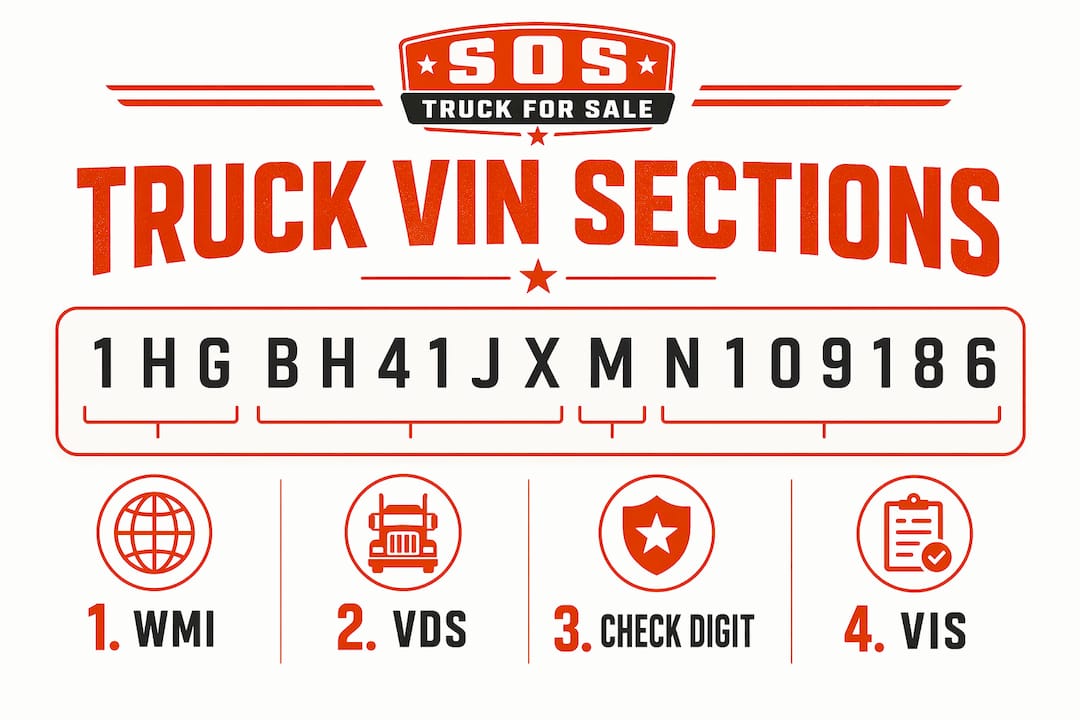
A standard VIN contains 17 characters divided into three functional sections, each carrying specific information about the truck. No two trucks share the same VIN. That uniqueness is what makes it the legal identifier for recalls, title transfers, and insurance underwriting.
World Manufacturer Identifier (positions 1–3)
The first three characters form the World Manufacturer Identifier, or WMI. Position 1 identifies the country of manufacture. Position 2 identifies the manufacturer. Position 3 identifies the vehicle type or division. For example, a WMI starting with "1" indicates the United States, while "W" indicates Germany. Heavy truck manufacturers like Freightliner, Kenworth, and Peterbilt each have their own registered WMI codes.
Vehicle Descriptor Section (positions 4–8)
Characters 4 through 8 form the Vehicle Descriptor Section, or VDS. This section encodes the truck's body style, engine type, gross vehicle weight rating, and restraint systems. VIN decoding reveals manufacturer, production region, vehicle attributes, model year, and assembly plant, giving buyers a full picture of what the truck was built to be. For heavy-duty trucks, the VDS often includes the cab configuration and axle class.

Check digit (position 9)
Position 9 is the check digit. It is a single number or the letter X, calculated using a weighted sum and mod-11 math applied to the other 16 characters. This calculation catches transposition errors and invalid VINs before they enter databases. A VIN that fails the check digit test is flagged as invalid, even if it looks correct at a glance.
Pro Tip: If an online VIN decoder flags a number as invalid, the most common cause is a single transposed character. Re-read the physical plate carefully before assuming the VIN is fraudulent.
Vehicle Identifier Section (positions 10–17)
Characters 10 through 17 form the Vehicle Identifier Section, or VIS. Position 10 encodes the model year using a standardized letter or number code. Position 11 identifies the assembly plant. Positions 12 through 17 are the sequential production number, making each VIN unique within a manufacturer's output.
| VIN Section | Positions | What It Encodes |
|---|---|---|
| WMI | 1–3 | Country, manufacturer, vehicle type |
| VDS | 4–8 | Body style, engine, weight class |
| Check digit | 9 | Mathematical validation character |
| VIS (model year) | 10 | Model year code |
| VIS (plant) | 11 | Assembly plant identifier |
| VIS (serial) | 12–17 | Sequential production number |
Where to locate the truck VIN number
Common VIN locations include the driver-side dashboard, door jamb, and frame rail near the front axle. Knowing all three locations matters because physical plates can be damaged, obscured, or in rare cases tampered with. Cross-referencing multiple locations confirms the number is consistent.
The most reliable physical locations on a truck are:
- Driver-side dashboard: Visible through the windshield at the base of the glass. This is the most commonly checked spot during a quick inspection.
- Driver-side door jamb: A sticker or stamped plate on the door frame or B-pillar. This location is standard on most North American trucks.
- Frame rail near the front axle: Stamped directly into the metal. This is the hardest location to alter, making it the most trusted for fraud detection.
- Vehicle registration and title: The VIN printed on official documents must match the physical plates exactly.
- Insurance documents: Insurers record the VIN at policy inception. A mismatch between the policy VIN and the physical truck is a serious red flag.
Pro Tip: Always copy the VIN directly from the physical plate or official title document. Never rely on a handwritten VIN from a classified ad or listing. Transcription errors in handwritten VINs are common and can cause verification failures even when the underlying truck is legitimate.
Why is truck VIN decoding important for buyers, sellers, and insurers?
VIN lookups support traceability, recall checks, and vehicle history verification for everyone involved in a truck transaction. A buyer who skips the VIN check is accepting unknown risk. A seller who provides the correct VIN builds immediate credibility. An insurer who records the wrong VIN may pay a claim on the wrong vehicle.
The VIN acts as a common language among manufacturers, insurers, and regulators, enabling consistent vehicle verification across every system that touches the truck's life. That standardization is what makes a VIN lookup so powerful. One 17-character string connects accident records, title history, recall notices, and registration data from multiple independent databases.
| VIN Lookup Reveals | Why It Matters |
|---|---|
| Accident and damage history | Identifies prior structural damage that affects safety and value |
| Title status | Confirms clean title vs. salvage, lien, or flood designation |
| Ownership history | Shows number of prior owners and usage patterns |
| Open recalls | Flags unresolved safety issues from NHTSA or manufacturer |
| Manufacturer specs | Verifies engine, weight class, and configuration match the listing |
| Odometer records | Detects potential odometer rollback fraud |
NHTSA maintains a free public recall database searchable by VIN. Running a truck's VIN through NHTSA before purchase takes less than two minutes and can reveal safety defects the seller may not have disclosed. For commercial trucks, unresolved recalls can also create liability exposure for fleet operators.
Fraud prevention is the most underappreciated use of the VIN check. Discrepancies between the physical VIN and paperwork are stronger red flags than minor vehicle detail mismatches. A truck with a clean listing but a mismatched VIN on the title is a transaction you should walk away from immediately.
Common errors and tips when working with truck VIN numbers
The most frequent mistake buyers make is confusing fleet identifiers with the actual VIN. Fleet operators often assign internal unit numbers to their trucks for dispatch and maintenance tracking. The 17-character VIN is the sole legal vehicle identifier for recalls, registration, and ownership transfer. A fleet number is not a VIN and cannot substitute for one in any official process.
Other common errors include:
- Misreading characters: The letters I, O, and Q are not used in VINs to avoid confusion with the numbers 1 and 0. If you see one of these letters in a VIN, the number has been misread or is fraudulent.
- Copying from ads instead of physical plates: Classified listings frequently contain typos. Always verify against the physical truck or official title.
- Ignoring check digit failures: A VIN that fails check digit validation is either mistyped or fabricated. Do not proceed with a transaction on a VIN that fails this test.
- Assuming all documents match: Exact matching of VIN between vehicle and paperwork is required. Even one wrong character can cause insurance or registration failures.
- VIN tampering: Altered or removed VIN plates are a serious legal issue. A truck with a damaged or missing VIN plate requires investigation before purchase.
Pro Tip: Use the NHTSA VIN decoder at vin.nhtsa.dot.gov to validate any truck VIN for free. It confirms the check digit, decodes the manufacturer data, and flags open recalls in a single lookup.
Key Takeaways
A truck VIN number is the definitive 17-character identifier that encodes manufacturer origin, vehicle specifications, and production sequence, making it the single most important piece of information in any truck transaction.
| Point | Details |
|---|---|
| VIN structure is standardized | The 17 characters split into WMI, VDS, check digit, and VIS each carry specific vehicle data. |
| Check digit prevents fraud | Position 9 uses mod-11 math to catch invalid or mistyped VINs before they enter databases. |
| Multiple physical locations exist | Always cross-check dashboard, door jamb, and frame rail VINs against title documents. |
| VIN lookups reveal critical history | Accident records, title status, open recalls, and specs are all accessible from one VIN search. |
| Exact character matching is required | One wrong character causes insurance, registration, and verification failures. |
Why I treat the VIN as the first thing I check on any truck
Most buyers focus on the truck's condition, mileage, and price before they ever look at the VIN. That order is backwards. The VIN tells you whether the truck in front of you is actually the truck being sold. Everything else is secondary until that question is answered.
I have seen transactions where the truck looked clean, the price was fair, and the seller was cooperative, but the VIN on the door jamb did not match the title. That mismatch killed the deal. The seller claimed it was a paperwork error. It may have been. But a buyer who had not checked would have taken on a title problem that could have taken months and significant legal cost to resolve.
The check digit is the detail most buyers overlook entirely. If you run a VIN through a decoder and it comes back invalid, do not assume the tool is wrong. Re-read the physical plate character by character. The letters I, O, and Q do not appear in valid VINs. If you see one, you have misread a number.
My consistent advice is to treat the physical VIN plate as the authoritative source and verify every other document against it. Registration, insurance, and title should all match the plate exactly. If any document differs by even one character, resolve it before money changes hands. Official documentation and physical VIN plates are the only sources worth trusting in a commercial truck transaction.
— Dave
Searching for trucks with verified listings on Sostruckforsale
Knowing how to read and verify a truck VIN number puts you in a stronger position as a buyer. Sostruckforsale is a commercial and industrial equipment listing platform where you can browse semi trucks and heavy-duty trucks for sale with the confidence that comes from understanding exactly what to verify before you commit.
Each listing on Sostruckforsale includes the vehicle details you need to start your VIN verification process. Whether you are sourcing a Class 8 semi, a heavy-duty work truck, or specialized industrial equipment, the platform gives you the starting point for a thorough due diligence check. Visit Sostruckforsale to search current inventory and approach your next truck purchase with the right information in hand.
FAQ
What does a truck VIN number tell you?
A truck VIN number encodes the manufacturer, country of origin, vehicle specifications, model year, assembly plant, and sequential production number. Running it through a decoder also reveals accident history, title status, and open recalls.
How do I find the VIN on a semi truck?
The VIN appears on the driver-side dashboard visible through the windshield, on the driver-side door jamb sticker, and stamped into the frame rail near the front axle. It also appears on the registration, title, and insurance documents.
Why does my truck VIN fail the check digit test?
A failed check digit means one or more characters were entered incorrectly. Re-read the physical VIN plate carefully, since the letters I, O, and Q are never used in valid VINs and are often confused with 1, 0, and 0.
Is a fleet number the same as a VIN?
No. A fleet number is an internal identifier assigned by the operator for dispatch and maintenance tracking. The 17-character VIN is the only legal identifier accepted for registration, recalls, and ownership transfer.
How many characters does a truck VIN have?
Every truck VIN has exactly 17 characters. Any code shorter or longer than 17 characters is not a valid VIN and cannot be used for official registration, insurance, or recall verification.