
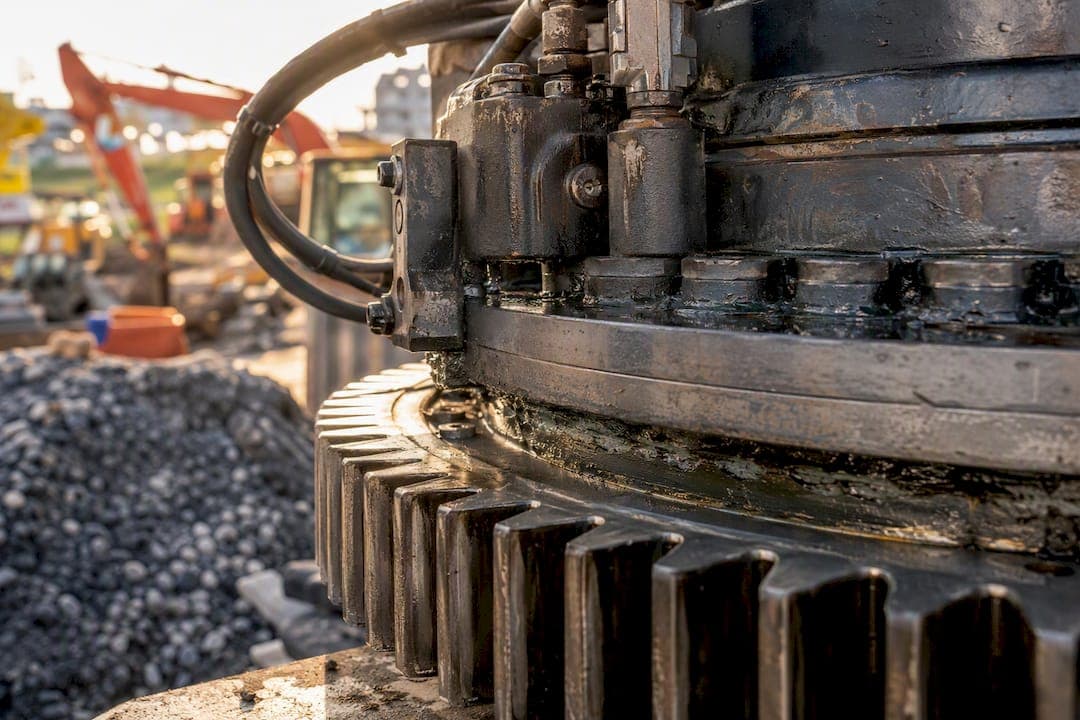
Stick-slip is a cyclic friction event where an excavator's slew drive alternates between static friction (stick) and kinetic friction (slip), producing jerky rotation, audible squeal, start-up delay, and velocity overshoot instead of smooth swing motion. It happens when the drive system cannot maintain constant torque against changing friction resistance, so the boom lurches forward in short bursts rather than gliding.
If you are troubleshooting this right now, start here:
- Lubrication coverage: check the slew ring and gear mesh for dry patches or contamination.
- Audible/vibration check: listen for a screech or feel a cabin shudder at low swing speed.
- Preload and stiffness test: command a slow swing sweep and watch for a delayed start followed by a jump.
Operators should run this triage before calling it a hydraulic fault. Engineers should move straight to instrumented measurement, since guesswork rarely isolates whether the cause is lubrication, backlash, or hydraulic elasticity.
Key Takeaways
Stick-slip in an excavator's swing drive is a friction cycle, not a single fault, and fixing it means matching the mitigation to the actual root cause instead of guessing.
| Point | Details |
|---|---|
| Definition matters | Stick-slip is the cyclic alternation between static and kinetic friction that causes swing jerking, screech, and start-up delay. |
| Lubrication is the cheapest fix | Coverage near 90% suppresses stick-slip while coverage around 75% makes it likely, per historical tribology data. |
| Start simple, escalate carefully | Run audible and mechanical checks before moving to instrumented testing with accelerometers and encoders. |
| Slip sizes vary widely | Mesoscale research shows slip events follow a power-law distribution, so rare large jerks matter more than average behavior. |
| Ignoring it shortens bearing life | Fatigue models accounting for stick/slip zones predict shorter slewing bearing life than full-sliding assumptions. |
Table of Contents
- Root Causes of Stick-Slip in Excavator Slew Drives
- How Do Engineers Model Stick-Slip in Swing Systems?
- What Effects Does Stick-Slip Have on Swing Performance?
- How Do You Diagnose Stick-Slip in the Field?
- What Fixes Reduce Stick-Slip in Excavator Swing Drives?
- Maintenance Checklist for Stick-Slip Prevention
- What Do Simulation and Experimental Studies Show?
- An Engineer's Take on Prioritizing the Fix
- Frequently Asked Questions
- Sources
Root Causes of Stick-Slip in Excavator Slew Drives
Stick-slip in a slew drive rarely comes from one problem. It's usually a combination of mechanical, hydraulic, and tribological factors working against each other.
- Hydraulic system elasticity and compressibility. Oil isn't perfectly rigid. As pressure builds and releases through hoses and the swing motor, the drive periodically loses and regains torque, which pairs with dry friction to produce pressure transients as significant as the friction itself.
- Gear backlash and contact geometry. Loose mesh between the pinion and slew ring gives the drive slack to build up energy before releasing it in a jerk.
- Low slew-drive efficiency. Poor helix angles, mismatched materials, or degraded lubrication can push drive efficiency well below its rated capacity, a factor engineering studies flag as a primary driver of stick-slip.
- Reducer and drive ratio interactions. The relationship between hydraulic motor flow and the reducer's transmission ratio directly shapes oscillation amplitude and how fast the system damps out after a slip event, according to parameter studies on excavator swing drives.
- Uneven loading from tilt. Operating on a slope beyond roughly 5 degrees can load one side of the slew bearing more than the other, amplifying stick-slip cyclically rather than uniformly.
Low lubrication coverage leads to intermittent boundary friction, which shows up as an audible squeal and a string of micro-stick events rather than one clean slip.
Pro Tip: Warm the hydraulic system to operating temperature and swing slowly in both directions. If the jerk disappears once the oil warms, you're likely looking at elastic-drive stick-slip tied to viscosity, not a dry lubrication gap in the gear mesh.
How Do Engineers Model Stick-Slip in Swing Systems?
Engineers model excavator stick-slip using three complementary approaches: spring-slider (Prandtl-Tomlinson / block-spring) models, velocity-dependent friction laws, and coupled hydraulic-mechanical models that combine oil compressibility with gear train dynamics. None of these works alone. The spring-slider analogy explains the basic stick-slip cycle of energy storage and release, but a real swing drive also needs the hydraulic side represented.
Calibrating any of these models requires measuring:
- Static and dynamic friction coefficients at the gear and bearing contacts
- Contact stiffness and backlash in the reducer
- Hydraulic oil bulk modulus and hose/pipe compliance
- Motor and reducer inertia, plus system damping and preload
What matters to an operator is what the model predicts: start-up delay, overshoot magnitude, and the size distribution of slip events. That last point matters more than it sounds. Mesoscale friction experiments show slip sizes follow a power-law distribution, meaning most events are tiny and a small number are large. A model tuned only to average behavior will miss the rare large jerk that actually damages hardware.
What Effects Does Stick-Slip Have on Swing Performance?
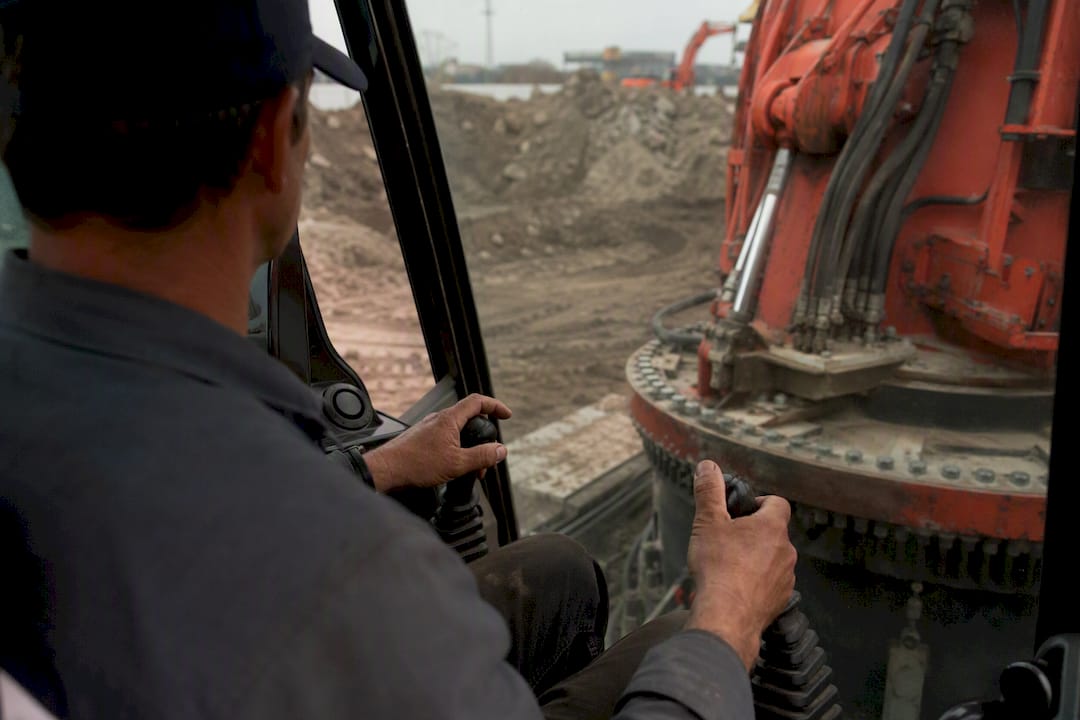
Stick-slip degrades swing motion in five measurable ways: start-up time delay, velocity overshoot, jerking and vibration, reduced positioning precision, and accelerated wear on bearings and gears.
You'll notice it before you can measure it. Watch for:
- An audible squeal or screech during slow swing
- Repeated micro-stops rather than continuous rotation
- Inconsistent tracking speed at low commanded velocities
Over time, these events compound. Slewing bearing fatigue models that account for stick/slip contact zones predict shorter service life than models assuming full sliding contact, which means the squeal you hear today is a preview of bearing wear tomorrow.
How Do You Diagnose Stick-Slip in the Field?
Start with the cheapest checks first: audible and vibration inspection, then basic mechanical and lubrication inspection, and only then move to instrumented testing if the problem persists.
- Slow-speed sweep. Command a full swing at minimum controllable speed and note where jerks occur.
- Start/stop step test. Issue repeated stop-start commands and time the delay before motion begins.
- Repeatability check. Run the same test three times; a consistent delay or overshoot pattern points to a mechanical or hydraulic root cause rather than random noise.
Log the start delay in milliseconds and the overshoot as a percentage of commanded velocity, then compare runs for consistency.
For instrumented testing, use:
- A low-frequency accelerometer mounted on the cab or slew frame
- A high-resolution rotary encoder on the output ring
- Pressure transducers on the hydraulic supply and return lines
Recording torque, pressure, angle, velocity, and time together lets you correlate stick intervals and slip amplitude with pressure transients, which is exactly how researchers validate these events in simulation.
What Fixes Reduce Stick-Slip in Excavator Swing Drives?
Start with the least invasive fix and work upward only if the problem persists.
- Lubrication and contamination control. Restore film coverage on the gear mesh and slew ring. Coverage near 90% suppresses stick-slip, while coverage around 75% makes it far more likely. This is a same-day field fix.
- Increase local stiffness or preload. Tightening backlash in the reducer reduces the energy the system can store before releasing it in a jerk.
- Add damping in the control loop. Software or hydraulic damping smooths the transition through the stick phase without a hardware change.
- Change helix angle or lubricant chemistry. This is a moderate redesign step, best done when efficiency has degraded well below rated capacity.
- Adjust control strategy. Lower loop gain at low speed and shape the velocity command to avoid abrupt torque demand.
- Mechanical redesign. Changing the reducer ratio or upsizing the axial bearing is the most invasive fix, reserved for chronic cases that survive every other step.
Pro Tip: When tuning the low-speed control loop, reduce integrator gain incrementally rather than all at once. Cutting gain too aggressively kills overshoot but introduces a sluggish, mushy response that hurts fine positioning just as much as the original jerk did.
Maintenance Checklist for Stick-Slip Prevention
Run through these on a recurring schedule, not just when you hear a problem:
- Lubricant type and coverage across the slew ring and pinion mesh
- Backlash quick-check at the gear mesh
- Slew bearing preload verification
- Fluid level and contamination inspection
- Chassis tilt and leveling before precision work
- Instrumented swing test on a set cadence (quarterly is a reasonable starting point for active fleets)
Log lubrication coverage percentage, backlash measurement in millimeters, and any observed start delay each time. A reading that trends worse across three consecutive checks, even if each one seems minor, is your cue to escalate to engineering analysis rather than waiting for a full stall.
What Do Simulation and Experimental Studies Show?
Simulation and physical testing agree on the same core finding: adding a stick-slip friction model to swing motion produces a measurable start-up delay and velocity overshoot, and hydraulic leakage and backlash contribute to pressure transients just as much as dry friction does.
Four sources worth knowing:
- The ASME excavator swing study, which validated the friction model against instrumented field tests
- The MDPI integrated-transmission analysis, which shows how motor flow and reducer ratio govern oscillation damping
- The Nature mesoscale tribology paper, establishing power-law slip-size statistics
- The SAGE slewing bearing study, quantifying fatigue-life sensitivity to stick/slip contact zones
For model calibration, start with the ASME paper for the friction formulation, then layer in the MDPI parameter study for drive-ratio effects.
An Engineer's Take on Prioritizing the Fix
Chase lubrication and preload before you touch the gear train. Most swing stick-slip is cheap to fix and expensive to ignore. Given resale value depends on smooth, documented operation, catching it early protects both uptime and the machine's future sale price.
Frequently Asked Questions
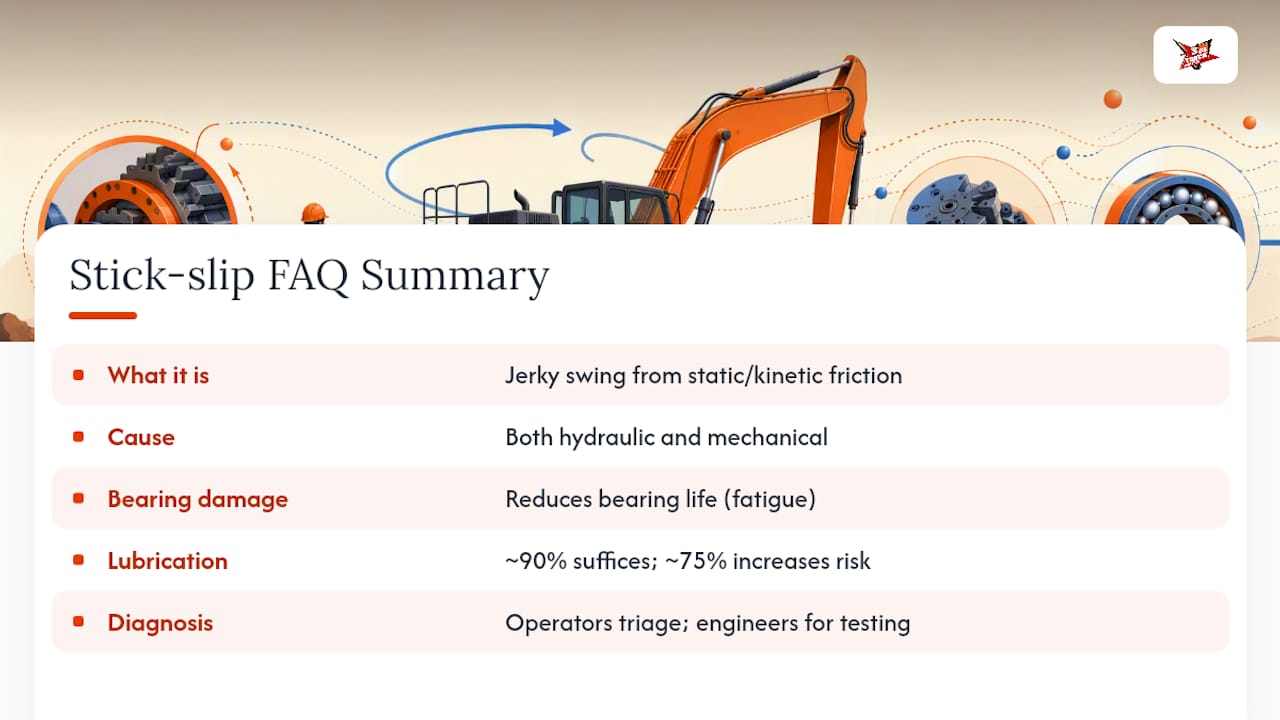
What is stick slip excavator behavior, exactly? It's the jerky, screeching swing motion caused by the drive alternating between static and kinetic friction instead of rotating smoothly, most often tied to lubrication gaps, backlash, or hydraulic elasticity.
Is stick-slip a hydraulic problem or a mechanical problem? Both, usually. ASME research shows hydraulic leakage and backlash contribute to pressure transients alongside dry friction, so treating the system as purely mechanical or purely hydraulic misses half the picture.
Can stick-slip damage the slewing bearing over time? Yes. Fatigue models that include stick/slip contact zones predict reduced bearing life compared with models that assume smooth, full-sliding contact.
How much lubrication coverage prevents stick-slip? Classic tribology data points to roughly 90% coverage as sufficient to suppress it, while coverage dropping to around 75% makes stick-slip much more likely.
Do I need an engineer to diagnose stick-slip, or can operators handle it? Operators can run the initial triage: lubrication check, audible inspection, and a slow-speed sweep. If the problem persists after basic maintenance, instrumented testing and modeling require engineering involvement to isolate the exact cause.
Whether you're evaluating a used excavator's swing performance before a purchase or listing one for sale, understanding how it handles a slow-speed swing test tells you more about drive condition than the hour meter ever will. Browse verified listings and dealer inventory at Sostruckforsale to compare machines with documented maintenance histories before you buy or sell.
Sources
- Simulation and Experimental Studies of Gear Backlash and Stick-Slip Friction in Hydraulic Excavator Swing Motion
- Analysis of Influential Parameters in the Dynamic Loading and Stability of the Swing Drive in Hydraulic Excavators
- Statistical laws of stick-slip friction at mesoscale
- Stick-slip phenomenon (Rabinowicz, Scientific American 1956)
For hydraulic contamination troubleshooting on-site, teams sometimes reference general industrial jetting and maintenance service practices, and structured inspection cadences like those used in scheduled facility maintenance programs translate well to instrumented swing-test scheduling.