

Truck telematics is the integration of telecommunications and vehicle diagnostics to monitor and manage commercial fleets in real time. The system combines GPS tracking, onboard diagnostics, and wireless communication to transmit vehicle data to centralized fleet management platforms. At its core, telematics collects:
- Vehicle location and route data via GPS receivers
- Engine diagnostics through OBD-II or CAN-bus interfaces
- Driver behavior metrics including speed, hard braking, and acceleration
- Fuel consumption and idle time from engine control modules
- Fault codes and maintenance alerts for proactive servicing
The Telematics Control Unit (TCU) is the hardware that makes this possible. Think of it as the data hub installed in each truck, collecting, timestamping, and transmitting information to cloud servers where fleet managers can view it through dashboards and mobile applications.
Table of Contents
- How truck telematics systems actually work
- What telematics delivers for fleet efficiency and safety
- How predictive maintenance works through telematics
- How insurers use telematics data to set fleet premiums
- Data privacy and security in telematics systems
- Practical applications that show real operational gains
- Challenges you will face when implementing telematics
- Where truck telematics technology is heading
- Key Takeaways
How truck telematics systems actually work
Understanding the operational architecture helps fleet managers evaluate and configure systems effectively. The workflow moves from hardware to cloud to dashboard in a clear sequence.
The TCU hardware components include a GPS receiver, a cellular modem with SIM card, a microprocessor, and vehicle interface ports. These connect directly to the truck's OBD-II port or CAN-bus network to pull data from the engine control module and onboard sensors.
- Data acquisition: Sensors read engine RPM, coolant temperature, fuel levels, tire pressure, and fault codes continuously
- Transmission: Data travels over cellular networks (most modern systems use 4G LTE, with 5G adoption increasing) or satellite to cloud servers
- Processing: Backend systems decode raw data, apply logic rules, and store structured records
- Visualization: Fleet managers access processed data through web dashboards or mobile apps, with alerts, reports, and driver scorecards
Integration with existing fleet management software is a practical priority. Most telematics platforms offer API connections to dispatch systems, payroll tools, and maintenance management software, so data flows into workflows already in place rather than creating a separate silo.
What telematics delivers for fleet efficiency and safety
The business case for truck telematics is grounded in measurable operational gains across fuel, safety, compliance, and maintenance.
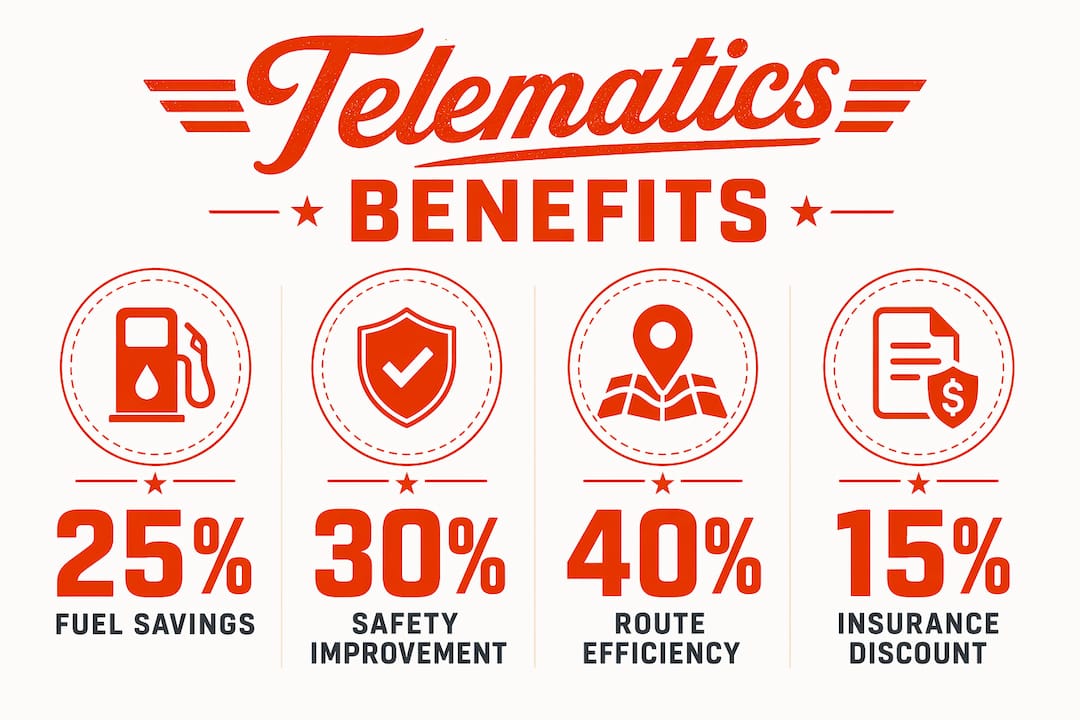
Route optimization and fuel savings are among the most immediate returns. Real-time GPS data lets dispatchers reroute trucks around traffic, reduce unnecessary mileage, and cut idle time, all of which directly reduce fuel spend.
Driver behavior monitoring gives fleet managers objective data on speeding, harsh braking, and rapid acceleration. Telematics platforms generate driver scores and coaching reports that supervisors can use in performance reviews, reducing accident rates and associated liability costs.

Regulatory compliance is simplified through automated reporting. Telematics systems capture Hours of Service (HOS) data, vehicle inspection records, and driver activity logs, helping fleets demonstrate regulatory adherence to FMCSA standards without manual paperwork.
Insurance premium reductions follow from documented safe driving records. Carriers offering usage-based insurance programs use telematics data to price risk accurately, rewarding fleets with strong safety profiles.
How predictive maintenance works through telematics
Predictive maintenance is where telematics delivers some of its highest operational value. Rather than waiting for a breakdown or relying on fixed mileage intervals, the system monitors real-time fault codes from the CAN-bus to flag developing issues before they cause downtime.
Fault code monitoring through CAN-bus allows early detection of engine and component problems, from oxygen sensor degradation to transmission irregularities. A fleet manager receives an alert, schedules the repair during planned downtime, and avoids a roadside breakdown that could cost far more in towing, delays, and lost revenue.
That said, implementation has real technical requirements. Device installation must match the vehicle's specific communication protocol, whether J-bus or CAN-bus, and misconfiguration creates "silent" data gaps where critical engine data never reaches the platform. Proper technician training during setup is not optional.
Alert fatigue is a genuine operational risk. Telematics subscription costs are typically between $25 and $75 per truck monthly, and without a clear prioritization strategy, the volume of alerts can overwhelm staff and reduce system effectiveness. Not every fault code demands immediate action.
Pro Tip: Establish a tiered alert protocol before going live. Classify faults as critical (immediate action), advisory (schedule within 48 hours), or informational (log and review weekly). Train maintenance staff to interpret codes in context, not just respond to every notification.
How insurers use telematics data to set fleet premiums
U.S. insurance companies have moved well beyond simple mileage-based pricing. Usage-based insurance models now adjust premiums dynamically based on driving behavior data collected from telematics devices, including hard braking frequency, speeding incidents, and nighttime driving patterns.
For fleet managers, this creates a direct financial incentive to monitor and improve driver behavior. Fleets with documented safe driving records can negotiate lower premiums at renewal, while high-risk driving patterns translate to higher costs. The data also supports claims management: when an incident occurs, telematics records provide objective evidence of vehicle speed, location, and driver inputs at the time.
Usage-based programs vary by carrier, but the underlying principle is consistent. Safer, data-verified fleets pay less. That connection between operational data and insurance cost makes driver behavior management a financial priority, not just a safety one.
Data privacy and security in telematics systems
Telematics systems collect detailed data on driver location, behavior, and working hours, which raises legitimate privacy and security concerns that fleet managers must address proactively.
On the driver privacy side, U.S. fleets operating across multiple states should be aware that some states have enacted regulations governing employee monitoring and data retention. Clear written policies informing drivers what data is collected, how it is used, and who can access it are both a legal safeguard and a trust-building measure with your workforce.
On the cybersecurity side, telematics data travels over cellular networks and resides in cloud platforms. Reputable telematics providers use encrypted data transmission and role-based access controls to limit who can view sensitive fleet records. When evaluating a platform, verify that it meets SOC 2 compliance standards and offers audit logs for data access.
Data retention policies matter too. Define how long historical telematics records are stored, who owns the data if you switch providers, and how data is deleted at contract end. These terms belong in the service agreement before you sign.
Practical applications that show real operational gains
Telematics moves from theory to results across several concrete use cases that U.S. fleets are applying today.
Geofencing for unauthorized use: Fleet managers set virtual boundaries around job sites or depots. If a truck moves outside the defined zone outside business hours, an instant alert goes to the manager's mobile device. This reduces fuel theft and unauthorized vehicle use without manual oversight.
Trailer and asset tracking extends telematics beyond powered vehicles. GPS trackers attached to trailers transmit location data continuously, letting dispatchers route drivers directly to stationary trailers and receive alerts if assets move without authorization. For construction fleets managing mobile equipment on job sites, this capability reduces equipment loss significantly.
AI-enabled dash cameras paired with telematics platforms identify distracted driving, tailgating, and stop-sign violations in real time, alerting drivers in-cab before a safety event occurs. This hands-off coaching model improves driver behavior without requiring a supervisor in the passenger seat.
HOS compliance automation removes the manual logbook entirely. Telematics systems record driving time, on-duty status, and rest periods automatically, keeping drivers compliant with FMCSA Hours of Service rules and reducing the administrative burden on both drivers and back-office staff.
Challenges you will face when implementing telematics
Telematics adoption is not without friction. Fleet managers who go in with realistic expectations manage the transition more effectively.
Hardware compatibility is the first hurdle. Older trucks may use proprietary communication protocols that require adapters or custom configurations. Verify protocol compatibility for every vehicle in your fleet before purchasing devices.
Driver adoption takes deliberate management. Drivers who feel monitored without context often resist telematics. Framing the system as a safety and coaching tool, rather than surveillance, and involving drivers in reviewing their own data, reduces pushback.
Data overload is a structural challenge. A fleet of 50 trucks generates an enormous volume of data daily. Without defined KPIs and reporting structures, managers spend time in dashboards without extracting decisions. Start with three to five core metrics and expand from there.
Integration complexity with legacy dispatch or maintenance software can extend implementation timelines. Budget for IT support and allow time for testing data flows before going fully live.
Where truck telematics technology is heading
The next generation of telematics is already in deployment across leading U.S. fleets, and the trajectory is toward greater automation and predictive intelligence.
5G connectivity is replacing 4G LTE in newer telematics devices, enabling faster data transmission, lower latency, and support for higher-bandwidth applications like real-time video streaming from multiple cameras simultaneously.
AI-driven analytics are moving beyond reporting into active decision support. Platforms are beginning to answer operational questions directly, flagging performance anomalies and recommending specific actions rather than presenting raw data for managers to interpret.
V2X communication (vehicle-to-everything) will allow trucks to exchange data with infrastructure, other vehicles, and logistics networks, enabling coordination that goes beyond individual fleet management into supply chain-wide visibility.
Sustainability reporting is becoming a telematics output as U.S. carriers face growing pressure to document emissions data. Telematics platforms are adding carbon tracking and idle-reduction reporting to support ESG compliance requirements.
For fleets evaluating new equipment, safety compliance tools integrated with telematics are also advancing rapidly, particularly in industries where regulatory scrutiny is high.
Key Takeaways
Truck telematics combines GPS, onboard diagnostics, and wireless communication to give fleet managers real-time visibility into vehicle location, driver behavior, engine health, and compliance status, making it the operational backbone of modern fleet management.
| Point | Details |
|---|---|
| Core technology stack | TCU hardware integrates GPS, cellular modem, and OBD-II or CAN-bus to collect and transmit vehicle data. |
| Predictive maintenance value | Real-time fault code monitoring enables repairs before breakdowns, reducing downtime and roadside costs. |
| Insurance impact | Usage-based insurance models tie premiums directly to telematics-verified driver behavior data. |
| Alert fatigue risk | Subscription costs are typically between $25 and $75 per truck monthly; a tiered alert protocol is needed to keep data actionable. |
| Implementation priorities | Verify protocol compatibility per vehicle, set clear driver policies, and define KPIs before going live. |