

Truck residual value directly determines how much you pay each month on a lease, when you should trade, and whether you walk away from a deal with equity or a bill. Higher residual means a smaller depreciation charge spread across your lease term, which translates to lower monthly payments and a more predictable end-of-lease position. Before you sign any lease or place a truck order, check three things immediately:
- Residual percentage: Is the lessor quoting 40%, 50%, or 60% of MSRP at lease end? A 10-percentage-point swing on a $180,000 Class 8 tractor changes your monthly depreciation charge by roughly $250–$300.
- Who guarantees it: A closed-end lease fixes the residual and puts market risk on the lessor. An open-end lease puts that risk on you.
- Mileage and spec limits: Residual assumptions are built around a specific annual mileage and configuration. Exceed either and the guaranteed value drops.
Residual value sits at the center of total cost of ownership (TCO). It shapes monthly cashflow through the depreciation portion of your payment, determines end-of-lease equity (or liability), and sets the optimal replacement window. Get it wrong and you overpay on every lease cycle.
Key Takeaways
Residual value is the single most powerful variable in a truck lease, and managing it proactively across the asset's lifecycle is what separates efficient fleet operations from costly ones.
Table of Contents
- What is residual value, and how does it differ from resale and depreciation?
- How does residual value determine your monthly lease payment?
- Who sets residual values, and when can they change?
- What drives truck residual values: controllable specs vs. market forces
- Which truck segments and specifications typically retain the most value?
- Can you negotiate residual value, and what lease structure choices change your exposure?
- How used-truck residuals act as market signals for fleet decisions
- Actionable steps to protect residual value and improve lease economics
- The marketplace perspective on residual value
- List your truck where serious buyers are looking
- Sources
What is residual value, and how does it differ from resale and depreciation?
Residual value is the lessor's forward-looking estimate of what a truck will be worth at the end of a lease term, expressed either as a dollar amount or as a percentage of the original MSRP. It is a contractual figure, set at lease inception, not a market price.
Resale value is the actual price a truck fetches in the market at the moment of sale. It is realized, not estimated. A truck's resale value at month 48 may be higher or lower than the residual the lessor projected three years earlier.
Depreciation is the loss in value over time, whether calculated for accounting purposes (straight-line or MACRS under IRS rules) or observed in the market. Under Section 179 and bonus depreciation rules, an owner can write down a truck's book value to near zero in year one, but the market does not follow that schedule. When that truck sells, the IRS recaptures the difference between the sale price and the depreciated book value as ordinary income under Section 1245.
The table below shows how the same Class 8 tractor carries three different values simultaneously, each relevant to a different decision:
The gap between residual and actual resale is where fleet equity is created or destroyed. When resale exceeds residual on a closed-end lease, the lessor captures that upside. When resale falls below residual on an open-end lease, the lessee absorbs the shortfall.
How does residual value determine your monthly lease payment?
The core lease payment formula is straightforward. The depreciation portion equals the capitalized cost (cap cost) minus the residual value, divided by the number of months in the term. The finance charge is calculated on the average of cap cost and residual, multiplied by the money factor. Monthly payment equals depreciation portion plus finance charge.
Edmunds' leasing basics explain this formula in consumer terms, and the same math applies directly to commercial truck leases when you substitute the truck's MSRP and commercial money factors.
Worked example: three residual scenarios on a Class 8 tractor
A 20-percentage-point spread in residual assumptions produces a $678 monthly payment difference on the same truck, the same term, and the same rate. Over 48 months, that is $32,544 in total lease cost variation driven entirely by the residual figure.
The residual percentage is the single most powerful lever in a lease negotiation. A 10-point improvement in residual reduces monthly cost more than most interest-rate concessions a lessor will offer.
End-of-lease equity matters just as much. In the high-residual scenario, if the truck's actual market value at month 48 is $95,000, the lessee on a closed-end lease walks away with no liability. On an open-end lease, that same lessee captures the $5,000 surplus. In the low-residual scenario with a contracted buyout at $54,000 and a market value of $65,000, the lessor on a closed-end deal keeps the $11,000 upside.
Brobas Capital Research quantifies one key driver of that gap: for Class 8 sleepers, each additional 100,000 miles reduces residual value by approximately $6,200. A truck running 130,000 miles per year versus 100,000 miles per year loses roughly $18,600 more in value over three years, purely from mileage.
Who sets residual values, and when can they change?
Residual values come from three sources, and knowing which one applies to your deal tells you how much flexibility you have.
- OEM captive finance arms (the manufacturer's own leasing subsidiary) set residuals based on proprietary sales data, fleet return volumes, and remarketing programs. They can offer manufacturer-backed residual guarantees or buyback programs, particularly during promotional periods.
- Third-party leasing companies and independent lessors use market data from services like ACT Research's used-truck price forecasts and Black Book to model expected future values. Their residuals tend to be more conservative because they carry the market risk without a manufacturer backstop.
- Industry forecast services (ACT Research, Black Book, Kelley Blue Book) publish segment-level and model-level forward pricing that lessors use as inputs. These are not residuals themselves but the data behind them.
Timing matters. On a closed-end lease, the residual is fixed at signing and does not change regardless of what the market does. On an open-end lease, the lessee is exposed to the difference between the contracted residual and actual market value at disposition. If the truck sells for less than the residual, the lessee pays the shortfall. If it sells for more, the lessee keeps the surplus.
Questions to ask any lessor before signing:
- Is the residual stated as a percentage of MSRP or as a fixed dollar amount?
- Is this a closed-end or open-end structure? Who carries the residual risk?
- Under what conditions can the residual be adjusted (early termination, excess mileage, damage)?
- Is there a manufacturer buyback or guaranteed repurchase program attached?
- What happens to the residual if you add or change upfit equipment after delivery?
Pro Tip: *On open-end leases, ask the lessor to show you the residual assumption as a percentage of current wholesale market value, not just MSRP.
What drives truck residual values: controllable specs vs. market forces
Not all depreciation is equal, and not all of it is outside your control. The factors that move residuals fall into two categories: things you decide at order time or manage in service, and macro forces you can monitor but not control.

Factors you can control
| Factor | Residual Impact | Practical Action |
|---|---|---|
| Mileage allowance | ~$6,200 per 100K miles (Class 8 sleeper) | Set realistic annual mileage; negotiate overage rate upfront |
| Spec standardization | High-demand specs retain value better | Stick to popular axle ratios, engine ratings, and fleet-standard upfits |
| Documented maintenance | Clean records improve buyer confidence | Use telematics and digital service logs from day one |
| Warranty coverage | Active warranty increases buyer pool | Time trades to keep remaining warranty on the unit |
| Upfit choices | Non-standard upfits narrow buyer pool | Avoid highly specialized bodies unless the use case demands it |
Brobas Capital Research's depreciation analysis identifies the 42–48 month window as often optimal for Class 8 sleeper trades, before the next major maintenance cycle drives costs up and while the unit still carries meaningful warranty coverage.
Market forces to monitor
Freight-cycle demand is the largest external driver. When freight volumes tighten and new-truck production is constrained, used values rise and residuals improve. When capacity floods the market, used values fall and lessors tighten residual assumptions on new deals. Black Book's Q2 2026 market update shows early 2026 moving from a broad correction toward early-stage firming, with late-model units showing stronger demand and monthly wholesale declines moderating from 2025 levels.
Regulatory and technology shifts also carry residual risk. Emissions-standard transitions, electrification timelines, and changes in Hours of Service rules can all compress demand for specific configurations. A pre-emissions-change engine that was a premium spec can become a liability if the regulatory environment shifts before the lease ends.
The largest single controllable dollar impact on residual is mileage discipline. Fleets that run 20,000–30,000 more miles per year than their lease assumption are effectively paying a hidden depreciation penalty that compounds across every unit in the fleet.
Which truck segments and specifications typically retain the most value?
Class 8 over-the-road tractors in late-model, low-mileage condition consistently show stronger residual performance than older or higher-mileage units. Vocational and specialty trucks vary significantly by regional demand and application depth.
J.D. Power's resale value research and Kelley Blue Book's best resale value awards both track model-level value retention, and the patterns they identify translate to commercial segments: reliability reputation, parts availability, and broad buyer demand are the consistent drivers of strong residuals.
Specification choices that protect value:
- Engine ratings in the mainstream range (400–500 hp for over-the-road) attract the widest buyer pool. Highly de-rated or over-spec'd engines narrow demand.
- Popular axle and ratio combinations for the dominant application in your region. Unusual ratios require a buyer with a matching application.
- Day cab vs. sleeper: Day cabs typically depreciate faster in percentage terms but serve a broader local/regional buyer pool. Sleepers hold absolute dollar value better in over-the-road markets.
- Clean emissions packages with current-generation aftertreatment systems. Units with documented aftertreatment issues or non-compliant modifications face steep discounts.
- Telematics-equipped units with a clean digital history. Buyers increasingly pay a premium for verifiable maintenance and usage data.
- Active manufacturer warranty remaining at trade time. A unit with 12 months of powertrain warranty left commands more at auction than an identical unit with none.
A value-retaining build looks like this: a 2022 or newer Class 8 sleeper, mainstream engine rating, popular axle ratio, under 500,000 miles, complete digital service records, active warranty, and standard fleet upfit. A value-leaking build is the opposite: a heavily customized vocational unit with a specialized body, non-standard powertrain, no service documentation, and a mileage history that exceeds the lease assumption.
Can you negotiate residual value, and what lease structure choices change your exposure?
The short answer is that the residual itself is rarely negotiable in a closed-end commercial lease. Lessors set it based on their own risk models and remarketing data, and they will not move it without a corresponding change in rate or structure. What you can negotiate are the variables that determine how much the residual matters to your deal.
Negotiable items that affect payment and equity:
- Capitalized cost: Reducing the cap cost through incentives, fleet discounts, or trade equity directly lowers the depreciation charge, independent of the residual.
- Mileage allowance and overage rate: A realistic mileage cap protects the residual assumption. Negotiate the overage rate per mile at signing, not at lease end.
- Maintenance and warranty addons: A full-service lease with maintenance included reduces residual risk from deferred maintenance and can improve the unit's condition at return.
- Purchase option price: On leases with a fixed purchase option, the buyout price is set at inception. If market values rise above that figure, you can buy and resell at a profit.
- Lease term: Shorter terms (36 months vs. 60 months) generally carry higher residuals because the lessor's forecasting risk is lower.
Lease structure and residual risk:
A closed-end lease fixes the residual. The lessor takes the market risk at disposition. Your exposure is limited to excess mileage, damage, and condition charges. This structure suits fleets that want payment predictability and do not want to manage remarketing.
An open-end lease passes market risk to the lessee. If the truck sells for less than the contracted residual at lease end, you pay the difference. If it sells for more, you keep the surplus. This structure suits fleets with strong remarketing capabilities and confidence in their residual assumptions.
A finance lease (or TRAC lease in commercial trucking) is structured like an open-end lease for tax purposes but with a terminal rental adjustment clause that settles the difference between contracted and actual residual at disposition.
Pro Tip: If a lessor offers a closed-end lease with a residual that seems unusually high, check whether it is backed by a manufacturer buyback program or whether the lessor is simply pricing in a higher rate to offset the risk. A high residual with a high money factor can cost more over the term than a mid-residual deal with a competitive rate.
How used-truck residuals act as market signals for fleet decisions
Used-truck values are not just secondary prices. ACT Research analysts treat them as leading indicators of freight-cycle health: when used values move, that movement often precedes visible changes in freight demand and fleet behavior. A fleet manager who tracks used-truck indices is watching the same data that lessors use to set residual assumptions on new deals.
The practical read: rising used values signal tightening capacity, stronger freight demand, and a seller's market for equipment. Falling values warn of excess capacity, softening freight, and a buyer's market where lessors will tighten residuals on new leases to protect their books.
ACT Research's secondary-market resources show how used-value movement informs buy, lease, and hold decisions across fleets and lenders. The signal is most useful when read by segment and model, not as a single market average.
Black Book's Q2 2026 update provides a concrete example: Q1 2026 saw smaller monthly wholesale declines than 2025, with late-model segments rebounding in March. A fleet that read that signal in February and accelerated trades on late-model units captured better auction prices than one that waited until the trend was widely reported.
Fleet replacement timing applications:
- Accelerate trades when used values are rising and your units are in the 36–54 month window. You capture peak residual before the next depreciation step.
- Delay trades when values are falling and your units are mechanically sound. Holding through a soft market avoids locking in a loss.
- Use residual forecasts in capital planning. If your lender uses truck values as collateral, a falling used-value environment tightens loan covenants and may require equity injections.
- Feed residual indices into remarketing strategy. Auction versus retail channel choice should reflect current market liquidity, not habit.
That kind of move often precedes a broader correction that will compress residuals on your next lease cycle.
Actionable steps to protect residual value and improve lease economics
Protecting residual value is a discipline that starts at the order sheet and runs through every month of the asset's life. The steps below are prioritized by dollar impact.
- Standardize specifications at order time. Choose mainstream engine ratings, popular axle ratios, and fleet-standard upfits. Spec diversity across a fleet creates remarketing complexity and reduces buyer pool depth at trade time.
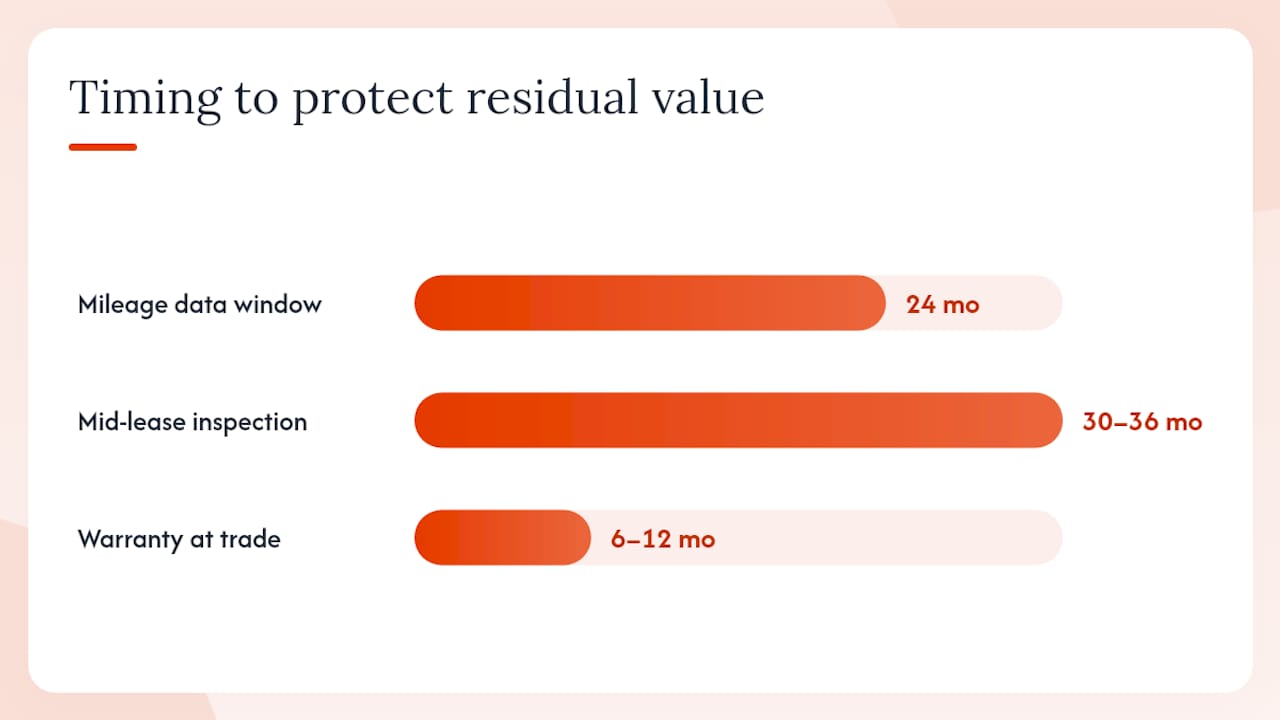
- Set realistic mileage allowances. Use 24 months of actual fleet data to set the mileage cap, not an optimistic projection. The per-mile penalty at lease end typically exceeds the overage rate you could have negotiated at signing.
- Implement digital maintenance records from day one. Telematics-linked service logs, oil analysis records, and inspection reports create a verifiable history that buyers pay for. Alliance Fleet Solutions' lifecycle guide shows that proactive lifecycle management with data-certified maintenance and multi-channel remarketing can increase disposal returns by roughly 10–15% compared with reactive trade-in practices.
- Time trades to preserve warranty coverage. A unit with active powertrain warranty remaining at disposition commands a measurable premium. Plan trade windows so at least 6–12 months of manufacturer warranty transfers to the buyer.
- Conduct mid-lease condition inspections at month 30–36. Identify and address deferred maintenance, cosmetic damage, and tire wear before they compound. A $2,000 reconditioning investment at month 36 can recover $5,000–$8,000 in auction price at month 48.
- Diversify remarketing channels. Retail sale, dealer trade, private fleet-to-fleet, and auction each reach different buyer pools at different price points. Relying on a single channel, especially reactive auction, consistently produces lower net proceeds.
- Compare lease offers on residual, not just rate. When evaluating two lease proposals, calculate the total depreciation charge (cap cost minus residual, divided by term) for each. A lower rate on a low-residual deal often costs more over the term than a slightly higher rate on a high-residual structure.
Pro Tip: When comparing two lease offers side by side, ask each lessor to provide the residual as both a percentage of MSRP and a dollar amount. Lessors sometimes quote percentage on a discounted cap cost rather than full MSRP, which makes the residual look higher than it is. The dollar figure does not lie.
Tax structure also affects the buy-versus-lease decision in ways that interact with residual value. As FreightWaves explains, taking full Section 179 or 100% bonus depreciation improves year-one cashflow but creates depreciation recapture risk at sale under IRS Section 1245. A truck written down to near zero on the books but sold for $70,000 generates $70,000 of ordinary income. Plan sale timing with your CPA, particularly if you are in a high-income year.
This article provides general information on truck residual value and leasing economics. It is not a substitute for professional financial, tax, or legal advice. Confirm current IRS rules and lease terms with a qualified advisor.
The marketplace perspective on residual value
Residual value is the number that separates informed equipment buyers and sellers from everyone else in the commercial truck market. After years of watching transactions move through the heavy equipment marketplace, the pattern is consistent: sellers who understand their asset's residual position price it correctly and sell faster. Buyers who ignore residual assumptions overpay on leases and underestimate their end-of-lease exposure.
Three things stand out from marketplace activity:
First, the gap between what sellers think their truck is worth and what the market will pay is almost always a residual-awareness problem. Sellers who track used-value indices and time their listings to market conditions consistently achieve better outcomes than those who list reactively.
Second, specification decisions made at order time have a longer financial tail than most buyers realize. A non-standard axle ratio or a heavily customized body does not just reduce the buyer pool at trade time. It reduces the lessor's residual assumption at lease inception, which means you pay more every month for the entire term.
Third, the 2026 market is rewarding late-model, well-documented units. The early-stage firming Black Book identified in Q1 2026 is concentrated in exactly the kind of units that were spec'd and maintained with residual value in mind.
List your truck where serious buyers are looking
Capturing residual value at disposition depends on reaching the right buyers at the right time. Sostruckforsale gives sellers direct access to a national audience of fleet managers, owner-operators, and equipment buyers actively searching for semi trucks, heavy-duty trucks, and commercial equipment.
Listing on Sostruckforsale puts your asset in front of buyers who are already in the market, not browsing casually. The platform supports classified listings across truck categories, trailers, and industrial equipment, with dealer directory placement for commercial sellers who want consistent visibility. For fleets timing a trade to current market conditions, that reach translates directly into a faster sale and a stronger net price.
Browse current inventory or list your commercial truck on Sostruckforsale today and put your asset in front of buyers who are ready to move.
Sources
These sources provide the data and analysis behind sound residual value decisions: