

For multi-location heavy-equipment dealers, the fastest way to stop duplicate listings and lost sales is one canonical machine record that publishes everywhere automatically. Multi-location dealer listings simply means how a dealer with two or more yards manages, posts, and updates equipment ads across every branch and marketplace without contradicting itself. The winning setup pairs a centralized inventory record with automated sync and standardized data fields, an approach Sostruckforsale builds its own listing tools around and one the wider heavy-equipment industry increasingly treats as standard(https://www.flyntlok.com/resource/multi-location-equipment-dealer-management).
TL;DR:
- Standardize inventory fields such as serial numbers, categories, and condition codes before connecting any sync automation to prevent data conflicts.
- Use a single machine record created at the location where the equipment physically resides, and publish it simultaneously across all channels to avoid duplicate listings.
- Log every transfer between branches with timestamps and custody details to prevent double-sold equipment and clarify ownership status.
- Track key performance metrics like views, inquiries, and time-to-sold at the branch level to identify slow-moving inventory and optimize listing strategies.
- Set role-based permissions aligned with organizational decision-making to control listing edits and avoid unauthorized changes that could cause inconsistencies.
Table of Contents
- Why Centralize Listings? The Case for One Source of Truth
- What Should You Standardize Before You Sync?
- How Do You Post, Update, and Transfer Listings Across Locations?
- What Belongs on Every Listing Regardless of Location?
- Which KPIs Prove Your Listings Are Actually Working?
- How Do You Bring a New Location Online Without Disruption?
- How Does Automatic Sync Keep Marketplaces Consistent?
- What Do You Do When Two Locations Disagree on Inventory?
- Who Should Have Access to Edit Which Listings?
- Should Pricing and Promotions Vary by Location?
- How Do Marketplace Rules Differ by Region?
- How Should You Coordinate Returns and Transfers Between Branches?
- What Practical Lessons Come from Running These Systems Daily?
- List Your Inventory Where Multi-Location Dealers Already Compete
- Sources
- FAQ
Why Centralize Listings? The Case for One Source of Truth
Running separate listing processes at each branch multiplies the same equipment record by however many locations you operate. A wheel loader gets typed into a spreadsheet at Yard A, retyped for the website at Yard B, and copied a third time when someone finally posts it to a marketplace. Every retype is a chance to fudge a serial number or leave off a spec.
Centralized publishing fixes the duplication problem at the source. You build the listing once, from one machine record, and push it to every connected channel from there, which is the model that saves the most administrative time for equipment dealers. Fewer manual entries means fewer missed sales, and it means less cash sitting frozen because two branches both think they still own a machine that actually sold last Tuesday.
You don't need five locations to feel this pain. Even a two-yard operation runs into double-booked inventory the moment a salesperson at one branch quotes a machine the other branch already sold. Centralization scales with your marketplace count and inventory size, but the time savings show up even for smaller dealers running just two locations and a handful of active listings.
What Should You Standardize Before You Sync?
Automated synchronization only works if every branch describes the same thing the same way. Skip this step and your sync tool will faithfully copy inconsistent data to every marketplace at once, which is worse than doing it manually.
Lock down these fields before you connect any sync tool:
- Stock and serial number formats (a single format, applied identically at every branch)
- Category and subcategory taxonomy (excavator vs. mini excavator vs. compact track loader, defined once)
- Condition and status codes (what exactly counts as "used" versus "refurbished," and what status flags a unit as sold, held, or in transit)
- Location and yard identifiers tied to every record
Build a one-page data dictionary that spells out these definitions, store it somewhere every branch manager can find it, and run a pilot of 5 to 10 listings before rolling sync out company-wide. Dealership Drive and similar inventory platforms centralize this control precisely because dealers who skip standardization end up with duplicate categories and conflicting status flags within weeks.
Pro Tip: Assign one person, not a committee, to own the data dictionary. Standards that get "revised by consensus" drift within a quarter.
How Do You Post, Update, and Transfer Listings Across Locations?
A working multi-location process follows the machine, not the paperwork. Here's the sequence that keeps records accurate from intake to sale:
- Create the machine record once, at the branch where the unit physically sits, with stock number, specs, and photos entered against your standardized fields.
- Publish from that single record to your website, dealer directory, and any connected marketplaces simultaneously, rather than rebuilding the ad on each platform.
- Set a sync frequency, typically hourly or on every status change, so a sale at one channel updates availability everywhere before a second buyer inquires.
- Flag transfers explicitly. When a unit moves between branches, log the transfer with a timestamp and the receiving branch's ID rather than just changing the location field silently.
- Auto-delist on sale. The moment a deal closes, the record should drop from every marketplace automatically, not on someone's end-of-day checklist.
- Archive rather than delete sold units, preserving the transfer and maintenance history for warranty and resale reference.
Manufacturing operations that manage equipment across multiple plants use the same logic: QR-code location updates and transfer logs solve the same custody problem heavy-equipment dealers face when a dozer moves from one yard to another mid-quarter. Skipping step four is the single most common cause of double-sold equipment.
What Belongs on Every Listing Regardless of Location?
A consistent listing template is what lets buyers trust that a Yard A ad and a Yard C ad from the same dealer group were built the same way. At minimum, every listing needs:
- Make, model, year, and hours or mileage
- Stock number and a clear, legible serial number photo
- Location, condition status, and price
- A written inspection note covering anything a buyer would ask about on a call
For photos, use an 8-photo minimum: front, rear, both sides, engine bay or compartment, cab or operator station, undercarriage or tires, and a dedicated serial number close-up. That eight-photo standard cuts down on buyer follow-up calls asking for pictures the ad should have included from the start, and it gives remote inspectors at other branches enough to work with without a site visit.
Keep the template's structure identical across every branch, but leave room for location-specific notes like regional attachment availability or a delivery radius. Listing quality directly affects how many qualified buyers actually call, and a template only works if every branch actually fills in every field instead of leaving the inspection note blank.
Which KPIs Prove Your Listings Are Actually Working?
Publishing consistently is only half the job. You need numbers that tell you whether the system is producing sales or just producing tidy spreadsheets.
Track these five at minimum:
- Views per listing, pulled from marketplace dashboards or UTM-tagged links to your own site
- Inquiries per listing, which tells you whether views are converting to interest
- Time-to-sold, measured from publish date to close, broken out by location
- Duplication rate, meaning how many units show up more than once across channels
- Location-level turnover, or how fast each branch clears its own inventory relative to the others
If a location's time-to-sold is running twice as long as your best-performing branch, check pricing and photo quality before assuming the market is just slow there. A short pilot of 5 to 10 listings is also the fastest way to catch whether your analytics setup itself is mapping data correctly before you trust the numbers company-wide. Guidance on tracking commercial vehicle listing analytics walks through setting up UTM tracking if you haven't already.
How Do You Bring a New Location Online Without Disruption?
Adding a branch to an existing multi-location system takes both a technical checklist and a people checklist, run in parallel rather than one after the other.
- Map the new location's existing data fields against your standardized dictionary before importing anything.
- Set role-based permissions for the new branch's staff before their first listing goes live.
- Configure the marketplace feed connection and confirm it syncs correctly with a small test batch.
- Train branch staff on the listing template and transfer-logging process, not just the software interface.
- Run a 30-day audit comparing the new branch's listings against your data dictionary to catch drift early.
Tying the new location's records to one shared chart of accounts, rather than a separate bookkeeping setup, lets finance pull branch-level profit and loss statements without reconciling two systems by hand. Before signing with any vendor, ask directly how they handle multi-branch permissioning and whether their system supports role-based access out of the box. A setup guide for dealer inventory platforms covers the onboarding sequence in more detail.
Pro Tip: Never let a new branch's staff post live listings until they've completed at least one supervised test batch. The habits they form in week one stick for years.
How Does Automatic Sync Keep Marketplaces Consistent?
Automatic inventory synchronization is the mechanism that makes centralized publishing actually hold together once you have more than one marketplace connected. Instead of a person manually updating price or availability on three different sites, the sync tool reads changes from your central machine record and pushes them out on a schedule or in real time.
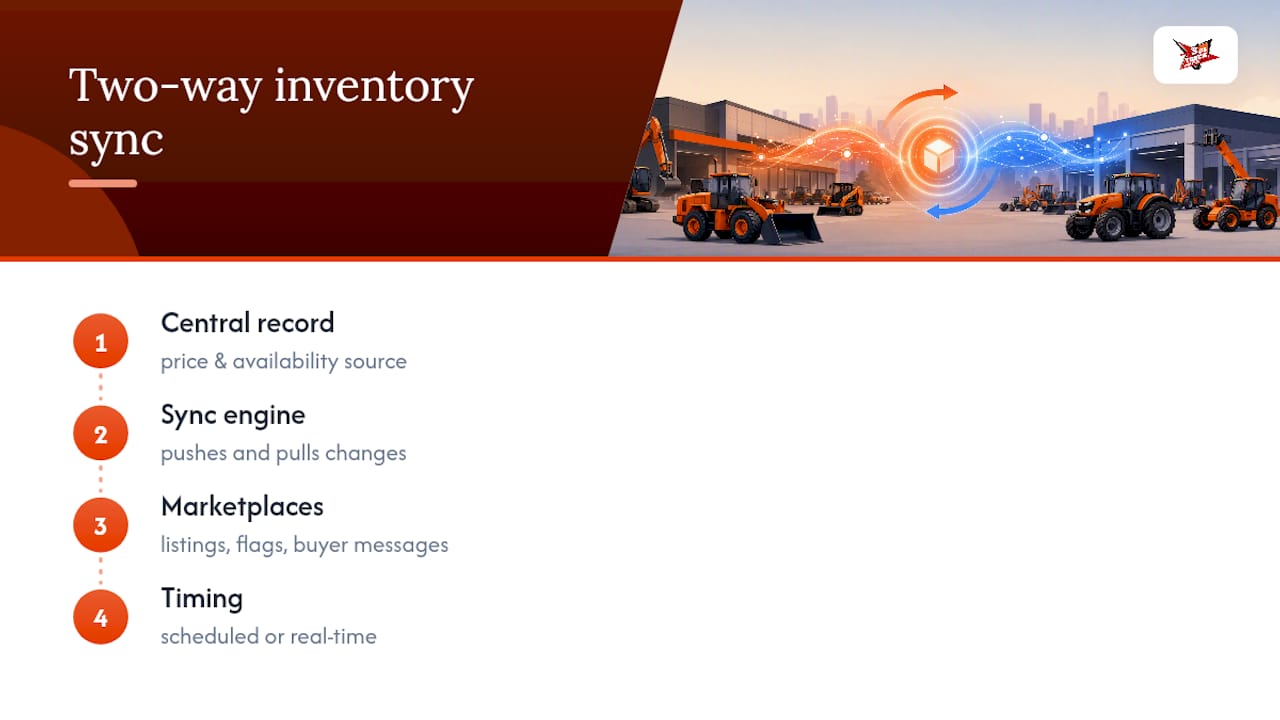
Web-based inventory systems built for heavy equipment centralize control and handle this synchronization automatically, which matters most the moment a unit sells. Without automated sync, a sold excavator can sit live on two marketplaces for days while someone works through a manual delist checklist, and that's exactly when a second buyer calls in and gets told the equipment is gone. Every duplicate inquiry like that costs staff time and, more damaging, costs buyer trust in your listings generally.
Sync also has to run both directions. It's not just about pushing your inventory out. Marketplace-side changes, like a listing getting flagged for a missing field or a buyer requesting more photos through a platform's own messaging system, need to flow back into your central record too, so branch staff aren't logging into four separate marketplace accounts to check for buyer questions.
Set your sync interval based on how fast your inventory actually turns. A dealer moving high volumes of common attachments might need near real-time sync to avoid double-sells, while a dealer with a smaller count of large capital equipment can run hourly syncs without much risk. The buyer's job is to find your equipment on the marketplace they already trust, which means your sync setup needs to cover every channel a serious buyer might actually check, not just your own website.
What Do You Do When Two Locations Disagree on Inventory?
Discrepancies between locations usually trace back to one of three causes: a transfer that wasn't logged, a status update that didn't sync, or two people editing the same record at the same time.
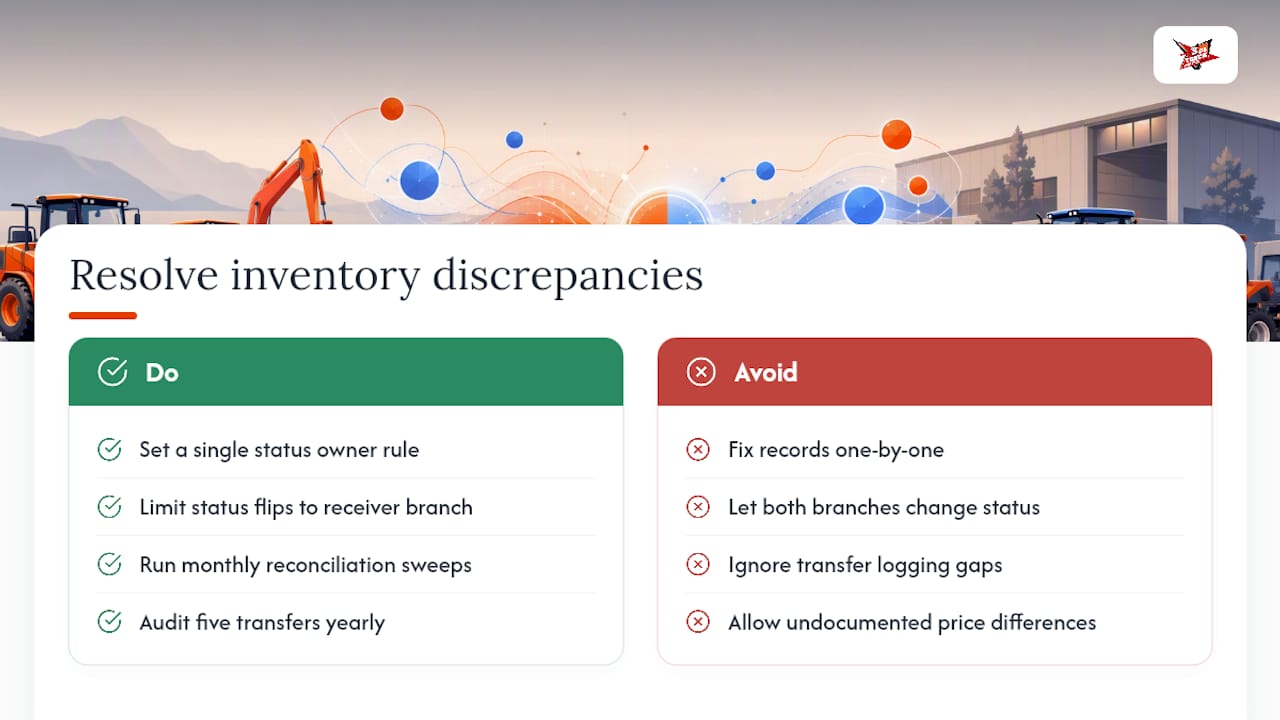
The fix starts with a clear rule on who owns a record's status at any given moment. Once a unit is marked "in transit" between branches, only the receiving branch should have authority to flip it back to "available." This single rule eliminates most of the accidental double-listings that happen when a shipping branch forgets to update status and the receiving branch also marks the unit live.
For discrepancies that have already happened, run a reconciliation sweep rather than fixing records one at a time as complaints come in. Pull every listing flagged as "active" across all locations and cross-check it against your actual yard counts monthly, not just when a customer calls confused about conflicting prices.
Transfer audits catch the discrepancies that reconciliation sweeps miss. Pick five units that moved between branches in the past year and try to reconstruct their custody and maintenance history from your records. If that reconstruction takes more than a few minutes per unit, your transfer logging has gaps that will keep producing conflicts no matter how often you sync.
Price discrepancies deserve their own rule. If Branch A and Branch B post the same model at two different prices without a documented reason (different hours, different condition, different regional demand), buyers notice, and it damages trust in every other listing your dealer group posts. Require a one-line justification field any time two identical models list at different prices.
Who Should Have Access to Edit Which Listings?
Permission structures for multi-location listings need to match how your organization actually makes decisions, not an idealized org chart. Most heavy-equipment dealer groups land on three or four permission tiers.
Branch staff should be able to create and edit listings for their own location's inventory, including photos, specs, and pricing within an approved range. They generally shouldn't be able to edit another branch's listings or override a company-wide pricing floor without escalation.
Branch managers get broader authority: approving price changes beyond staff limits, confirming transfers into or out of their location, and reassigning listings if a salesperson leaves. This is also the tier that should own final approval before a listing goes live on external marketplaces, catching errors before they're public.
A company-wide administrator role, usually held by ownership or a general manager, needs visibility across every branch and the ability to edit the shared data dictionary, add new marketplace connections, and onboard new locations into the system.
Keep the number of people who can edit the core data dictionary small, ideally one or two people total. Every additional editor is another chance for someone to quietly redefine "refurbished" and break the standardization you worked to establish. Audit permission logs quarterly to catch former employees who still have edit access to listings months after leaving.
Should Pricing and Promotions Vary by Location?
Regional pricing differences are usually legitimate, and pretending every branch faces identical market conditions creates more problems than it solves. A used skid steer in a market with three competing dealers within 20 miles needs different pricing logic than the same unit in a market where you're the only seller for 100 miles.
Build location-level pricing bands into your central system rather than letting each branch price independently with no visibility to the others. A band gives branch managers room to adjust for local demand, freight cost to the buyer, or seasonal equipment needs (grounds care equipment sells differently in spring than in November) while keeping headquarters aware of what's happening across the network.
Promotions work best when they're branch-initiated but centrally visible. If Branch C wants to run a season-end discount on excess forestry equipment, that decision should stay local, but the promotion needs to show up in your central inventory system so Branch A doesn't quote a customer full price on a unit that's actively discounted 50 miles away.
Watch for a specific trap: identical equipment priced differently across branches with no field explaining why. Buyers cross-shop your own locations more than dealers expect, and an unexplained price gap on the same model reads as either a pricing error or a sign the dealer isn't paying attention to its own inventory.
How Do Marketplace Rules Differ by Region?
Every marketplace and dealer directory sets its own listing rules, and those rules can vary depending on the equipment category and the region a listing targets. A construction equipment listing might require different disclosure fields than an agricultural machinery listing, and some marketplaces enforce category-specific requirements around emissions labeling or safety certification language.
The practical approach is to build your central data dictionary with enough fields to satisfy the strictest marketplace you post to, then let each channel's feed pull only the fields it actually requires. This keeps you from maintaining separate compliance checklists per marketplace while still meeting each platform's specific rules.
Regional regulations on equipment sales, particularly around emissions disclosures and used-equipment warranty language, can differ by state and by category. Heavy equipment dealers operating across multiple states should confirm with legal counsel or their state dealer association which disclosure requirements apply to each branch's jurisdiction, since assuming one state's rules apply everywhere is a common and costly mistake for growing dealer groups.
Keep a compliance note field in your listing template, even if it stays blank most of the time. When a branch does need to add region-specific disclosure language, having a designated field keeps that language from getting buried in a generic description where a buyer, or a regulator, might miss it.
How Should You Coordinate Returns and Transfers Between Branches?
Logistics coordination across locations breaks down most often at the handoff points: when a unit transfers between branches, when a buyer wants delivery from a different location than the one that closed the sale, or when equipment comes back on a return or trade-in.
Treat every inter-branch transfer as a mini-sale internally, complete with a timestamp, a receiving signature, and a condition note logged at both ends. This is the same custody-tracking discipline that manufacturing operations use across multiple plants, and it solves the same problem: knowing exactly where a unit is and who is accountable for its condition at any given moment.
For returns and trade-ins, assign the receiving branch responsibility for re-inspecting the unit against your standard listing checklist before it goes back live, rather than assuming the original inspection notes still apply. A trade-in that sat in transit for two weeks may have new wear or damage that the original listing never mentioned.
Coordinate delivery logistics through whichever branch is closest to the buyer, even if that's not the branch that closed the sale, and build a simple handoff protocol so the closing branch isn't scrambling to arrange freight from 200 miles away. Dealers using connected dealer management systems across departments often handle this coordination through shared visibility tools rather than phone calls and spreadsheets, which cuts the delay between sale and delivery scheduling considerably.
What Practical Lessons Come from Running These Systems Daily?
The most common mistake isn't a bad photo. It's skipping the data dictionary and syncing anyway, which multiplies errors instead of fixing them. Three one-week wins: standardize your status codes, run a 10-listing sync pilot, and add a serial number photo requirement to every active ad. Start with the listing template if you haven't built your own yet.
— Dave
List Your Inventory Where Multi-Location Dealers Already Compete
There are dealer directories and classified marketplaces that let multi-location dealers publish across them, instead of juggling separate accounts and rules on every channel the branches happen to use. The platform organizes listings by category, subcategory, price, and country, which means your construction equipment, trucks and trailers, material handling machinery, agriculture, forestry, and grounds care listings all sit in a structure buyers already know how to filter.
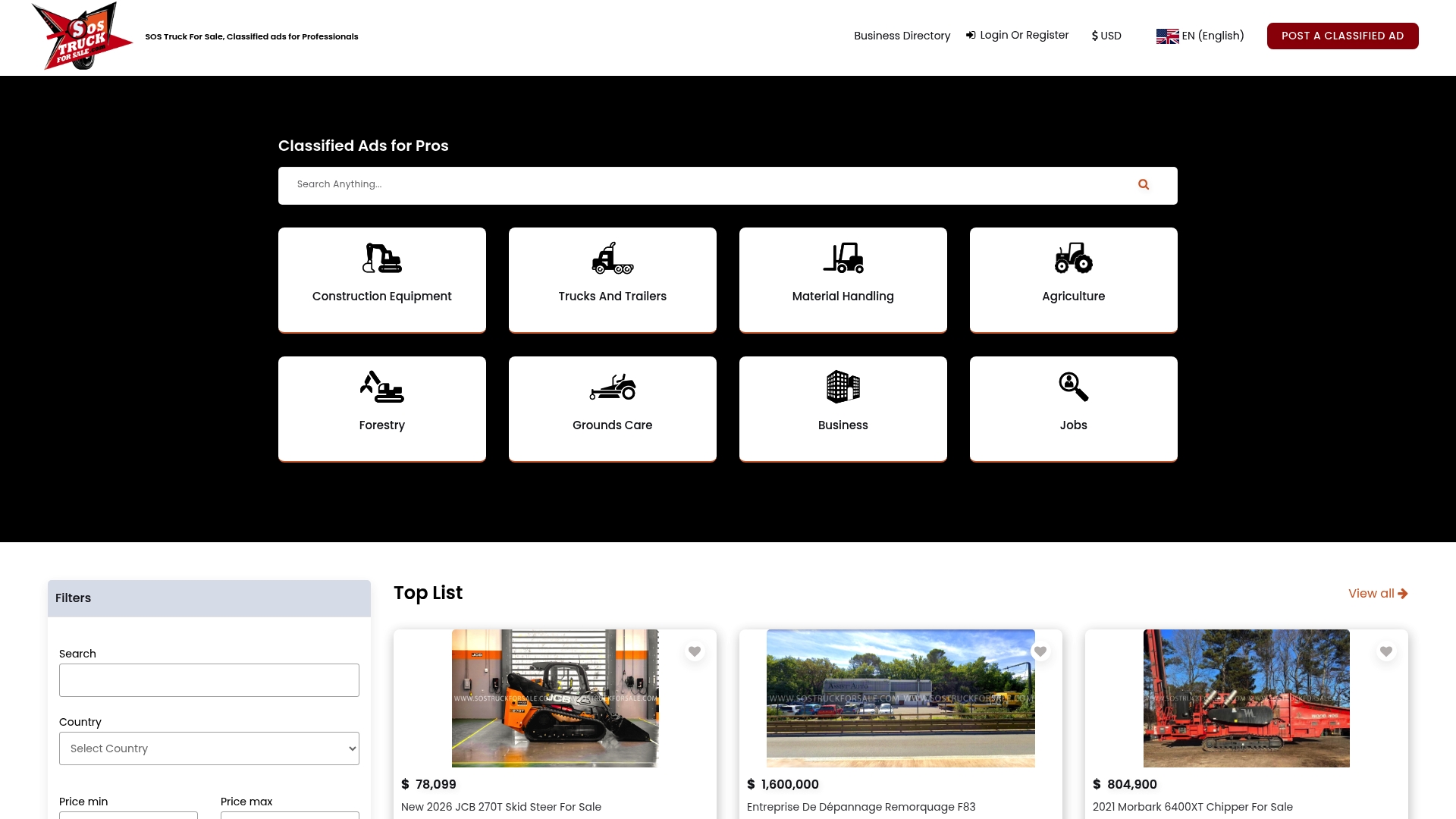
That structure matters most for dealer groups running the kind of standardization this article just walked through. Publishing to a marketplace built specifically for commercial and industrial equipment reduces the need to translate listings into a format designed for passenger vehicles or general classifieds. If you operate multiple branches and want a directory built around heavy equipment categories from the start, post your inventory on Sostruckforsale and get your first listings live across every branch this week.
Sources
- How Multi-Location Equipment Dealers Can Grow Without Losing Visibility or Control | Flyntlok
- Inventory Management System for Heavy Equipment, Truck & Trailer Dealerships | Dealership Drive
- Why Centralised Marketplace Publishing Saves Dealers Time | Machineric
FAQ
What Are Multi-Location Dealer Listings?
Multi-location dealer listings are equipment ads that a dealer operating more than one branch posts and manages across its locations and connected marketplaces. The goal is one accurate record per machine rather than separate, potentially conflicting entries at each branch.
How Often Should Inventory Sync Across Locations?
Sync frequency should match how fast your inventory turns, ranging from near real-time for high-volume categories to hourly for slower-moving capital equipment. The priority is closing the gap between a sale and delisting everywhere else to prevent double-sold units.
What Fields Should Be Standardized First?
Start with stock and serial number formats, category taxonomy, and condition or status codes, since these are the fields that break synchronization when they're inconsistent. A one-page data dictionary covering these fields should exist before you connect any automated sync tool.
Does Sostruckforsale Support Multiple Dealer Locations?
Sostruckforsale's dealer directory and classified listings are organized by category, subcategory, price, and country, which supports dealers publishing inventory from multiple branches into one structured marketplace. Current listing pricing and options are available directly on the Sostruckforsale site.
How Do You Prevent Double-Selling Between Branches?
The most reliable fix is a clear ownership rule: only the branch currently holding a unit, or the branch actively receiving a transfer, can change its status to available. Pairing that rule with automated delist-on-sale sync closes the window where two buyers can inquire on the same machine.