

Selling a trailer online successfully comes down to four moves: get your paperwork and condition report ready, build a complete listing with real specs and 15 or more photos, price against actual comparables, and manage every lead with a fast, secure closing process. Dealers and fleet operators who follow that order sell faster and field fewer repeat questions from buyers who never even call.
TL;DR:
- Complete and verify all documentation, including titles, VINs, and lien details, before listing to reduce delays and back-and-forth with potential buyers.
- Use at least 15 clear photos and include a detailed video walkaround to significantly improve listing visibility and buyer confidence.
- Price based on recent comparables adjusted for condition and included equipment, opting for fixed prices unless speed is a priority.
- Respond promptly to hot leads with structured questions, offer remote inspections, and verify funds before releasing the trailer to ensure a secure transaction.
- Refresh stagnant listings by changing images, adjusting keywords, and making small price adjustments to attract renewed buyer interest.
Table of Contents
- How Do You Prepare a Trailer Before You Sell It Online?
- How Do You Write a Listing That Actually Converts?
- What's the Right Price and Where Should You List?
- How Do You Handle Buyer Leads and Close the Sale Safely?
- When Should You Refresh a Stalled Listing?
- What Legal Steps Matter When Selling a Trailer Online?
- What Do Dealer Listings Get Wrong Most Often?
- List Your Trailer Where Serious Buyers Are Already Looking
- Sources
How Do You Prepare a Trailer Before You Sell It Online?
Buyers vetting a trailer remotely act like they're conducting due diligence on a used truck, not browsing a garage sale. That means your paperwork needs to be ready before the listing goes live, not scrambled together after the first serious inquiry.
Start by pulling the title, a clear photo of the VIN plate, and a bill of sale template you can fill in fast once a buyer commits. If there's a lien, get the payoff amount and lender contact information in hand. Dealers moving used heavy equipment consistently find that assembling a complete document package before posting cuts down on the back-and-forth that stalls deals. Digitized service and maintenance records matter just as much. Buyers who can't inspect in person lean on paper trails to judge how a trailer was maintained.
Before you shoot a single photo, walk the trailer and note what needs fixing. Minor safety items, lights, tires, and any visible fluid leaks, tend to widen your buyer pool more than cosmetic touch-ups, so tackle those first if your repair budget is limited.
- Gather title, VIN plate photo, bill of sale template, and lien payoff details.
- Fix lights, tires, and fluid leaks before anything cosmetic.
- Record axle count, GVWR, deck dimensions, and towing/hitch requirements.
- Wash and stage the trailer on level, well-lit ground before shooting photos or video.
Pro Tip: Photograph the VIN plate and title side by side before you write a single word of your listing. It forces you to confirm every spec matches what's on paper, and it saves you from a rewrite later.
How Do You Write a Listing That Actually Converts?
A trailer listing isn't an ad. It's a data package a buyer uses to decide whether to call at all, and the more complete it is, the fewer calls you'll waste on questions the listing should have already answered.
1. Build the title around what buyers search. Lead with year, make, model, and one defining spec, something like "2022 [Make] Drop Deck Trailer, 53 ft, 80,000 lb GVWR." Skip vague titles like "Trailer for Sale" entirely; they get buried and attract low-intent clicks.
2. Fill every spec field, not just the easy ones. VIN, year, GVWR, axle count and rating, hitch type, brake type, tare weight, deck length and width, and any attachments (ramps, winches, tarps) all belong in the listing, not just the description. Dealer playbooks that emphasize filled-out spec templates and multiple images tend to surface higher in marketplace search and convert better once a buyer clicks through.
3. Shoot a real photo set, not a quick walk-around. Capture full exterior angles from all four corners, then close-ups of the VIN plate, axles, tires, lights, and coupler. Trailer-specific photography guidance recommends including VIN and build-sheet detail in your shots so buyers can verify configuration without a phone call.
By the numbers: Listings built with 15 or more photos and a complete spec sheet consistently outperform bare-bones posts on both visibility and conversion, according to dealer-focused selling guides.
4. Add a video walkaround. A short clip showing the hitch, ramps, and a braking demo (if applicable) does more to build buyer confidence than another dozen photos. Marketplace research on high-value equipment listings points to video as one of the strongest levers for boosting inquiry rates on bigger-ticket assets.
5. Write the description in a fixed structure, lead sentence stating year/make/model/condition, six technical bullets covering the specs above, then a short paragraph on location, logistics, and how to arrange an inspection. If you're listing a specialized configuration, our guide on drop deck trailer specs breaks down the terminology buyers expect to see.
What's the Right Price and Where Should You List?
Pull three to five recent comparable listings for the same make, model, and configuration, then adjust for hours or mileage, included attachments, and condition. A trailer with a rebuilt suspension or newer tires justifies a premium; one with deferred maintenance needs a discount that matches, not a hopeful asking price.
Fixed pricing works best when you need predictable margin and can wait for the right buyer. Auction or reserve pricing moves faster but usually costs you top-dollar in exchange for speed. Seller guides that track pricing tradeoffs across trailer sales generally recommend fixed pricing for specialized equipment and auction formats for standard configurations with deep buyer pools.
- Research comparables adjusted for condition, hours, and included equipment.
- Choose fixed pricing for margin, auction/reserve for speed.
- Cross-post to a specialized industrial marketplace, general classifieds, and your own dealer site if you have one.
- Keep specs and pricing identical across every channel to avoid buyer confusion.
Paid promotion or a featured listing slot earns its cost when a trailer is high-value, seasonal, or competing against a crowded category. For a standard flatbed sitting in a thin market, organic listing completeness usually does the job on its own.
How Do You Handle Buyer Leads and Close the Sale Safely?
Speed and structure separate a smooth sale from a stalled one. Sort every inbound inquiry into hot, warm, or cold, and answer hot leads, ones asking about price, inspection, or delivery, within hours, not days. A standardized lead triage system is what most dealer playbooks point to for converting serious buyers before they move to another listing.
- Qualify the lead fast. Ask about intended use, financing status, and timeline in your first reply.
- Offer an inspection option. A live video walkaround works for most buyers; for higher-value trailers, a third-party inspection report covering frame, brakes, and tires removes doubt without requiring travel.
- Verify funds before you commit. Wire transfer or a cashier's check confirmed directly with the issuing bank are the safest options; avoid releasing a trailer against an unverified check or a payment app transfer.
- Document the handoff. Complete the bill of sale with VIN, sale price, and both parties' signatures, take proof-of-load photos before the carrier leaves, and provide clear pickup instructions if a third-party hauler is involved.
Pro Tip: Never release title paperwork until funds have actually cleared, not just "shown pending." A verified cashier's check confirmed by phone with the issuing bank beats any promise of a wire "on the way."
When Should You Refresh a Stalled Listing?
Give a new listing seven to fourteen days before you touch it. If clicks are steady but inquiries are thin or low-quality, the listing itself is the problem, not the trailer. Practitioner guidance on underperforming listings consistently points toward active refresh tactics rather than passive leave-it-and-wait strategies.
- Swap the primary photo and add a video or inspection report if you skipped it initially.
- Adjust the title and spec keywords to match how buyers actually search.
- Make a small, deliberate price step instead of a dramatic cut that signals desperation.
- Consider an auction, broker, or bulk-sale channel if the trailer has sat unsold for months despite refreshes.
Our breakdown on relisting stalled semi trucks covers the same refresh logic in more depth if your inventory needs a broader push.
What Legal Steps Matter When Selling a Trailer Online?
Title transfer rules and registration requirements vary by state, so confirm your state's Department of Motor Vehicles or equivalent agency process before you finalize a sale, particularly for trailers above the weight threshold that triggers commercial registration in your state. Some states require a separate bill of sale form, notarization, or an odometer/hour disclosure depending on trailer type and age; others accept a generic bill of sale as long as it includes VIN, sale price, and signatures from both parties.
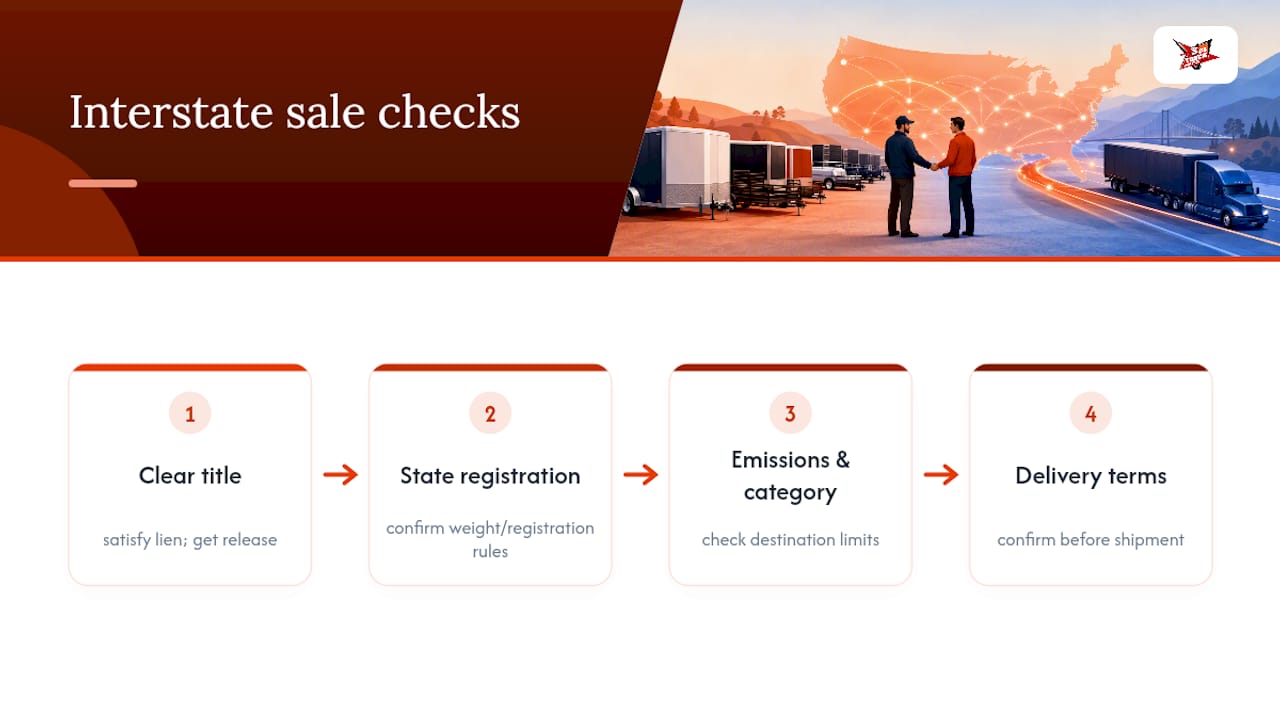
If a lien exists, you're legally obligated to satisfy it and obtain a lien release before transferring clear title. Selling with an open lien and no disclosure exposes you to liability even if the buyer never finds out until later. Sales tax treatment differs by state and by buyer type too. A dealer-to-dealer sale, a sale to an out-of-state buyer, or a private sale can each trigger different tax obligations, so confirm the applicable rule with your state's tax authority or a qualified accountant rather than assuming the deal is tax-exempt.
Interstate transactions add another layer. If you're shipping across state lines, check whether the destination state has different emissions, weight, or registration requirements for the trailer's category before you commit to delivery terms. None of this replaces legal advice specific to your state and trailer classification, but skipping the check entirely is how avoidable disputes turn into expensive ones.
What Do Dealer Listings Get Wrong Most Often?
The pattern that separates a fast sale from a stalled one is almost always documentation discipline. Photographing the VIN plate and uploading service records before posting, not after the first inquiry, tells a buyer you're organized and lowers their guard immediately.
Vague titles, half-filled spec fields, and inconsistent pricing across platforms are the three mistakes that kill momentum fastest. A trailer priced at $28,500 on one channel and $26,900 on another doesn't read as a negotiation opportunity, it reads as a red flag. Dealers who keep every field, every photo, and every price identical across channels close faster because buyers stop double-checking and start deciding.
— Dave
List Your Trailer Where Serious Buyers Are Already Looking
Sostruckforsale gives you the tools to skip the guesswork that slows down most online trailer sales. Detailed spec templates walk you through every field a buyer expects, dealer tools help you manage multiple listings without retyping information, and a lead inbox keeps inquiries organized so hot leads never sit unanswered.
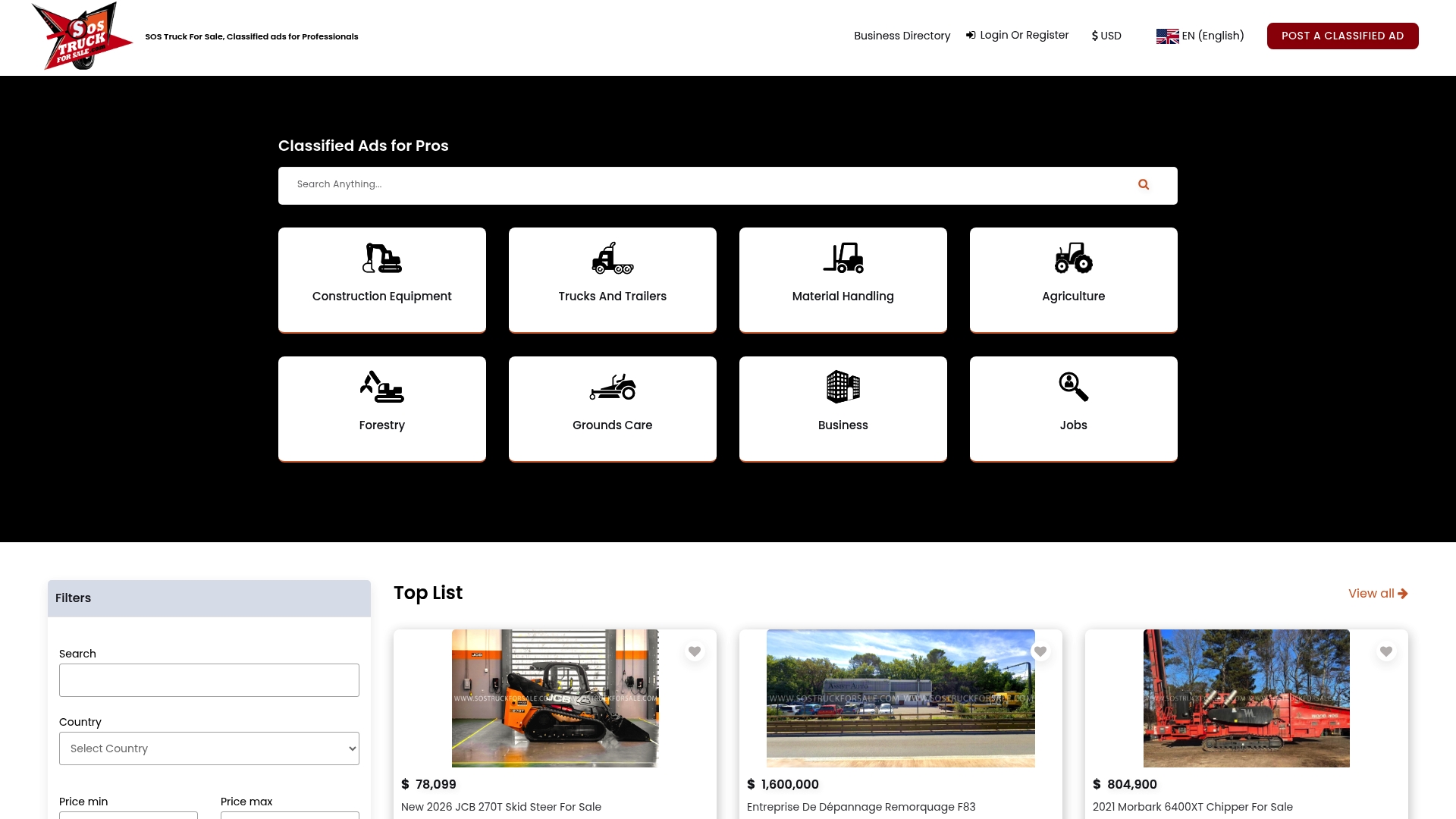
Promoted listing placement puts your trailer in front of buyers actively searching your category, cutting down the days a listing sits idle before the right person sees it. That means fewer repeat calls asking questions your spec sheet already answers and faster movement from inquiry to signed bill of sale. If you're managing a fleet or dealer lot with multiple trailers to move, the same structure that speeds one sale scales cleanly across your whole inventory, and a dealer web presence built around clear listings only reinforces that trust once buyers land on your page. Start a listing on Sostruckforsale today and get your trailer's spec sheet, photos, and pricing in front of buyers who are ready to move.
Sources
- How to Sell Used Heavy Equipment
- How to Sell Heavy Equipment Online: 10 Proven Steps for Dealers
- How to Sell Your Trailer Fast in the USA (2026 Complete Guide)