
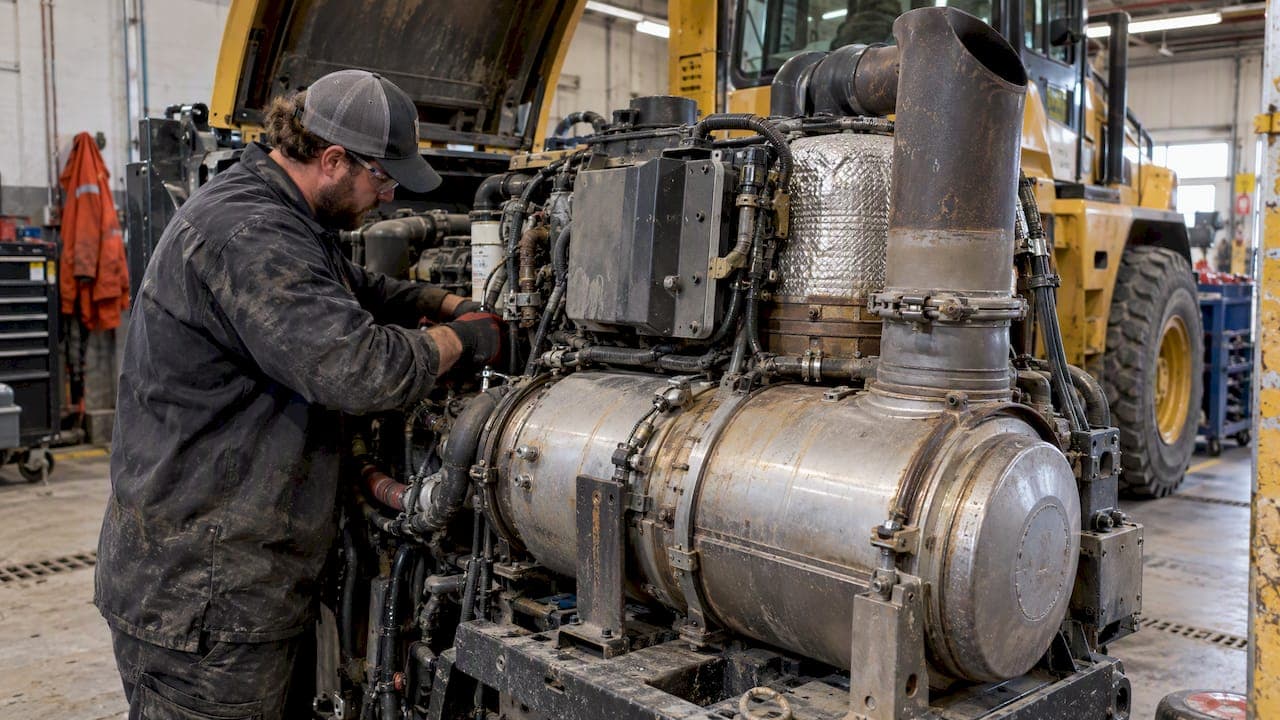
Tier 4 Final is the EPA's most stringent nonroad diesel emissions standard, and it requires engines to pair a diesel particulate filter with selective catalytic reduction to hit near-zero particulate and nitrogen oxide levels. For owners, that means planning around ultra low sulfur diesel, diesel exhaust fluid refills, and filter maintenance, because skipping any of these can trigger a performance derate.
TL;DR:
- Low load or prolonged idling can prevent passive regeneration, so schedule forced burns and watch for backpressure warnings before engine power drops.
- Use ultra low sulfur diesel capped at 15 ppm, keep DEF sealed and uncontaminated, and refill before diesel runs out to avoid inducements.
- Plan DPF ash cleaning roughly every 6 to 12 months, adjusting for duty cycle, and retain regeneration, DEF refill, and cleaning records for resale.
- Before buying used equipment, verify the engine family’s Tier 4 Final certification and request diagnostic history plus documentation for the DPF, SCR, and DEF tank.
Table of Contents
- What Tier 4 Final requires: headline numbers and legal anchors
- Core aftertreatment and fuel systems: DPF, SCR, EGR, DOC, ULSD, and DEF
- Regeneration, DEF logistics, and what triggers a derate
- A buyer and operator checklist for Tier 4 Final machines
- What this means for buyers and sellers in the used equipment market
- Find Tier 4 Final equipment on SOSTruckForSale
- FAQ
- Sources
What Tier 4 Final requires: headline numbers and legal anchors
Tier 4 Final targets reductions of roughly 90% in particulate matter and about 80% in nitrogen oxides compared with earlier tiers, part of a push toward near-zero emissions from nonroad diesel engines, according to the EPA's final rule. Meeting those numbers requires a diesel particulate filter for particulate control and selective catalytic reduction with diesel exhaust fluid for nitrogen oxide reduction, alongside ultra low sulfur diesel to protect the catalysts doing that work.
The certification and compliance text lives in 40 CFR Part 1039, which governs nonroad compression ignition engines and remains the controlling framework since no Tier 5 standard has been established. Manufacturers phased in this aftertreatment suite mostly between 2014 and 2015.
A few things worth confirming before you buy or spec equipment:
- The engine family has a documented Tier 4 Final certification, not just a manufacturer claim.
- Fuel and DEF systems match the ULSD and SCR requirements for that engine's horsepower class.
- Any transition program accommodations, such as the Transition Program for Equipment Manufacturers, are documented if the machine was built during the phase-in window.
Core aftertreatment and fuel systems: DPF, SCR, EGR, DOC, ULSD, and DEF
Four systems work together to meet Tier 4 Final, and each one needs a different kind of attention from an owner.
- The diesel particulate filter traps soot as exhaust passes through a ceramic substrate, and it needs periodic regeneration to burn off that accumulated particulate matter.
- Selective catalytic reduction injects diesel exhaust fluid into the exhaust stream, where it reacts with nitrogen oxides and converts them into nitrogen and water vapor.
- Exhaust gas recirculation reduces nitrogen oxide formation inside the cylinder itself, lowering the load the aftertreatment system has to handle downstream.
- The diesel oxidation catalyst, usually paired upstream of the DPF, oxidizes carbon monoxide and hydrocarbons and helps raise exhaust temperature to support regeneration.
DPF regeneration happens two ways. Passive regeneration occurs automatically when exhaust temperatures run high enough during normal operation. Active regeneration kicks in when temperatures stay too low, injecting extra fuel or requiring a stationary burn cycle, which costs fuel or operator time. DPFs can cut particulate matter by more than 85% when maintained correctly, and using fuel additives can enhance fuel efficiency and reduce ash buildup that requires physical cleaning roughly every 6 to 12 months depending on duty cycle.
DEF quality matters as much as DPF care. Contaminated or diluted DEF won't convert nitrogen oxides properly, and onboard sensors are built to catch that fast.
Pro Tip: Keep DEF sealed and out of direct sunlight; heat and contamination degrade it faster than most owners expect.

Ultra low sulfur diesel, capped at 15 ppm sulfur, isn't optional on these engines. Higher sulfur content poisons the catalysts in both the DOC and SCR system, which shortens their service life and undermines the whole aftertreatment chain.
Regeneration, DEF logistics, and what triggers a derate
How you run the machine changes how often it needs attention. Extended low-load or idle-heavy duty cycles keep exhaust temperatures too low for passive regeneration, so soot builds up faster and the engine leans on active regeneration or manual cleaning more often, a pattern industry technical sources consistently flag in low-load applications. Watch for backpressure warnings and a noticeable drop in power as early signs.
- Refill DEF on a schedule tied to fuel capacity. EPA guidance ties minimum DEF refill intervals to how far a tank of fuel will take the machine, so DEF shouldn't run dry before diesel does.
- Expect inducements if DEF quality drops or dosing fails. EPA guidance calls for sensors that can detect poor DEF quality within 30 to 60 minutes, with final inducements designed to stop the machine from working until the fault is fixed.
- Keep service records current. Regeneration cycles, DEF fill dates, and filter cleaning intervals all belong in a maintenance log, both for your own troubleshooting and for resale.
Pro Tip: Treat a backpressure alert as a scheduling problem, not an emergency, and plan a forced regeneration window before the derate logic takes the decision out of your hands.
A buyer and operator checklist for Tier 4 Final machines
A short list of checks before you sign and before you operate reduces most of the surprises that come with Tier 4 Final equipment.
- Confirm the engine family's certification and ask for documentation on the specific DPF, SCR, and DEF tank sizing fitted to the machine.
- Request diagnostic history if available, since fault codes around DEF quality or DPF backpressure tell you how the previous owner ran it.
- Train operators on regeneration behavior and DEF handling before they ever sit in the cab.
- Stock DEF on site and set refill reminders tied to fuel usage rather than guesswork.
- Schedule DPF ash cleaning on a calendar, not a reaction to a warning light.
- Require service records as part of any resale, since documented maintenance supports resale value the same way it does for reconditioned equipment.
What this means for buyers and sellers in the used equipment market
Tier 4 Final machines with clean service records command more buyer confidence, and that shows in how fast they move. A documented DPF cleaning schedule or DEF system history tells a buyer the aftertreatment hasn't been neglected, which matters more on a used machine than a new one. We'd rather see sellers list that paperwork up front than have buyers ask for it after the fact.
— Dave
Find Tier 4 Final equipment on SOSTruckForSale
We list various categories of commercial and industrial heavy equipment from dealers and private sellers, with filters that let you narrow by price and category while you search for the right machine. When you find a listing that fits, contact the seller directly and ask for service records and aftertreatment documentation before you commit. Start your search on SOSTruckForSale.
FAQ
What are the final emissions requirements for Tier 4 diesel engines?
Tier 4 Final requires roughly 90% lower particulate matter and 80% lower nitrogen oxides compared with earlier tiers, achieved through a diesel particulate filter and selective catalytic reduction. Engines must also run on ultra low sulfur diesel to protect those aftertreatment components.
What are Tier 4 requirements for equipment owners?
Owners need to run ultra low sulfur diesel, keep diesel exhaust fluid stocked and uncontaminated, and maintain the diesel particulate filter through regeneration and periodic ash cleaning. Missing any of these can trigger inducements that limit or stop the machine from working.
What is a Tier 5 engine?
There is no Tier 5 standard for nonroad diesel engines. Tier 4 Final remains the most stringent phase under the current regulatory framework.
What should I check before choosing between Tier 3 and Tier 4 Final equipment?
Tier 4 Final machines carry additional aftertreatment, including a DPF and SCR system, which means more components to maintain but far lower particulate and nitrogen oxide output. Tier 3 machines skip that aftertreatment complexity but can't match the emissions performance, so the right choice depends on your job site's regulatory requirements and how much maintenance capacity you have.
How does DPF regeneration affect daily operation?
Passive regeneration happens automatically when exhaust temperatures run high enough, usually during normal working loads. Low-load or idle-heavy duty cycles can force active regeneration more often, which uses extra fuel or requires a stationary burn cycle.
Sources
Manufacturer claims about Tier 4 Final compliance are easiest to verify against the source documents rather than a sales sheet.
- Final rule to control emissions of air pollution from new nonroad engines and vehicles | US EPA
- EPA certification guidance letter (nonroad SCR/DEF inducement guidance)
- EPA: Sets Standards for Diesel Fluid Systems; Adopts Relief Measures for Nonroad Equipment