
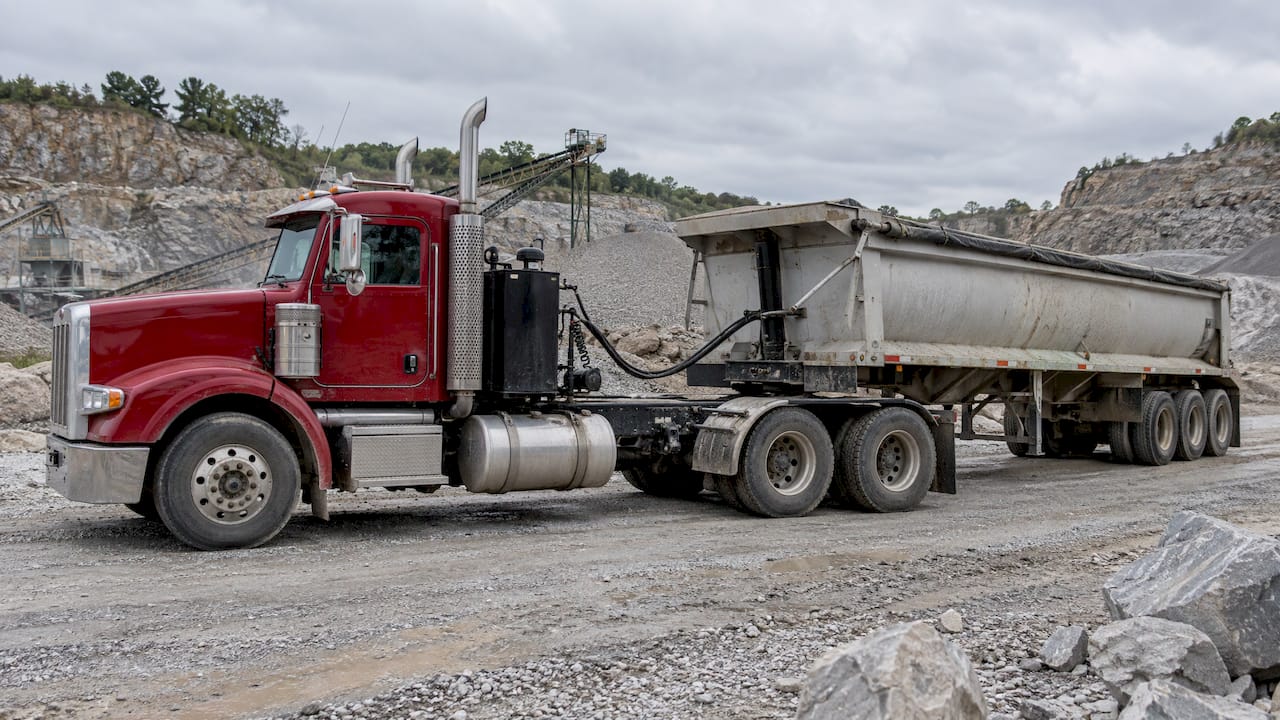
A wet kit is the hydraulic system on the truck that powers a dump trailer. The trailer carries the cylinder, and the tractor supplies the pump, the reservoir and the power. For a dealer, the practical point is simple: a tractor listed with a complete, correctly described wet kit answers the first question an end-dump buyer asks. A tractor listed with "hydraulics: yes" invites a round of calls that never turn into offers. This guide covers what the kit is, what is in it, how to read the specs, and how to write a listing that qualifies the buyer before the first phone call.
TL;DR
- A wet kit (also called a wetline kit) is a PTO, pump, reservoir, hoses and couplers on the tractor that supply oil pressure to the dump trailer's cylinder.
- Two-line kits suit lighter use. Three-line kits add a dedicated return line and filtration and are the usual recommendation for heavy use.
- End-dump cylinders are commonly rated around 2,000 psi, while belt, shuffle-floor and chain trailers need 3,000 psi or more. Pressure and flow must match the trailer.
- Compatibility starts with the transmission. Record the make and model in every listing.
- State the kit type, pump, PTO, tank size and coupler layout in the ad, so only qualified buyers call.
Table of Contents
- What a wet kit is and how it powers a dump trailer
- What is in a dump trailer wet kit
- Two-line, three-line and single-line: what to put in the listing
- Pressure, flow and reservoir: the specs buyers ask about
- Does it work with an automatic transmission?
- Fluid and maintenance details that make a listing credible
- Installation quality is what the buyer is really judging
- A listing template for a tractor with a wet kit
- Where to list it
- Our view: spec the kit like you spec the engine
- FAQ
- Sources
What a wet kit is and how it powers a dump trailer
The name comes from the oil. Hydraulic oil makes the line "wet," as opposed to the dry air lines used for brakes, according to a 2026 TorqueLoads explainer. The sequence is the same on every end-dump setup:
- The driver engages the power take-off (PTO), a gearbox attachment that taps power from the transmission.
- The PTO turns the hydraulic pump.
- The pump pulls oil from the reservoir and pushes it under pressure through a hose to a quick coupler behind the cab.
- The trailer's hydraulic line connects at that coupler and sends oil to the cylinder, which extends and raises the body.
- A return line brings oil back to the tank.
Eaton's guide to two-line and three-line systems describes the lowered position this way: in neutral, flow from the cylinder back to the pump is cut off, which holds the body down. The cylinder itself belongs to the trailer, not the kit. That matters when you list a tractor and a trailer separately, because each half carries its own specs and the two must agree.
What is in a dump trailer wet kit
The typical component list from the same Eaton guide is a reservoir, PTO, dump pump, quick disconnect and cylinder, with the cylinder on the trailer side. In practice, a buyer inspecting your tractor will look for these pieces:
- PTO. End-dump PTOs are typically mounted to the bottom of the transmission, are mostly air-actuated, and run at around 120% of engine speed.
- Dump pump. Usually direct-mounted to the PTO. Eaton's turnkey kits use a roller-bearing dump pump.
- Reservoir. The same guide says it typically holds 50 to 70 gallons. Eaton's own kits come with a 50-gallon aluminum tank, mounted upright behind the cab or as a saddle on the frame.
- Hoses, fittings and couplers. The pressure and return hoses run to the coupler bracket at the back of the cab.
- Filters and valves. Three-line kits add two 25-micron spin-on filter elements and a dual filter head, per the same Eaton flyer.
- Cab controls. Air or electric controls for PTO engagement and the hoist.
Eaton's 2020 release says its PTO wet kits for end-dump applications bundle the PTO, pump and tank under one part number. For a dealer, a kit that is documented as a single package is easier to describe and easier for a buyer to trust than a mix of parts added over the years.
Two-line, three-line and single-line: what to put in the listing
The line count is the most useful single fact about a wet kit, so it belongs in the first lines of your description.
| Kit type | How oil returns | Typical fit |
|---|---|---|
| Single-line | Oil returns by gravity | Light, low-frequency dumping |
| Two-line | Pressure line plus a return hose | Lower-usage applications |
| Three-line | Pressure line, dedicated return line, filtration | Frequent cycles, high-flow work |
The single-line and gravity-return description is from a dump truck wet kit explainer. On the choice between two-line and three-line, Trucks, Parts, Service reports that Muncie Power Products recommends three-line kits in nearly all applications for faster cycle times, fewer pump failures and lower system temperature. The same article notes that a three-line kit does not raise the trailer faster, and that two-line kits suit lower-usage work and perform best when not left in neutral.
That gives you honest listing language. If your tractor has a three-line kit, say so and say it is filtered. A hauler running many cycles a day knows what that means for pump life and oil temperature. If it has a two-line kit, say so as well, so the buyer who dumps a few loads a day finds the match.
Pressure, flow and reservoir: the specs buyers ask about
A wet kit has to match the trailer. Three numbers decide that: pressure, flow and reservoir capacity.
Pressure
Kanamak's end-dump kit sheet states that end-dump trailers with single-acting cylinders are rated for 2000 psi with minimal safety factors, while belt, shuffle-floor and chain trailers need 3000 psi or more. It also warns that 3000 psi will damage a 2000 psi end-dump cylinder. The two applications cannot be mixed without a combination kit that has a high-pressure pump and pressure-reducing valving.
This is the most important sentence a dealer can pass on to a buyer. If you are selling a tractor with a 3,000 psi relief setting and a buyer is pulling an end dump, the relief setting is the first thing to confirm. Put the relief pressure in the listing. A tractor that can run either application through a combination kit is worth saying so.
Flow
Pump flow is rated at a given RPM. Muncie Power Products' product guide lists dump pumps for small single- or tandem-axle dump trucks at 2,500 to 3,000 PSI maximum with 6.4 to 17.2 GPM at 1,000 RPM, and standard tandem or tri-axle truck and trailer pumps at 2,500 PSI with 22.5 to 27.6 GPM. Kanamak's 2000 psi end-dump kit is specified at 32 gpm at 1000 engine rpm.

Trailer manufacturers also set limits. One trailer maker's installation sheet notes that hydraulic ratings vary by model and year, from 12 GPM at 2,000, 2,200 or 3,000 PSI to 20 GPM at 2,200 PSI, and advises verifying the system before installing. A listing that gives pump GPM and PSI saves the buyer that phone call.
Reservoir
Muncie's wet line kit brochure, in the same product guide, offers tanks in aluminum, steel and polyethylene in 25 to 100 gallon capacities. For a dump trailer, the Eaton figure of 50 to 70 gallons is the typical range. Note the tank material, the capacity and whether it is an upright or saddle mount. A saddle mount keeps weight on the frame and leaves cab space free, which some buyers prefer.
Does it work with an automatic transmission?
This is one of the most common questions, and the answer is yes, with conditions. The PTO has to be designed for the specific gearbox. One supplier's list of supported transmissions includes Eaton Fuller RTLO, Eaton Endurant, Allison 3000 and 4000, Volvo I-Shift, Mack mDRIVE, Mercedes DT12 and Paccar TX-12 and TX-18, and it directs buyers to confirm technical details in the PTO manufacturer's configurator.
Eaton's Bezares wet kits are described in its flyer as designed for Eaton Fuller and Eaton Cummins Endurant HD applications. So the transmission make and model is the fitment key. Write it in the listing in full, not as "automatic" or "manual." If you want a refresher on how transmission type shapes a tractor's value and use, our guide to the role of the transmission in semi trucks covers the types.
Fluid and maintenance details that make a listing credible
Buyers read maintenance detail as a sign of how the unit was run. One single-acting dump trailer power unit manual recommends ISO viscosity grades 22 to 46 hydraulic fluid with anti-wear, antifoaming and rust inhibitor additives, with ATF Dexron III in colder climates. It warns against synthetic, biodegradable or water-based fluids because of Buna O-ring incompatibility. It specifies a fluid change after the first 100 hours and then every 3000 hours or 2 years. Kanamak's sheet recommends AW46 hydraulic oil or equivalent.
These are manufacturer figures for their own equipment. The point for a dealer is to record what your unit actually uses and when the oil and filters were last changed. A line such as "AW46 oil, filters changed at service, dated" costs you nothing and answers a real question.

Installation quality is what the buyer is really judging
When a wet kit has been added to a used tractor, the buyer wants to know if it was done properly. Eaton's wet kit tips give the points an inspector will look at:
- Backlash between the input gear and the transmission gear measured with a dial indicator at .006" to .012", for smooth operation and to prevent premature wear.
- Correct pump rotation, which Eaton stresses because wrong rotation leads to premature failure and costly repairs.
- Greased PTO and pump shafts, bolts not over-tightened, and the pump pre-flooded before first use.
- The tank mounted above the pump level for priming.
- Fewer 90-degree fittings and reducers, to cut heat, cavitation and failure points.
If your unit has an installation record, mention it and attach the paperwork or photos. Photos of the PTO, the pump, the tank, the coupler bracket and the hoses do more than a paragraph of claims. Also photograph the coupler layout. The trailer maker's sheet notes that the pressure line is normally on the front of the gooseneck road side with the return line on the curb side, and that the coupler type must be validated before first operation or after a new power source is installed. A buyer who sees the couplers in a photo can confirm compatibility without calling.
Before a unit goes on the lot, the same inspection discipline applies to the rest of the truck. Our semi truck inspection checklist is a useful companion for pre-sale walk-arounds. Installation and repair work on PTOs and hydraulics should be done by a qualified technician, and a system should be run under load and checked for leaks before the sale.
A listing template for a tractor with a wet kit
Use the same fields every time so buyers can compare your units quickly:
- Kit type: two-line or three-line, with or without filtration.
- PTO: make, model, air-shift or other, and the transmission it is fitted to.
- Pump: make, rated GPM and the RPM it is rated at.
- Relief pressure: the setting in psi, and whether it suits end-dump (2,000 psi class) or higher-pressure trailers.
- Reservoir: capacity in gallons, material and mount style.
- Couplers: size and which side carries pressure and which carries return.
- Fluid and service: oil type, last change, filter changes.
- Photos: PTO, pump, tank, couplers, cab controls.
If you are also selling the trailer, give its cylinder spec and rated pressure next to the tractor's. A buyer matching the two halves is the buyer closest to an offer. For the wider sale, including the tax side of selling a work truck, see our guides on selling a dump truck fast and selling a dump truck online for your business.
Where to list it
Sostruckforsale is a classified marketplace for commercial vehicles and heavy equipment, with listings filtered by category, subcategory, price and country, plus a business dealer directory. Semi trucks, trailers and parts sit alongside excavators, cranes, material handling, forestry, grounds care and agricultural machinery. Dealers can register and post equipment for sale, and the platform is designed for industry professionals.
If you have a tractor, a dump trailer or a truck with a wet kit to place, list it on Sostruckforsale under Trucks and Trailers, and use the template above so your specs are in the ad from the first line.
Our view: spec the kit like you spec the engine
Dealers tend to describe an engine and transmission in detail and then write "PTO and hydraulics" for everything else. For an end-dump buyer, that is the line that decides whether they call.
We built Sostruckforsale as a dedicated classified environment for commercial and industrial equipment, for people who already know the difference between a two-line and a three-line kit. That is the buyer who reads a listing closely. Give that buyer the pressure, the flow, the tank size and the transmission, and the listing does your qualifying for you.
Multi-category coverage matters here too. A dealer who sells tractors, dump trailers and parts can post each in its own category and let buyers filter by category, price and country, so the right unit reaches the right person.
Write the wet kit into the ad the way you would write the engine. It is a major part of the sale.
Dave
FAQ
What is a wet kit?
It is the hydraulic system on the truck that powers a dump trailer. A PTO drives a pump that moves oil from a reservoir, through hoses and a coupler, to the trailer's cylinder. The oil returns to the tank when the body lowers.
What is a wet kit for an end dump?
It is a kit built around single-acting end-dump cylinders, which are commonly rated around 2000 psi. Eaton's end-dump kits combine a PTO, dump pump and tank in one part number. Match the kit's relief pressure to the trailer before the first dump.
Can a truck with an automatic transmission have a wet kit?
Yes, if the PTO is designed for that gearbox. Supported lists include Allison, Volvo I-Shift, Mack mDRIVE and Paccar units. Record the exact transmission model in the listing, because the PTO choice follows from it.
Is a two-line or three-line kit better?
Three-line kits add a dedicated return line and filtration, and Muncie Power Products recommends them for nearly all applications because of cycle times, pump life and temperature. Two-line kits suit lower-usage work. Neither raises the trailer faster.
What fluid goes in a dump trailer wet kit?
Follow the manufacturer's specification. One dump trailer power unit manual calls for ISO 22 to 46 hydraulic fluid with anti-wear, antifoaming and rust inhibitors, and warns against synthetic, biodegradable or water-based fluids because of seal compatibility.
Sources
- TorqueLoads: Wet Kit for Semi Truck
- Eaton: Two-Line vs. Three-Line Hydraulic Systems
- Eaton: Bezares wet kits flyer
- Eaton: Power Takeoff wet kits for end-dump applications
- Eaton: Wet Kit Tips & Tricks
- Forge Truck Centers: Understanding Wet Kits
- Trucks, Parts, Service: Selecting the right wet kit
- Kanamak: End-Dump Trailer Wet Kit 2000 psi Relief
- Muncie Power Products: Product Guide
- Wet kit installation sheet, trailer hydraulic ratings
- The Gear Centre: Wet Kit Packages
- Single Acting Dump Trailer Power Unit Owner's Manual