
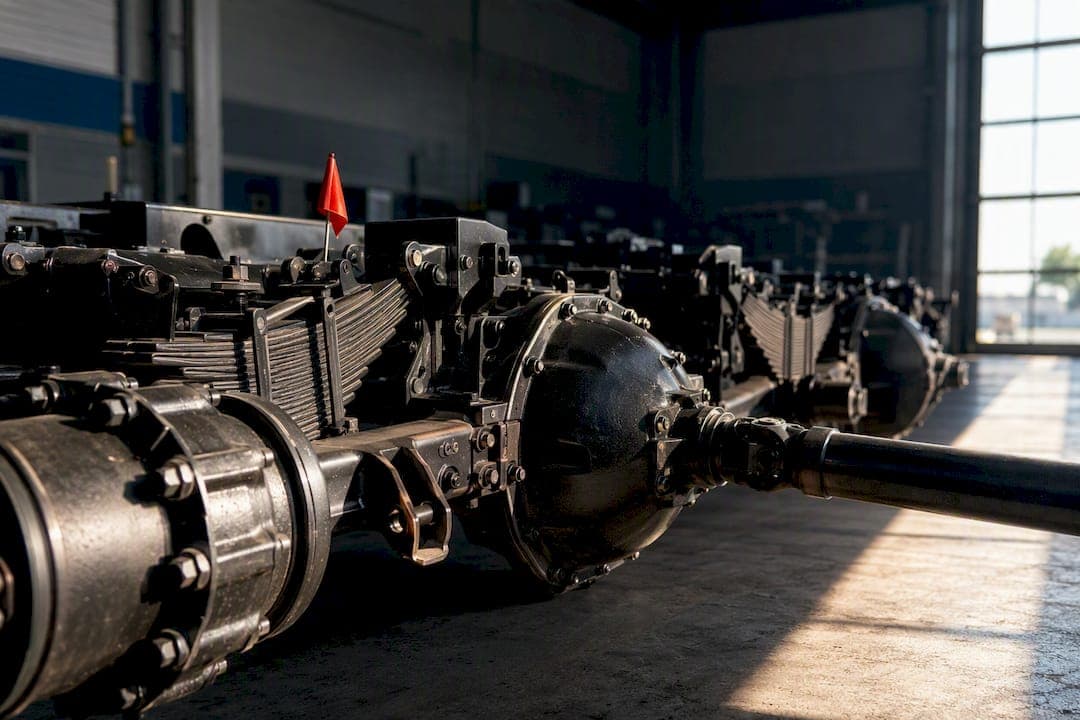
A 6x2 tractor uses one driven rear axle and typically delivers better highway fuel economy and payload capacity, making it the right call for predictable, paved-route line-haul work. A 6x4 tractor powers both rear axles, giving it stronger traction for construction, off-highway, or grade-heavy routes where wheel slip is a real risk. Modern suspension controllers and lift-axle automation have narrowed that traction gap, but only on trucks where those features are actually specified and confirmed.
TL;DR:
- A 6x2 tractor offers around 2.5% better fuel economy in highway lane-haul duty, mainly on flat and consistent routes.
- Modern lift-axle automation and suspension controllers can improve the traction of 6x2 trucks, but only when specified and properly documented.
- Resale value tends to favor 6x4 trucks because they serve a wider range of duties, including off-highway and construction work.
- The choice between 6x2 and 6x4 depends heavily on route variability, terrain, weather, and the importance of resale value, not just initial cost.
- Verify documentation such as lift-axle systems, suspension brands, and drive-axle architecture before purchasing, as configurations greatly influence performance.
Table of Contents
- 6x2 vs 6x4: A Quick Comparison
- How Do 6x2 and 6x4 Driveline Architectures Differ?
- What Do These Differences Mean for Fuel, Traction, and Resale?
- How Do You Choose Between 6x2 and 6x4 for Your Routes?
- Putting the Checklist to Work on SOS Truck for Sale
- Why the Traction Gap Gets Overstated
- Find the Right Axle Spec on the Marketplace
- Sources
- FAQ
6x2 vs 6x4: A Quick Comparison
The two layouts trade off in nearly opposite directions, and the right pick depends entirely on what a truck does day to day.
6x2 advantages:
- Better fuel economy on paved, predictable routes
- Lighter weight, which frees up payload capacity
- Fewer driven components to maintain over the truck's life
6x2 drawbacks:
- Reduced traction on wet, icy, or loose surfaces
- Weaker pulling power from a stop or on steep grades
- Narrower resale demand compared to 6x4 specs
6x4 advantages:
- Stronger traction across mixed and marginal surfaces
- Broader resale appeal across duty cycles
- More consistent performance when loads or grades vary
6x4 drawbacks:
- Lower fuel economy versus a comparable 6x2
- Added weight that cuts into payload
- More driven-axle components to service over time
Industry testing commonly cites an average 2.5% fuel economy gain for 6x2 tractors in highway line-haul duty, largely from reduced rolling resistance and fewer driveline losses. That number holds up best on flat, paved, high-mileage routes. It shrinks fast once terrain, weather, or load variability enters the picture. For long-haul freight over consistent lanes, this alone often settles the decision.
How Do 6x2 and 6x4 Driveline Architectures Differ?
The "6x2" and "6x4" labels come from the vehicle chassis formula, written as A×B, where A is the total wheel stations and B is how many are driven. A 6x4 tractor has six wheel stations (steer axle plus two rear axles) with four of them driven, meaning both rear axles turn under power. A 6x2 tractor keeps the same six wheel stations but only two are driven, leaving one rear axle to roll freely.
Two 6x2 architectures dominate the U.S. market. A tag-tandem design powers the forward rear axle and leaves the rear one un-driven, while a pusher-tag design does the opposite, powering the rear axle and leaving the forward one free. Each configuration changes weight distribution and handling characteristics slightly, which matters when spec'ing for specific trailer setups.
A 6x4 sends torque to both rear axles through an inter-axle differential, often paired with a splitter that divides power between the tandem axles. That's the mechanical source of its traction advantage: two axles gripping the road instead of one.
Lift axles and suspension controllers try to close that gap on 6x2 trucks. These systems shift weight onto the driven axle when traction demands increase, and under ideal conditions a 6x2 can reach 85 to 90 percent of a 6x4's tractive effort through transient load shifting. Holding that load shift continuously, rather than in short bursts, risks overloading axle limits and wearing components faster than intended.
What Do These Differences Mean for Fuel, Traction, and Resale?
The 2.5% fuel-economy figure isn't a flat guarantee. It reflects average highway conditions, and it applies best to fleets running consistent freight lanes with minimal grade or weather variation. Regional haulers with frequent stops, hilly terrain, or unpaved yard access will see that advantage shrink or disappear.
Traction limits on a 6x2 show up in predictable spots:
- Starting from a dead stop on wet pavement or gravel
- Climbing steep or icy grades
- Turning sharply while loaded, where weight transfers unevenly
Fleets running mixed-condition routes typically pair a 6x2 with traction control, differential locks, or automatic load-transfer systems to offset these weak points, and those additions matter more than the base axle count once winter weather enters the equation. Operations working in snow country should treat a rig's snow-hauling readiness as seriously as fuel economy when specifying axles.
On the maintenance side, a 6x2 has fewer driven components: one less differential, fewer U-joints, and typically less tire wear on the un-driven axle. That translates to lower service costs over the truck's life, though brake wear patterns can shift depending on how weight sits across the tandem.
Resale tells a different story. Fleet managers and dealers often favor 6x4 specs because they fit a wider range of jobs, from construction to regional freight to off-highway work. A 6x2 sitting on a used-truck lot faces a narrower buyer pool, which can affect resale timelines and offers.
How Do You Choose Between 6x2 and 6x4 for Your Routes?
Run through these questions before committing to a spec:
- What percentage of your miles run on paved highway versus unpaved or job-site terrain?
- How often do your routes include steep grades, tight turns while loaded, or seasonal ice and snow?
- What are your typical trailer and axle loads, and how close do they run to legal limits?
- How much weight do you put on resale value when planning your replacement cycle?
- What's your annual maintenance budget, and can it absorb the extra driven-axle upkeep a 6x4 requires?
Mostly highway miles, predictable freight, and a priority on fuel savings point toward a 6x2. Frequent grade changes, unpaved access, seasonal weather, or a need for broad resale appeal point toward a 6x4.
Before buying either, check the spec sheet for suspension-controller brand and features, whether the lift axle operates automatically or manually, the presence of an inter-axle differential or splitter, and the documented axle ratios. These details decide how a 6x2 actually performs once conditions get marginal.
Pro Tip: An owner-operator running mostly interstate freight lanes gains the most from a 6x2's fuel savings. A regional contractor splitting time between paved highway and gravel job sites is usually better served by a 6x4, even at the fuel-economy cost.
Putting the Checklist to Work on SOS Truck for Sale
An expert who covers heavy equipment specs built this comparison around the same questions fleet buyers ask before they call a seller: what's actually driven, what's automated, and what's documented on paper.
When you're browsing listings, look past the headline axle configuration. Check whether the listing specifies lift-axle automation, names the suspension-controller brand, and documents drive-axle architecture (tag-tandem versus pusher tag). A listing that skips these details is one worth a direct question to the seller before you move forward.
Search listings using terms like "lift axle," "inter-axle differential," or "load shift" alongside your axle configuration to surface trucks that match your checklist, rather than relying on the bare 6x2 or 6x4 label alone.
Why the Traction Gap Gets Overstated
The conventional wisdom treats 6x2 versus 6x4 like a binary choice between fuel savings and traction, but that framing misses how much modern hardware changes the equation. A 6x2 with a well-tuned suspension controller and automatic lift axle behaves nothing like the bare-bones 6x2 designs that gave the layout its reputation for getting stuck on wet ramps.
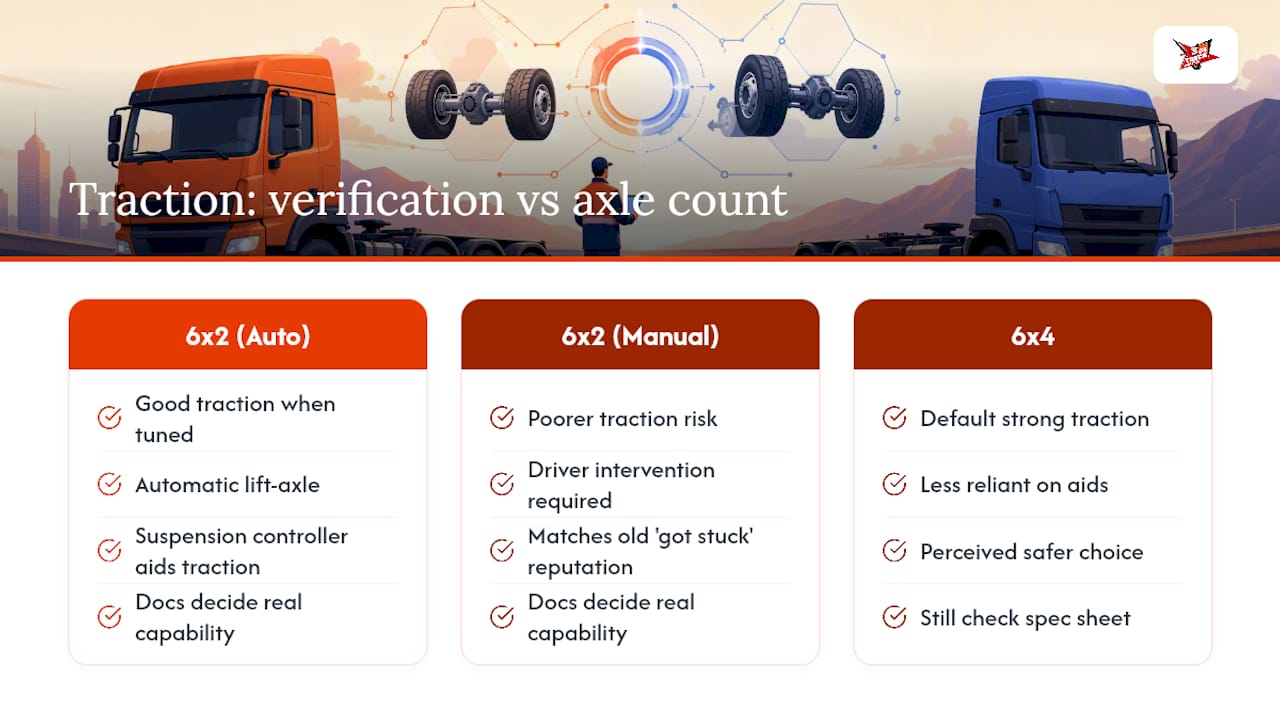
What gets overlooked is that the documentation gap matters more than the axle count. Two 6x2 trucks can perform very differently depending on whether their load-shift system engages automatically or requires driver intervention, yet buyers rarely ask sellers to confirm which one they're getting.
If there's one place to focus first, it's verification over assumption. Don't buy a 6x2 assuming modern traction aids are standard, and don't dismiss a 6x2 for a job it could actually handle well with the right equipment. Read the spec sheet like it's the whole story, because for this decision, it mostly is.
— Dave
Find the Right Axle Spec on the Marketplace
A listing website gives you a direct way to act on this checklist instead of guessing from a windshield photo. Search listings by category and subcategory, then filter down to the trucks worth a closer look before you ever pick up the phone.
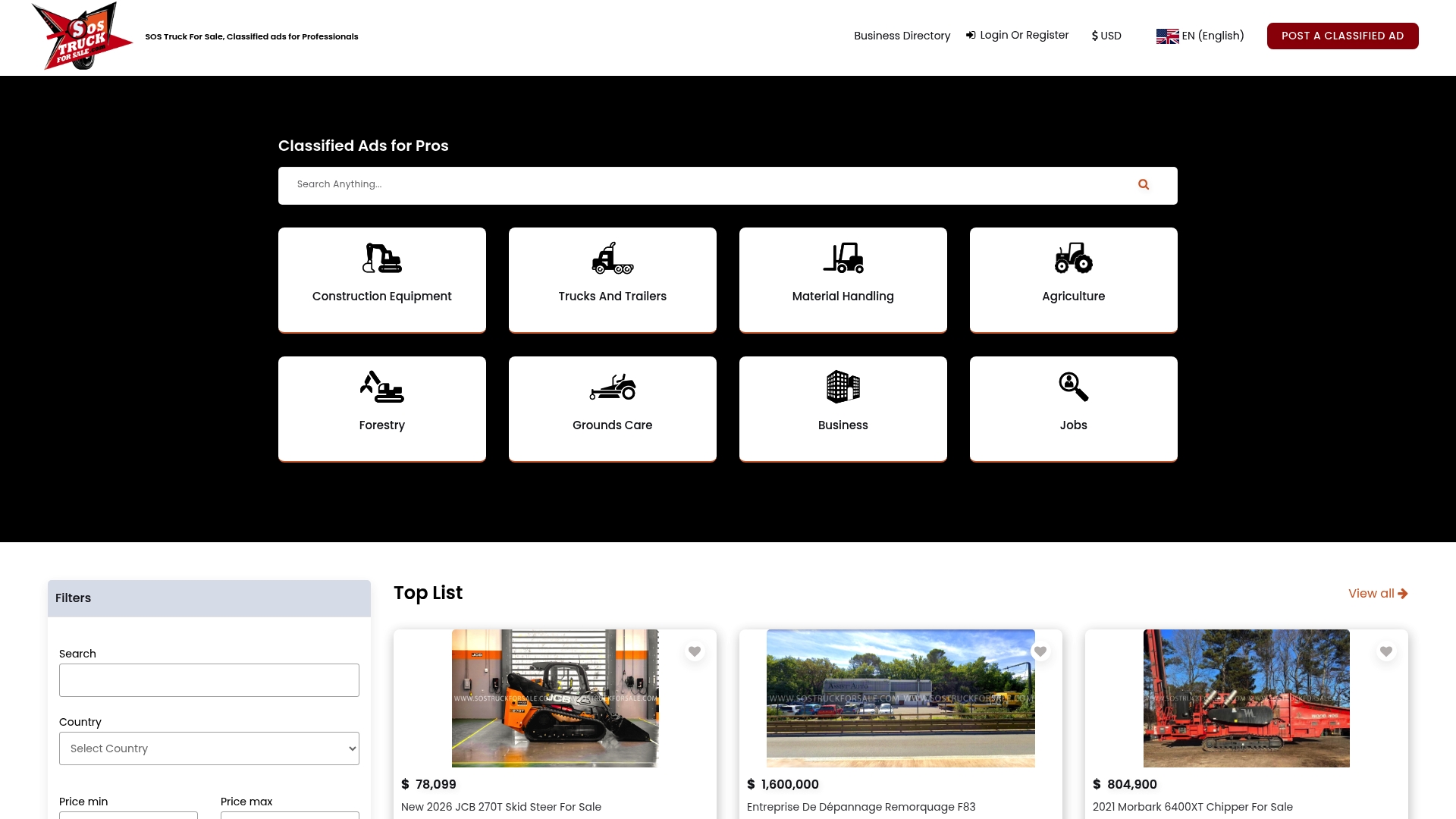
Every listing on the site is a chance to verify the details this comparison covers: axle arrangement, lift-axle notes, and suspension type, all visible before you contact a seller. That saves you the wasted call to a dealer whose truck doesn't match what you actually need. Whether you're shopping trucks and trailers for a highway fleet or comparing specs across construction-ready rigs, start by checking the spec fields on each listing. Browse the current inventory at Sostruckforsale and narrow your search by axle configuration before reaching out to a seller.
Sources
- 6x2 vs 6x4: A Question of Traction — Cummins
- Heavy-duty vehicle 6x2 drive knowledge gap briefing — NRC
- Chassis configuration — Wikipedia
FAQ
What Is the Difference Between 6x2 and 6x4 Trucks?
A 6x4 truck powers both rear axles for stronger traction, while a 6x2 truck powers only one rear axle, leaving the second rear axle un-driven for better fuel economy and lighter weight.
What Does a 6x2 Look Like?
A 6x2 tractor has three axles: a steer axle up front and two rear axles, but only one rear axle connects to a drive shaft. You can often spot it by the tag or pusher axle sitting without visible driveline hardware.
What Does "6x2" Mean When Referring to a Truck?
The number 6 refers to total wheel stations, and the 2 refers to how many are driven, following the standard chassis configuration notation used across the trucking industry.
What Does 6x4 Mean on a Semi Truck?
A 6x4 semi truck has six wheel stations with four of them driven, meaning both axles in the rear tandem receive power through an inter-axle differential.
Does Sostruckforsale List Both 6x2 and 6x4 Trucks?
Yes, listings on the site span both configurations across categories like trucks and trailers and construction equipment, often with spec details visible before you contact a seller.