
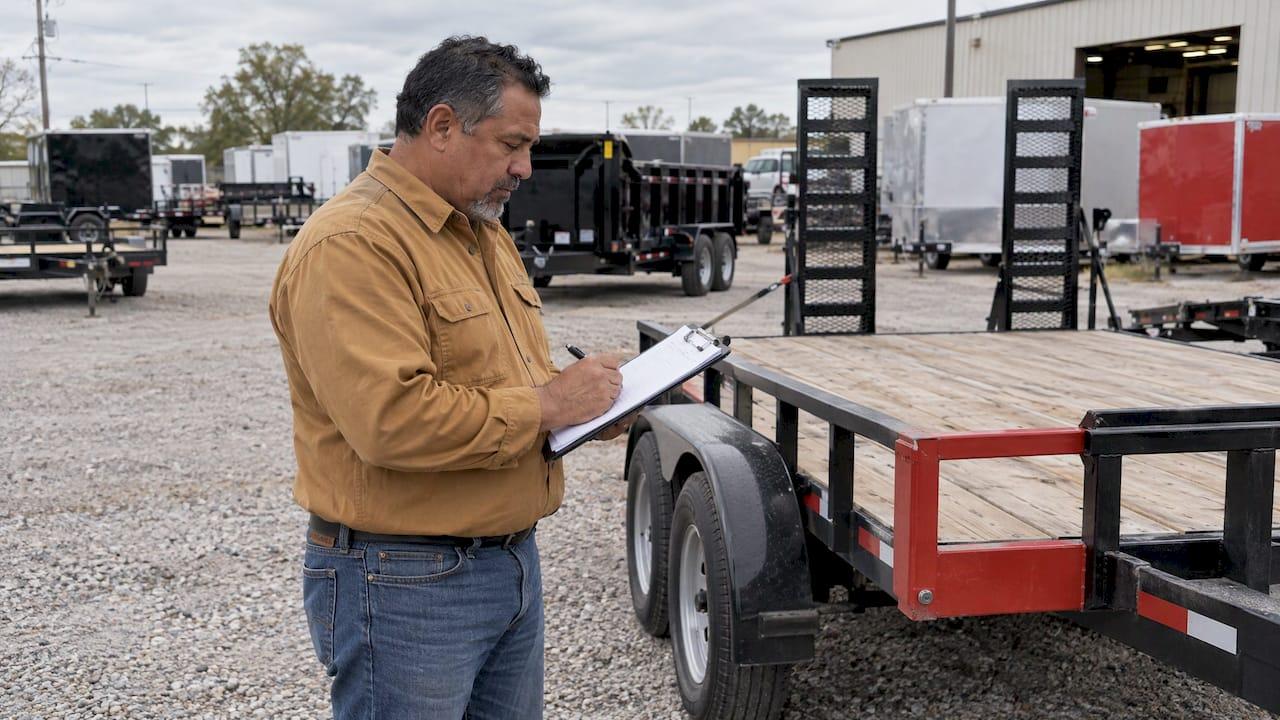
A bonded title lets you put a trailer into your inventory, register it and sell it when the original title is missing and you can still show the unit is yours. The state issues a title backed by a surety bond, a financial guarantee that pays anyone who later proves a better ownership claim. For a dealer, it turns a stuck unit into a sellable one. The rules differ by state, so this guide covers the pattern every state follows and the numbers that change from one DMV to the next.
TL;DR
- A bonded title is a state-issued title backed by a surety bond. Under Vermont DMV guidance, it can be used to register, insure or sell the trailer.
- The bond is usually set at 1.5 times the trailer's value, and most states keep it on record for three years. Connecticut is the exception in the research: twice the value, held five years.
- States ask for proof of ownership, a VIN inspection and often notice to prior owners or lienholders before you buy the bond.
- The premium is a small percentage of the bond. One Texas title-bond agency publishes $15 per $1,000 with a $100 minimum.
- Some light trailers need no bond at all, so check your DMV before paying for one.
Table of Contents
- What a bonded title is, and why it matters on a trailer lot
- When a trailer qualifies
- The proof you need before the bond
- How the bond amount is set
- What it costs
- Step by step: getting a bonded trailer title
- Selling a trailer on a bonded title
- Bonded titles and your dealer license
- Our perspective
- List your trailers where equipment buyers look
- FAQ
- Sources
What a bonded title is, and why it matters on a trailer lot
A standard title is the state's record that you own the trailer. A bonded title does the same job when the paper trail is broken: a lost title, a seller who never signed one over, a chain of bills of sale with a gap in it. The Vermont DMV explains that the bond's main role is to guarantee that the person applying is giving truthful information. If the applicant misrepresents the ownership history, the bond protects injured parties such as lienholders or a legal previous owner.
It is a three-way agreement among you, the surety company and the DMV. NFP's explanation puts it this way: if someone later proves rightful ownership, the surety pays that person the vehicle's value, and you must reimburse the surety. The bond does not grant ownership. It lets the DMV issue a title while protecting a possible rightful owner.
Once the bond period ends with no claims, the bonded status is usually removed. The DMV can then issue a standard title that looks like any other.
What it does for your inventory
With a bonded title you can do what a standard title allows: register, insure and sell. Vermont also says the bond can pass between owners when the trailer is sold. NFP adds that a bonded title does not make a unit less legal. It notes that some buyers and lenders see it as temporary until the bond period runs out. Tell the buyer up front, put it in the listing and keep the bond paperwork with the deal file.
When a trailer qualifies
States list slightly different triggers, but they come down to the same situation: you hold the trailer, you cannot produce a properly assigned title, and you have used the normal routes first.
- Arizona: the Arizona DOT calls for a bonded title when documentation cannot satisfy an ownership claim or there are undisclosed liens.
- Nebraska: the Nebraska DMV offers it to Nebraska residents only, when no title was ever issued in any state, when you cannot provide a properly assigned title or manufacturer's certificate, or when the vehicle already carries a bonded title in another state.
- Vermont: only a Vermont resident who has exhausted all other options to get the previous title may apply.
- Alaska: Alaska's DMV requires a bond for trailers over 500 pounds with inadequate proof of ownership. Lighter trailers may not need one, and a certified scale weight slip should be provided.
Note the residency rules. If your dealership is in one state and the trailer sits in another, confirm which DMV will accept the application before you spend anything.
Light trailers and old trailers can skip the bond
Check this first. Several states carve out exceptions:
- Wisconsin: form MV2083 lets a light trailer of 3,000 pounds gross weight or less, not used for hire or rental, be titled without a surety bond. You supply three listed proof-of-ownership items, such as the manufacturer's certificate of origin, the original purchase agreement, lien or bank documents, or insurance papers showing year, make and VIN.
- Montana: Montana's MVD requires no bond when the trailer, semitrailer or pole trailer is 30 years old or older, or when the determined value is $1,000 or less.
- Maryland: under Transportation Code §13-109, the state can register a non-camping trailer rated at 2,500 pounds GVW or less without a certificate of title.
Most dealer trailers, such as flatbeds, lowboys, dry vans, reefers and equipment haulers, are far above these weights. Expect to bond them.
The proof you need before the bond
The bond is rarely the first step. States want you to show a good-faith claim and give prior owners a chance to object.
Proof of ownership. Montana accepts a notarized bill of sale, a cancelled check or a purchase invoice. Nebraska also asks for documents such as a bill of sale. If you are building a file from a private or auction purchase, a clean bill of sale with the VIN, the date, the price and both parties' signatures is the backbone of it. Our partner-adjacent reading on what an equipment bill of sale should include covers the fields and signing, and the same fields matter when a construction trailer ends up on a bonded title.
VIN inspection. Montana wants a Stage 1 VIN Inspection Form (MV20) completed by law enforcement. Nebraska requires a Sheriff's Inspection Certificate for $10, valid 90 days, with cabin trailers and manufactured homes exempt. Texas asks for a Law Enforcement Identification Number Inspection (Form VTR-68-A) when no Texas record exists. Alaska needs a Form 811 inspection by a DMV representative or peace officer.
Notice to prior owners. Nebraska is the clearest example. Per its DMV page, you run a title search, send certified letters to the titled owner, lienholder or seller, and wait 30 days for responses. Only then do you buy the bond, and it must be submitted within 30 days of issuance. That order is why the bond is the last purchase, not the first.

Affidavit. Arizona's process includes an applicant affidavit. North Carolina requires an Affidavit of Facts (MVR-92H) and a notarized title application.
How the bond amount is set
The standard formula is 1.5 times the trailer's value. Where the value comes from depends on the state:
| State | Bond amount | Term or notes |
|---|---|---|
| Arizona | 1.5 times the vehicle value | Covers prior owners, lienholders and later purchasers |
| Nebraska | 1.5 times current value (property tax valuation or NADA Guide) | Three years; $50 application and title fee |
| North Carolina | 1.5 times value, $100 minimum | On file three years |
| Alaska | 1.5 times appraised value | Three-year non-cancelable bond (Form 824) |
| Vermont | 1.5 times J.D. Power average trade-in value | Three years |
| Connecticut | Twice the value set by the commissioner | Returned after five years, if no action is pending |
| Alabama | Flat $25,000, $10,000 or $5,000 by trailer age | Three-year bond |
Sources for the table: Arizona, Nebraska, North Carolina, Alaska, Vermont, Connecticut, Alabama.
Two state shortcuts worth knowing
Alabama sets trailer bond amounts by age instead of by appraisal: $25,000 for trailers under 5 model years old, $10,000 for 5 to 10 model years and $5,000 for 10 or more. The title application (form MVT 5-1E) must be made within 90 days of the bond being executed.
Texas lets a trailer or semitrailer owner use a department value in place of an appraisal. Per the TxDMV, that is $4,000 for a trailer under 20 feet and $7,000 for one 20 feet or longer, and the bond is 1.5 times that value. You have one year from the Notice of Determination (Form VTR-130-ND) to buy the bond.
What a $30,000 bond means
It is a coverage limit, not a price. A $30,000 bond means the surety stands behind claims up to $30,000. Under the 1.5 times rule, that implies a trailer valued at about $20,000. You pay a premium, not the face amount.
What it costs
The bond is the main expense, plus state fees and inspection charges. One Texas title-bond agency, Lawrence Auto Title, publishes a premium of $15 per $1,000 of bond amount with a $100 minimum. Its example: a $5,000 value yields a $7,500 bond and a $112.50 premium. Premiums vary by surety and state, so treat that as a worked example, not a quote.
A worked dealer example, using Texas's published trailer values and that premium rate: a 24-foot trailer takes the $7,000 department value. The bond is 1.5 times that, $10,500, and at $15 per $1,000 the premium is $157.50. Add the inspection and title fees. Against a trailer that cannot be sold, that is a modest cost.
On a high-value unit the math changes. A $40,000 reefer or lowboy needs a $60,000 bond. Underwriting may apply at higher bond amounts, so build that lead time into your acquisition cost.

Step by step: getting a bonded trailer title
The details vary, but the order holds in most states.
- Confirm you need a bond. Check weight and age exemptions with your DMV. NFP notes some trailers may not require a title at all, so a call can save the expense.
- Gather proof of ownership. Bill of sale, invoice, cancelled check, VIN, photos. Fix gaps now, not at the counter.
- Run the VIN inspection. Use the inspector your state names: law enforcement, a sheriff, the State Highway Patrol Investigative Services Unit in North Carolina, or a DMV representative.
- Notify prior owners and lienholders where required. Keep the certified-mail receipts. Nebraska's 30-day wait is the model.
- Get the bond value. Use your state's method: NADA, trade-in value, a department value, or an appraisal.
- Buy the surety bond. Mind the deadlines: one year from the Texas notice, 30 days in Nebraska, 90 days before the Alabama title application.
- File the application with the bond and fees. Vermont's Title Bond form (VT-020) is completed by the insurance company and returned with the registration, tax and title form, the VIN verification and ownership paperwork. Vermont rejects forms with erasures, alterations or strikeouts, so submit clean originals.
- Receive the bonded title. Alabama prints a legend on the title stating it was secured under a three-year surety bond.
For a Texas application, TxDMV has you submit documents to a Regional Service Center, receive the notice, buy the bond, then take the notice, application and inspection form to the county tax office within 30 days.
Selling a trailer on a bonded title
The bond can pass to the next owner. Disclose it in the listing so the buyer, and any lender, is not surprised. The bonded notation clears when the term ends. Connecticut and Maryland return the bond and any deposit at the end of the term, five and three years respectively, unless an action to recover on the bond is pending. Montana issues a new title without the bond designation after the bond expires.
If you are moving trailers to buyers across state lines, the title still has to transfer cleanly. Our guides on transferring a semi truck title properly and the excavator ownership paperwork checklist walk through the same bill of sale and signature discipline. For marketing the unit, see how dealers close trailer sales faster online.
Bonded titles and your dealer license
A dealer's licensing bond is a separate thing from a title bond. The first is a condition of operating as a dealer. The second is a one-unit guarantee attached to a single trailer's title. Keep them apart in your books. For the licensing side, see our guide to US dealer licensing requirements and the $50k bond.
Our perspective
Most title trouble we hear about from dealers starts at purchase, not at the DMV. A trailer comes in with a signed bill of sale and no title, and the paperwork gap is only noticed when a buyer asks for the title.
Our view is simple: treat title status as part of the listing. Sostruckforsale is built for industry professionals, with a dedicated classified environment for commercial and industrial equipment, multi-category coverage and dealer registration options. A listing that states the title status clearly, bonded or standard, gives the next buyer what they need to act.
Buyers can filter listings by category, subcategory, price and country, and dealers can add a business directory presence. A well-documented trailer in front of that audience is easier to move than one that raises questions.
Dave
List your trailers where equipment buyers look
Sostruckforsale is an online marketplace for commercial vehicles and industrial heavy equipment. Its categories include Trucks and Trailers, Construction Equipment, Material Handling, Agriculture, Forestry and Grounds Care. Dealers and private sellers post classified ads, and the site has a business dealer directory.
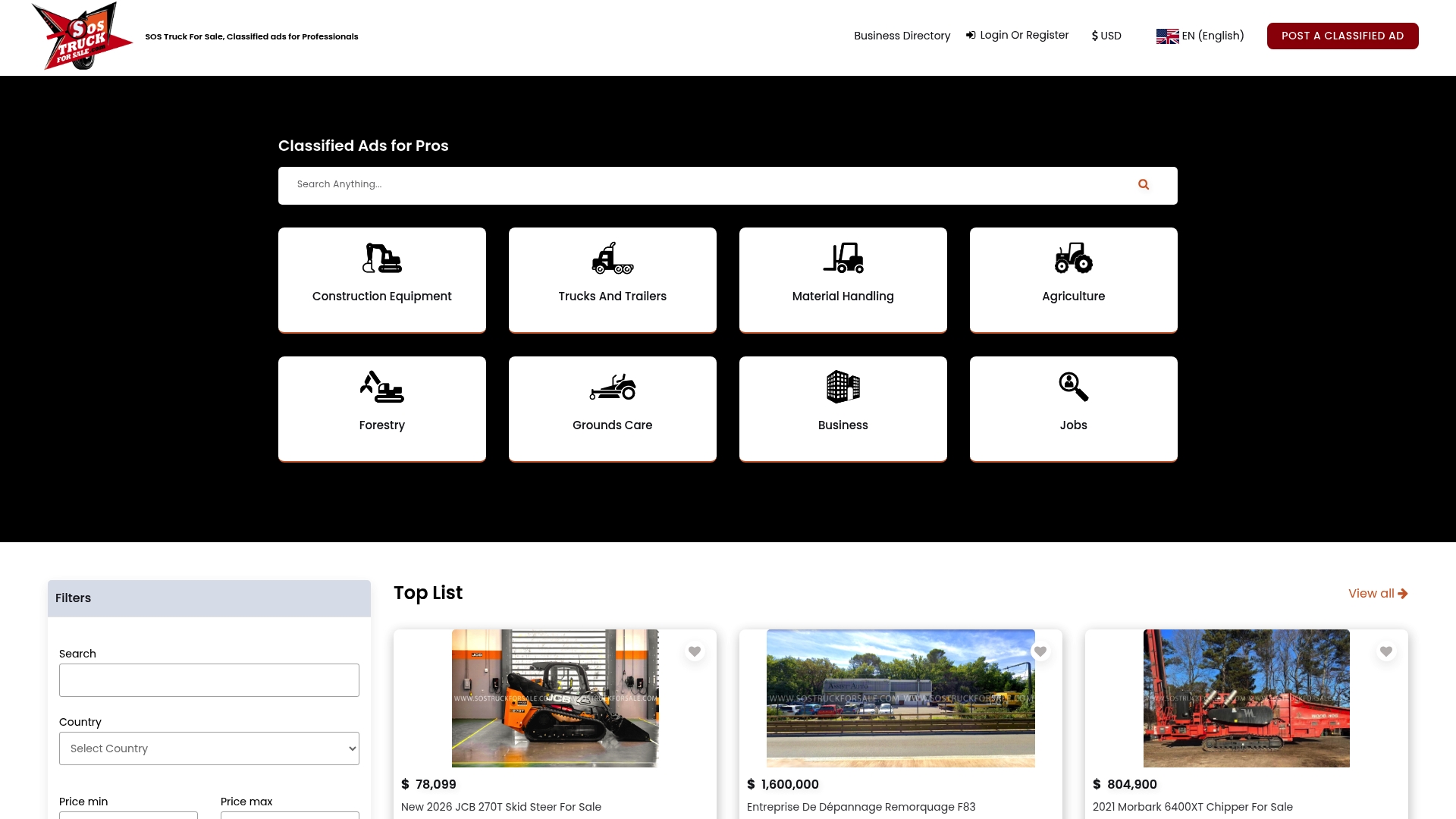
When your title paperwork is in order, post your trailer on Sostruckforsale and state the title status in the description.
FAQ
Is a bonded title as good as a regular title?
For registering, insuring and selling, a bonded title does the same job. The difference is the surety bond behind it. After the bond period ends with no claims, the DMV can usually issue a standard title.
How long does the bond stay on a trailer title?
Three years is the most common term in the research: Alabama, Alaska, Arizona-style programs, Nebraska, North Carolina, Vermont and Maryland. Connecticut holds it for five years. Check your own state's term before you quote a buyer.
Do I need a bonded title for a small utility trailer?
Not always. Wisconsin allows light trailers of 3,000 pounds or less to be titled without a bond with enough proof of ownership. Maryland can register a non-camping trailer of 2,500 pounds GVW or less without a title, and Montana waives the bond at $1,000 in value or less.
Who pays if someone claims the trailer later?
The surety pays the rightful owner up to the bond amount, then you reimburse the surety. That is why states require honest documentation and notice to prior owners first.
Sources
- What is a Bonded Title? Vermont DMV
- Bonded Title, Vermont DMV
- Bonded Title Explained, NFP
- Bonded Title, Arizona DOT
- Bonded Certificate of Title, Nebraska DMV
- No Proof of Ownership (Surety Bond), Alaska DMV
- MV2083 Application, Wisconsin DOT
- Vehicle Title Information, Montana MVD
- Maryland Transportation Code §13-109
- Vehicle Title Special Cases, NCDMV
- Connecticut General Statutes Chapter 247
- Rule 810-5-75-.34, Alabama Administrative Code
- Bought a Vehicle Without a Title? TxDMV
- Texas title application steps, TxDMV
- Title bond premium FAQ, Lawrence Auto Title
- Equipment bill of sale guide