

You can sell a truck with a salvage title. State law allows it as long as you disclose the title brand and transfer ownership correctly, so the transaction isn't voided later. Your first move: gather the title, repair receipts, any inspection paperwork, and clear photos before you contact a single buyer.
TL;DR:
- Accurate disclosure of the title brand, detailed documentation, and organized photos boost offers and speed up the sale process.
- You must confirm ownership, gather repair receipts, and verify the truck's damage history before listing it for sale.
- Selling cross-state can trigger re-inspection rules, and liens must be released before transfer; failing to disclose can void the sale.
- Private buyers and franchised dealers typically avoid branded titles, so targeting rebuilders, dismantlers, or salvage platforms yields better prices.
Table of Contents
- Actionable Checklist: The Steps to Sell Now
- What State Disclosure Rules and Title Transfer Actually Require
- How Much Does a Salvage Title Cut Your Truck's Value?
- Which Buyers Actually Pay for a Salvage Title Truck?
- What Paperwork and Photos Actually Raise Offers?
- How Do You Compare Offers and Negotiate a Fair Net Price?
- How Do You Handle Pickup, Payment, and Auction Timing?
- What Mistakes Cost Sellers the Most Money?
- A Marketplace Perspective on Selling Salvage Trucks
- List Your Salvage Truck Where Rebuilders and Dealers Actually Look
- Where to Verify State Rules and Valuation Before You Sell
- Sources
Actionable Checklist: The Steps to Sell Now
Selling a salvage title truck moves faster when you work through the same order buyers and DMVs expect. Skip a step and you'll either lose money or stall the sale at title transfer.
- Confirm ownership and the exact title brand printed on your certificate (salvage, rebuilt, or nonrepairable). Each carries different disclosure rules and buyer expectations.
- Decide whether to sell as-is or repair it toward a rebuilt inspection. Run the numbers: if repair cost is well below the value gain, rebuilding usually pays off.
- Gather documentation and photos, then pull a VIN history report so buyers can verify the damage story matches the paperwork.
- Request at least two offers that spell out pickup or towing terms, then compare the net amount each buyer actually pays you, not the headline number.
What State Disclosure Rules and Title Transfer Actually Require
Every state treats a branded title as material information a buyer has a right to know before money changes hands. "Salvage" typically means an insurer or state agency declared the truck a total loss. "Rebuilt" means it passed a state inspection after repair. "Nonrepairable" means it can only be sold for parts or scrap, never re-registered for road use.
Disclosure obligations vary by state, but the pattern is consistent: put the title brand in writing, usually on the bill of sale and the title itself, before the buyer signs anything. New York requires sellers of rebuilt salvage vehicles to provide a written salvage disclosure statement, and skipping it can bring penalties or a refused registration for the buyer.
A few practical wrinkles worth checking before you list:
- Some states, including Alabama, allow you to sell a salvage vehicle even if the title hasn't been retitled into your name yet, but they require the disclosure to appear in a specific minimum font size on the paperwork.
- Selling across state lines can trigger the buyer's home-state re-inspection rules, so confirm where the truck will end up registered.
- If a lien is still attached, you'll need a lien release before the title can transfer at all.
How Much Does a Salvage Title Cut Your Truck's Value?
A salvage brand knocks a serious dent into resale value, and the size of that dent depends heavily on damage type and your local market. Edmunds points to a reduction of up to about half off an identical clean-title vehicle's market value, though the exact discount swings with the type and severity of damage.
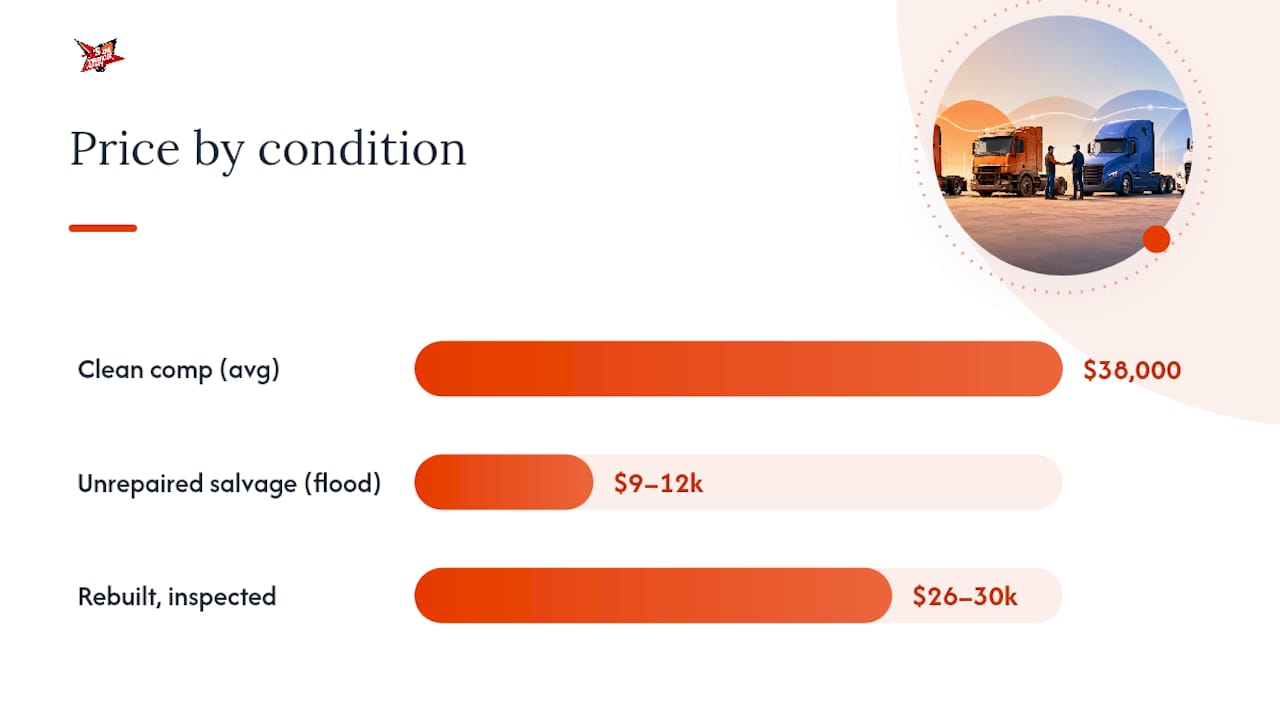
Auction-market analysis backs that pattern up: unrepaired salvage trucks tend to trade near parts and scrap pricing, while rebuilt-and-inspected trucks often land much closer to clean-market value once a buyer can verify the repair quality.
Here's a simple way to price yours:
- Pull three clean-title comps for the same year, make, and configuration in your area.
- Decide your tier, unrepaired salvage or rebuilt inspected, since they price in different brackets.
- Apply a conservative discount to the clean comp average based on your tier and damage severity.
- Set a walk-away minimum before you talk to a single buyer.
Example: a clean comp averages $38,000. An unrepaired flood-damage truck at the low tier might only fetch $9,000 to $12,000. The same truck rebuilt and inspected, with receipts to prove it, could land closer to $26,000 to $30,000, following break-even guidance on repair-to-value math.
Which Buyers Actually Pay for a Salvage Title Truck?
Match the buyer to the damage. A truck with a cracked frame and a torched engine belongs in a different sales channel than one with hail dents and a bent bumper.
- Rebuilders pay the most for trucks worth repairing. They want documentation and clear photos, and they're your best bet for moderate mechanical or body damage.
- Dismantlers and parts sellers pay based on component value, not the whole truck. This suits heavy structural or fire damage where rebuilding doesn't make financial sense.
- Salvage buyers and online salvage services offer fast, no-haggle quotes, usually lower than a private sale but with minimal back-and-forth.
- Salvage auctions reach the widest buyer pool at once, which can push price up on desirable trucks, though seller fees eat into your net.
- Private buyers occasionally pay the most for light cosmetic damage, but expect more questions, more negotiation, and slower closing.
Franchised dealers and most retail buyers won't touch a branded title at all, so don't waste time chasing that channel.
What Paperwork and Photos Actually Raise Offers?
Buyers pay more when they don't have to guess; thorough documentation and sharp photos follow best practices in damage documentation that routinely help close sales faster. A thin folder with just a title invites lowball offers; a complete packet invites competition.
Documents to gather:
- The salvage title itself, plus a signed bill of sale
- Repair invoices, itemized by part and labor
- A rebuilt-inspection certificate, if the truck has passed one
- A VIN history report
- Emissions or safety inspection forms, where your state requires them
Photos to shoot:
- Full exterior from all four corners
- Close-ups of every repaired or damaged area
- Odometer and VIN plate, clearly legible
- Engine bay and undercarriage
- Scanned copies of receipts, laid out flat and readable
Pro Tip: Label every receipt by repair category (frame, engine, electrical, cosmetic) and staple them into a single one-page seller packet. Rebuilders and inspectors move faster on trucks where they don't have to ask you for missing paperwork. Sellers who hand over thorough documentation and sharp photos routinely close faster than those who list with a bare description.
How Do You Compare Offers and Negotiate a Fair Net Price?
A $20,000 headline offer that requires you to pay $1,500 in towing nets less than an $18,000 offer with free pickup. Always convert every offer to what actually lands in your account.
- Subtract towing or transport costs the buyer won't cover.
- Subtract auction or platform fees if you're selling through a salvage auction.
- Add back any premium a rebuilder will pay for a completed inspection certificate versus an unrepaired truck.
- Use your repair receipts to justify pricing at the rebuilt tier rather than the unrepaired tier, since documentation is often the only thing separating the two price brackets.
- Get every offer in writing, confirm pickup terms in advance, and set your minimum acceptable net price before you start talking numbers.
How Do You Handle Pickup, Payment, and Auction Timing?
Rebuilders and salvage services frequently include free pickup as part of their offer, since they need the truck moved fast. Private buyers almost never do, so factor towing costs into your asking price if you're going that route.
- Use escrow or certified funds for any high-value sale, and never release the title before funds clear.
- Keep a signed record of the transfer date, odometer reading, and sale price for your own file.
- If selling through auction, expect a set consignment window, seller responsibility for getting the truck to the lot, and a load-out deadline once it sells.
What Mistakes Cost Sellers the Most Money?
- Concealing the salvage brand. Disclosure is required, and concealment can void the sale entirely.
- Accepting payment before the title paperwork and transfer documents are complete and signed.
- Taking the first offer without comparing net proceeds, including towing, from at least one other buyer.
A Marketplace Perspective on Selling Salvage Trucks
The biggest gap I see between sellers who net top dollar and sellers who don't isn't the truck's condition. It's the paperwork. A frame-damaged truck with organized repair invoices, a rebuilt-inspection certificate, and sharp photos will out-earn an identical truck with a bare title and a phone-camera snapshot, every time.
Rebuilders search listings for specific proof: itemized repair costs, VIN history, and inspection dates. Trucks that show that proof up front attract serious offers within days instead of weeks of back-and-forth. Trucks that don't tend to sit, then get sold in a hurry for less than they're worth.
If you only do one thing before listing, build the seller packet. It's the cheapest upgrade available to you, and it's the difference between buyers negotiating against your price and buyers negotiating against each other.
— Dave
List Your Salvage Truck Where Rebuilders and Dealers Actually Look
Sostruckforsale gives salvage-title sellers something a general classifieds site doesn't: a buyer pool already searching for exactly this kind of truck. Rebuilders, dismantlers, and commercial dealers browse category-filtered heavy-truck listings here specifically because they're looking for salvage and rebuilt inventory, not scrolling past it.
Starting a listing takes the documentation you've already gathered, title status, repair receipts, inspection certificate if you have one, and a full photo set, and turns it into a complete profile buyers can evaluate without a back-and-forth of questions. Listings with clear damage disclosure and organized paperwork tend to draw stronger, faster offers than bare-bones posts. Create your listing now and put your salvage truck in front of buyers who know exactly what they're looking at.
Where to Verify State Rules and Valuation Before You Sell
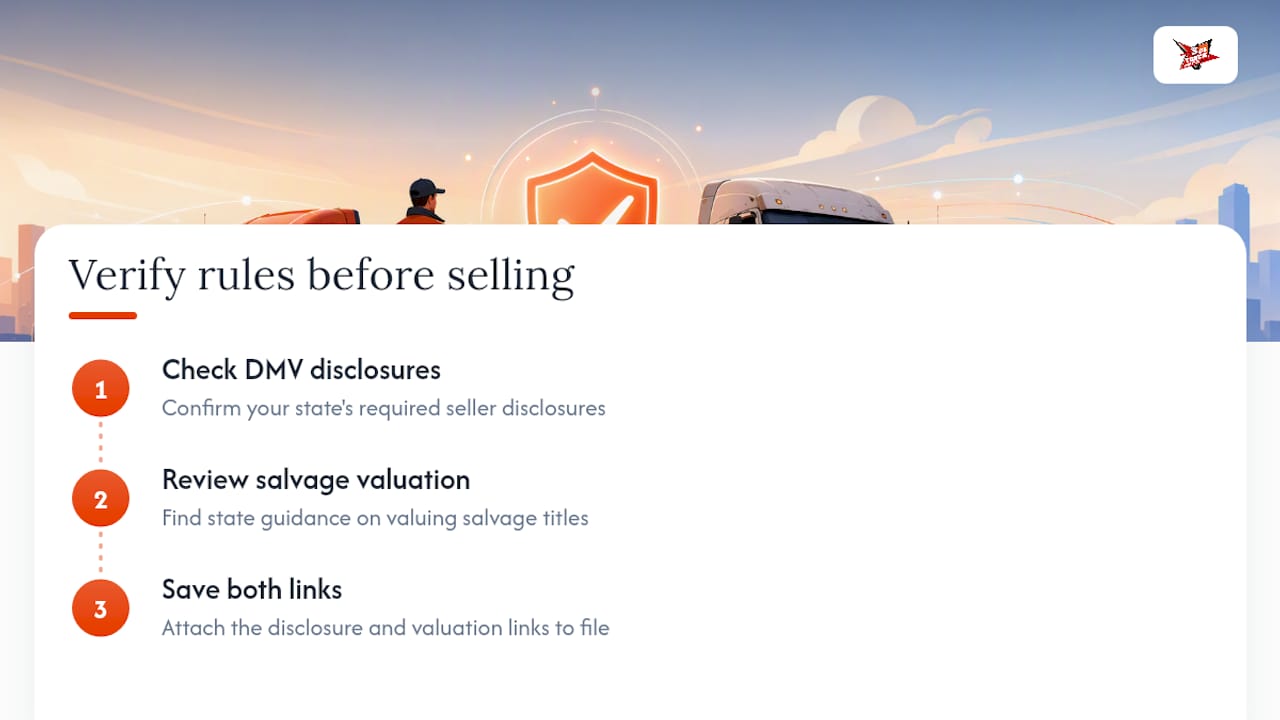
Check your state's DMV disclosure requirements and review salvage valuation guidance before setting a price or signing paperwork. Save both links to your file.
Sources
- What is the value of a salvage title vehicle? – Edmunds Help Center
- How Much Is a Salvage Title Car Worth Compared to Clean? | SCA Auction
- Salvage Title Value Calculator - 2026 Estimate | RecycleFind
- Sell a Salvage Vehicle (Salvage Vehicle Disclosure) | NY DMV