
Compare at least two lender types before signing anything: a bank or credit union for the lowest rate if you have two-plus years of history, and an online lender or leasing company if speed or credit flexibility matters more. SBA-backed loans fit large purchases where you can absorb a longer approval window. Sale-leaseback works when you already own equipment and need cash without giving up its use, as explained in this investor teaser deck. Pull your last two years of tax returns and financial statements now, then request quotes from two or three lenders this week.
TL;DR:
- For established companies with good credit, bank or credit union loans typically offer the lowest rates, ranging from 6% to 14%, with a funding timeline of two to six weeks.
- Online lenders and leasing companies provide faster funding, sometimes within days, but generally at higher rates between 10% and 30%, and often require less documentation.
- Equipment intended for long-term use benefits financially from financing due to depreciation advantages, while short-term or upgradeable machinery is better suited to leasing for cash flow flexibility.
- Credit costs can vary significantly based on down payment size and loan term, with larger down payments reducing interest rates and overall costs.
- Prepping detailed equipment and sale listings with accurate photos, maintenance, and auction comparables can streamline approval and speed up funding processes.
Table of Contents
- Which Lenders Should You Call First for Heavy Equipment Financing Options?
- How Lender Categories Compare on Cost, Speed, and Long-Term Value
- What Rates and Fees Should You Expect on Heavy Machinery Credit Options?
- How Do You Choose Between a Loan, a Lease, or Another Option?
- How Marketplace Listings and Auction Comps Speed Up Approval
- What Contractors Actually Get Wrong About This Decision
- Find Financing-Ready Listings Before You Apply
- Sources
- FAQ
Which Lenders Should You Call First for Heavy Equipment Financing Options?
Every heavy equipment financing option falls into one of six buckets, and each one solves a different problem. Matching your situation to the right bucket before you start dialing saves weeks.
- Banks and credit unions offer the lowest cost of capital for borrowers with at least two years in business and clean credit. Wells Fargo and Bank of America both run dedicated equipment finance divisions that handle everything from skid steers to fleet-scale excavator purchases, though expect a full underwriting process with financial statement review.
- SBA 7(a) and 504 loans suit large purchases, like a new crane or a fleet of dump trucks, where a lower rate offsets a slower timeline. The U.S. Small Business Administration's lender match tool connects borrowers to SBA-approved lenders and is the most reliable starting point for eligibility and paperwork requirements.
- Captive and OEM finance programs come from equipment manufacturers themselves. These programs sometimes bundle promotional rates or extended warranties with the purchase, though they can limit your flexibility if you later want to sell into the used market.
- Leasing companies trade ownership for lower monthly outlay and predictable payments. CrestCapital and Triton Capital both specialize in equipment leases and application-only approvals for qualified borrowers, which speeds up smaller transactions considerably.
- Online and specialty lenders fund fast, often within days, and tend to accept a wider range of credit profiles than a traditional bank. Balboa Capital, National Funding, JR Capital, and Commercial Fleet Financing all fall into this category, with underwriting that leans more on cash flow and equipment value than on a spotless credit file.
- Sale-leaseback arrangements let you sell equipment you already own to a lender or leasing company, then lease it back for continued use. This route generates liquidity without pulling machinery off the job site, and firms like CIT Bank have historically structured these deals for mid-size fleets.
The paperwork burden splits along similar lines. Bank and SBA routes typically require full financial statement packages, tax returns, and sometimes a business plan. Online and leasing routes often move forward with an application, a recent bank statement, and an equipment invoice, which is why they close faster even when the rate runs higher.
How Lender Categories Compare on Cost, Speed, and Long-Term Value
The rate you get and the deal structure you sign shape your total cost far more than the sticker price of the machine. Banks, credit unions, and SBA-backed lenders consistently offer the tightest rates because they underwrite against your full financial history and treat the equipment as secured collateral. Online and specialty lenders trade that lower rate for faster funding and a wider credit tolerance, a pattern confirmed by Dimension Funding's breakdown of 2026 rate expectations.
Ownership outcomes diverge just as sharply. A financed purchase puts the equipment on your balance sheet, which opens the door to Section 179 and bonus depreciation. A lease, depending on its structure, often gets treated as an operating expense instead, which simplifies the accounting but forfeits the depreciation benefit. Forbes Advisor's comparison of leasing versus financing lays out that trade-off clearly: financing builds equity and tax deductions, leasing protects cash flow and predictability.
PNC's guide for business owners frames the decision around lifecycle needs. Equipment you plan to run for a decade, like a well-maintained dozer, usually makes more financial sense to own. Equipment that turns over every three or four years, like certain attachments or technology-heavy machinery, often favors a lease you can walk away from at term's end.
| Lender category | Best for | Typical rate range | Term length | Speed to funding | Typical down payment |
|---|---|---|---|---|---|
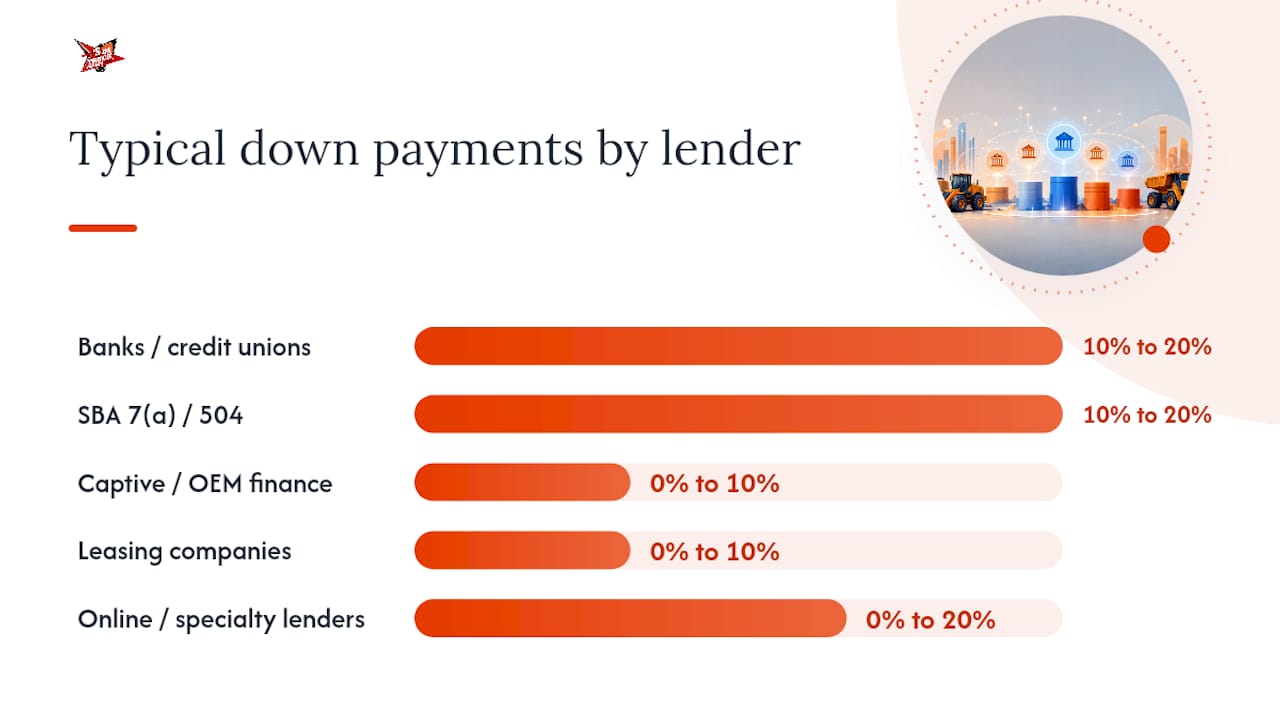
| Banks / credit unions | Established businesses, lowest cost | 6% to 14% | 3 to 7 years | 2 to 6 weeks | 10% to 20% |
| SBA 7(a) / 504 | Large purchases, long-term rate savings | 6% to 14% | Up to 10 years | 2 to 6 weeks | 10% to 20% |
| Captive / OEM finance | New-equipment buyers wanting bundled offers | Varies, sometimes promotional | 2 to 6 years | 1 to 3 weeks | 0% to 10% |
| Leasing companies | Flexibility, lower monthly outlay | Quoted as payment factor | 2 to 5 years | Days to 2 weeks | 0% to 10% |
| Online / specialty lenders | Fast funding, wider credit acceptance | 10% to 30%+ | 1 to 5 years | Days to 1 week | 0% to 20% |
| Sale-leaseback | Liquidity from owned equipment | Varies by lender | 2 to 5 years | 2 to 4 weeks | None (existing asset) |
A few practical notes sit underneath that table. Most equipment financing programs use the machine itself as primary collateral, which is part of why rates run lower than an unsecured business loan, according to SoFi's overview of heavy equipment financing. Sale-leaseback and equipment lines of credit both function as liquidity tools rather than acquisition tools. A line of credit gives you draw-as-needed access for repairs or smaller purchases, while sale-leaseback frees cash tied up in equipment you already own outright. Neither replaces a term loan for a major acquisition, but both help bridge gaps between jobs.
What Rates and Fees Should You Expect on Heavy Machinery Credit Options?
Rate ranges vary by lender type more than by equipment brand or model, and knowing the band before you apply keeps you from overpaying out of urgency.
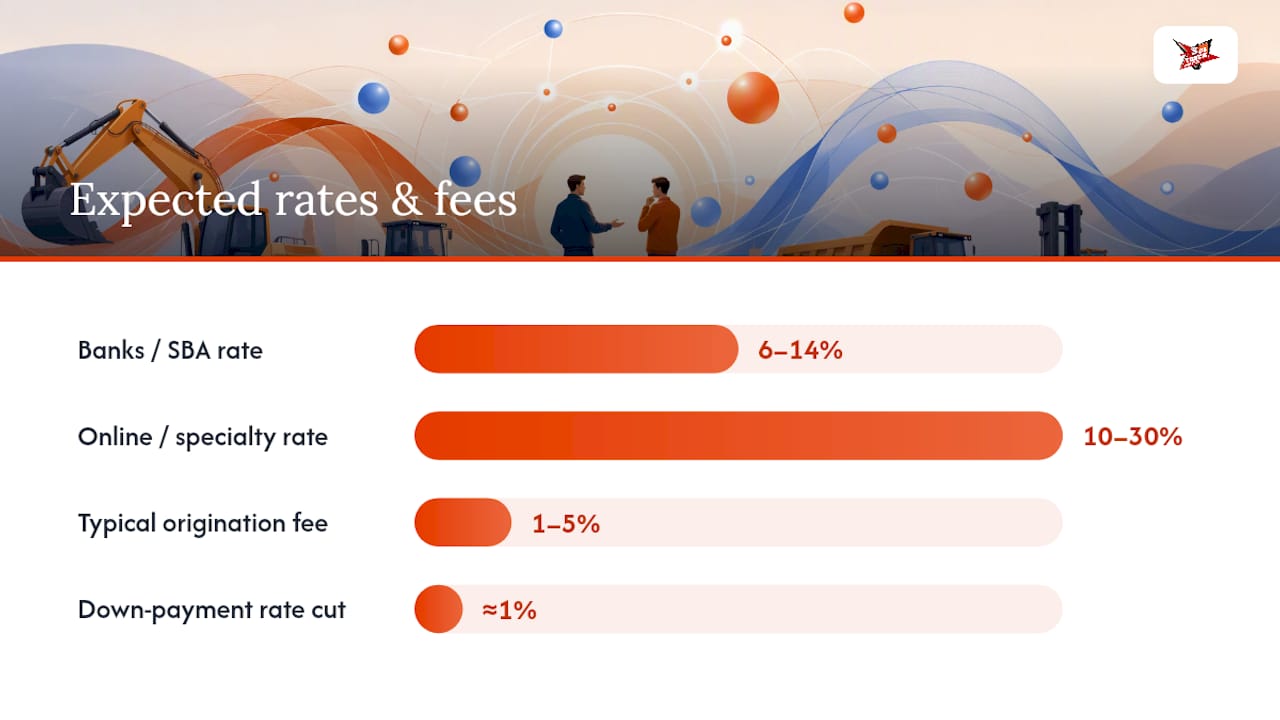
- Banks, credit unions, and SBA programs: roughly 6% to 14% for well-qualified borrowers with strong revenue and time in business.
- Online and specialty lenders: commonly 10% to 30%, occasionally higher depending on credit profile, equipment age, and how fast you need funding.
- Leasing companies: quoted as a payment factor rather than a stated APR, which can obscure the true cost if you don't convert it yourself.
Statistic Callout: Well-qualified borrowers working with banks or SBA-backed programs often land rates in the 6% to 14% range, while online and alternative lenders frequently quote 20% or higher for thinner credit files or faster funding timelines.
Run the math before you compare offers side by side. A $100,000 excavator financed over 60 months at 8% runs roughly $2,028 a month. The same loan at 18% from a faster online lender runs closer to $2,540 a month, a difference of over $30,000 across the full term once you add it up. That gap is exactly why a slower bank process is often worth the wait for large purchases, and why speed-focused financing makes more sense for smaller, shorter-term equipment needs.
Fees add another layer. Origination fees typically range from 1% to 5% of the loan amount, and some lenders charge documentation or filing fees on top. Prepayment penalties show up more often in bank and SBA loans than in online lending, where many lenders actively encourage early payoff. Down payment size moves the needle on rate more than most borrowers expect: putting 20% down instead of 10% can shave a point or more off your quoted rate, since it lowers the lender's exposure if the equipment loses value faster than projected.
Pro Tip: Ask every lender for the total cost of the loan in dollars, not just the rate. A lower rate with a longer term can cost more overall than a slightly higher rate paid off faster.
How Do You Choose Between a Loan, a Lease, or Another Option?
Run through this checklist before you sign, in this order:
- Decide your ownership goal first. If you want to build equity, claim depreciation, and eventually sell the asset, lean toward financing. If you want the lowest monthly payment and plan to upgrade in a few years, lease.
- Gather your documents early. Lenders commonly ask for two years of business tax returns, recent financial statements, the equipment invoice or listing, proof of insurance, and the equipment's specs, VIN, and hour meter reading.
- Ask specific questions on every quote. Confirm the term length, the actual APR (not just a payment factor), the residual or buyout value at lease end, any restrictions on how the equipment can be used, who handles maintenance, and what an early termination costs.
- Watch for red flags. Walk away from any lender who won't disclose a clear APR, leaves the residual value vague, bundles maintenance costs without itemizing them, or charges prepayment penalties that exceed a reasonable percentage of the remaining balance.
- Weigh cash flow against balance-sheet goals. A tight cash flow month favors a lease with a lower payment. A strong quarter with tax planning in mind favors financing and the depreciation benefit that comes with it.
Cross-collateralization deserves its own question on your list. Some lenders, particularly online ones moving fast, will ask you to pledge other business assets or equipment as additional security. That can tie up more collateral than the deal warrants, so ask directly whether the loan is secured solely by the equipment being financed.
How Marketplace Listings and Auction Comps Speed Up Approval
Lenders appraising a used machine look for the same things a buyer does: clear photos, an accurate hour meter, maintenance records, and a VIN they can verify. A detailed listing with auction comps and a pricing checklist gives an appraiser a faster path to a loan-to-value number, which often shortens underwriting by days.
Build a lender-ready package before you apply: the seller's equipment statement, recent comparable sale prices, any inspection report, and clear photos of hour meters and attachment points. If you're buying and selling in the same window, coordinate the closing dates so funding lands before your seller's deadline. A funding gap of even a week can cost you a deal on a competitive listing. For electric equipment, add battery health data and cycle counts to the package. Lenders increasingly ask for that detail the same way they'd ask about engine hours on a diesel machine, a shift covered in more depth in Sostruckforsale's guide to electric heavy equipment.
What Contractors Actually Get Wrong About This Decision
Most contractors either chase the lowest rate regardless of speed, or chase speed regardless of cost, and both mistakes get expensive. The better question is what your cash flow can absorb this quarter versus what ownership is worth to you over five years.
An established contractor with steady receivables and two years of clean financials should default to a bank or SBA loan every time; the rate savings compound. A growing subcontractor chasing a tight bid deadline should accept a higher rate from an online lender or lease rather than lose the job waiting on a bank's underwriting queue. Cash preservation and asset ownership aren't opposites. They're a trade-off you make deliberately, not by default.
— Dave
Find Financing-Ready Listings Before You Apply
Online marketplaces offer listings with details appraisers want, such as photos, hours, maintenance notes, and dealer contact information, helping prospective buyers prepare documentation for financing conversations.
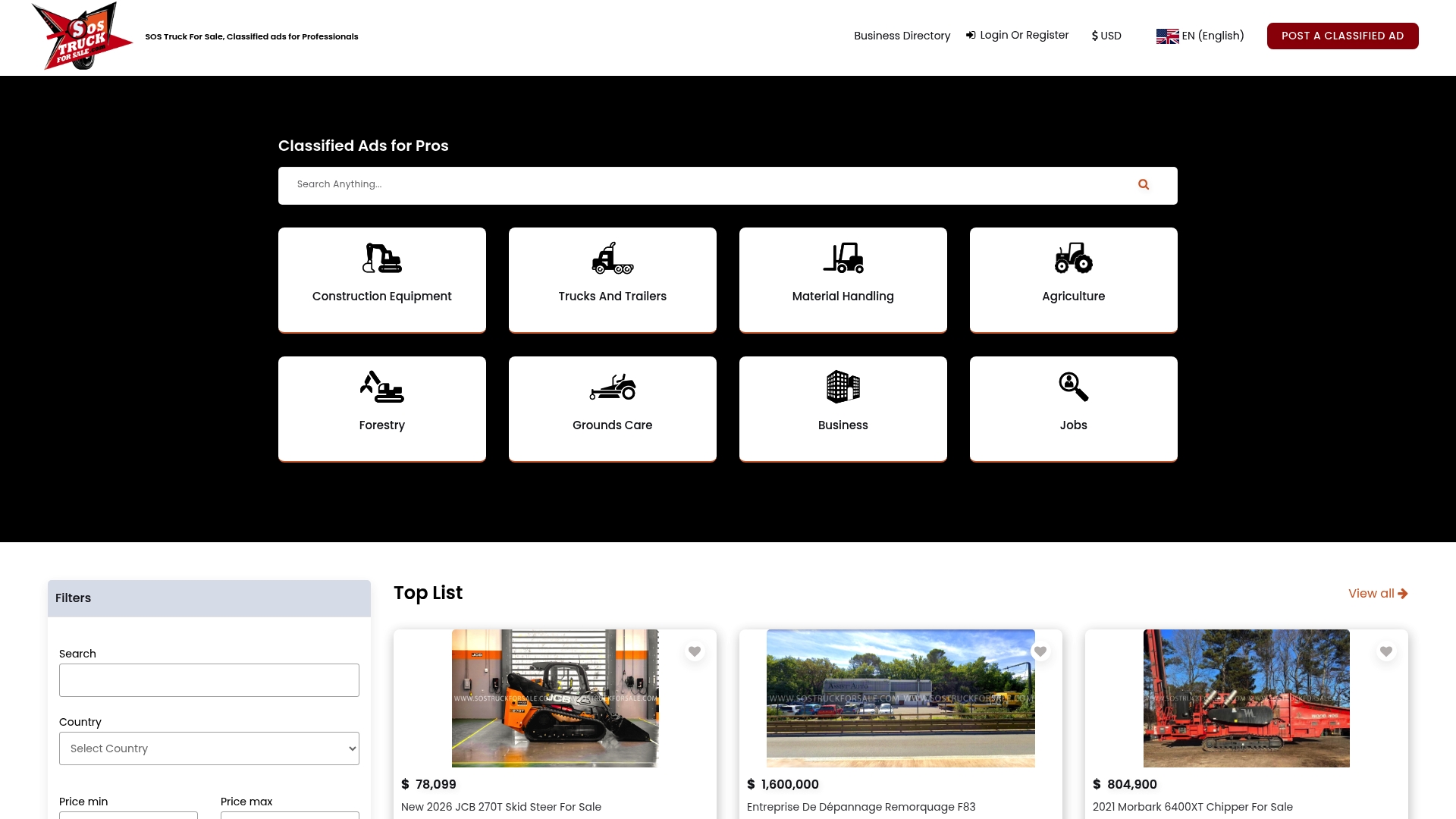
Start by browsing listings filtered by equipment type and price range to build your shortlist, then pull auction comps to support your loan-to-value conversation with a lender. If you're financing a truck or vocational vehicle specifically, Sostruckforsale's breakdown of commercial truck financing covers documentation lenders ask for on that equipment class. Once you've got a listing and a quote in hand, bring both to the seller. A pre-approval in your pocket during negotiation is worth more than most buyers realize. Browse current equipment listings on Sostruckforsale to get started.
This article is general information, not a substitute for advice from a qualified financial advisor. Consult a qualified financial professional about your own circumstances before acting on anything here.
Sources
- Equipment Leasing vs. Financing: Which Should You Choose? — Forbes Advisor
- Equipment Financing Rates in 2026: What Interest Rate to Expect? — Dimension Funding
- Equipment Leasing vs. Financing guide for business owners — PNC Insights
FAQ
What Company Has the Best Heavy Equipment Financing?
No single lender wins for every borrower. Banks like Wells Fargo and Bank of America tend to win on rate for established businesses, while online lenders like Balboa Capital and National Funding win on speed and flexibility.
What Are Typical Interest Rates for Heavy Equipment Financing?
Well-qualified borrowers working with banks or SBA programs typically see rates between 6% and 14%, while online and specialty lenders often quote 10% to 30% depending on credit profile and funding speed.
What Is the Monthly Payment on a $50,000 Equipment Loan?
At 8% over five years, a $50,000 loan runs roughly $1,014 a month.
Do You Need 20% Down for a Construction Equipment Loan?
Not always.
Should I Lease or Finance a Piece of Heavy Equipment?
Finance equipment you plan to run for its full useful life and want to depreciate; lease equipment you expect to upgrade within a few years or want off your balance sheet.