
Mobile cranes need three tiers of inspection: pre-shift visual checks by a competent person, documented monthly inspections retained according to OSHA retention requirements, and comprehensive annual inspections signed off by a qualified person, all under OSHA 29 CFR 1926.1412. Wire rope gets pulled from service once it hits ASME's measurable removal thresholds, not when it merely "looks worn." Every lift also depends on a pre-lift verification tied to those inspection records. Skip any layer and you're carrying legal and safety risk that a signed form would have prevented.
TL;DR:
- Regular inspection records must be detailed, signed by qualified personnel, and retained for at least 12 months for annuals and three months for monthly checks.
- Wire rope removal hinges on measurable thresholds like six broken wires in one lay or corrosion and must be documented and acted upon immediately beyond these limits.
- Pre-lift verification depends on verifying current inspection records, load calculations, ground stability, and safety devices, typically taking around 15 minutes per lift.
- Inspections must be organized by component systems, with specific checks for structural integrity, wire ropes, hooks, brakes, outriggers, safety controls, and ground contact.
- Using unqualified inspectors, missing or unsigned reports, subjective rope assessments, and skipping idle-period inspections are common errors that can lead to OSHA citations.
Table of Contents
- What OSHA 1926.1412 Requires and Who Signs Off
- The Component Checklist: What to Inspect on Every Tier
- When Wire Rope Must Come Out of Service
- How Pre-Lift Checks Use Your Inspection Records
- Recordkeeping That Survives an Audit
- The Mistakes That Trigger Citations and Incidents
- Who to Hire for Annual and Qualified Inspections
- Building a Program That Actually Holds Up
- Documentation Support When You're Listing or Retiring a Crane
- Where to Verify These Rules Directly
- Sources
- FAQ
What OSHA 1926.1412 Requires and Who Signs Off
OSHA's mobile crane inspection standard breaks the job into distinct windows, and mixing up who performs each one is where most operations get exposed. After assembly or a repair, someone must inspect the machine before it lifts anything. Each shift, the operator or another competent person runs a visual check for obvious problems: leaks, loose bolts, damaged rigging. Monthly inspections go deeper and must be documented, with records retained as required by OSHA regulations. Annual inspections are comprehensive and legally required to be performed by a qualified person, someone with the training, certification, or verified experience to judge complex defects, not just spot them.
A competent person can identify hazards and has authority to fix them or pull equipment from service. A qualified person carries the credentials or documented experience to evaluate structural and mechanical issues that a shift-level check would miss. OSHA requires the qualified-person signature specifically for annual and post-assembly inspections.
- Each shift: competent person, visual only, no formal report required
- Monthly: competent person, documented, retained 3 months
- Annual: qualified person, comprehensive, retained 12+ months
- After repair, modification, or idle period: inspection tier depends on duration idle
Penalties for skipping any of this aren't theoretical. Serious violations can run up to tens of thousands of dollars, and willful or repeated violations can reach over one hundred thousand dollars per occurrence, according to OSHA's penalty schedule.
The Component Checklist: What to Inspect on Every Tier
A crane inspection checklist only works when it's organized by system, not by tier alone. Each component carries different failure signatures, and conflating them is how inspectors miss things. Here's the practical breakdown crews actually use in the field, adapted from checklist formats aligned to ASME B30.5.
- Boom and structure. Check for cracks, weld failures, bent sections, and pin wear. This is the annual inspection's primary focus, since structural fatigue builds slowly.
- Wire rope and reeving. Look for kinks, corrosion, birdcaging, and broken wires. Tag findings to the correct tier: shift-level spotting versus monthly measurement.
- Hooks and load blocks. Measure throat opening for spread, test the safety latch, and check for wear grooves at load-bearing points.
- Brakes, clutches, and swing mechanisms. Run functional tests under load and check adjustment tolerances, not just whether the brake engages.
- Outriggers, mats, and ground contact. Confirm full extension, level ground bearing, and correctly sized pads for the load and soil condition.
- Safety devices and controls. Test the load moment indicator (LMI), anti-two-block system, boom angle indicators, and limit switches.
- Carrier, engine, and travel gear. Inspect tires or tracks, verify travel locks are engaged for transport, and check for hydraulic leaks along hose runs.
Pro Tip: Photograph every wire rope section during monthly checks, not just when you suspect a problem. A dated photo record turns a subjective "looked fine last month" into an objective comparison point when wear accelerates.
When Wire Rope Must Come Out of Service

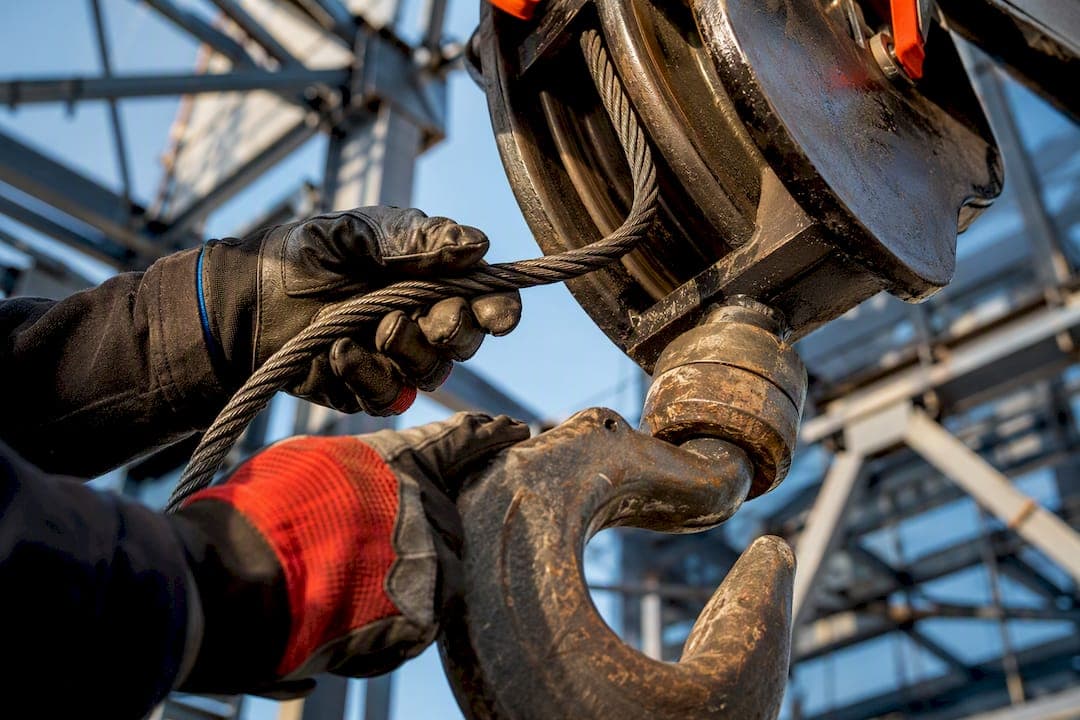
Wire rope removal isn't a judgment call. ASME B30.5 and OSHA reference measurable thresholds, and applying them consistently is what separates a real inspection program from a guess. The ASME B30.30 criteria set specific limits: six broken wires in one lay, or three broken wires in one strand of that lay, on running rope. Diameter reduction, birdcaging, core protrusion, heat damage, and corrosion that pits or reduces cross-section all trigger removal on their own, independent of the wire-break count.
Inspecting rope properly means rotating it slowly under load-free conditions, checking the full length lay by lay, and paying close attention to end attachments and sections that run over sheaves repeatedly. Those spots wear faster than the rest of the rope.
- Six broken wires in one lay (running rope)
- Three broken wires in one strand
- Measurable diameter loss beyond manufacturer tolerance
- Birdcaging, kinking, or core protrusion
- Corrosion pitting or heat discoloration
Once rope crosses a threshold, tag it, remove it from service immediately, and log the specific criterion that triggered removal. That documentation matters later if a claim or audit ever questions the decision.
How Pre-Lift Checks Use Your Inspection Records
A pre-lift check isn't a separate ritual from your inspection program. It's where those records get put to work. OSHA 1926.1417 organizes pre-lift verification into eight zones, and confirming inspection currency is the first item on the list.
- Documentation. Confirm the most recent monthly and annual inspections are current and on file.
- Load chart. Match the planned lift against the chart for boom angle, radius, and configuration.
- Load weight verification. Weigh the load whenever it's estimated at 75% or more of the rated capacity at that configuration.
- Ground bearing. Check soil compaction and use mats or cribbing where needed.
- Outrigger setup. Confirm full extension and correct pad placement.
- Rigging. Inspect slings, shackles, and hardware for rating and condition.
- Weather. Check wind speed against the crane's rated limits.
- Communications. Confirm the signal person and lift team have a clear, agreed signal method.
The full sequence typically runs about 15 minutes and covers roughly 30 discrete checks, with signatures from the operator, lift director, signal person, and rigger required on higher-risk lifts.
Recordkeeping That Survives an Audit
OSHA auditors focus on the monthly inspection layer more than any other document, because it's the one most often missing or unsigned. A complete report needs the equipment ID, inspector name and credential, the specific items checked, findings, corrective actions taken, and dated signatures. Skip any field and the report reads as incomplete even if the inspection itself was thorough.
Retention rules are straightforward: keep monthly records for at least three months, annual records for at least 12 months, per OSHA 1926.1412. Digital sign-off and photo timestamping close the gap that paper forms leave open.
- Equipment ID and location
- Inspector name and credential level
- Itemized findings, not just pass/fail
- Corrective actions with follow-up date
- Signature and date, every time
Pro Tip: Version your inspection forms. When you update a checklist template, keep the old version archived with a date range. If an incident review pulls a six-month-old report, you need to know which form was in use at the time.
The Mistakes That Trigger Citations and Incidents
Most crane inspection failures trace back to a handful of repeat errors, and they're avoidable once you know to look for them. An operator signs an annual inspection that legally requires a qualified person's credential. Monthly records go missing or sit unsigned in a drawer. Rope gets judged by eye instead of measured against ASME's objective thresholds. Idle-equipment rules get skipped entirely when a crane sits parked for a season and rolls back into service without the inspection its idle duration requires.
- Using an operator's signature where a qualified person is legally required
- Missing or unsigned monthly reports
- Applying subjective "looks fine" judgment instead of measurable rope criteria
- Skipping the inspection tier tied to idle duration before reuse
- No photo evidence to back up a written finding
Fixing this starts with training that draws a hard line between competent and qualified roles, checklists built around objective thresholds instead of vague language, and random supervisory audits that spot-check completed reports before they're filed away.
Who to Hire for Annual and Qualified Inspections
Annual inspections require a qualified person, and verifying that credential before you hire matters as much as the inspection itself. NCCCO certification is the most widely recognized standard in the industry, though OSHA also accepts documented experience and formal training as qualifying paths.
Before engaging an inspector, request proof of certification or training, sample reports from prior jobs, references from past clients, and current insurance coverage. A contractor verification process built around these four checks catches most unqualified providers before they touch your equipment.
- Proof of NCCCO or equivalent qualification
- Sample inspection reports showing itemized findings
- Client references from comparable equipment classes
- Active insurance and liability coverage
Escalate to an engineer-level inspection when structural defects are suspected, or when a crane hits the 10-year mark and needs non-destructive testing (NDT) beyond what a standard annual inspection covers.
Building a Program That Actually Holds Up
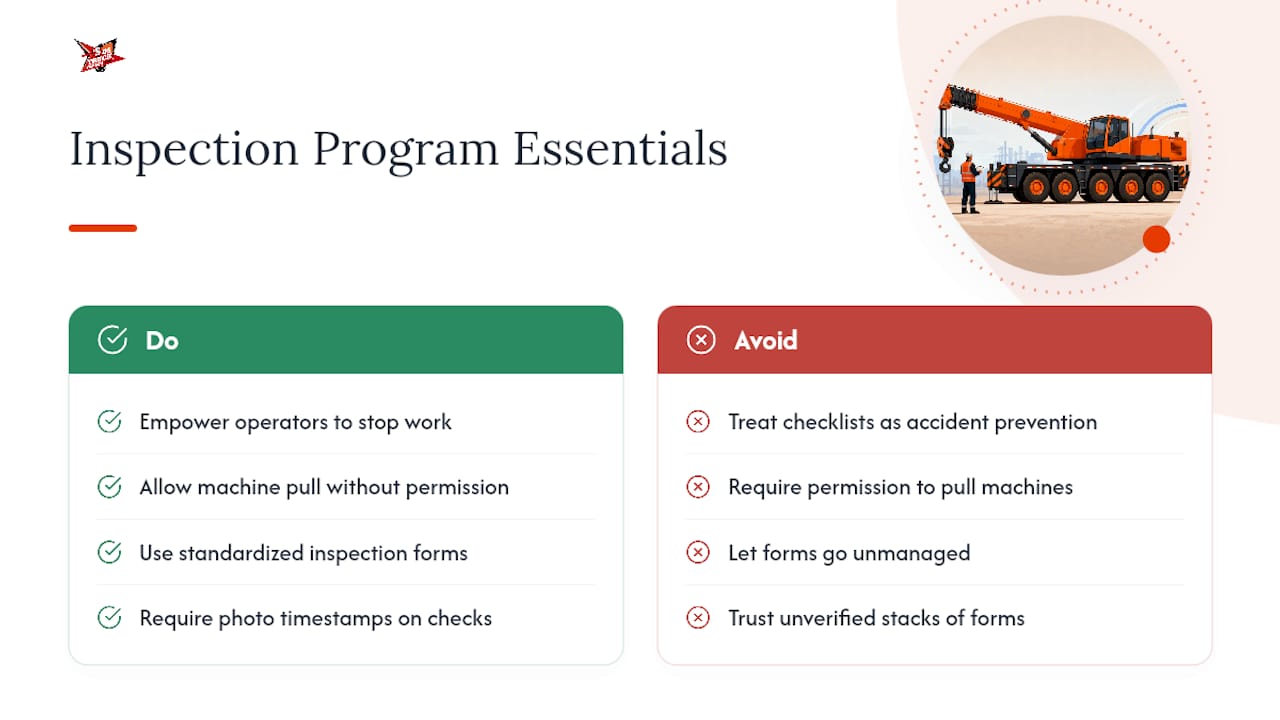
Checklists don't prevent accidents. Culture does. Industry data tied to OSHA fatality records consistently point to human error as the root cause behind most crane incidents, which means the strongest inspection program is the one where any operator can pull a machine from service without asking permission first.
Standardized forms, photo timestamps on rope and structural checks, and versioned checklist templates aren't paperwork for paperwork's sake. They're the audit trail that protects your crew and your business when something goes wrong. Some fleet operators build exactly this kind of documentation discipline into their equipment records, and it's the difference between a defensible program and a stack of forms nobody trusts.
— Dave
Documentation Support When You're Listing or Retiring a Crane
Selling a crane or pulling it out of active service comes with its own documentation demands. Buyers want inspection history, and a clean audit trail makes a listing more credible than a bare description ever will. An online marketplace connects sellers of cranes and other heavy equipment with buyers actively searching by category, and a related blog carries practical checklist and paperwork guidance, including a seller's checklist for shipping sold equipment and a buyer and seller checklist for transfer paperwork, that pair well with your existing inspection records.
If you're preparing a crane for sale, start by pulling your most recent annual inspection report and monthly logs together. Then head to Sostruckforsale to list the equipment with that documentation ready to hand off to a buyer.
Where to Verify These Rules Directly
For legal decisions, go to the primary text: OSHA 1926.1412 for inspection requirements, the ASME B30.30 criteria for rope removal thresholds, and state resources like North Carolina's crane inspection checklists for downloadable forms.
FAQ
How much does a crane inspection cost?
Costs vary widely by crane size, inspection tier, and region, but annual comprehensive inspections by a qualified person typically cost more than routine monthly checks because they require specialized credentials and more time on-site. Contact a qualified inspection provider for a quote specific to your equipment class.
How often do mobile cranes need to be inspected?
Mobile cranes need pre-shift visual checks before every shift, documented monthly inspections retained according to OSHA retention requirements, and comprehensive annual inspections by a qualified person retained for at least 12 months, per OSHA 1926.1412.
What is the 3-3-3 rule for cranes?
There's no OSHA-defined "3-3-3 rule" for mobile cranes; the number that does matter is wire rope removal criteria, where six broken wires in one lay or three in one strand triggers removal under ASME B30.30. Definitions of informal "rule of thumb" phrases vary by trainer, so verify against the ASME standard directly.
How much is a mobile crane certificate?
Operator and inspector certification costs depend on the certifying body and credential level; NCCCO publishes its own fee schedules for exams and renewals. Check with NCCCO directly for current pricing on the specific certification track you need.