

A preventive maintenance log is the institutional memory of your fleet: it turns scattered service history into a searchable record that shortens diagnosis time, protects warranty claims, and proves compliance during an audit. The U.S. EPA maintains a preventive maintenance log package built around this exact idea, and NIST's maintenance research treats logging as the backbone of any planned maintenance strategy. Sostruckforsale sees the payoff daily: equipment with a clean, complete service record sells faster and commands a better price than a machine with gaps in its file.
Key Takeaways
Preventive maintenance logs work because they convert scattered repair history into structured data that shortens diagnosis time, protects warranty claims, and drives smarter repair-versus-replace decisions.
| Point | Details |
|---|---|
| Logs are institutional memory | A complete log turns past repairs into faster diagnosis for the next failure. |
| Mandatory fields prevent gaps | Asset ID, date, task, parts, technician, downtime, and next service date belong in every entry. |
| Point-of-work entry beats memory | Mobile logging at the job site catches details a technician forgets by end of shift. |
| MTBF and MTTR guide decisions | These metrics reveal repeat-failure patterns worth changing intervals or replacing parts over. |
| Documented faults need follow-through | An unresolved flagged issue can create warranty or liability exposure later. |
Table of Contents
- Why Do Preventive Maintenance Logs Matter for Fleet Performance?
- What Belongs in Every Preventive Maintenance Log Entry?
- How Do You Keep Logs Accurate and Timely?
- Can Maintenance Logs Predict Equipment Failure?
- How Do Maintenance Logs Reduce Legal and Warranty Risk?
- How Do You Build or Improve a Preventive Maintenance Logging Program?
- Where Does Sostruckforsale's Experience Fit In?
- What the Research Actually Supports
- Frequently Asked Questions
- Sources
Why Do Preventive Maintenance Logs Matter for Fleet Performance?
The gap between reactive and planned maintenance is not small. Honeywell reports that equipment run reactively experiences 3.3 times more downtime than equipment on a preventive schedule, and reactive repairs can cost two to five times more than planned service. A log is what makes "planned" possible in the first place, since you cannot schedule around a failure history you never recorded.
Complete logs also change how fast a technician can diagnose a problem. Cryotos describes the maintenance log as an asset's medical chart: a tech who can see three prior hydraulic leaks on the same excavator diagnoses the fourth in minutes instead of hours.
Statistic Callout: Preventive maintenance can extend equipment life by 20 to 40 percent, according to Honeywell's data, a margin that often decides whether a machine gets rebuilt or replaced.
The practical benefits stack up fast:
- Faster fault diagnosis using documented failure history
- Fewer surprise breakdowns and less unplanned downtime
- Stronger warranty and insurance claims backed by dated evidence
- Better repair-versus-replace decisions based on repeat-failure data
- More accurate spare-parts forecasting
What Belongs in Every Preventive Maintenance Log Entry?
A log entry that skips a field is a log entry that fails you later, usually during an audit or a warranty dispute. Every entry should capture the same core data regardless of asset type, so patterns are comparable across your fleet.
Mandatory fields for each entry:
- Asset ID (unit number or VIN, never a nickname)
- Date and time of service
- Maintenance type (preventive, corrective, inspection)
- Task performed, described specifically rather than vaguely
- Parts used, with part numbers and quantities
- Technician name or ID
- Downtime duration
- Next scheduled service date
Free-text notes feel natural but wreck long-term analysis. A short, controlled list of failure codes, hydraulic leak, electrical fault, worn brake pad, and so on, lets you run trend reports later that a paragraph of prose never will.
Not every asset needs its own dedicated log. A fleet of a dozen identical mowers can share one log with an Asset ID column, but a crane or a semi tractor pulling six-figure loads should always get a one-asset history of its own.

How Do You Keep Logs Accurate and Timely?
Delayed entries are the single most common way logs go bad. A technician who logs a repair three days later from memory will skip details, and skipped details are exactly what a future diagnosis needs.
Point-of-work entry, meaning the technician logs the job on a tablet or phone right where the work happens, closes that gap. IBM notes that pairing a CMMS with mobile entry eliminates most late-entry and missing-field problems automatically, since the system won't let a technician submit an incomplete record.
Digital signatures matter more than most fleets realize. A signed, timestamped entry creates an audit trail nobody can quietly edit after the fact, which is exactly the kind of documentation an insurer or regulator wants to see.
Practices worth locking in:
- Require mandatory fields before a work order closes
- Use digital signatures, not initials scrawled on paper
- Link every log entry to the asset's permanent record in your CMMS
- Flag "write-only" logs, records nobody ever reviews, as a wasted asset
Pro Tip: If a technician has to log a repair from memory after their shift ends, you've already lost half the value of that entry. Push logging to the point of work, not the end of the day.
Can Maintenance Logs Predict Equipment Failure?
Logs stop being a filing cabinet and start being a decision engine once you extract two numbers from them: Mean Time Between Failures (MTBF) and Mean Time To Repair (MTTR). MTBF tells you how long a component typically runs before it fails; MTTR tells you how long a repair usually takes once it does. Both require the same log fields: asset ID, failure date, repair completion time, and failure code.
Once you have a few cycles of data, repeat-failure patterns jump out. If the same hydraulic hose fails on three trucks inside two years, that's not bad luck, that's a signal to shorten the replacement interval or swap the part entirely.
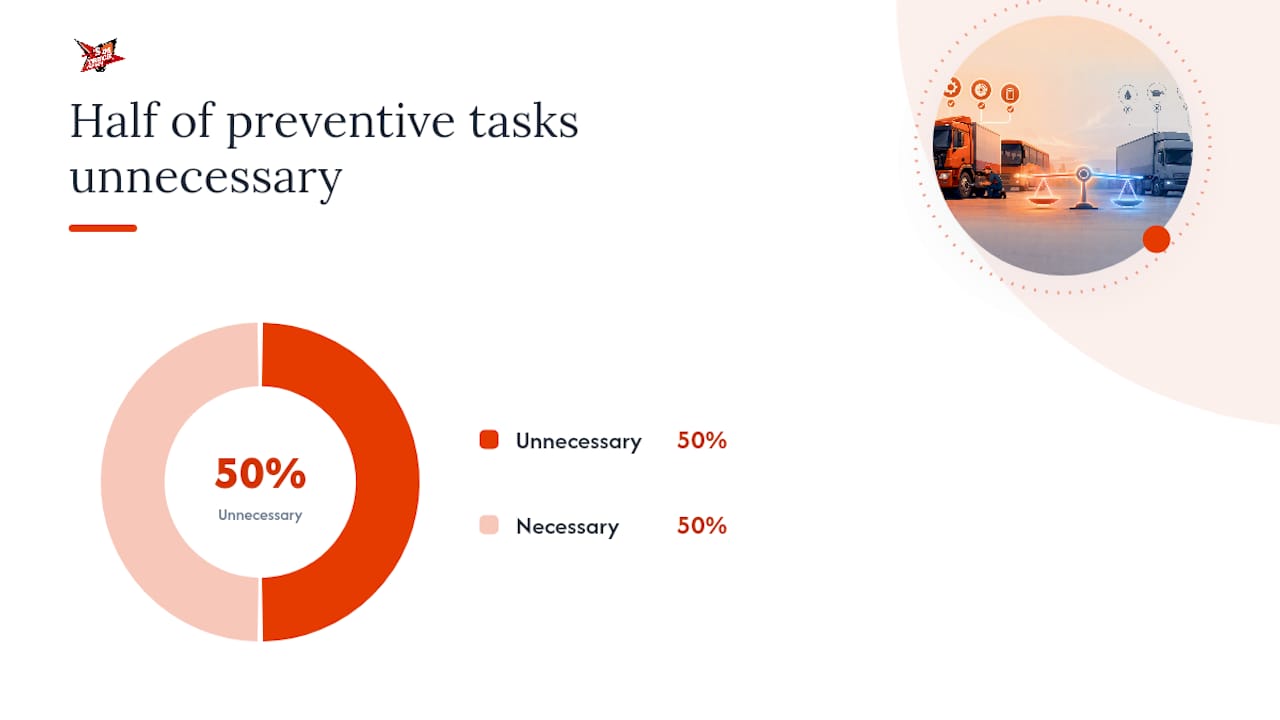
Statistic Callout: NIST's research found preventive tasks get performed unnecessarily as often as 50 percent of the time in some manufacturing settings, a reminder that logs should guide schedule adjustments, not just document them blindly.
Logs also drive spare-parts planning. Once you know a part fails on a predictable cycle, you order it ahead of the failure instead of after it. That single shift often does more for labor planning than any staffing change.
- Track MTBF by asset class to spot early wear trends
- Use MTTR to identify which repairs eat the most technician hours
- Adjust parts inventory based on documented failure cycles, not guesswork
How Do Maintenance Logs Reduce Legal and Warranty Risk?
Auditors, insurers, and warranty administrators all want the same thing: dated, documented proof that scheduled service happened. A missing entry doesn't just create a gap, it can void a manufacturer warranty or expose the operation to liability if that same component later causes an accident.
The rule that protects you is simple: a documented fault has to trigger a corrective work order. A preventive maintenance form that records a known defect and then goes nowhere can become evidence of negligence rather than evidence of diligence.
- Keep every fault, work order, and resolution linked in one chain
- Retain records for the full warranty or regulatory retention period
- Never let a flagged issue sit unresolved in the log
How Do You Build or Improve a Preventive Maintenance Logging Program?
Most fleets don't need a new system, they need discipline around the one they already have. A 30/60/90 rollout keeps the change manageable.
- Days 1 to 30: Standardize your template with the eight mandatory fields, decide digital or paper, and review your current logs for gaps.
- Days 31 to 60: Train every technician on point-of-work entry and require digital signatures on every closed work order.
- Days 61 to 90: Set up MTBF and MTTR tracking, and establish a monthly or quarterly review cadence with your maintenance lead.
When a preventive check turns up a fault, the escalation is always the same: flag it, open a corrective work order, and keep the paper trail connected from discovery to resolution.
Pro Tip: Run your first monthly review before month two ends, not after quarter one. Catching a bad habit at 30 days is cheap; catching it at 90 is expensive.
Where Does Sostruckforsale's Experience Fit In?
Sostruckforsale runs a marketplace built around commercial trucks, trailers, excavators, and heavy equipment, and equipment with a documented service history consistently moves faster and sells for more. Buyers treat a maintenance log as proof, not paperwork, which is why resale mistakes so often trace back to missing records. For inspection-specific fields worth logging on commercial trucks, the semi truck inspection checklist is a useful companion resource.
What the Research Actually Supports
The conventional advice treats logging as a compliance chore, something you do to survive an audit. That undersells it badly. The fleets that get the most out of preventive maintenance logs treat them as a planning tool first and a paper trail second, and NIST's own finding that preventive tasks get performed unnecessarily up to half the time in some settings backs that up: without log data driving the schedule, you're either fixing things too often or not often enough, and you have no way to tell which.
Where most operations fall short isn't the template, it's the review cadence. A perfect log nobody reads monthly is barely better than no log at all. If you're starting from scratch, don't chase the fanciest CMMS on the market first. Get the eight mandatory fields right, get technicians logging at the point of work, and get one person reviewing the data every month. The software matters less than the discipline behind it.
Frequently Asked Questions
What is the main role of preventive maintenance logs? Preventive maintenance logs serve as an asset's documented history, recording every service event so technicians can diagnose faster, managers can plan repairs, and audits or warranty claims have dated proof of compliance.
How often should preventive maintenance logs be reviewed? A monthly review catches problems early; a quarterly review works for lower-criticality assets, but any fleet running high-value equipment should default to monthly.
Should preventive maintenance logs be digital or paper? Digital logs paired with a CMMS reduce late entries and missing fields significantly, according to IBM's overview, and they make MTBF and MTTR calculation far easier than paper records.
What happens if a maintenance log is incomplete? An incomplete log can void a manufacturer warranty, weaken an insurance claim, and in the worst case become evidence of negligence if a documented fault was never addressed.
Sources
- Electronic Preventive Maintenance Logs | US EPA
- Current Maintenance Practices and Costing | NIST
- What is preventive maintenance? | IBM
- Preventive maintenance benefits | Honeywell
- Equipment Maintenance Log Best Practices | Cryotos