
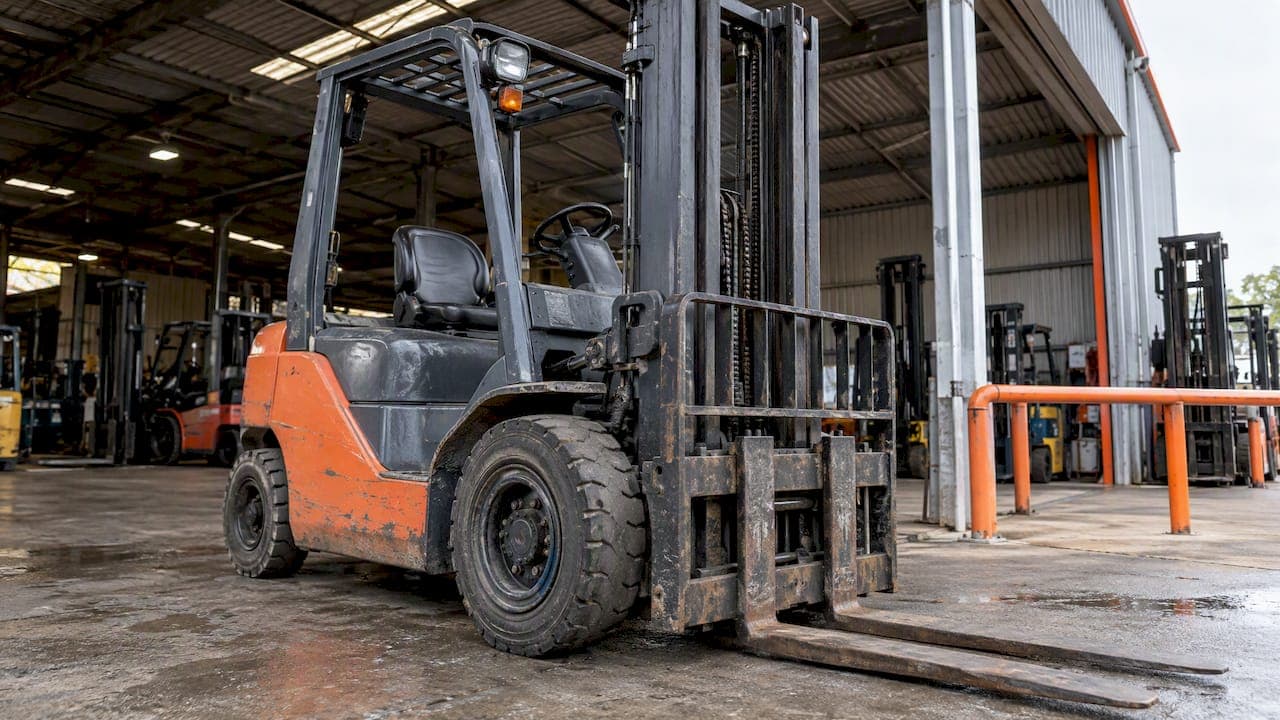
Most used forklifts in the US sell for somewhere between $5,000 and $45,000, and where yours lands depends on capacity, power type, hours and condition. Appraisal data puts a typical forklift at $5,000 to $45,000+ in 2026, with older light-duty units at the low end and late-model, high-capacity trucks at the top. This guide breaks that range into usable numbers, explains what moves a price up or down, and shows how to check a truck before you pay for it.
TL;DR
- Older used units of 3,000 to 5,000 lb capacity often run about $5,000 to $20,000. Late-model 5,000 to 6,500 lb trucks commonly run $14,000 to $30,000 (Heavy Equipment Appraisal).
- The hour meter, and the kind of work those hours came from, tells you more than the model year.
- For electric trucks, budget for the battery. A cheap electric unit with a tired battery is rarely a bargain.
- OSHA requires a pre-shift examination of every powered industrial truck, so a used truck should pass one before it goes on your floor.
- Compare asking prices across many listings and sellers before you make an offer.
Table of Contents
- What a used forklift costs: realistic ranges
- What pushes a used forklift price up or down
- A worked example: pricing a 5,000 lb electric truck
- Inspect before you pay
- Buy, rent or reconditioned: which route fits
- Our view on used forklift pricing
- Find used forklifts and compare listings
- Negotiating the final price
- Resale value: what you get back later
- FAQ
- Sources
What a used forklift costs: realistic ranges
Forklift prices are not set like car prices. There is no single book value, and two trucks with the same year and brand can sit $10,000 apart. Still, the ranges are consistent enough to plan around.
| Truck type | Typical used range | Source |
|---|---|---|
| Older light-duty, 3,000 to 5,000 lb | About $5,000 to $20,000 | Heavy Equipment Appraisal |
| Late-model, 5,000 to 6,500 lb | Commonly $14,000 to $30,000 | Heavy Equipment Appraisal |
| Whole market, all types | $5,000 to $45,000+ | Heavy Equipment Appraisal |
These are market ranges, not offers from us, and they will shift by region and season. Treat them as a sanity check. If a listing sits far below its range, find out why before you get excited. If it sits far above, the seller should be able to explain it with low hours, recent work or included attachments.
High-capacity trucks, rough-terrain units and specialty machines sit above these bands. A 15,000 lb container handler is a different purchase from a warehouse truck, and it should be priced against its own class. If you are unsure which class you are looking at, our guide to forklift classes and how to read the nameplate will help you match a listing to the right comparison group.
What pushes a used forklift price up or down
Seven factors account for most of the spread you will see between listings.
Capacity and class
Capacity is the first filter. A 5,000 lb counterbalance truck is the workhorse of warehouses and has the deepest pool of buyers, so it has the most price data and the easiest resale. Larger capacities cost more, but there are fewer of them on the market, so negotiating is harder.
Class matters as much as capacity. An electric sit-down counterbalance truck, a pneumatic-tire internal combustion truck and a reach truck do different jobs and are priced differently. Do not compare across classes.
Hours, and what kind of hours
The hour meter is the nearest thing a forklift has to an odometer, but it needs context. A truck that ran one shift a day in a dry warehouse has aged differently from one that ran three shifts in a yard, even if the meters match. A machine with 3,000 single-shift hours is often a better buy than a newer one with 8,000 hours from a multi-shift operation.
Ask the seller where the truck worked, how many shifts, and whether service records exist. A seller who cannot answer any of that is telling you something.
Power type
Internal combustion trucks (LP gas, diesel, gasoline) and electric trucks age differently. On an engine truck you are judging the engine, transmission and hydraulics. On an electric truck the battery and charger can be a large share of the truck's value. A used electric forklift with a worn battery may need a replacement that eats a big part of what you saved. Ask for battery age, charging history and, where possible, a load test. Be especially wary of lithium-ion trucks priced far below comparable units: find out whether the battery is original, replaced or bypassed.
Mast and attachments
A mast with more stages and greater lift height costs more, and a low-lift mast will not reach your racking at all. Check the lift height against your tallest rack beam, and check the collapsed height against your lowest doorway. A side-shifter, fork positioner or special carriage can add value, or it can be a retrofit cost if the truck lacks it and you need one. Price the missing attachment into your offer.
Tires
Cushion tires suit smooth indoor floors. Pneumatic tires suit yards and rough surfaces. Worn tires are a quick negotiating point, since replacing a full set is a real expense, but make sure the tire type fits the job first.
Brand and parts support
Major brands tend to hold value because parts and technicians are easy to find. A rare brand at a low price can cost more later if you wait weeks for a part. Before you buy, confirm that a service shop near you can work on that make.
Where and how it is sold
A dealer-reconditioned truck usually costs more than the same truck sold as-is by a private owner. You are paying for inspection, repairs and some recourse. Reconditioning can recover a lot of value from used equipment, so a rough truck at a low price is sometimes a fair project and sometimes a money pit. Know which one you are buying.
A worked example: pricing a 5,000 lb electric truck
Say you need a 5,000 lb sit-down electric counterbalance truck for a single-shift warehouse. Here is how a careful buyer would work through it.
- Set the band. A late-model truck in this weight range commonly sits in the $14,000 to $30,000 range, and older units fall lower, per the appraisal ranges above.
- Collect five to ten listings of the same class and capacity. Note hours, mast height, tires and attachments for each.
- Adjust for the differences. A truck with lower hours and a newer battery deserves a higher price. One with a worn battery, bald tires and no side-shifter should be priced below the pack by roughly what it will cost you to fix those items.
- Get the repair quotes before you offer, not after. Ask a local service shop what a battery, tires and a service would cost.
- Offer on the adjusted number, and put the reasoning in front of the seller. A buyer who shows his math is hard to dismiss.
The same method works for any machine. Our guide to heavy equipment pricing with auction comps and a checklist shows how to build a comparison set when listings are thin.
Inspect before you pay
A used forklift is a safety purchase as much as a financial one. CDC research on powered industrial trucks reports an annual average of 86 forklift-related fatalities from 2013 to 2017, along with about 7,100 injuries involving days away from work each year. A cheap truck with a failing brake or a cracked fork is not cheap.

Under 29 CFR 1910.178(q)(7), OSHA requires that every powered industrial truck be examined before being placed in service, daily or after each shift on round-the-clock operations. The practical lesson for a buyer: if the truck cannot pass that daily examination on delivery day, you inherit the repair bill immediately. NIOSH publishes a guide to the daily inspection that covers items such as seatbelts, LP gas leaks and frayed wiring, and it works well as a checklist for a pre-purchase walk-around.
The walk-around
- Data plate. Confirm that the nameplate is present and legible, and that capacity, serial number and attachments match the paperwork. A missing or altered plate is a reason to stop.
- Forks. Look for cracks near the heel, bent blades and uneven wear. Check that both forks sit level.
- Mast and chains. Raise and lower through the full height. Watch for jerky movement, leaking cylinders, stretched chains and rollers that bind.
- Leaks. Check under the truck, around the hydraulic fittings and at the transmission. Heavy grime can hide the source of a leak, which is why a clean truck is easier to judge. If a unit arrives caked in oil and dirt, ask for it to be washed first, and see these heavy equipment degreasing steps for how a proper cleaning exposes defects.
- Brakes, steering and horn. Test them under load, not just empty.
- Operator compartment. Seatbelt, overhead guard, lights, backup alarm and controls should all work.
- Battery and charger (electric). Check water levels, cable condition, case damage and how long a charge lasts.
- Engine (IC trucks). Cold start it, watch exhaust smoke, listen for knocking and check fluid condition.
Also check the truck's weight against your floor and lift ratings. Our forklift weight guide gives typical ranges so you can confirm that the truck fits your dock plates, elevators and floors.
Operators still need training
Buying the truck is only half of compliance. OSHA guidance states that employers must make sure operators are trained and evaluated, and that training must be specific to the truck and the workplace. If your new truck is a different type from what your team used before, plan training time into the first week.
Buy, rent or reconditioned: which route fits
Rental rates are a useful reference point for a truck's value, but they vary widely with term and specification. The appraisal group behind the figures above notes that rental rates differ widely, and for a formal asset valuation it recommends a USPAP-compliant appraisal. For most buyers an appraisal is overkill, but it matters for financing, insurance claims and fleet accounting.
A rough way to decide:
- Rent if the need is under a few months, seasonal or uncertain.
- Buy used as-is if you have a service shop, know the make and can price the repairs.
- Buy reconditioned if downtime is expensive and you want inspection and some recourse behind the truck.
- Buy new if you run multiple shifts, need a full warranty or have strict fleet standards.
Our view on used forklift pricing
We run a marketplace, not a repair shop, so we see what sellers ask and how buyers react. Our experience is that most bad forklift purchases share one trait: the buyer compared sticker prices and never compared trucks. Two machines at $18,000 are not the same deal if one has 3,000 hours and a fresh battery and the other has 9,000 hours and a battery near its end.
Our advice is simple. Decide the class and capacity first. Collect listings in that class from several sellers, dealers and private owners alike. Write down hours, mast height, tires, attachments and power type for each. Only then look at price. The listing that looks cheapest on the page is often the third or fourth cheapest once you add the repairs.

To sellers we say the same thing in reverse. Photograph the data plate, show the hour meter, list the mast height and say what the truck did for a living. Complete listings sell faster and closer to asking price, because buyers do not have to guess.
And never skip the inspection. A forklift that looks like a bargain and fails its first daily examination is not one.
— Dave
Find used forklifts and compare listings
Sostruckforsale is a classified marketplace for commercial and industrial equipment, where dealers and private sellers post trucks, trailers, material handling machinery, construction equipment and more, and buyers filter by category, price and country. If you are building a comparison set for a forklift purchase, start with the Material Handling category on our marketplace and read each listing the way this guide describes. If you sell equipment, the same site lets dealers and private owners post listings and join the business directory.
Negotiating the final price
Once you have a comparison set and an inspection result, you have what you need to negotiate.
- Lead with facts. Say what comparable trucks are listed at, and what the repairs you found will cost.
- Ask what is included. Charger, spare forks, attachments, manuals and service records all have value. Get them in writing.
- Confirm the terms. Ask whether the sale is as-is, whether any warranty applies and who pays freight. Freight on a forklift can be a meaningful extra, so get a quote before you agree on the number.
- Check the title and ownership. Make sure the seller can legally sell the truck and that no lien is attached.
- Be willing to walk. With a common 5,000 lb truck, another listing is usually a few days away.
Resale value: what you get back later
The flip side of buying used is that depreciation has already done most of its work. A truck bought in the middle of its life curve will usually lose value more slowly than a new one. What protects resale most: documented maintenance, a common brand and capacity, an intact data plate and reasonable hours for its age. Keep every service record. They are the cheapest way to raise what the next buyer will pay.
FAQ
How much does a used forklift cost?
Most used forklifts cost between $5,000 and $45,000+, according to 2026 appraisal data. Older light-duty trucks in the 3,000 to 5,000 lb range often land around $5,000 to $20,000, while late-model 5,000 to 6,500 lb trucks commonly run $14,000 to $30,000. Hours, power type and condition move a specific truck within those bands.
Is a lower-hour forklift always the better buy?
Not always. Hours matter, but so does how the truck was used. A truck with moderate hours from single-shift warehouse work can be in better shape than a lower-hour truck that sat outside or was neglected. Ask for service records and inspect it in person.
What should I check on a used electric forklift?
Start with the battery: its age, case condition, cable condition and how long it holds a charge. Then test the charger, the mast and the brakes. Be skeptical of any electric truck priced well below comparable units, since a battery replacement can take a large share of the savings.
Do I need to inspect a used forklift before using it?
Yes. OSHA requires that powered industrial trucks be examined before being placed in service, daily or after each shift if used around the clock. Do the examination on delivery day, and do not put a truck into service that fails it.
Sources
- Heavy Equipment Appraisal: Forklift Rental Cost, What You'll Actually Pay in 2026
- OSHA: Powered industrial trucks, examination prior to being placed in service
- OSHA: Competency of powered industrial truck trainers, training must be truck- and site-specific
- CDC NIOSH: Conducting a Daily Inspection of Powered Industrial Trucks