
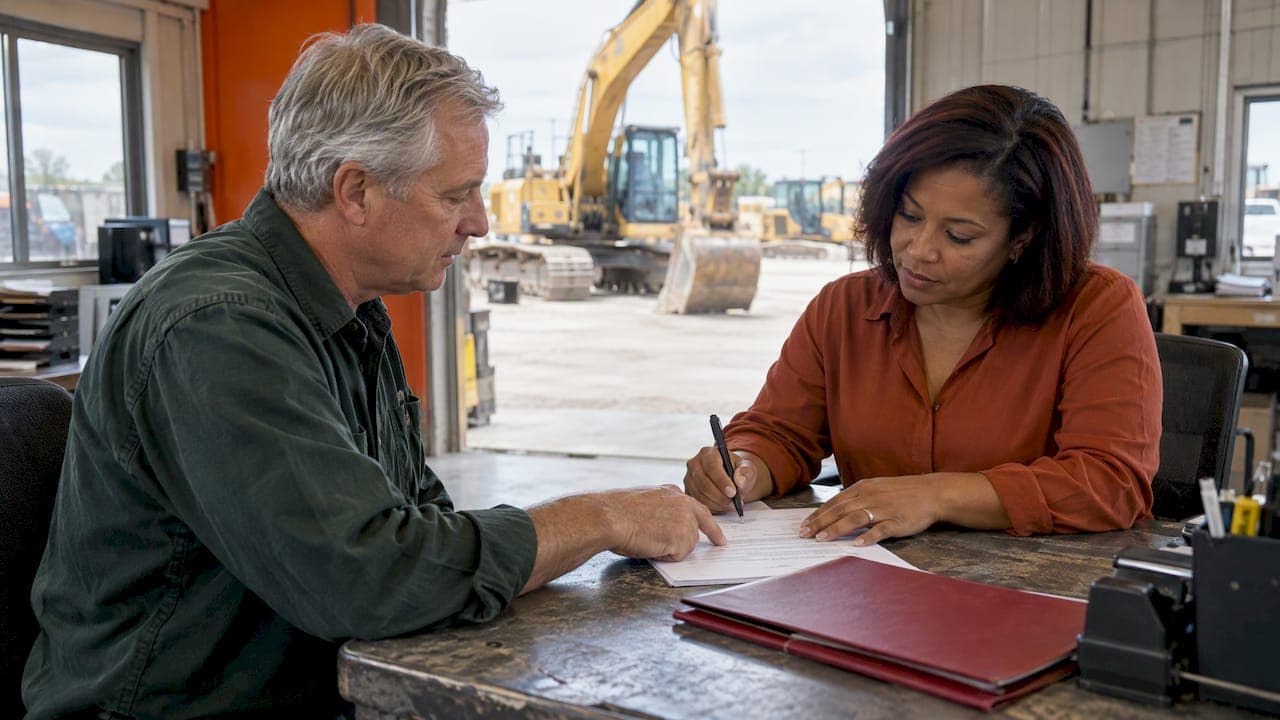
Yes, you can sell equipment that still carries a lien. The sale has to be structured so the lender is paid, or agrees in writing to the transfer, before the buyer takes ownership. Skip that step and the lender's claim can follow the machine to the new owner, while you stay exposed on the debt. This guide covers the payoff, the paperwork and the closing sequence for semi trucks, excavators, loaders and other commercial equipment.
TL;DR
- A lien does not block a sale, but the lender's security interest generally survives the sale unless the lender authorizes the transfer free of it.
- Ask the lender for a written payoff quote and its sale conditions before you advertise the equipment.
- If the price is below the payoff, you cover the shortfall or get the lender to agree to a different arrangement in writing.
- Close with the lender paid directly, then collect the lien release (and the title, for titled units) and document the sale with a bill of sale.
- Blanket liens and leases need their own handling: ask for a release of the specific machine.
Table of Contents
- What a lien on equipment actually means
- Can you sell it without the lender's permission?
- Step 1: Get the lender's terms before you advertise
- Step 2: Compare the payoff with the sale price
- Step 3: Handle blanket liens, leases and multiple lenders separately
- Step 4: Structure payment so the lender is paid first
- Step 5: Get the release, then the transfer paperwork
- What if you are the lender or the debtor has defaulted
- Perspective: how we see lien sales
- Where to list a financed machine
- Mistakes that cost sellers money
- FAQ
- Sources
What a lien on equipment actually means
A lien, in this context, is a lender's security interest in the machine. You borrowed to buy it, and the lender holds a claim on it until the loan is repaid. How that claim is recorded depends on the type of equipment.
- Non-titled equipment (many excavators, attachments, cranes, shop and material handling machinery): the lender typically files a UCC-1 financing statement with the Secretary of State in the debtor's state.
- Titled vehicles (semi trucks, trailers, many dump trucks): the lienholder is usually recorded on the certificate of title, so the lien shows up when the title is issued or transferred.
Some machines are both: a titled truck can also sit inside a broader UCC filing that covers all of a company's equipment. That is why you should check both the title and the UCC record before you list anything.
Can you sell it without the lender's permission?
Legally, you own the equipment and can contract to sell it. Practically, you should not do it without the lender. The UCC, which every state has adopted in some form, says a security interest continues in collateral after a sale unless the secured party authorized the disposition free of the security interest. The same section also gives the lender a claim on the identifiable proceeds of the sale. In plain terms: the lender can look to the buyer's machine, to the money you received, or both.
Courts have enforced this. In a California appellate case, a security agreement barred sale without written consent, and the court held that written creditor consent was generally required to authorize a transfer free of the security interest. The judgment against the sellers was affirmed.
Lenders are not obliged to say yes. Guidance on UCC filings notes that when your equipment is under a UCC lien, you must ask the creditor for permission to sell, and the lender can refuse. In practice, lenders agree readily when the payoff covers what they are owed, because a full payoff removes their risk.
There are two other consequences worth knowing before you consider a quiet sale:
- The buyer may discover the lien in a UCC search or title check and walk away, or demand a lower price.
- If a buyer pays you and the lender later enforces its claim, the dispute lands on you, with a buyer who has legitimate grounds to come after you.
Step 1: Get the lender's terms before you advertise
Contact the lender first and ask for four things in writing:
- A payoff quote with a per-day interest figure and an expiration date, so you can calculate the amount on the day of closing.
- Prepayment terms. Some equipment loans carry prepayment charges or minimum interest. Ask for the total, not just the principal balance.
- Sale conditions. Does the lender require payment by wire or certified funds? Does it want to receive funds directly from the buyer or the buyer's finance company?
- The release process. Ask what document it issues, how fast, and who receives it. For titled units, ask how and when the title is released, and whether it is electronic.
Having these answers before you post an ad lets you tell serious buyers exactly how the transaction will run. It also keeps the listing honest: say in the description that a lien exists and will be paid at closing.
Step 2: Compare the payoff with the sale price
Subtract the payoff from your realistic sale price. There are three outcomes.
| Situation | What it means | What to do |
|---|---|---|
| Price is above payoff | You have positive equity | Pay the lender from the proceeds at closing and keep the difference |
| Price roughly equals payoff | Little or no cash to you after costs | Check fees, transport and commissions so you do not end up short |
| Price is below payoff | There is a shortfall | Cover the difference from your own funds, or negotiate with the lender before listing |
A worked example with simple numbers: a loan payoff of $62,000 and a buyer offer of $70,000 leaves $8,000 before your costs. If the same buyer offered $58,000, you would need to bring $4,000 to closing, because the lender will not release its claim for less than it is owed unless it agrees to that in writing.
Be realistic about price. Price the machine against comparable listings for the same make, model, year and hours, not against what you owe. A payoff figure does not set market value.
Step 3: Handle blanket liens, leases and multiple lenders separately
Not every lien is attached to one machine.
Blanket liens. A lender that financed several machines, or a line of credit, may have filed a UCC-1 covering all business equipment. Selling one excavator under that filing means asking for a partial release or a letter from the lender confirming that the individual machine is released from the collateral pool. Do not assume that paying the loan on one unit clears the filing, since the lender may hold other debt against the same collateral.
Leases. If the equipment is leased rather than financed, the lessor owns it. You cannot sell it until you buy it out under the lease terms. Get the buyout figure and the lessor's written confirmation of ownership transfer.
Multiple lenders. The SBA notes that when more than one lender holds a claim, proceeds must be applied according to lien priority, and failing to coordinate this can put the whole transaction at risk. If a second-position lender exists, bring both into the process before you set a closing date.
SBA EIDL loans. Many small businesses carry an SBA EIDL lien that covers business assets. Practitioners report that for a sale of specific collateral, the SBA may release that collateral without a full loan payoff, but it may require a paydown. Start that request early, because a government lender does not move on a closing-day timeline.
Step 4: Structure payment so the lender is paid first
The safest design is simple: the money goes to the lender, not through you.
- Direct payoff by the buyer. The buyer wires the payoff amount to the lender and the remainder to you. The lender confirms receipt and issues the release.
- Escrow. For higher-value units, or when you do not have funds to clear the shortfall yourself, use a neutral escrow agent. Funds are held until the release documents are ready, then disbursed in the agreed order.
- Buyer's financing. If the buyer uses a finance company, that company normally requires a clean security position. Its closing instructions will usually require the old lender to be paid and the lien released, so share the payoff letter with them early. The new lender's priority is confirming the exact amount owed, what assets the old lien covers, and a clean security position.
Avoid cash or personal checks handed over for a lien-encumbered machine. You want a paper trail showing the lender received its payoff from a traceable source.
Step 5: Get the release, then the transfer paperwork
Paying the loan does not erase the lien record by itself. Someone has to clear it.
For UCC filings. Under the UCC, once the debt is satisfied, the debtor can send the secured party an authenticated demand. The secured party must then file a termination statement within 20 days after it receives that demand in cases outside consumer goods. Send the demand in writing the day the payoff is confirmed, and keep proof of delivery. Afterward, run a fresh UCC search to confirm the termination appears.

For titled units. The lender releases its interest on the title, either by signing a lien release, sending the physical title, or releasing it electronically through your state's system. Timing varies by state and lender, so ask your state motor vehicle agency how it handles lien releases for commercial vehicles.
Bill of sale. Draw one up with the machine's make, model, year, serial number or VIN, hours or mileage, price, as-is language and both parties' signatures. A bill of sale documents the deal, but it does not clear a lien. Only the lender's release does.
For a detailed paperwork walkthrough on one common machine type, see our excavator ownership transfer checklist.
Closing file checklist
Keep these together for at least as long as your accountant and attorney recommend:
- Payoff letter with the per-day amount
- Wire confirmations to the lender and to you
- Signed lien release or UCC termination confirmation
- Title (if applicable) with the lien cleared
- Signed bill of sale
- Any lender consent letter for a partial release
- Photos and hour-meter or odometer reading at handover
What if you are the lender or the debtor has defaulted
This article is written for the owner who is selling. If the borrower has defaulted, the rules change: a secured party may dispose of collateral under UCC Article 9, but the sale must be commercially reasonable and, in most commercial cases, preceded by written notice describing the collateral, the method and timing of the sale, and the debtor's accounting rights. If you are in default, talk to your lender and a business attorney before you list. A negotiated sale you run is usually better for both sides than a repossession auction.
Perspective: how we see lien sales
We run a marketplace where dealers and private sellers list semi trucks, excavators, cranes and material handling equipment, and the pattern is consistent. The listings that move cleanly are the ones where the seller knows the payoff before posting. Buyers of commercial equipment expect a lien to exist on financed units. What they do not accept is surprise.
Our advice to sellers is practical. State in the ad that the unit is financed and will be released at closing. Have the payoff letter ready for serious buyers. Offer a lender-direct payment so the buyer can see the lien being cleared, rather than asking them to trust you. A listing that handles this up front tends to attract buyers who are ready to transact, which is the kind of inquiry a seller wants.
For dealers carrying floorplan or inventory financing, the same discipline applies at scale: keep a record for each unit of the lender, the payoff contact and the release process, so a buyer's question never stalls a closing.
— Dave
Where to list a financed machine
Once the payoff plan is set, you need buyers who work in your category. Sostruckforsale is a classified marketplace built for commercial and industrial equipment, with listings organized by category, subcategory, price and country, plus a business dealer directory. You can post construction equipment, trucks and trailers, material handling, agriculture, forestry and grounds care units from the Sostruckforsale marketplace. Put the lien status and your closing method in the description so inquiries start at the right place.
If you are selling a truck, our guides on selling a dump truck fast and selling heavy equipment without leaving money on the table cover pricing and presentation. If your sale has tax consequences, our piece on selling a dump truck and Form 4797 is a good starting point, and your CPA should confirm the treatment for your situation.
Mistakes that cost sellers money
- Advertising before getting a payoff figure. You may discover the price you hoped for does not cover the loan.
- Relying on a verbal OK from a loan officer. Get consent and release terms in writing.
- Paying off one loan and ignoring a blanket filing. Search the UCC record for every filing against your business name.
- Taking the buyer's money before the lender is paid. If the sale falls through or the funds are slow, you carry the risk.
- Treating the bill of sale as proof of a clean title. It documents the deal only.
- Forgetting to confirm termination. Run the UCC search again after the release so the buyer, and their lender, see a clear record.
FAQ
What happens if you sell something that has a lien on it?
The lender's security interest generally continues in the equipment, and it can also claim the sale proceeds, unless it authorized the sale free of the lien. The buyer may end up with a machine the lender can pursue, and you remain liable on the loan. Get the lender's written consent or pay it off at closing.
How do you sell equipment you still owe on?
Get a payoff quote and the lender's sale conditions, disclose the loan to buyers, and arrange for the lender to be paid directly at closing. If the price is below the payoff, cover the shortfall. Then collect the lien release and title where applicable.
Who pays for a lien release?
There is no single rule. Typically the seller, as the borrower, bears any release or termination costs the lender charges, and that cost should be settled in the purchase agreement. Ask your lender about fees when you request the payoff letter, and decide with the buyer in writing who covers any title or filing charges.
Can I sell a truck with a lien on the title?
Yes, if the lienholder is paid and releases its interest. The buyer cannot get a clean title until the lender signs off, so most deals pay the lender directly at closing and transfer the title once the release is in hand. Ask your state motor vehicle agency how lien releases are processed for commercial vehicles.
Sources
- UCC § 9-315, secured party's rights on disposition of collateral
- UCC § 9-513, termination statement
- Central California Equipment Co. v. Dolk Tractor Co.
- SBA National Guaranty Purchase Center, liquidation process
- UCC Filing: What It Is and How It Affects Your Business
- Non-Judicial Collateral Remedies, Part 2: Sale of Collateral
- Best Practices: EIDL Lien Subordinations and Collateral Releases
- Equipment Financing With an Existing Equipment Lien
- Securing Free and Clear Title on Every Transaction