
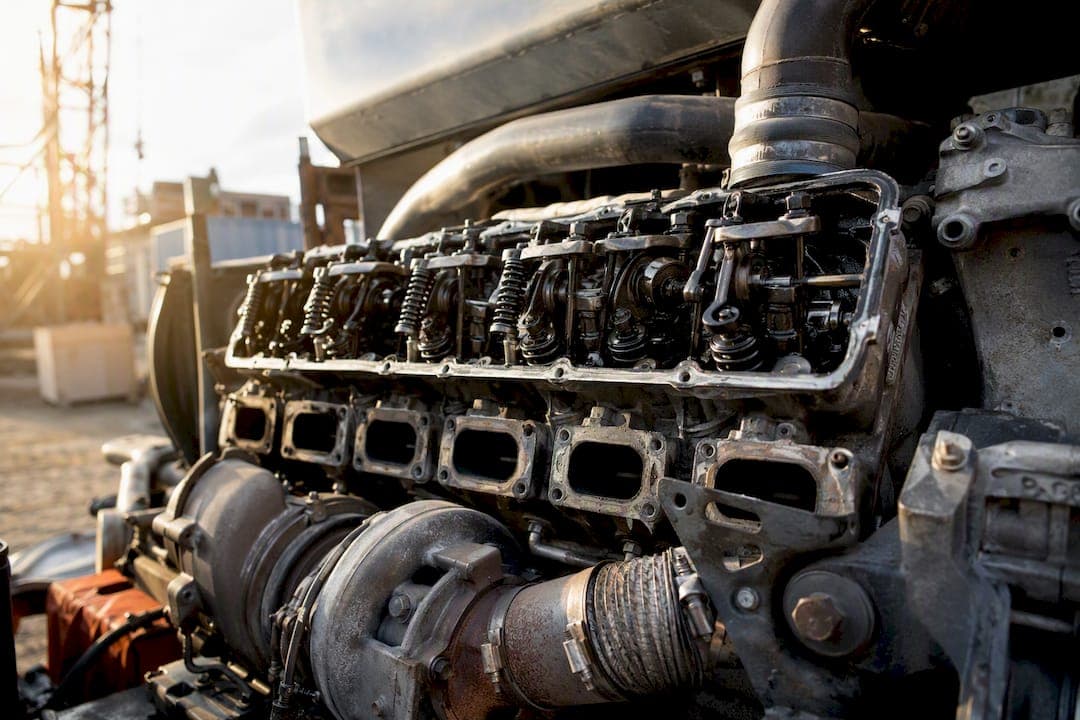
Engine braking slows a vehicle by using the engine's own internal resistance instead of the friction brakes. Lift off the accelerator, and the engine turns into a power-absorbing air compressor that fights the wheels' momentum. Gasoline engines do this through manifold vacuum; diesels rely on exhaust backpressure or dedicated hardware like the Jacobs Engine Brake (Jake Brake) or an exhaust brake.
The practical claim matters more than the mechanics: engine braking is a speed-control tool that spares your service brakes on long grades or heavy loads. It is not a stopping device.
- Deceleration Fuel Cut Off (DFCO) shuts fuel delivery when you lift off the throttle in modern gasoline engines
- Jake Brakes alter exhaust valve timing on diesels to bleed off compression energy, producing distinctive noise that leads to local restrictions
- Exhaust brakes use a valve or variable-vane turbo to build backpressure without touching the intake side
Key Takeaways
Engine braking controls vehicle speed by using the engine's internal resistance, which preserves service brake life but never replaces the friction brakes for actual stopping.
| Point | Details |
|---|---|
| Two mechanisms, one goal | Gasoline engines use manifold vacuum; diesels rely on exhaust brakes or Jake Brakes to build resistance. |
| Not a stopping device | Engine braking slows the vehicle gradually and must never replace service brakes in an emergency. |
| Automatics have built-in help | Tow/haul or L/B modes hold lower gears automatically, reducing the need for manual downshifting guesswork. |
| Noise drives most restrictions | Jake Brakes are loud enough that many municipalities post signage restricting their use near residential areas. |
| Technique prevents wear | Rev-matching on manual downshifts avoids the clutch damage that gets wrongly blamed on engine braking itself. |
Table of Contents
- What Is Engine Braking and How Does It Produce Retarding Force?
- Exhaust Brakes, Jake Brakes, and Transmission-Based Methods
- When Should You Use Engine Braking, and What Are Its Limits?
- How to Use Engine Braking in Cars and Trucks
- Does Engine Braking Damage Your Engine, and Why Do Some Areas Ban It?
- Field Guidance and Resources From Sostruckforsale
- Manuals and Explainers Worth Consulting
- Why the Engine-Damage Myth Won't Die
- Sources
What Is Engine Braking and How Does It Produce Retarding Force?
Understanding engine braking starts with a simple fact: an engine that isn't being fed fuel still has to move air, and moving air costs energy. That energy comes from the wheels, which is exactly why the vehicle slows down.
In a gasoline engine, closing the throttle chokes off incoming air. The pistons keep trying to pull air past a nearly shut throttle plate, creating a vacuum in the intake manifold. That vacuum resists piston movement, and since the pistons are mechanically tied to the wheels, the resistance transfers straight to your speed. Downshift into a lower gear and you spin the engine faster for the same road speed, which multiplies the vacuum effect and the braking force with it.
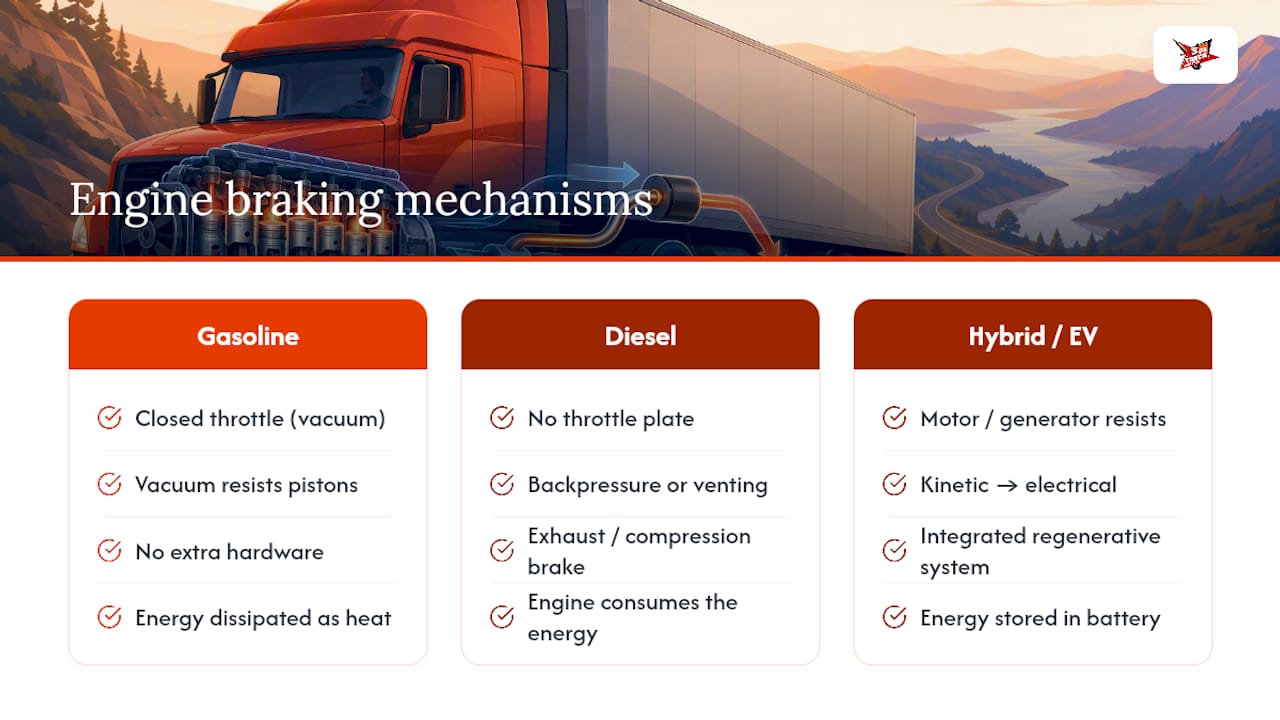
Diesel engines don't have a throttle plate restricting airflow, so they can't generate meaningful vacuum. Instead, they need dedicated hardware. An exhaust brake or compression-release system creates backpressure by closing off the exhaust path or by venting compressed air at the top of the compression stroke rather than letting it push the piston back down on the power stroke. Either way, the engine stops producing power and starts consuming it, acting like an air compressor bolted to the drivetrain.
Diesel engines can't rely on manifold vacuum for engine braking because they lack a restrictive throttle plate, which is why compression-release and exhaust brake systems exist as separate add-on hardware rather than a built-in side effect of lifting off the throttle.
Hybrids and EVs work on a completely different principle. Regenerative braking converts kinetic energy into electricity and stores it in the battery, rather than dissipating it as heat and mechanical resistance the way a combustion engine does.
Exhaust Brakes, Jake Brakes, and Transmission-Based Methods
Three distinct systems handle engine braking, and knowing which one you're dealing with changes how you use it.
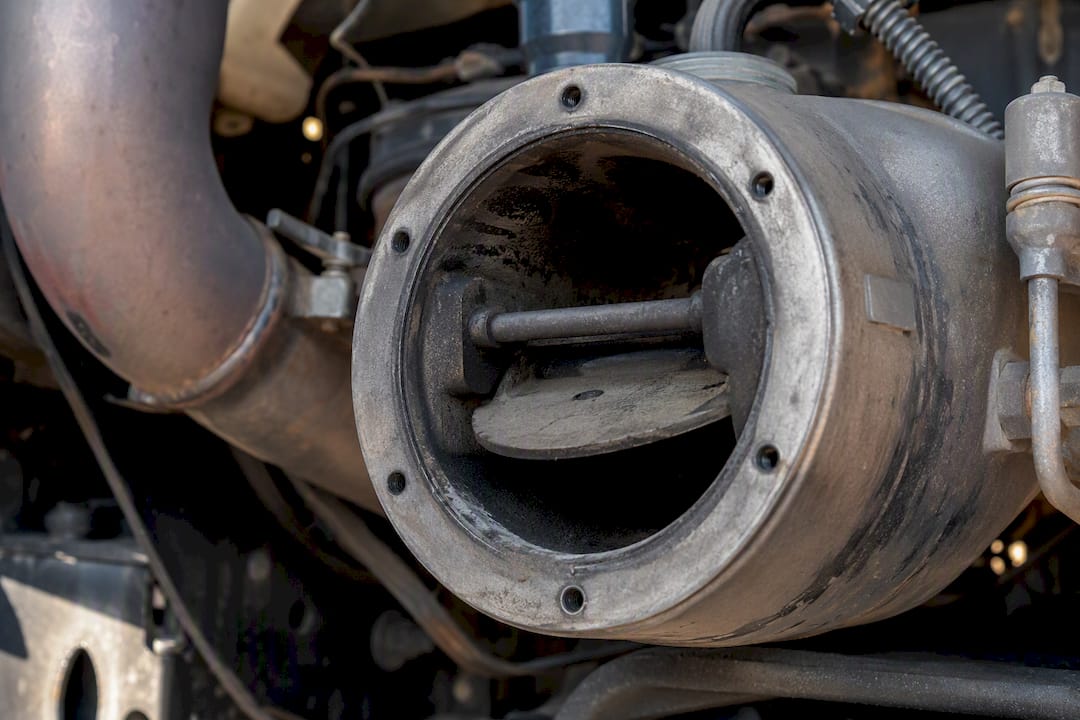
An exhaust brake uses a butterfly valve or a variable-vane turbocharger to restrict exhaust flow, building backpressure that resists the engine's rotation. It's relatively quiet, common on light and medium diesel trucks, and often integrated with the turbo system rather than bolted on separately.
A compression-release brake, the Jake Brake being the best-known example, works differently. It opens the exhaust valve near the top of the compression stroke, releasing compressed air before it can push the piston back down on what would otherwise be the power stroke. This is why Jake Brakes produce that distinctive machine-gun rattle you hear from big rigs descending a grade. It's also far more effective at high RPM than an exhaust brake alone.
Passenger vehicles rarely carry either system. Instead, automatic transmissions offer tow/haul or L/B modes that hold lower gears automatically, and manual transmissions rely on simple downshifting.
- Exhaust brakes: quieter, common on pickups and medium-duty diesels
- Jake Brakes: louder, commonly used on large heavy-duty trucks
- Tow/haul and manual downshifting: the passenger vehicle equivalent
Pro Tip: If your truck has both an exhaust brake and a Jake Brake, use the exhaust brake for gradual speed control and save the Jake Brake for steeper grades where you need more retarding force fast.
When Should You Use Engine Braking, and What Are Its Limits?
Engine braking earns its keep on long downhill grades and while towing, where riding the service brakes for miles would build up heat and risk brake fade. Using the engine to hold speed keeps your friction brakes cool and ready when you actually need them.
It is never a substitute for stopping. Engine braking slows a vehicle gradually. It doesn't bring one to a halt in an emergency, and treating it that way is a genuine safety risk.
- Match your gear to the grade, not just your current speed, to avoid over-revving the engine
- Never slip the clutch while downshifting on a manual, since that transfers wear from your brakes to your clutch
- Watch your tachometer. Redlining the engine to squeeze out more braking force risks real mechanical damage
- Blend in light service brake application when engine braking alone isn't holding your target speed
How to Use Engine Braking in Cars and Trucks
The mechanics differ by vehicle, but the goal is the same: let the engine do the slowing before your brake pads have to.
In a manual car, downshift one gear at a time and rev-match on the way down. Bring the engine speed up to meet the lower gear before you release the clutch, rather than dumping the clutch and letting the drivetrain force the match. That single habit prevents most of the clutch wear people blame on engine braking.
In an automatic car, shift into L or tow/haul mode rather than fighting the transmission's default logic. Tow/haul mode holds lower gears automatically and shifts up later, which gives you more sustained engine braking without you having to manage gear selection yourself.
In a truck, follow the operator's manual for engaging the Jake Brake or exhaust brake, and respect the posted RPM limits exactly. Manufacturer documentation exists because retarder limits vary by engine, and guessing is how components fail early.
- Identify the grade or load situation before you need to react
- Select the appropriate gear or mode in advance, not mid-descent
- Monitor RPM continuously and back off if you're pushing the limit
- Add short, controlled service brake applications only when engine braking alone can't hold your target speed
Does Engine Braking Damage Your Engine, and Why Do Some Areas Ban It?
The myth that engine braking wears out engines faster than normal driving doesn't hold up. Compression-release and exhaust brake systems are engineered specifically to absorb that stress. What actually causes damage is misuse: over-revving past redline, or slipping a clutch to force a downshift instead of rev-matching properly.
The noise complaints are real, though. Jake Brakes produce loud noise due to releasing compressed air, which often results in local restrictions on their use near residential areas.
- Respect posted signage. Switch to the exhaust brake if you have one, or blend in service brakes instead
- Local noise ordinances exist because Jake Brake noise genuinely disturbs residential areas at night
- Courtesy costs you nothing. Coast down the grade using a lower gear and light service brake taps where signage restricts compression-release use
Field Guidance and Resources From Sostruckforsale
Sostruckforsale's blog covers the operator-level detail this article can only summarize. The role of exhaust brakes in trucks breaks down retarder systems in more depth, and mechanic truck explained covers the maintenance side.
Before any long descent, run through this:
- Inspect service brakes for wear and confirm fluid levels
- Verify which retarder mode is engaged and its RPM ceiling
- Confirm gear selection matches the grade ahead
- Consult your manufacturer's operator manual for vehicle-specific retarder limits
Manuals and Explainers Worth Consulting
- Cummins on how an engine brake works
- UTI's engine braking explainer
- Capital One on when to use engine braking
- HowStuffWorks on engine brake mechanics
- Sostruckforsale's exhaust brake guide
Why the Engine-Damage Myth Won't Die
Most of what gets written about engine braking treats it as a footnote to "real" braking, and that framing undersells how much it actually protects a drivetrain. The conventional advice tells drivers to avoid engine braking because it's "hard on the engine." That advice is backward. What's hard on a vehicle is riding the service brakes down a six-mile grade until they fade, or slipping a clutch because nobody explained rev-matching.
The gap I'd flag is this: passenger-car drivers treat engine braking as optional finesse, while truck operators treat it as mandatory procedure with RPM limits spelled out in a manual. That difference in seriousness isn't about vehicle size. It's about consequence. A car that loses brake function on a hill is dangerous. A loaded semi that loses brake function on a mountain grade is catastrophic.
If you take one thing from this, prioritize knowing your gear and RPM limits before you need them, not while you're already on the downgrade. That single habit separates confident engine-brake use from a white-knuckle guess.
— Dave
Sources
- How an Engine Brake works | Cummins Inc.
- What is engine braking | UTI
- What Is Engine Braking, and When Should You Use It? | Capital One
- How engine brakes work | HowStuffWorks