

Equipment depreciation is the systematic allocation of an asset's cost over its useful life, not a measure of what the machine would fetch on the resale market. If you own or manage commercial equipment, three things come first: confirm the asset actually qualifies (ownership, business use, a determinable life beyond one year) and lock in its placed-in-service date; pick a depreciation method and useful-life estimate that fits how you use the machine; and either build a basic schedule yourself or bring in a tax professional to sort out the MACRS implications.
- Confirm eligibility and the exact date the equipment went into service.
- Choose a depreciation method (straight-line, declining-balance, units-of-production) matched to actual usage.
- Build a year-by-year schedule, or loop in a CPA for MACRS and Section 179 questions.
Quick fact: the IRS's Publication 946 is the governing reference for MACRS recovery periods and placed-in-service conventions. Every serious depreciation decision for U.S. tax purposes traces back to it. For buyers and sellers tracking what similar equipment actually sells for once its book value hits zero, marketplaces like Sostruckforsale fill the gap that accounting figures alone can't.
Key Takeaways
Equipment depreciation allocates cost over an asset's useful life for tax and accounting purposes, and it never substitutes for a real market valuation.
| Point | Details |
|---|---|
| Depreciation is cost allocation | It spreads an asset's cost over its useful life, not a measure of resale value. |
| Method choice affects timing | Straight-line, DDB, SYD, and units-of-production all total the same cost, distributed differently. |
| MACRS drives tax deductions | Publication 946 sets recovery periods, conventions, and Section 179 or bonus depreciation options. |
| Book value diverges from market price | Check comparable listings before pricing equipment for sale or disposal. |
| Documentation prevents errors | Track placed-in-service dates, usage, and business-use percentage from day one. |
Table of Contents
- What Is Equipment Depreciation in Accounting Terms?
- What Are the Main Depreciation Methods for Equipment?
- How Do You Calculate Depreciation Step by Step?
- How Do You Determine Useful Life and Salvage Value?
- How Do You Build a Depreciation Schedule?
- What Tax Rules Affect Equipment Depreciation?
- Does Book Value Reflect What Equipment Actually Sells For?
- What Mistakes Should You Avoid With Depreciation?
- A Marketplace Perspective on Depreciation Guidance
- Where to Find Official Depreciation Guidance
- Frequently Asked Questions
- Sources
What Is Equipment Depreciation in Accounting Terms?
Depreciation spreads an asset's cost across the years it generates revenue, rather than expensing the entire purchase in one shot. It's an accounting and tax mechanism built for matching costs to the periods that benefit from the equipment, not a precise readout of market value.
Not every asset qualifies. The IRS lays out a straightforward eligibility test in Topic No. 704:
- You must own the equipment (leased assets follow different rules).
- It must be used in business or income-producing activity.
- It needs a determinable useful life.
- That life must exceed one year.
- It can't fall into an excepted property category.
Depreciation is a non-cash expense. It reduces the equipment's carrying value on the balance sheet and lowers taxable income on the income statement, even though no cash actually leaves the business that year.
That non-cash quality matters for cash flow. A company can show lower net income on paper from depreciation expense while its actual cash position stays untouched, which is why depreciation gets added back when analysts calculate operating cash flow.
What Are the Main Depreciation Methods for Equipment?
Four methods cover almost every equipment depreciation scenario you'll run into, and each one answers a slightly different question about how a machine loses value over time.
- Straight-line. Formula: (Cost minus salvage value) divided by useful life. This spreads the expense evenly across every year, which makes it the default for internal financial reporting.
- Double-declining balance (DDB). Formula: book value multiplied by (2 divided by useful life). DDB front-loads deductions, reflecting how equipment often loses more value in its early years.
- Sum-of-years'-digits (SYD). A weighted formula that also accelerates depreciation, though less aggressively than DDB, using a fraction based on remaining useful life divided by the sum of all the years' digits.
- Units-of-production. Formula: (Cost minus salvage value) divided by total estimated units or hours, multiplied by units produced that year. This ties expense directly to actual usage rather than the calendar.
Each method carries trade-offs worth weighing before you commit:
- Straight-line is simple and predictable but doesn't reflect the reality that a lot of heavy equipment loses the bulk of its value in the first few years of ownership.
- DDB and SYD shrink taxable income faster in early years, which helps cash flow when you need it most, but they also mean smaller deductions later on.
- Units-of-production matches expense to wear and tear precisely, but it requires you to track hours or output consistently, something not every shop is set up to do.
Total depreciable cost stays identical no matter which method you choose. Only the timing of when you recognize that cost changes, along with the pattern of reported profit across the equipment's life.
Pro Tip: You don't have to pick one method for everything. Many businesses run MACRS for tax filings to accelerate early deductions, while using straight-line internally to present smoother, more predictable profit figures to lenders or investors.
Accelerated methods exist mainly for tax timing, not because they measure how fast a machine physically wears out. Accounting practitioners are clear that front-loading deductions is a cash-flow strategy, and it pays to treat it that way when deciding what fits your situation.
How Do You Calculate Depreciation Step by Step?
Numbers make this concrete. Say you buy a piece of equipment for $50,000 with an estimated salvage value of $5,000 and a five-year useful life.
Straight-line: ($50,000 minus $5,000) divided by 5 equals $9,000 per year, every year, for five years.
Double-declining balance: Year one is $50,000 times 40% (2 divided by 5), or $20,000. Year two applies that same 40% rate to the new book value of $30,000, giving $12,000. This continues until book value approaches salvage, at which point many businesses switch to straight-line for the remaining years.
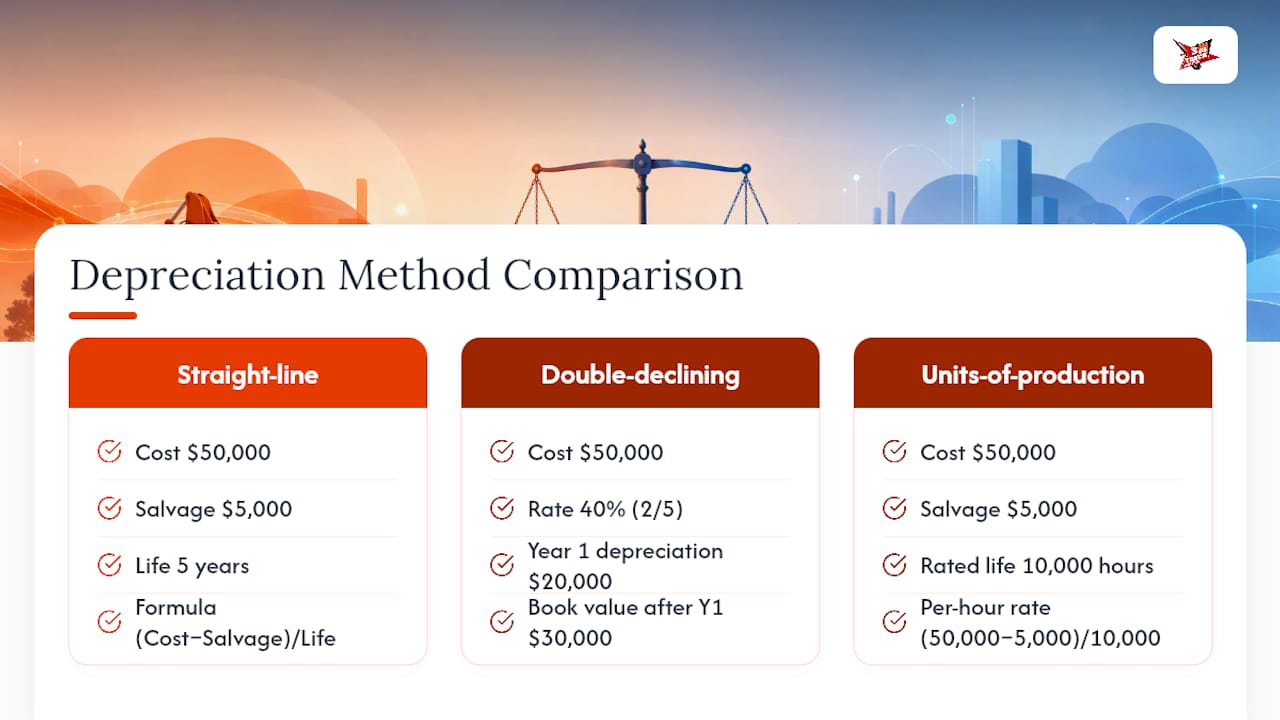
Units-of-production: If the machine is rated for 10,000 total hours and you log 1,800 hours in year one, depreciation equals ($50,000 minus $5,000) divided by 10,000, multiplied by 1,800, which comes to $8,100.
At disposal, the math shifts. If that machine sells for $12,000 once its book value has fallen to $5,000, the $7,000 difference is a taxable gain on disposal. Sell it for less than book value, and you record a loss instead.
How Do You Determine Useful Life and Salvage Value?
Manufacturer specs, IRS asset class lives, and your own maintenance and usage history all factor into a realistic useful-life estimate. Heavier duty cycles shorten it; strong maintenance records and low technological obsolescence risk extend it.
- Manufacturer-published service life and duty ratings
- IRS class lives and recovery periods for tax purposes
- Actual usage intensity (hours, mileage, load cycles)
- Maintenance history and parts availability
- Technological or regulatory obsolescence risk
For tax filings, most businesses assume a salvage value of zero to simplify MACRS calculations, even though the equipment will likely sell for something. Internal reporting often keeps a realistic salvage estimate instead, since that number matters for replacement budgeting.
How Do You Build a Depreciation Schedule?
A usable schedule tracks six columns: year, beginning book value, depreciation expense, accumulated depreciation, ending book value, and notes on hours or units where relevant.
The journal entry each period is simple: debit Depreciation Expense, credit Accumulated Depreciation. When you dispose of the asset, remove both the original cost and the accumulated depreciation from the books, then record any gain or loss on the difference between sale proceeds and remaining book value.
- Group similar equipment by asset class to speed up annual updates.
- Tag each entry with its placed-in-service date for audit trail purposes.
- Reconcile book depreciation against tax depreciation at least once a year.
What Tax Rules Affect Equipment Depreciation?
MACRS governs most equipment depreciation for U.S. tax purposes, assigning recovery periods (commonly 5 or 7 years for machinery and equipment) that dictate how fast you can deduct the cost. Publication 946 contains the full tables and conventions.
- MACRS recovery periods set the schedule; most equipment falls into 5-year or 7-year classes.
- Section 179 lets qualifying businesses expense the full cost of eligible equipment in the year it's placed in service, up to annual limits set by the IRS.
- Bonus depreciation allows an additional first-year deduction percentage on top of regular MACRS, though the applicable rate has changed across recent tax years.
- Placed-in-service timing determines which partial-year convention applies, and buying equipment late in the year can shrink that year's deduction significantly.
Buying a truck or excavator in December instead of October can materially reduce the first-year deduction you're entitled to claim, purely because of which IRS convention applies to that placed-in-service date.
None of this replaces professional advice. Section 179 limits, bonus depreciation percentages, and MACRS class assignments shift from year to year, and a small-business guide to depreciation is a reasonable place to start, but a CPA familiar with your specific equipment mix is worth the consultation fee before you file.
Does Book Value Reflect What Equipment Actually Sells For?
Rarely, and that gap catches a lot of owners off guard. Depreciation schedules are cost-allocation tools, not appraisals, and a machine can carry a $0 book value while still running productively and commanding real money on the resale market.
- Check comparable listings for the same make, model, and hour range.
- Weigh condition and maintenance records against the asking prices you find.
- Factor in regional demand, since equipment values shift by market.
Pro Tip: Before setting a reserve price on equipment you're retiring from the books, pull recent comparable listings on Sostruckforsale rather than pricing off depreciated book value alone. The two numbers rarely match, and the market figure is the one that pays your bills.
What Mistakes Should You Avoid With Depreciation?
The most common errors are avoidable with a little discipline up front.
- Mixing personal and business use without documenting the business-use percentage.
- Estimating useful life without checking manufacturer or IRS guidance.
- Losing track of the exact placed-in-service date.
- Ignoring partial-year conventions when equipment is bought or sold mid-year.
Pro Tip: If you're both depreciating equipment for tax purposes and eventually selling it, keep your maintenance and hours records current. Buyers on marketplaces pay a premium for documented service history, and that same paperwork makes disposal accounting far less painful.
A Marketplace Perspective on Depreciation Guidance
Working around heavy equipment listings day to day, I've seen how often owners assume a fully depreciated machine is worth nothing. Tax rules and market comparables answer different questions, and smart replacement planning needs both.
Where to Find Official Depreciation Guidance
- Publication 946 for MACRS tables and official IRS depreciation rules.
- Topic No. 704 for eligibility and property classification.
- Investopedia's depreciation guide for method comparisons and formulas.
Frequently Asked Questions
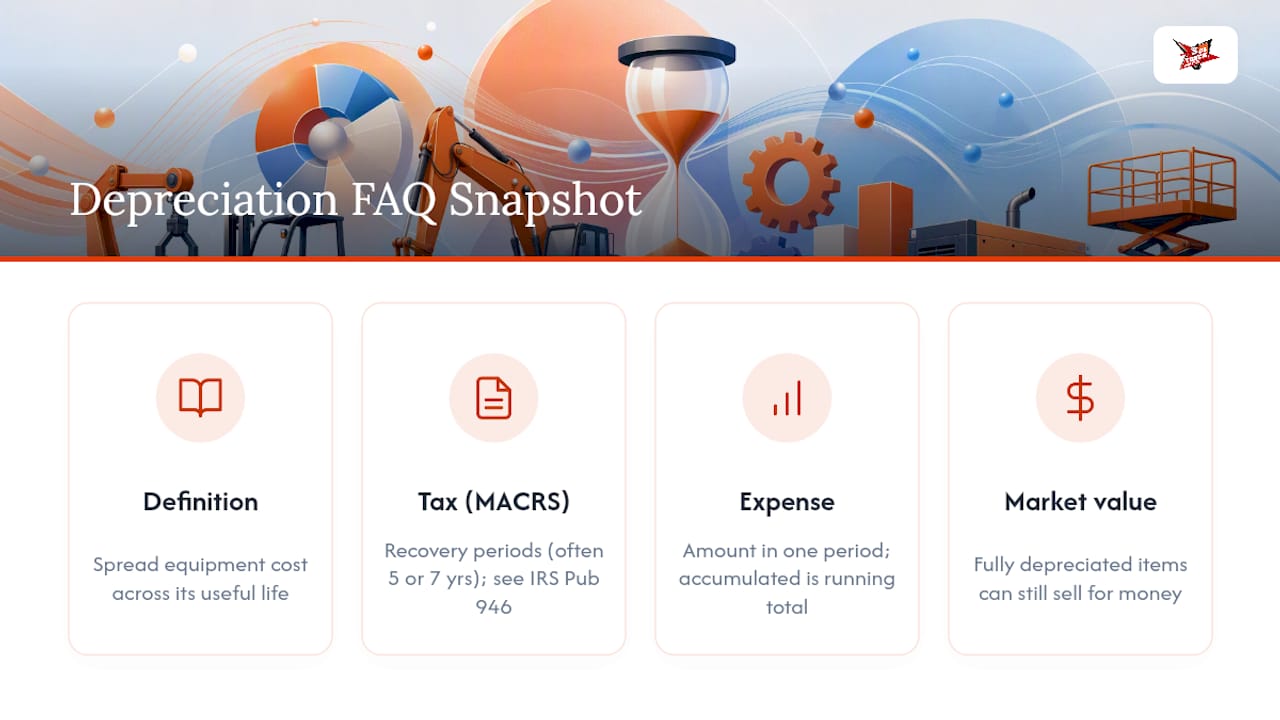
What is equipment depreciation in simple terms? It's the accounting method of spreading a piece of equipment's cost across the years it's used, rather than expensing the full purchase price immediately.
How does equipment depreciation work for tax purposes? Most businesses use MACRS, which assigns a recovery period (often 5 or 7 years) and lets you deduct a portion of the asset's cost each year according to IRS tables in Publication 946.
What's the difference between depreciation expense and accumulated depreciation? Depreciation expense is the amount recognized in a single period on the income statement. Accumulated depreciation is the running total subtracted from the asset's original cost on the balance sheet.
Can I switch depreciation methods after I start? Generally no, not without IRS approval for tax purposes, since consistency is required once a method is elected for a given asset class.
Does fully depreciated equipment still have market value? Often, yes. A machine with $0 book value can still run productively and sell for real money, which is why checking comparable listings matters more than book value when it's time to sell.
This article is general information, not a substitute for advice from a qualified financial advisor. Consult a qualified financial professional about your own circumstances before acting on anything here.
Sources
- Publication 946 (2025), How To Depreciate Property
- Topic No. 704 Depreciation
- Understanding Depreciation: Methods and Examples for Businesses
- Depreciation Expense | Formula + Calculation Tutorial
- How to Depreciate Equipment (Small Business Guide)