

Electric Class 8 semi trucks are production-ready today for many regional and hub-to-hub uses. Expect a wide range of range capabilities depending on trim and payload, with megawatt-class charging that can add significant range during a driver's 30-minute break. Deliveries remain limited, but production is ramping through 2026 for the industry's headline models.
- Range: Variable depending on battery configuration and load
- Charging: Megawatt Charging Standard (MCS) can restore significant range in about 30 minutes
- Availability: Reservation queues are active, deliveries are still limited, and production capacity is scaling through 2026
Key Takeaways
Electric semi trucks now deliver 200 to 500 miles of range with megawatt charging fast enough to fit inside a driver's mandatory break, making regional and hub-to-hub routes viable today.
| Point | Details |
|---|---|
| Range depends on load | Expect 200 to 500 miles depending on battery size, payload, and terrain, not a single fixed number. |
| Megawatt charging changes the math | MCS-class charging can add significant range during a standard 30-minute driver break. |
| Efficiency drives everything | A benchmark near 1.7 kWh per mile shapes both range and battery size requirements. |
| Route fit matters more than specs | Regional and hub-to-hub routes under 300 miles are the strongest fit for current technology. |
| Verify before buying | Confirm usable battery kWh, charging standard, and maintenance history on Sostruckforsale listings before committing. |
Table of Contents
- Key Specs That Actually Matter in Electric Semi Trucks
- How Far Can Electric Semi Trucks Go Between Charges?
- What Does It Cost to Run an Electric Semi Truck?
- Which Routes Actually Work for Electric Semi Trucks Right Now?
- What Fleet Changes Come With Going Electric?
- How to Verify Availability Before You Buy an Electric Semi
- What Sostruckforsale Recommends When Evaluating Electric Semi Listings
- Should You Buy an Electric Semi Truck Now?
- Search and List Electric Semi Trucks on Sostruckforsale
- Sources
Key Specs That Actually Matter in Electric Semi Trucks
Manufacturers publish a lot of numbers, but three of them decide whether an electric semi fits your operation: battery capacity, curb weight, and efficiency.
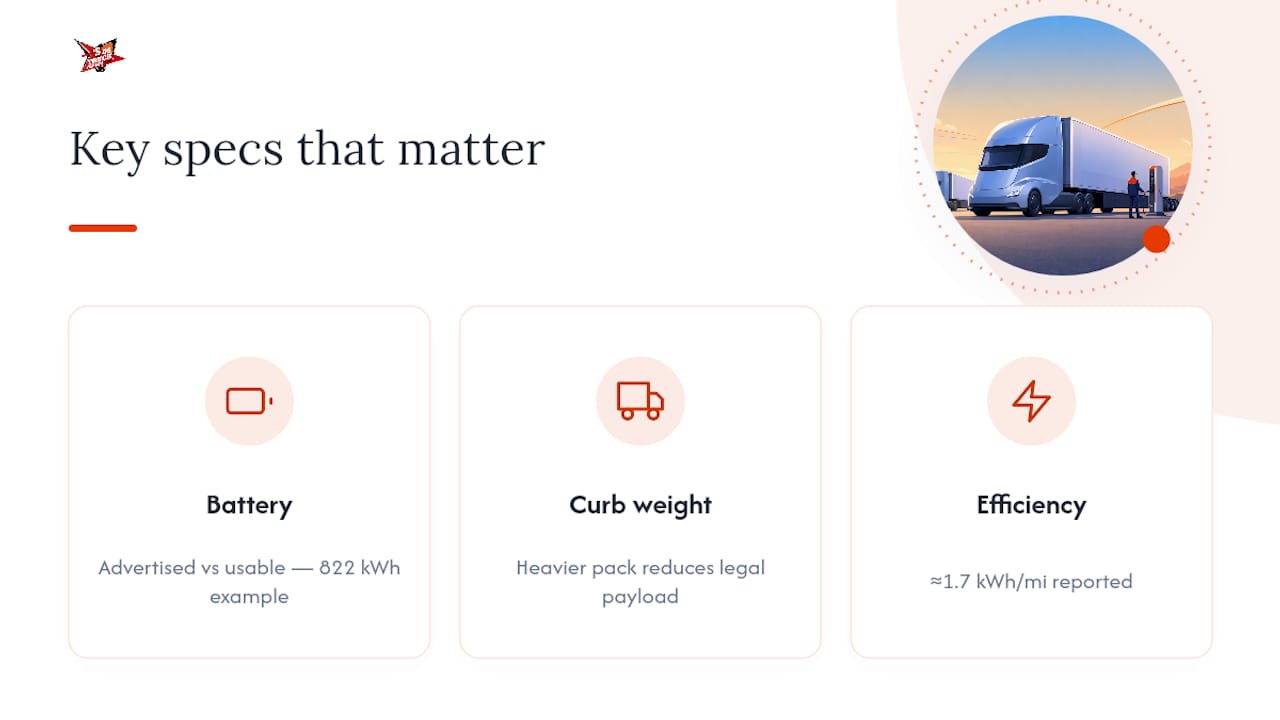
Battery capacity gets quoted two ways: advertised (total) and usable. The gap between them matters because a truck rarely discharges to zero in daily service. When a spec sheet lists an 822 kWh pack, regulatory filings confirmed with CARB that figure as an official capacity, not a marketing estimate. That's the kind of documentation worth asking for on any listing you're evaluating.
Curb weight rises with battery size, and every pound added to the truck is a pound subtracted from legal payload. A heavier pack buys range but can shrink what you're allowed to haul under gross vehicle weight limits, so the tradeoff between range and payload is real and worth modeling before you buy.
Efficiency, expressed in kWh per mile, is the number that separates marketing claims from operational reality. Lower is better. Recent industry reporting on production Class 8 electric semis put efficiency near 1.7 kWh per mile, which directly shapes how much battery a manufacturer needs to hit a given range target.
Pro Tip: Always check the test conditions behind a range figure. Rated gross combination weight (GCW), speed, and ambient temperature all swing real-world range by a wide margin, so a number tested empty at 55 mph won't hold up loaded at 65 mph in winter.
How Far Can Electric Semi Trucks Go Between Charges?

Range and charging work together, and neither number means much without the other. A truck with strong range but slow charging still stalls out a tight delivery schedule.
Megawatt-class charging, built around the Megawatt Charging Standard, is the technology making longer daily routes plausible. Because federal hours-of-service rules already require drivers to take breaks, a charger that can meaningfully refill a battery during a mandated stop turns downtime into productive time. The FMCSA's hours-of-service guide is worth reading if you're planning routes around these windows, since a 30-minute break used for charging doesn't cost the driver extra time.
Three charging patterns show up in real fleet operations:
- Depot overnight charging at lower power, used when trucks return to a yard each night and have hours to recharge.
- En-route megawatt top-ups during driver rest breaks, adding meaningful range in roughly 30 minutes.
- Opportunity charging at distribution hubs during loading or unloading, squeezing in extra range without a dedicated stop.
Payload, terrain, and speed all move the efficiency needle. A fully loaded truck climbing grades at highway speed burns more energy per mile than the same truck running empty on flat ground at a moderate pace.
Typical efficiency benchmark: Around 1.7 kWh per mile for a production Class 8 electric semi, meaning a 500 kWh usable battery translates to roughly 290 miles under favorable conditions, before payload and terrain adjustments.
What Does It Cost to Run an Electric Semi Truck?
The math starts simple: multiply kWh per mile by your electricity price to get energy cost per mile. At 1.7 kWh per mile, a fleet paying commercial electricity rates can compare that number directly against diesel cost per mile at current fuel prices to see where the savings actually land.
Maintenance is where electric trucks tend to pull ahead over time. The Department of Energy's guidance on EV maintenance notes that electric drivetrains carry fewer moving parts prone to wear, cutting costs tied to oil changes, exhaust systems, and traditional transmission service. Battery and thermal-management servicing become the new line items instead.
A few other cost factors shape the total picture:
- Incentives vary by state and can include grants, tax credits, and voucher programs that reduce upfront purchase price.
- Resale value is still being established for this category, since the used market is thin compared to diesel.
- Battery warranty terms matter more than almost any other spec, because degradation risk sits with whoever owns the truck when the warranty runs out.
Fleet decisions here often hinge on financing structure as much as the truck itself. If leasing versus buying is still an open question for your operation, a truck leasing versus buying comparison can help frame that decision before you commit capital.
Which Routes Actually Work for Electric Semi Trucks Right Now?
Route fit is the single biggest factor in whether an electric semi pays off, more than any spec sheet number in isolation.
- Shorter daily routes: Regional distribution, drayage, and repeat hub-to-hub lanes are the strongest fit today, since trucks return to base often enough for overnight depot charging to fully cover the next day's range.
- Longer routes: Some long-haul lanes work if payload stays light and megawatt charging is available along the route. The LBNL analysis on truck electrification finds these routes technically feasible when charging strategy lines up with duty cycle.
- Yard and construction work: Short-radius, stop-and-go duty cycles suit electric drivetrains well, since regenerative braking recovers energy that a diesel engine simply burns off.
Before committing a route to electric, map your stops, driver hours-of-service windows, and available charging infrastructure together. If you're still sorting out which truck class fits which job, the guide to semi truck types breaks down duty cycles by classification.
What Fleet Changes Come With Going Electric?
Buying the truck is the easy part. The infrastructure and workflow changes around it decide whether the switch actually works.
- Electrical service upgrades: Megawatt depot chargers often require new transformers and utility service upgrades, sometimes with lead times measured in months, not weeks.
- Preventive maintenance shifts: Technicians need training on battery diagnostics and thermal systems rather than traditional engine service, and driveline components change too, as explored in this look at semi truck transmissions.
- Driver habits: Charging windows need to be built into dispatch planning, not treated as an afterthought.
- Utility coordination: Permits and utility approval for high-power charging installations can take longer than the truck delivery itself.
How to Verify Availability Before You Buy an Electric Semi
Production status claims vary widely, so verify them against real documentation, not sales copy.
- Check manufacturer spec releases and regulatory filings. CARB documentation, for instance, has been used to officially confirm battery capacities that were previously just OEM claims.
- Ask about reservation queues and deposit terms, since order backlogs directly affect realistic delivery timing.
- Treat used listings as a signal of real-world availability, but verify battery health, charging standard compatibility, and remaining warranty coverage before assuming the truck is a match for your routes.
Pro Tip: When shopping used, ask for a battery state-of-health report, not just mileage. Two trucks with identical odometer readings can have very different remaining range if one spent its life on hot, heavy-payload routes.
If you're new to evaluating used equipment generally, the first-time buyer's guide to used semi trucks covers inspection basics that apply just as much to electric models.
What Sostruckforsale Recommends When Evaluating Electric Semi Listings
Sostruckforsale advises checking three things before committing to any electric semi listing: usable battery kWh (not just advertised capacity), charging standard compatibility, and documented maintenance history covering battery and thermal-system service.
- Sellers should list usable kWh, charging connector type, and any battery health reports up front.
- Buyers should request maintenance records specific to battery and thermal-system servicing, not generic engine logs.
- For broader fleet-planning context, see Sostruckforsale's guide to electric heavy equipment.
Should You Buy an Electric Semi Truck Now?
Fleets running predictable regional or hub-to-hub routes under 300 miles, with depot charging already planned, should move now. The technology fits that duty cycle well.
Fleets running long-haul lanes without confirmed megawatt charging access along the route should wait. Infrastructure gaps, not the trucks themselves, are the real bottleneck.
— Dave
Search and List Electric Semi Trucks on Sostruckforsale
Sostruckforsale is the direct route to real electric semi inventory instead of chasing manufacturer waitlists or scattered dealer sites. Buyers can filter listings by category and subcategory to isolate electric semi trucks specifically, then narrow by price and country to find units that actually match a route profile.

Sellers listing an electric semi get more buyer confidence by documenting usable battery kWh, charging standard, and service history directly in the ad, the same checklist outlined above. A listing with that detail attracts serious buyers faster than one with just a photo and a price. Whether you're sourcing your next electric semi or moving one off your lot, browse current listings on Sostruckforsale to see what's actually available right now.
Sources
- Tesla reveals final Semi specs with two trims | Electrek
- Electric vehicle maintenance | AFDC
- Why regional and long-haul trucks are candidates for electrification | LBNL