

The 2026 equipment market is best described as a stabilization year, with AI-driven capital spending and electrification buildouts carrying more of the demand load than traditional cyclical drivers. Sector performance is diverging sharply, used-equipment inventory is tightening in specific categories, and financing demand remains strong even as loss-rates warrant attention. Dealers who triage inventory, market tech-enabled equipment aggressively, and lock in flexible financing terms are positioned to capture the upside.
TL;DR:
- Capital spending driven by AI infrastructure is expected to grow over 6%, primarily supporting electrification, data infrastructure, and related equipment demand.
- Used equipment availability is tightening in late-model categories as fewer low-hour machines reach auction, especially in high-horsepower agricultural and construction equipment.
- Despite strong financing demand projected at over $129 billion in new-business volume, rising raw material costs and higher loss-rates may pressure margins and credit conditions.
- Sector performance varies: agriculture and construction remain stable but in different ways, while industrial demand is targeted by factory modernization and retrofitting projects.
- Dealers should focus on inventory triage, showcase telematics data, build retrofit packages, and strengthen fast-listing practices to adapt to 2026 market divergence.
Table of Contents
- Top 6 trends to watch in 2026
- Sector outlooks: agriculture, construction, industrial and used equipment
- Technology and product trends shaping equipment value
- Financing, pricing, and inventory pressures for 2026
- Practical strategy: six actions to take in 2026
- Sostruckforsale perspective on the 2026 market
- How a marketplace supports your 2026 strategy
- Sources
- FAQ
Top 6 trends to watch in 2026
Six themes define the equipment market this year, and they interact more than they compete. AI infrastructure spending sits at the top: real equipment and software investment is projected to grow 6.2% in 2026, with investment growth exceeding 15% annualized in both the first and second quarters, driven largely by AI-related capital expenditures.
Investment growth of 6.2% in real equipment and software spending signals that 2026 capex is broad enough to lift adjacent categories like industrial and construction equipment, not just data center hardware, according to the Equipment Leasing & Finance Foundation.
- AI-driven capex is the single largest demand driver, pulling capital into electrification, data infrastructure, and the equipment that supports both.
- Sector divergence means agriculture, construction, and industrial equipment each move on their own timeline rather than a shared cycle.
- Used-equipment tightening is showing up in specific late-model categories as fewer low-hour machines reach auction.
- Financing volume is strong, with credit quality still sound but loss-rates ticking upward, a trend worth tracking through 2027.
- Technology adoption, including physical AI, telematics, and cybersecurity standards, is starting to reshape how buyers value used equipment.
- Input-cost and supply-chain volatility continue to threaten lead times and pricing stability across nearly every category.
None of these trends operate in isolation. A dealer ignoring telematics data, for instance, is also likely to misprice used inventory in a tightening market.
Sector outlooks: agriculture, construction, industrial and used equipment
Sector performance in 2026 is uneven, and that unevenness is the story. Agriculture and construction are, according to AEM's 2026 market analysis, settling into stability rather than growth, but stability looks different in each sector.
- Agriculture: high-horsepower equipment inventory sits somewhat above its historical average supply level, and replacement cycles for large units are stretching out as farmers wait out tighter margins.
- Construction: infrastructure and heavy civil work are seeing selective gains while commercial construction stays soft, so equipment mix within a dealer's lot matters more than total volume.
- Industrial and manufacturing: reshoring and factory modernization are driving targeted capex, particularly where plants are retrofitting rather than building new. BCG's analysis of factory modernization finds that predictive maintenance and IoT upgrades can raise productivity substantially in existing facilities, which supports demand for retrofit-ready equipment over greenfield builds.
- Used equipment: supply is fragmented by category and age. Industry reports point to fewer late-model, low-hour machines reaching auction in some segments this year, which could push buyers back toward dealer and wholesale channels rather than auction houses.
Low-horsepower agriculture equipment is drawing closer to a six-month supply norm, per AEM, while high-horsepower units sit tighter. That split means a blanket ag strategy will underperform a category-by-category approach. The same logic applies in construction, where a dealer heavy in commercial-grade equipment faces a different 2026 than one weighted toward infrastructure-ready machines.
Technology and product trends shaping equipment value
Gartner's list of top strategic technology trends for 2026 reads like a preview of what buyers will start asking about at the point of sale. Production-scale AI, physical AI, preemptive cybersecurity, and digital provenance are all named as priorities, and each has a direct line to equipment value.
- Predictive maintenance and autonomous workflows are moving from pilot programs to standard equipment features, and buyers increasingly expect telematics-backed maintenance records before they'll pay top dollar.
- Electrification retrofits raise real questions about battery health, charging infrastructure, and service intervals, all of which affect resale value differently than a traditional diesel unit.
- Connected-equipment data functions as both a selling point and a provenance signal, letting a buyer verify usage history instead of taking a seller's word for it.
- Cybersecurity and digital provenance are becoming procurement filters for larger fleet buyers, particularly on equipment tied to industrial networks.
Resources on predictive analytics and physical-AI applications for fleets, such as those from EnerlyticsAI, illustrate how quickly these tools are moving from novelty to expectation. A telematics history attached to a listing is no longer a bonus; it's approaching table stakes for late-model units.
Pro Tip: List telematics data and maintenance logs directly in your equipment listing description; buyers increasingly treat missing history as a red flag, not a neutral gap.
Financing, pricing, and inventory pressures for 2026
Financing demand is strong enough to set records this year, but the details matter more than the headline. ELFA projects real equipment and software investment growth of 6.2% for 2026, with new-business volume among ELFA members expected to top $129 billion for the year.

$129 billion in projected new-business financing volume for 2026 signals that credit is flowing, even as ELFA's own Q3 commentary flags cost-of-funds and rising loss-rates as risks to watch into 2027.
On the cost side, manufacturers are not getting relief. NAM's Q3 2026 Manufacturers' Outlook Survey found a large majority of respondents citing rising raw-material costs as a top challenge, with input costs expected to climb moderately over the next year. That pressure moves through the supply chain into freight and, eventually, into the price tags on new equipment.
For dealers, the practical effect is a squeeze from both directions: strong financing demand supports sales, but rising input costs and cost-of-funds pressure margins. Watching auction flow, carrying costs, and pricing discipline closely will matter more in 2026 than in a typical stable year. Buyers weighing financing options should compare lease and loan terms now, before rate movements narrow the field.
Practical strategy: six actions to take in 2026
Reacting to these trends works better than waiting them out. The following actions translate the macro signals into dealer-level moves.
- Triage inventory by scarcity and tech-readiness, moving scarce late-model units to the front of the lot and flagging tech-enabled equipment for premium pricing.
- Showcase telematics and service history in every listing where it's available; buyers are starting to expect it, not just appreciate it.
- Build retrofit and service packages around electrification and AI-enablement, turning a compliance question into a revenue line. Guidance on electric equipment planning is a useful starting point for structuring these packages.
- Strengthen finance partnerships and run internal loss-rate stress tests so financing terms hold up if credit tightens later in the year.
- Use dealer-to-dealer wholesale channels proactively rather than waiting on auction timing, especially in categories where late-model units are scarce.
- Sharpen listing quality and buyer response time, since a fragmented used market rewards whoever moves fastest on a well-documented unit.
Pro Tip: Run a loss-rate stress test against a 2027 slowdown scenario now, while financing partners are still competing for your business.
Sostruckforsale perspective on the 2026 market
Listing activity and buyer inquiries on Sostruckforsale track the same divergence showing up in national data: strong interest in tech-documented, late-model units and slower movement on undocumented older stock. That pattern reinforces a simple point worth repeating to any dealer weighing 2026 strategy: the equipment with a paper trail moves faster and sells for more.
— Dave
How a marketplace supports your 2026 strategy
Acting on inventory triage and tech-enabled listings takes a place to execute, and that's where a focused marketplace earns its keep. A focused marketplace gives dealers and private sellers a direct route to list equipment by category, filter by price and country, and reach buyers actively searching for retrofit-ready or late-model units.
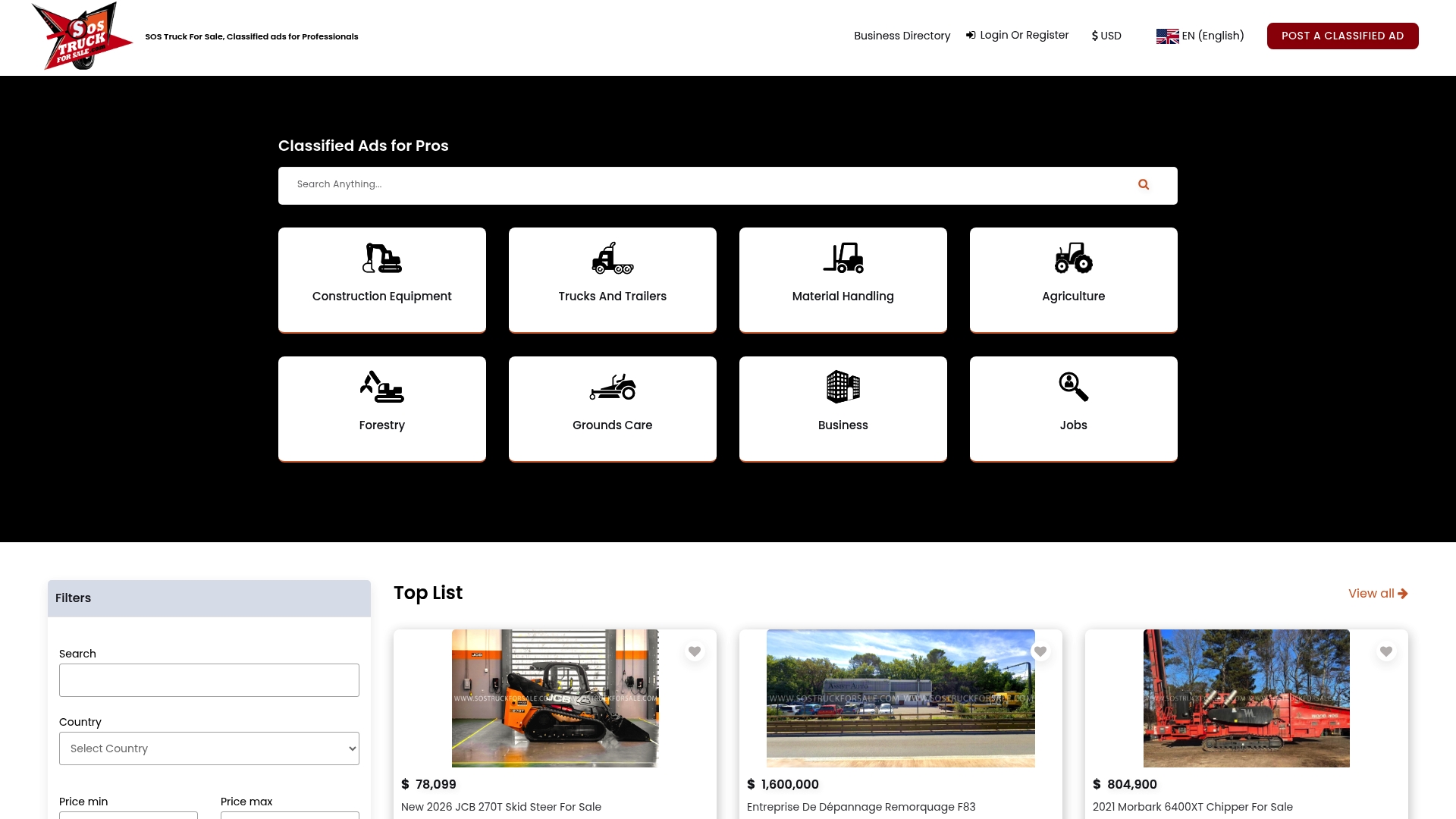
- Category listings cover construction equipment, trucks and trailers, material handling, agriculture, forestry, and grounds care.
- A dealer directory helps buyers find sellers directly rather than sorting through unrelated listings.
- Filtered search by price, category, and country speeds up sourcing for buyers chasing scarce late-model inventory.
Browse or list equipment on the Sostruckforsale marketplace to put these 2026 strategies into practice today.
Sources
- 2026 Economic Outlook: Economic Expansion Expected to Continue, But Balance of Risk Tilts Modestly Downward - Equipment Leasing & Finance Foundation
- Ag and construction industries settle for stability in 2026 - AEM
- Top Strategic Technology Trends for 2026 | Gartner
- 2026 Third Quarter Manufacturers’ Outlook Survey - NAM
FAQ
What are the key manufacturing trends for 2026?
Manufacturers are focused on factory modernization, including predictive maintenance and IoT upgrades, rather than large new-facility builds. NAM's Q3 2026 survey also found rising input costs, with more than 80% of respondents citing raw-material cost increases as a top challenge.
What are the top technology trends for 2026?
Gartner's 2026 list centers on production-scale AI, physical AI, preemptive cybersecurity, and digital provenance. For equipment buyers, these translate into predictive maintenance features, connected-equipment data, and stronger scrutiny of a machine's digital history before purchase.
What is the equipment market expected to do in 2026?
Real equipment and software investment is projected to grow 6.2% in 2026, according to ELFA's economic outlook, with AI-related capital spending as the main driver. Sector performance will diverge, with agriculture and construction settling into stability while industrial demand stays selective.
What farm equipment is in high demand in 2026?
High-horsepower agriculture equipment shows tighter supply, averaging five months of inventory against a four-month historical norm, per AEM. Low-horsepower equipment supply is closer to a six-month norm, meaning demand and availability vary significantly by equipment class.
How should dealers analyze equipment market trends for 2026?
Dealers should track sector-specific data rather than relying on broad market averages, since agriculture, construction, and industrial equipment are moving on different timelines this year. Watching inventory-to-sales ratios, financing volume reports, and input-cost surveys together gives a clearer read than any single indicator alone.