
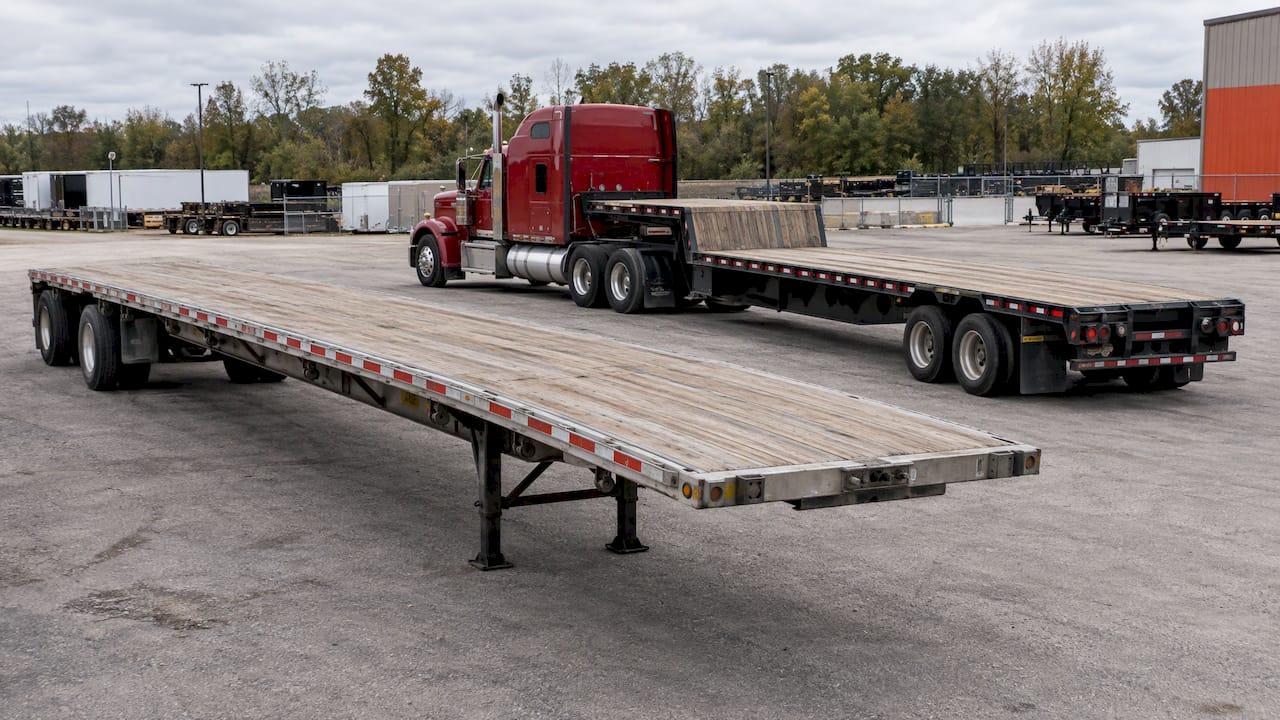
Use a flatbed when the loaded machine stays under about 8 feet 6 inches of freight height. Use a step deck when it is taller, up to roughly 10 feet, and you still want open-deck loading. The deciding number is total height from the road to the top of the load. Most states cap that at about 13 feet 6 inches, and a step deck rides lower, so it gives you more headroom.
For a dealer, this choice affects more than freight. It decides whether a sold excavator, loader or roller gets delivered without a height permit, what the buyer pays to move it, and what you should state in a listing so buyers can plan transport before they call. On Sostruckforsale, buyers filter equipment by category, price and country, and a listing that already answers "what will it take to move this?" is easier to act on.
TL;DR
- A standard flatbed has a single deck about 5 feet (60 inches) off the ground and holds freight up to about 8 feet 6 inches tall within normal height limits.
- A step deck has an upper deck and a lower deck about 36 to 42 inches high, which allows freight up to about 10 feet tall in most cases.
- Legal height is measured from the road, not from the deck. Add deck height to machine height, then check the state rules on your route.
- Both trailers carry roughly 45,000 to 48,000 lb of freight, so weight rarely separates them. Height, loading method and tarping do.
- Machines over about 10 feet loaded, or very heavy ones, move up to a lowboy or RGN. Do not force them onto a step deck.
Table of Contents
- The basic difference between a flatbed and a step deck
- Deck height, length and payload side by side
- Height is the deciding factor
- When a flatbed is the right call
- When a step deck is the right call
- When neither works: lowboy and RGN
- Loading and securement
- A checklist for dealers before booking
- How to put this in your listings
- Where Sostruckforsale fits
- Our perspective
- FAQ
- Sources
The basic difference between a flatbed and a step deck
A flatbed is an open platform trailer with no sides and no roof. Its deck is one level from front to back, so everything on it starts at the same height. WarehouseOnWheels describes a step deck as a flatbed with two deck levels: a shorter upper deck over the fifth-wheel coupling (the connection to the tractor) and a longer lower deck closer to the ground. You will also hear step deck called drop deck, and our drop deck trailer guide covers the design in more detail.
The step is the whole point. National Flatbed notes that the lack of sides, roof and doors lets crews load with a crane or forklift, and the step gives the trailer a lower profile so taller freight can travel than on a conventional flatbed.
The term "flat deck" is just another name for a flatbed in everyday use. When a buyer or carrier says flat deck, they mean the single-level open trailer.
Deck height, length and payload side by side
The figures below come from carrier and trailer guides. Treat them as typical values, since individual trailers vary by manufacturer, tire size and suspension.
| Spec | Standard flatbed | Step deck |
|---|---|---|
| Typical length | 48 or 53 ft | Lower deck about 38 to 41 ft, upper deck about 10 to 12 ft |
| Deck width | 102 in (8 ft 6 in) | 102 in (8 ft 6 in) |
| Deck height | About 60 in | Lower deck about 36 to 42 in |
| Typical legal freight height | About 8 ft 6 in | About 10 ft |
| Typical payload | Roughly 45,000 to 48,000 lb | Roughly 45,000 to 48,000 lb |
| Loading | Crane or forklift | Crane, forklift or ramp |
Sources for the table: ASE North Logistics for the flatbed and step deck specifications, IZ Freight for the lower and upper deck lengths, and OpenDeckLoads for the 36 to 42 inch versus 54 to 60 inch deck-height comparison. Loading methods are from O Trucking's guide.
Two things stand out. Width is identical, so a machine that is too wide for a flatbed is too wide for a step deck. And payload is about the same, so a step deck does not carry more. It carries taller.
Height is the deciding factor
There is no federal height limit for commercial vehicles. The FHWA's size regulations report states that states set their own height restrictions, with most limits between 13 feet 6 inches and 14 feet, and exceptions for roads with lower clearance. In practice, 13 feet 6 inches is the number dealers work with.
The arithmetic is simple. Total height equals deck height plus machine height.
- On a flatbed with a 60-inch (5 ft) deck, you have about 8 feet 6 inches left before you reach 13 feet 6 inches.
- On a step deck with a lower deck near 40 inches, you have about 10 feet left.
ASE North Logistics stresses that legal height is measured from the road surface to the top of the load, so shippers who measure only the freight get surprised at the scale house or under a bridge.
Worked example: a mid-size excavator
Say you sell a 20-ton excavator. With the boom folded and the cab at its highest point, the machine measures 9 feet 8 inches tall in transport position. Always take that number from the machine's own spec sheet or a tape measure, not from memory.
- On a flatbed: 5 ft deck plus 9 ft 8 in is 14 ft 8 in. That is over 13 ft 6 in, so the load needs an oversize permit and likely a different trailer.
- On a step deck with a 40-inch lower deck: 3 ft 4 in plus 9 ft 8 in is 13 ft. That is under 13 ft 6 in, so it can usually travel without a height permit in most states.
This is the most common situation in dealer freight. Many mid-size excavators, dozers with cabs, and tracked loaders sit right in the gap between what a flatbed allows and what a step deck allows.
What a low-pro step deck adds
A low-profile step deck pushes the lower deck down further. Interstate 365 explains that a regular step deck rides at about 36 to 42 inches on 22.5-inch tires, while a low-pro uses 17.5-inch or 19.5-inch tires to bring the deck to about 35 inches or less. That extra few inches can be the difference on a machine that is only slightly over the limit. Ask the carrier for a low-pro by name when your load is borderline.

When a flatbed is the right call
A flatbed is the simpler, cheaper and more available choice when the machine fits. Choose it for:
- Machines that stay under about 8 feet 6 inches loaded. Skid steers, compact track loaders, small wheel loaders, forklifts and many attachments fit comfortably.
- Palletized parts and attachments. Buckets, forks, couplers and cut-to-length parts stack on a single level.
- Dock loading. Western Truck explains that a flatbed deck sits near dock height along its full length, while a step deck's lowered rear section is not always compatible with backing to a dock and driving on.
- Wide carrier choice. Flatbeds are the more common open-deck unit, so you have more carriers to quote against.
When a load could go on either, a flatbed is usually the lower-friction option. Some carriers charge more for step deck because it is more specialized equipment, so do not book one for a machine that clears on a flatbed.
When a step deck is the right call
Choose a step deck when height is the problem and you still want open-deck access. Cowtown Logistics notes that step decks are used when freight is too tall for a standard flatbed but still needs open-deck loading, unloading or securement, without stepping up to heavy-haul equipment.
Typical step deck loads for a dealer:
- Mid-size excavators and tracked loaders near 9 to 10 feet in transport position
- Dozers, graders and rollers with cabs or ROPS (roll-over protective structures) that push height up
- Skid steers and loaders that drive on by ramp rather than being craned
- Tall enclosed or boxy equipment, such as generators and compressors on skids
The lower deck also lowers the cargo's center of gravity, a plus for tall, top-heavy machines. UTB Logistics describes a step deck as ideal when a shipment exceeds flatbed legal height but does not need special permits for length.
When neither works: lowboy and RGN
A step deck tops out around 10 feet of freight height. Past that, or when a machine is very heavy, you need a lowboy or removable gooseneck (RGN) trailer with a deck even closer to the ground. Large excavators, big dozers and crawler cranes usually fall here. A rule from Great Western Transport's equipment hauling guide is to ask three questions: how tall is the loaded machine, how much does it weigh, and how does it get on and off the trailer. Answer all three before you call for a quote.
Loading and securement
Both trailers use the same tiedown methods, but the work differs.
Securement rules. The federal rule for heavy equipment applies to machines on wheels or tracks that weigh 10,000 lb or more, such as front end loaders, bulldozers and tractors. It is 49 CFR 393.130 on the eCFR, and it also requires that articulated machines be restrained so they cannot articulate in transit. Tell the carrier if your machine has an articulating frame, a boom or an attachment that needs to be lowered, pinned or removed.
Tarping. Machines rarely need tarps, but parts, enclosed components and some attachments do. Truck Dispatch Experts reports that tarping a step deck is harder than a flatbed because of the height difference between decks, and wind catches the step. Plan the cover method before the pickup, not at the yard.
Loading access. A step deck accepts a ramp as well as a crane or forklift. For a self-propelled machine that drives on, that can save you a crane rental. Check ramp angle against the machine's ground clearance, because a long-wheelbase or low-clearance machine can hang up at the transition between the lower deck and the beavertail (the sloped rear section).

OTR Logistics advises giving the carrier complete loaded dimensions and weight, confirming loading access, and checking route compatibility, since a lower deck alone does not prove the load is legal.
A checklist for dealers before booking
- Measure the machine as it will ride. Boom down, bucket curled, cab guards and beacons on or off, whatever the transport configuration is. Note length, width, height and weight.
- Add deck height. Use the 60-inch flatbed figure or the step deck's lower deck figure. Compare the total with the state limit on your route.
- Check the route, not only the origin. States set height limits, and some roads have lower clearance. A load legal in one state may need a permit in the next. C.H. Robinson cautions that permits may still be required and rules vary by state.
- Say how it loads. Drive-on by ramp, crane, or forklift. Tell the carrier which, and whether the buyer's site has a dock or a loader.
- Name the trailer you need. Ask for a standard step deck, a low-pro step deck, or a flatbed with specific tarps, so the quote matches the truck that shows up.
- Get the weight right. Payload on both trailer types sits around 48,000 lb under the 80,000 lb federal gross limit, according to IZ Freight. Attachments, fuel and buckets add up, so use real weights.
If you need a sense of per-mile costs when you quote buyers, our heavy equipment shipping cost guide walks through how to compare quotes.
How to put this in your listings
A buyer in another state cannot see your yard. The more transport detail a listing carries, the sooner a serious buyer can price delivery and commit.
- State transport length, width, height and weight in the specs, not just the operating figures.
- Note the trailer type you would use: flatbed, step deck, or lowboy/RGN.
- Mention drive-on capability, removable attachments, and any items that ship separately.
- Show the machine in a clear side view so the carrier can judge profile height.
Our guide on how to sell an excavator fast covers photo and video habits that help here, and choosing the right equipment category helps you place the machine where buyers look for it.
Where Sostruckforsale fits
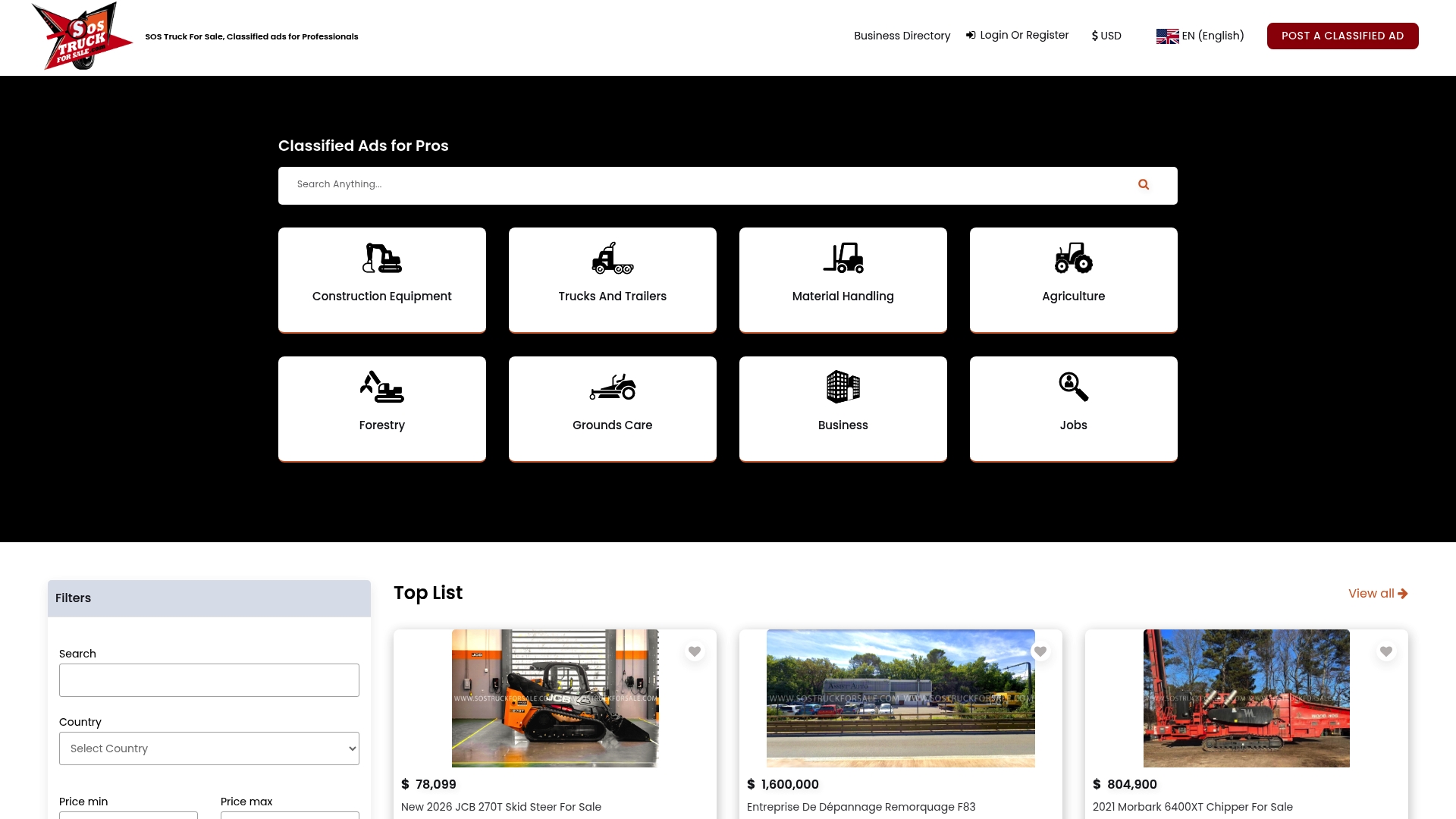
Sostruckforsale is an online marketplace where commercial equipment dealers and private sellers post heavy equipment, trucks and trailers for sale. Buyers browse by category, subcategory, price and country, and dealers can register and list inventory across construction equipment, trucks and trailers, material handling, agriculture, forestry and grounds care. The platform is designed for industry professionals, so the equipment you list is seen by people who already know what a step deck is.
If you have inventory to move, post it on Sostruckforsale.
Our perspective
Most freight problems on a sale start before the truck arrives. A dealer lists a machine with its operating specs, a buyer in another state says yes, and only then does anyone measure the transport height. That is when a flatbed turns into a step deck, or a step deck turns into a lowboy, and the delivery cost changes after the price was agreed.
We built Sostruckforsale around the way dealers actually sell: by category, by price and by country, across trucks, trailers, excavators, cranes and the rest of the heavy equipment range. Our view is that the best listing is the one that makes the next step obvious for the buyer. Transport dimensions and trailer type belong in that listing.
Put the flatbed or step deck question to the machine, not to habit. Measure it, add the deck, and check the route. Then list it where industry buyers are searching.
Dave
FAQ
Is a step deck more expensive than a flatbed?
Often, yes, because it is more specialized equipment and there are fewer of them on the road. The premium depends on the lane, season and carrier. Because height is the real reason to pay it, confirm the machine does not clear on a flatbed before you book a step deck.
How tall a load can a step deck carry without a permit?
About 10 feet of freight on the lower deck in most cases, since the lower deck sits roughly 36 to 42 inches off the ground and most states cap total height at 13 feet 6 inches. There is no federal height rule, so each state on the route sets its own limit, and the FHWA report notes most fall between 13 feet 6 inches and 14 feet.
What is a low-pro step deck?
It is a step deck with a lower lower-deck, about 35 inches or less, achieved with smaller 17.5-inch or 19.5-inch tires instead of 22.5-inch ones. That extra height clearance can help with tall freight and with bridge clearance. Ask for one specifically when a machine is only slightly over the standard step deck limit.
What is a flat deck trailer?
Flat deck is a common name for a flatbed: a single-level open trailer with no sides or roof. It is the simplest open-deck trailer and works for freight that fits under about 8 feet 6 inches tall.
Can a step deck haul the same weight as a flatbed?
Generally yes. Both types are typically rated for roughly 45,000 to 48,000 lb of freight. If the machine is much heavier than that, look at a lowboy or RGN, which are built for heavier equipment.
Sources
- Federal Size Regulations for Commercial Motor Vehicles (FHWA)
- 49 CFR 393.130 (eCFR)
- Stepdeck Trailers (National Flatbed)
- Types of Semi-Trailers (WarehouseOnWheels)
- Flatbed and Step Deck Specifications (ASE North Logistics)
- Trailer Types and Load Dimensions (IZ Freight)
- Step Deck vs Flatbed: Height, Freight, Rates (OpenDeckLoads)
- Low Profile Step Decks vs Regular Step Decks (Interstate 365)
- Step Deck vs Flatbed Trailer (Western Truck)
- Step Deck Trailers: A Shipper's Guide (Cowtown Logistics)
- When to Use Flatbed, Step Deck and RGN (UTB Logistics)
- Construction Equipment Hauling (Great Western Transport)
- Flatbed vs Step Deck: Which Trailer Should You Run? (Truck Dispatch Experts)
- Flatbed vs Step Deck: Equipment Guide (OTR Logistics)
- Flatbed vs Step Deck: Which Trailer Should You Buy? (O Trucking)