
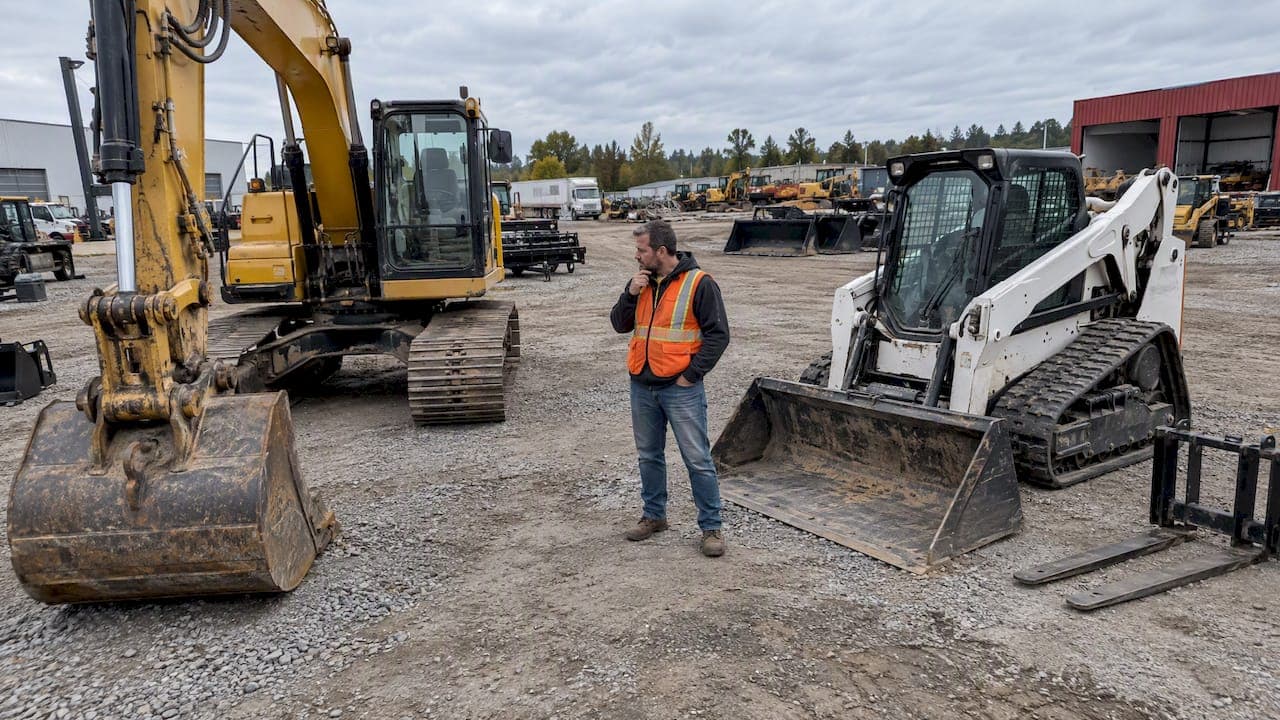
Choose the category from the work, not from the machine. Define the task, the site and the crew first. Then pick the category that holds machines built for that job, and narrow by subcategory, price and country. Buyers who start from a favorite model often end up with a unit that is too big, too small or wrong for the ground it works on.
This guide walks through that process for the six categories on a commercial equipment marketplace: construction equipment, trucks and trailers, material handling, agriculture, forestry and grounds care. It also covers the regulatory and cost checks that should happen before you contact a seller.
TL;DR
- Start with the task and the site. The category follows from the work, and the specific machine comes last.
- Use the category list as a first filter, then subcategory, price and country to cut the field to a handful of units.
- Vehicle classification and safety rules differ by category. Check them before you shortlist, not after you buy.
- Compare total cost of ownership, not just asking price: service access, wear parts, attachments and resale.
- If a unit could fit two categories, search both. Sellers sometimes list by how they use a machine rather than how a manufacturer classifies it.
Table of Contents
- Start with the job, not the machine
- The six categories at a glance
- Trucks and trailers: classify by configuration
- Construction equipment: let the attachment pick the machine
- Material handling: the yard, the dock and the lift
- Agriculture, forestry and grounds care: three categories, three ground conditions
- Use subcategory, price and country filters in order
- Count the whole cost, not just the asking price
- A five-step process you can use today
- Our perspective: the category is a decision, not a label
- Browse by category on Sostruckforsale
- FAQ
- Sources
Start with the job, not the machine
The most common buying mistake is choosing a machine first. Equipment makers and rental fleets give the same advice: define the work, identify the tool or attachment that does it, and select the machine that carries that tool. A hydraulic breaker, a grapple and a pallet fork all push you toward different machines, and sometimes toward a different category altogether.
Write down five things before you open any listing:
- The task. Digging, hauling, lifting, loading, clearing, mowing, felling, moving pallets. Use verbs, not model names.
- The material and volume. Dirt, aggregate, lumber, grain, palletized freight, finished goods. Daily tonnage or loads per shift.
- The site. Soft ground, slopes, tight yards, indoor floors, public roads, overhead lines.
- The crew. Who will operate it, and what training or licensing do they hold?
- The horizon. Is this a single job or work you expect to keep for years? A machine that accepts different attachments gives you room if the scope changes.
Those five answers usually point to one category within a minute. The rest of this article helps you confirm it.
The six categories at a glance
| Category | Typical machines | Choose it when |
|---|---|---|
| Construction equipment | Excavators, loaders, dozers, skid steers, cranes, compactors | You move earth, demolish, grade, lift structural loads or build |
| Trucks and trailers | Semi tractors, straight trucks, box trucks, dump trucks, flatbeds, reefers, lowboys | You haul freight or materials over public roads |
| Material handling | Forklifts, telehandlers, pallet jacks, aerial lifts | You move or place loads in a yard, warehouse or on a job site |
| Agriculture | Tractors, combines, balers, sprayers, implements | You work farmland, crops or livestock operations |
| Forestry | Skidders, feller bunchers, chippers, loaders, logging trucks | You harvest or process timber |
| Grounds care | Mowers, utility vehicles, sweepers, stump grinders | You maintain turf, campuses, roadsides or landscapes |
Overlap is normal. A skid steer sits in construction but works in landscaping. A telehandler lifts on a farm and on a building site. Treat the table as a starting point and read the subcategories.
Trucks and trailers: classify by configuration
If your work happens on public roads, begin here. Federal rules treat vehicles by configuration. The Federal Highway Administration's size regulations for commercial motor vehicles separate truck tractor-semitrailer combinations from straight trucks, and they apply different length provisions to each. A truck tractor is a power unit that does not carry cargo itself. A vehicle that carries cargo on its own chassis is a straight truck.
That distinction affects which subcategory you search:
- Truck tractors for pulling semitrailers. Decide between day cab and sleeper, and between single and tandem drive axles, based on your routes. Our guide to the types of semi trucks covers the configurations in detail.
- Straight trucks, including box trucks, for local delivery and service work. See types of box trucks for body lengths and use cases.
- Heavy haul, for oversize and overweight loads, where axle count and trailer type matter more than horsepower. Review examples of heavy haul trucks before you set a budget.
- Logging trucks, which sit between trucks and forestry. Our logging truck guide explains which fit which terrain.
States set their own provisions for straight trucks, so confirm the length, width and weight limits in every state you will run through. Federal rules are a floor for your research, not the end of it.
The FHWA also publishes its vehicle classification scheme, which groups non-passenger vehicles by axle count and number of units. It is useful when a listing describes a truck by axles and you need to know where it fits.
Construction equipment: let the attachment pick the machine
Construction is the widest category, so it rewards the most discipline. Pick the work tool first. A demolition job that needs a concrete-crushing jaw requires an excavator with the right hydraulic flow and weight class. A site that needs pallet forks and a bucket might be better served by a different machine entirely.
Right-size for the work
Larger machines move more material per cycle. Compact machines get into tight spaces and cost less to move between sites. Neither is better in the abstract. Match the unit to the daily volume and the narrowest access point on your site.

Check attachment and coupler compatibility
A machine is only as flexible as its coupler and auxiliary hydraulics. Before you shortlist a skid steer, read 7 specs to check before buying skid steer attachments. For dozers, industrial bulldozer types explains how blade configuration and undercarriage change what a machine can do.
Know the safety baseline
OSHA's construction standard on material handling equipment, 29 CFR 1926.1000, covers machines such as rubber-tired scrapers, front-end loaders, dozers and wheel-type tractors. It sets rollover protective structure (ROPS) requirements, and the research we reviewed points to July 15, 2019 as the manufacture date that triggers the performance standards. If a used unit predates that, ask the seller exactly what protective structure it carries and confirm it against the standard before you commit.
For a first look at what the whole category contains, start with what heavy equipment is and how it is used.
Material handling: the yard, the dock and the lift
Choose material handling when the job is moving and placing loads over short distances. Forklifts, telehandlers and aerial lifts all live here, and the right pick depends on three things:
- Surface. Pneumatic or rough-terrain tires for gravel and mud. Cushion tires for smooth indoor floors.
- Reach and height. Telehandlers reach forward and up. Forklifts lift straight and stack in aisles.
- Load center. Rated capacity drops as the load moves away from the carriage. Read the capacity plate with the actual attachment installed.
The hazards on the ground should drive the choice. Unstable surfaces, overhead obstructions and vehicle traffic all change which machine is safe to use. Walk the site and write those hazards down before you filter listings. OSHA's recommended practices for safety and health programs in construction say employers should select controls that are the most feasible, effective and permanent. In practice, that means preferring equipment that removes or reduces a hazard by design over relying on procedure or protective gear alone.
Operators should also inspect the machine every shift. Steering, brakes, backup alarms, hydraulics and emergency controls are the usual checkpoints, and a unit with a defect should be tagged out until a qualified person repairs it. Our skid steer inspection walkthrough shows a quick version you can adapt to other machines.
Agriculture, forestry and grounds care: three categories, three ground conditions
These three categories look similar from a distance, because they all involve outdoor work with tractors, loaders and implements. They separate on the work and the terrain.
- Agriculture is organized around crop cycles. Horsepower, hitch and PTO compatibility, and implement availability matter most. Buy the tractor with the implement list in hand.
- Forestry is organized around timber. Ground pressure, slope capability, guarding and cab protection matter most, because felled trees and uneven terrain put machines under constant stress.
- Grounds care is organized around finish quality and access. Deck width, turning radius, turf impact and noise matter most, especially near buildings and the public.
If you manage a mixed property, such as a ranch with timber and pasture, search two categories and compare. A tractor listed under agriculture may do the same job as one listed under grounds care at a different price.
Use subcategory, price and country filters in order
A category narrows the field. Filters finish the job. On a marketplace that lets you filter by category, subcategory, price and country, apply them in this order:
- Category. Pick the one that matches the task.
- Subcategory. Choose the machine type. This is where most of the noise disappears.
- Country. Fix the region before price. Transport, import rules and service coverage all depend on where the machine sits.
- Price. Set a range with a realistic ceiling and a floor. Unusually low prices deserve extra questions, not extra excitement.
For a way to judge asking prices once you have a shortlist, use heavy equipment pricing with auction comps and a checklist.
If you are on the selling side and wonder how to structure your own listings so buyers find them under the right category, see six equipment listing categories you can copy and paste.
Count the whole cost, not just the asking price
The lowest acquisition price is often a misleading number. Practitioners in the construction trades point out that labor, delays and ongoing maintenance can make a cheaper, under-specified option cost more over its life than a better-specified one. That logic applies to used machinery as well.
Before you contact a seller, put numbers beside these items:
- Service access. Is there a technician within a day's reach? Who supplies wear parts?
- Downtime cost. What does one idle day cost your crew or your truck route?
- Attachments. Do the ones you need exist for this model, and are they included?
- Condition evidence. Hours or mileage, service records, photos of the undercarriage, tires, frame and cab.
- Resale. Common, well-supported models are easier to sell later.
If the machine will stay with you for years, settle service responsibilities before you finalize the purchase. Agree who replaces wear parts and how quickly a field technician responds.
A five-step process you can use today
- Write the task in one sentence. Example: "Load 20 tons of aggregate a day into highway trucks from a graded yard."
- Name the tool or body. Bucket, forks, grapple, flatbed, dump body.
- Choose the category. Use the table above. If two fit, search both.
- Set filters. Subcategory, country, price range.
- Verify before you call. Check the applicable regulations, ask for the serial number and service history, and request photos of the areas that wear first.
That sequence takes less than an hour and removes most of the guesswork.
Our perspective: the category is a decision, not a label
We run a listing marketplace for commercial and industrial equipment, and we see the same pattern in how buyers search. The ones who succeed treat the category as the first real decision. They know the work they need to do, they open the matching category, and they use subcategory, price and country filters to reach a short list quickly.

The ones who struggle start with a brand or a model number, then discover the unit is the wrong size, the wrong configuration or in the wrong country. Our advice is plain. Decide the job. Choose the category. Then inspect hard, because a listing is a starting point and the condition of the machine is what you actually pay for.
We built the site for dealers and industry professionals, with multiple categories in one place and dealer registration, so a buyer can compare a truck, a loader and a lift without switching platforms.
— Dave
Browse by category on Sostruckforsale
Sostruckforsale lists construction equipment, trucks and trailers, material handling, agriculture, forestry and grounds care equipment in one place. You can browse the categories, filter by subcategory, price and country, and contact sellers directly. Dealers and private sellers can also post equipment for sale to reach buyers searching by category.
FAQ
How do I know which equipment category fits my job?
Start with the task, the material and the site, not the machine. If you haul freight on public roads, choose trucks and trailers. If you move earth or build, choose construction equipment. If you move loads short distances, choose material handling. When two categories could work, search both and compare.
What is the difference between a truck tractor and a straight truck?
A truck tractor is a power unit that does not carry cargo and pulls a semitrailer. A straight truck carries cargo on its own chassis, as a box truck or dump truck does, according to the FHWA's size regulations. The two types fall under different length provisions, so confirm state rules for your routes.
Does a used machine need a rollover protective structure?
For covered construction machines, OSHA's 1926.1000 standard sets ROPS requirements. Ask the seller for the model, serial number and ROPS details, and compare them with the standard. If you are unsure, consult a qualified safety professional before you buy.
Should I buy for today's job or for future work?
Buy for the work you can name, with some margin. A machine that accepts several attachments or front ends gives you flexibility if the scope changes. Do not pay for capacity you cannot define.
Which filters matter most when I search?
Category and subcategory remove the most irrelevant listings. Country comes next, because transport and service coverage depend on location. Apply price last, so you do not hide good units that sit slightly above your first guess.
Sources
- OSHA 1926.1000, Scope (material handling equipment and ROPS)
- OSHA, Recommended Practices for Safety and Health Programs in Construction
- FHWA, Federal Size Regulations for Commercial Motor Vehicles
- FHWA, Vehicle Types classification scheme