
Yes, Section 179 remains available for 2026, with higher limits from inflation indexing following the One Big Beautiful Bill Act. The maximum deduction is $2,560,000, the phase-out begins at $4,090,000 of total qualifying purchases, and full elimination hits at $6,650,000. Heavy SUVs face a separate $32,000 cap, and timing still rules everything: equipment must be placed in service by December 31.
TL;DR:
- The deduction cannot exceed annual business taxable income; disallowed amounts carry forward, so a loss year may limit immediate tax savings.
- Used equipment qualifies when it is new to your business and bought from an unrelated seller, but mixed use must exceed 50% business use.
- Section 179 applies first, followed by 100% bonus depreciation on remaining eligible basis; state conformity varies, so check local treatment before choosing an election.
- Heavy SUVs from 6,001 to 14,000 pounds face a $32,000 cap, but pickups with at least six feet of cargo bed avoid it.
- Equipment must be installed, tested when needed, and ready for its intended use by December 31; purchase or delivery alone does not qualify.
Table of Contents
- 1. The 2026 numbers at a glance and what they mean for your purchase
- 2. What equipment and property qualify for Section 179 in 2026
- 3. How Section 179 and bonus depreciation work together
- 4. Vehicle rules that trip up truck and van buyers
- 5. How to claim Section 179: Form 4562 and documentation
- 6. Year-end planning: timing, financing, and a quick ROI example
- 7. Resources that help you find qualifying equipment and get it placed in service on time
- 8. Limitations or exceptions for certain industries or equipment categories
- 9. Common mistakes and audit triggers to avoid
- 10. Planning strategies to make the most of Section 179 in 2026
- 11. Don't let the write-off drive the purchase
- 12. Find equipment that fits your 2026 tax plan
- FAQ
- Sources
1. The 2026 numbers at a glance and what they mean for your purchase
The headline figures set the boundaries for every equipment purchase decision this year. We outline them here so you can map a planned purchase against the ceiling before you sign anything.
- The 2026 Section 179 deduction cap is $2,560,000.
- The phase-out threshold begins at $4,090,000 in total qualifying purchases for the year.
- The deduction disappears entirely once purchases reach over six and a half million dollars.
- Section 179 is applied before bonus depreciation and before standard MACRS depreciation.
The deduction shrinks dollar for dollar once you cross $4,090,000 in qualifying purchases, so a business buying $4,500,000 of equipment in 2026 would see its cap reduced by $410,000, leaving $2,150,000 available under Section 179 rather than the full $2,560,000.
There is also a business-income limitation: the deduction cannot exceed your business's taxable income for the year, and any amount disallowed because of that limit carries forward to future years. Combined with the phase-out, this means a profitable year with modest equipment spending usually captures the full deduction, while a loss year or a heavy buying year requires more careful math before you commit to a purchase price.
2. What equipment and property qualify for Section 179 in 2026
Most of what equipment buyers actually purchase falls squarely into Section 179 territory, but the rules draw some lines worth knowing before you finalize a deal.
Tangible personal property is the core category, and it covers the bulk of what moves through a heavy equipment lot: excavators, dozers, loaders, cranes, semi trucks, trailers, and attachments like buckets, forks, and booms. Off-the-shelf software also qualifies, which matters for buyers adding fleet management or dispatch systems alongside new machinery.
Qualified improvement property, often shortened to QIP, extends the deduction to interior improvements made to nonresidential buildings after they are first placed in service. Specific building systems such as roofs, HVAC, fire protection and alarm systems, and security systems can also qualify under Section 179, which matters for operations expanding a shop or yard alongside equipment purchases.
Used equipment qualifies too, as long as it is new to your business. A machine that has been running on someone else's job site for a decade still counts, provided you did not acquire it from a related party or receive it as a gift.
- Qualifying categories include construction machinery, trucks and trailers, attachments, and off-the-shelf business software.
- QIP and certain building systems (roofs, HVAC, fire protection, security) can qualify when tied to nonresidential property.
- Used equipment qualifies if it is new to you, purchased in an arm's length transaction.
- Land, land improvements, and property acquired from a related party or by gift are excluded.
Pro Tip: Run a quick eligibility check against your invoice description before closing a deal. Vague line items like "miscellaneous parts" can create headaches if the IRS later questions what you actually bought.
3. How Section 179 and bonus depreciation work together
Buyers often treat these two provisions as interchangeable, but they follow a specific order and serve different purposes depending on how much you are spending and how your state handles each one.
- Section 179 is applied first, up to the $2,560,000 cap and subject to the business-income limitation.
- Bonus depreciation under Section 168(k) applies next to any remaining basis, and the One Big Beautiful Bill Act reinstated 100% bonus depreciation for qualified property acquired and placed in service after January 19, 2025.
- Standard MACRS depreciation picks up whatever basis is left after both elections.
The practical difference: Section 179 has a dollar cap and an income limitation, while bonus depreciation has no dollar cap and can create a net loss. Because Section 179 is elected asset by asset, while bonus depreciation is elected by property class, buyers with mixed purchases (say, a few trucks and a forklift) can pick and choose where Section 179 applies and let bonus depreciation absorb the rest. Many businesses reserve Section 179 for QIP or for assets where state tax law has not fully conformed to federal bonus depreciation rules, since bonus depreciation conformity varies more by state than Section 179 conformity does.
Pro Tip: If your state hasn't adopted 100% bonus depreciation, shifting more basis into Section 179 (where conformity is usually broader) can reduce your state tax bill even when the federal outcome is the same.
4. Vehicle rules that trip up truck and van buyers
Vehicles are where Section 179 gets complicated fast, and the rules change depending on weight class and body configuration.
The 2026 Section 179 cap for heavy SUVs (6,001 to 14,000 pounds GVWR) is $32,000, a limit aimed at large passenger-style SUVs rather than work trucks. That cap does not apply to every heavy vehicle, though.
- Heavy SUVs between 6,001 and 14,000 pounds GVWR are capped at $32,000 under Section 179.
- Pickup trucks and cargo vans with at least six feet of cargo bed behind the driver's seat escape the SUV cap entirely.
- Vehicles rated above 14,000 pounds GVWR, like most semi trucks and large box trucks, are not subject to the SUV cap.
- Passenger autos (not SUVs or trucks) face separate, lower first-year limits under Section 280F, though bonus depreciation can raise that first-year number.
In practice, a long-bed F-250 or F-350 used for hauling equipment typically clears the cargo-length test and avoids the $32,000 ceiling, while a large passenger SUV used for client meetings does not. Keep mileage logs and a written description of the vehicle's business use on file, since vehicle deductions draw more scrutiny than almost any other Section 179 category.
5. How to claim Section 179: Form 4562 and documentation
Claiming the deduction is straightforward on paper, but the supporting file is what protects you if the return gets a second look.
- Report the election on Form 4562, listing each asset, its cost, and the elected Section 179 amount.
- Confirm the property was placed in service, meaning it is installed, tested if necessary, and ready and available for its intended use, not simply delivered or sitting in a yard.
- Attach Form 4562 to your business tax return for the year the property was placed in service.
Keep a file for each asset that includes the purchase invoice, delivery and installation dates, any financing agreement, and a record of business-use percentage. Carryovers from a disallowed deduction (because of the business-income limit) need their own tracking, since they follow the asset into future years until fully used.
- Form 4562 and supporting asset-level detail are the baseline documentation.
- Installation and "ready for use" dates matter more than the purchase or delivery date.
- Business-use logs protect against recapture if usage changes.
- Financing agreements and title records establish ownership for placed-in-service purposes.
6. Year-end planning: timing, financing, and a quick ROI example
December 31 is the hard line for placed-in-service status, and equipment bought but not installed or operational by then does not count for the 2026 tax year.
- Confirm delivery, installation, and any required inspection or vendor acceptance will be complete before December 31.
- Financed equipment still qualifies for Section 179, as long as it is placed in service by year-end, regardless of how much of the loan is paid off.
- Check whether your state has adopted the federal 2026 Section 179 limits, since some states cap the deduction lower or decouple from federal bonus depreciation.
- Build a short buffer into vendor scheduling since late-December delivery delays are common across heavy equipment dealers.
A quick example: say a business buys a $150,000 excavator in November 2026 and places it in service the same month. For financing, compare lender terms before committing. Our heavy equipment financing guide walks through options buyers commonly use for this kind of purchase.
Pro Tip: Ask your vendor for a written placed-in-service date on the invoice or delivery receipt. It is the single easiest thing to produce if your return is ever questioned.
7. Resources that help you find qualifying equipment and get it placed in service on time
There are online marketplaces built for exactly this kind of year-end search: buyers looking for construction equipment, trucks and trailers, material handling machinery, agriculture equipment, forestry gear, and grounds care machines that commonly qualify for Section 179. Listings are filterable by category, price, and location, which makes it easier to compare options against your remaining 2026 budget before the deadline.
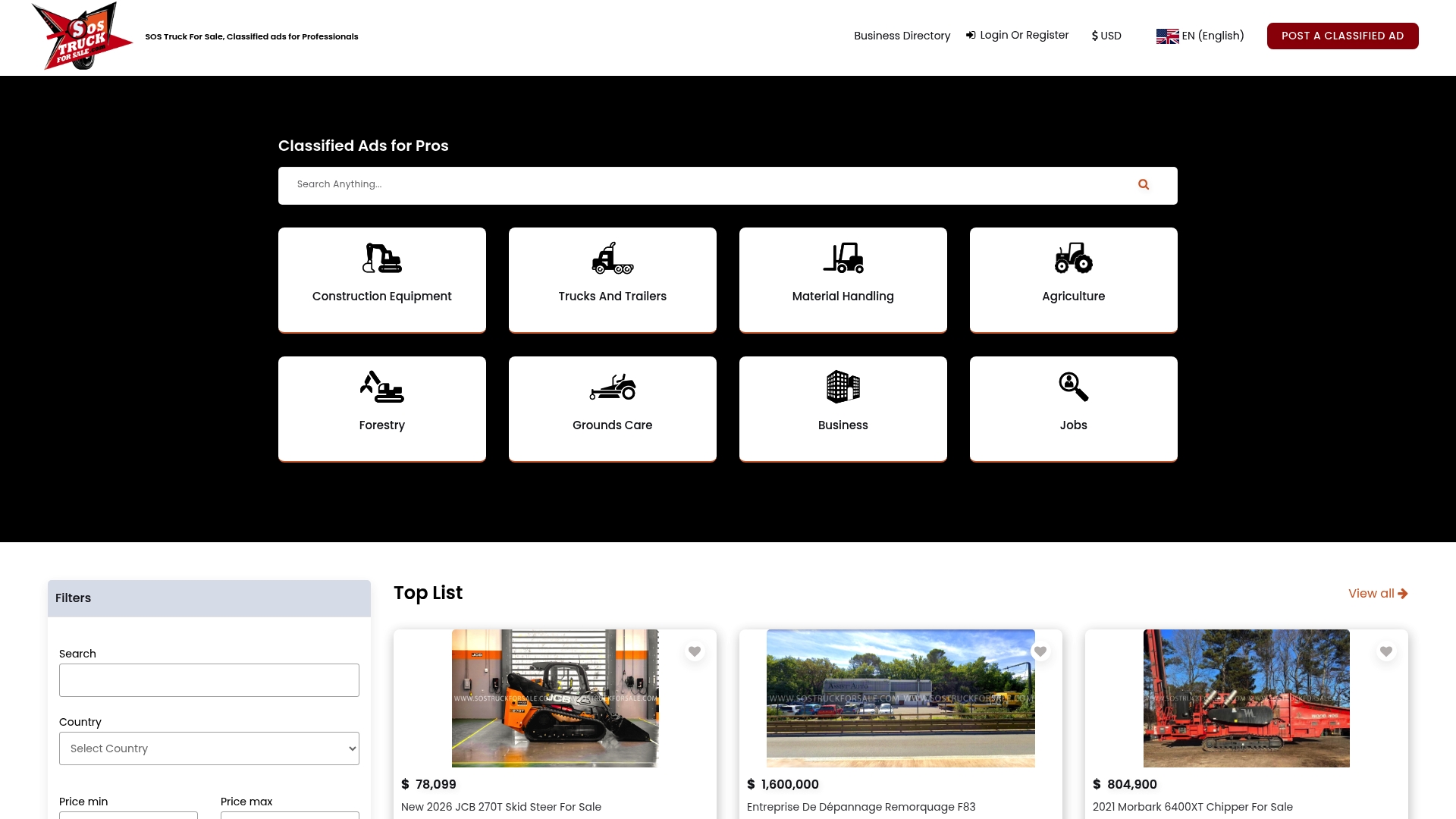
Beyond browsing listings, we publish practical guidance on issues that affect placed-in-service timing, including sales tax exposure on used equipment purchases. Our used equipment sales tax guide covers the state-level issues that can delay a closing if they are not addressed upfront, and our market trends report gives useful context on financing conditions heading into year-end.
8. Limitations or exceptions for certain industries or equipment categories
Section 179 applies broadly, but a few categories carry extra restrictions worth checking before you count on the deduction.
Real property improvements outside the QIP and enumerated building-system categories (structural components, land, and land improvements like parking lots or fencing) generally do not qualify, which matters for construction and agriculture businesses that often bundle site work into an equipment purchase. Equipment used predominantly for lodging, such as machinery tied to a residential rental property, faces additional restrictions under the tax code.
Agricultural buyers should note that certain farm property has its own depreciation conventions that interact with Section 179 differently than standard business equipment, so a combine or irrigation system purchase may need separate treatment from a dump truck or skid steer bought the same year. Leased equipment where your business is the lessor, rather than the end user, generally does not qualify for Section 179 on your return, since the deduction follows the party putting the asset to business use.
Any asset with mixed personal and business use still needs to clear the 50% business-use threshold, and industries where equipment commonly serves dual purposes, like certain vehicles or multi-use trailers, draw more attention on this point than a dedicated piece of construction machinery ever would.

9. Common mistakes and audit triggers to avoid
Most Section 179 problems come from timing and documentation gaps rather than eligibility questions.
Claiming the deduction for equipment that was purchased or delivered in 2026 but not actually installed and operational until January is one of the most frequent errors, since the placed-in-service date, not the purchase date, controls which tax year the deduction belongs to. Vague invoice descriptions that lump several items together under one line also create problems if the IRS asks for an asset-by-asset breakdown.
Overstating business-use percentage on a vehicle or piece of equipment with mixed use is another common trigger, especially when the claimed percentage is not backed by a mileage log or usage record. Electing Section 179 on an amount that exceeds the business-income limitation, without properly tracking the carryover, can also create mismatches between what was claimed and what the return actually supports.
Keeping dated, asset-specific records from day one is the simplest way to avoid all four of these issues.
10. Planning strategies to make the most of Section 179 in 2026
Smart planning around Section 179 is less about finding a loophole and more about sequencing purchases to match your income and your state's rules.
Businesses with a strong profit year should prioritize placing equipment in service before December 31, since the deduction is capped by business income and unused profit in a given year does not carry the same deduction value forward. If you are weighing several purchases, electing Section 179 on assets with longer MACRS recovery periods, and letting bonus depreciation handle shorter-lived property, often produces a better mix given how the provisions interact.
For multi-asset purchases, electing Section 179 on an asset-by-asset basis gives you flexibility to stay under the business-income limitation while still using bonus depreciation on the remainder, since bonus depreciation has no income cap. Buyers operating in states that have not fully adopted federal bonus depreciation should lean more heavily on Section 179 for qualifying assets, since state conformity for Section 179 tends to be broader. Finally, coordinating with your vendor on delivery and installation scheduling well before the holidays reduces the risk of a last-minute placed-in-service failure that pushes the entire deduction into 2027.

11. Don't let the write-off drive the purchase
Section 179 is a real benefit, but it should never be the reason you buy equipment you don't need. A tax deduction on a machine sitting idle in your yard is still a bad purchase. Accelerate buying when the equipment fills a genuine gap in your operation and the timing happens to align, and hold off when it doesn't. Confirm the specifics with a tax advisor before you finalize anything.
— Dave
12. Find equipment that fits your 2026 tax plan
Section 179 only pays off when the equipment itself makes sense for your operation, and that's where sourcing the right machine matters as much as the tax math. There are marketplaces listing construction equipment, trucks and trailers, material handling machinery, agriculture equipment, forestry gear, and grounds care machines from dealers and private sellers, filterable by category, price, and location so you can match a purchase to your remaining budget before year-end.
- Browse listings by category and price to find equipment that fits your Section 179 planning window.
- Use our financing and sales tax resources to avoid delays that could push your placed-in-service date past December 31.
- Compare multiple sellers in one place instead of chasing quotes across separate dealer sites.
For upfitting needs like lighting and safety equipment on work trucks, Strobe My Ride offers LED light bars and warning systems worth checking for fleet vehicles, though availability for U.S. buyers is worth confirming directly with the supplier. Start browsing current listings at Sostruckforsale to find equipment that fits both your operational needs and your 2026 tax timeline.
This article is general information, not a substitute for advice from a qualified financial advisor. Consult a qualified financial professional about your own circumstances before acting on anything here.
FAQ
Is Section 179 still available in 2026?
Yes, Section 179 is fully available in 2026, with a maximum deduction of $2,560,000 and a phase-out beginning at $4,090,000 in total qualifying purchases.
What equipment can be deducted under Section 179?
Tangible personal property used in a business, including construction equipment, trucks, trailers, attachments, and off-the-shelf software, generally qualifies for Section 179. Certain qualified improvement property and specific building systems like roofs and HVAC can also qualify, while land and structural components do not.
What qualifies for 100% bonus depreciation in 2026?
Qualified property acquired and placed in service after January 19, 2025, qualifies for 100% bonus depreciation under the One Big Beautiful Bill Act. It generally applies to qualified property and is typically used for basis remaining after any Section 179 election.
What are the new rules for Section 179 deductions?
The One Big Beautiful Bill Act reinstated higher baseline amounts for Section 179, and inflation indexing produced the 2026 limits including a $2,560,000 cap and a $4,090,000 phase-out threshold.