
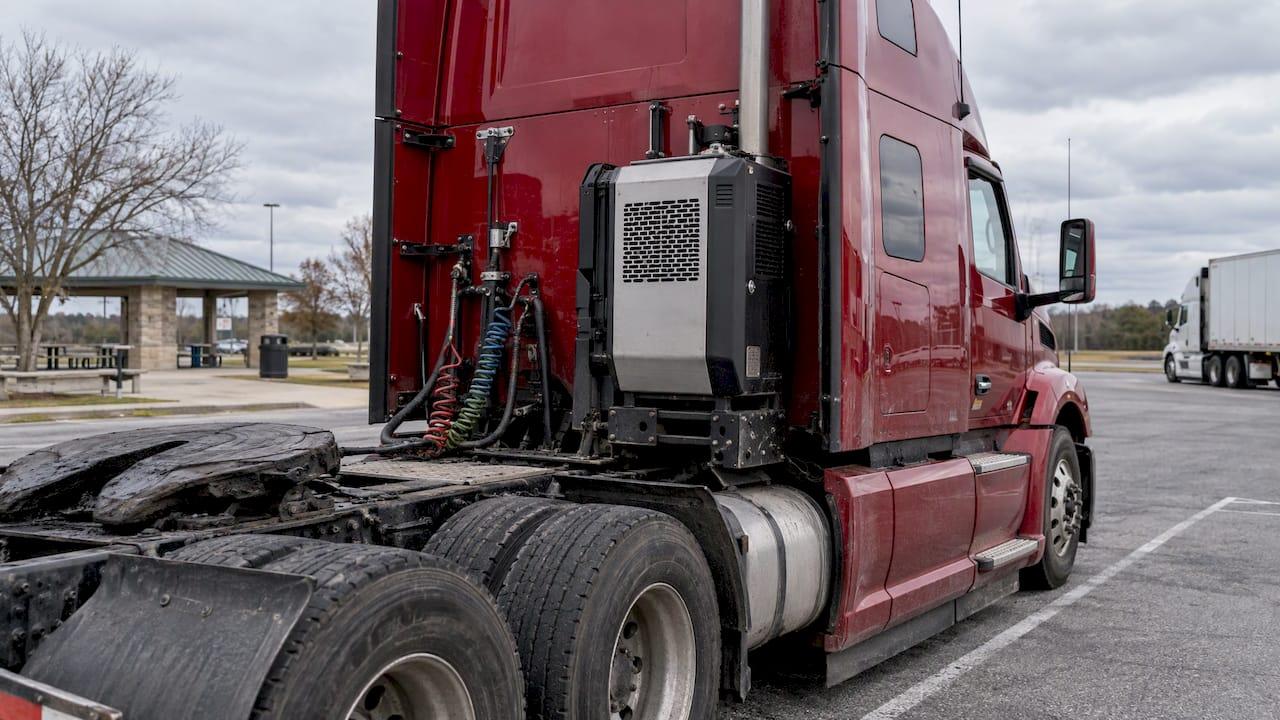
APU stands for auxiliary power unit. On a semi truck it is a separate system that heats, cools and powers the sleeper cab while the main engine is off, so the driver does not have to idle a 400-plus horsepower tractor all night. For a dealer, the unit matters twice: it is a feature buyers search for, and it is a component with a make, a type, an hour count and a weight that belongs in the listing. This guide explains the technology at the level a dealer needs, then shows how to present it.
TL;DR
- An APU is a vehicle-mounted system that supplies engine-off climate control and electrical power. It can be diesel-fired or battery-electric.
- A modern diesel APU burns roughly 0.25 gallons per hour, about 75% less than an idling tractor engine, according to NACFE.
- Installed diesel units are typically priced at $8,500 to $13,000 and add roughly 400 to 600 lb to the tractor.
- Type, make, model, hours and condition are the details a buyer of a sleeper tractor wants to see in the ad.
- Sleeper tractors with APUs can be posted by category, price and country on Sostruckforsale.
Table of Contents
- What APU means on a truck
- What an APU runs in the cab
- How a diesel APU works
- Diesel APU or electric APU
- What an APU saves
- Weight, tax and anti-idling rules
- How to present an APU in a used tractor listing
- Perspective
- Put your sleeper tractors in front of truck buyers
- FAQ
- Sources
What APU means on a truck
The U.S. Department of Energy's Alternative Fuels Data Center defines an APU as a vehicle-mounted system, installed by the manufacturer or as an aftermarket add-on, that provides power for climate control and electrical devices when the engine is off. The same definition covers locomotives and marine vessels, but the version you see on the lot is the one bolted to a Class 8 sleeper.
The Minnesota Department of Revenue describes the common diesel version as a small diesel engine that provides air conditioning, heating, cab power, engine warming, battery charging and optional shore power. Most of these units have no tank of their own and draw from the tractor's main fuel tank.
In short: the APU does the job of the idling engine, with a fraction of the fuel, wear and noise.
What an APU runs in the cab
During a 10-hour break, a driver needs cooling or heat, light, and power for a refrigerator, microwave, TV and phone chargers. Thermo King says its APUs supply cooling, heating and electrical power for these cab loads, keep the tractor batteries charged, and can tie into the engine coolant system to help starting in cold weather.

That last point matters when you sell into northern states. A unit that pre-heats the engine is a selling point for a buyer running in winter. Carrier's Aspen, for example, lists an engine pre-heat function called Winter Watch, along with automatic battery charging and a shore-power plug-in.
How a diesel APU works
A diesel APU is a compact engine with accessories. NACFE explains that every diesel APU engine drives an air-conditioning compressor for bunk cooling. Electrical output comes in one of two arrangements:
- A 4 kW to 6 kW generator supplies AC power directly to the cab, and a 12V DC alternator charges the batteries.
- A 12V DC alternator charges the batteries and an in-cab inverter produces 110/120V AC power.
Physically, a typical installation has the main unit (engine, generator, radiator and condenser) on the frame rail, a heater core and A/C evaporator in a heater box under the bunk, and a control panel in the cab. Diesel units usually sit on the frame rail behind the fuel tank and ahead of the first axle, per Crosspoint Power & Refrigeration, which names the Carrier Aspen and the Thermo King TriPac as the most common diesel systems.
Figures from the two common units
Thermo King's 2026 whitepaper describes its third-generation TriPac as using an EPA Tier 4 compliant two-cylinder diesel driving a compressor rated at 13,000 BTU/hr of cooling. The standard fuel heater is 7,500 BTU/hr, with a 13,600 BTU/hr option, and a 120-amp alternator charges the truck batteries and runs in-cab devices.

Carrier lists its Aspen at 12,000 BTU/hr of cooling and 7,500 BTU/hr of heating, with Integrated, Stand-Alone and Power-Only models. Those model names are worth copying exactly into a listing, because a buyer or a parts counter will search by them.
What BTU means: a British thermal unit is the measure of heat moved per hour. Higher cooling BTU means more capacity for a large sleeper in hot weather.
Diesel APU or electric APU
The second basic type is the electric APU, which uses a battery bank charged by the tractor's alternator while driving, or by shore power when parked, according to Crosspoint. There is no engine to maintain, but runtime depends on battery capacity.
| Point | Diesel APU | Electric (battery) APU |
|---|---|---|
| Power source | Small diesel engine, fed from the tractor's fuel tank | Battery bank, recharged while driving or on shore power |
| Typical installed price | $8,500 to $13,000 | $3,000 to $10,000+ |
| Typical weight | About 400 to 600 lb | Lithium systems about 250 to 350 lb |
| Runtime | As long as there is fuel | Limited by battery charge |
| Upkeep | Engine service, per NACFE every 500 to 2,000 hours | Battery replacement about every 3 to 5 years at roughly $2,000 to $4,000 |
Price, weight and battery-life figures in the electric column and the diesel weight come from Heavy Vehicle Inspection's 2026 planning ranges; the service interval is from NACFE.
The runtime difference is the one buyers ask about. The DOE's Clean Cities report notes that battery APUs suit a 10-hour break but are generally not enough for a 34-hour restart without shore power or intermittent recharging. A diesel unit keeps running as long as it has fuel, which is why it fits heavy over-the-road work. A battery unit fits operations that return to a terminal or sleep where shore power is available.
The DOE also lists simpler idle-reduction options, such as fuel-fired bunk heaters and coolant heaters. A tractor with one of these is not the same as a tractor with an APU, so the listing should say which it is.
What an APU saves
Your buyer will ask whether the unit pays for itself. The published numbers give you a straight answer.
- Fuel burn: NACFE puts diesel APUs at 0.1 to 0.5 gallons per hour depending on design, temperature, sleeper insulation and load, with a modern unit at about 0.25 gal/hr.
- Annual savings: the DOE's worked example takes a sleeper idling 6 hours a day for 300 days (1,800 hours) at 0.8 gal/hr and finds about 990 gallons saved per year with a diesel APU burning 0.25 gal/hr. NACFE cites savings of up to about 2,500 gallons per truck per year for heavy idlers.
- Payback: NACFE says installed prices of $8,500 to $13,000 typically pay back in 12 to 24 months for trucks idling more than 1,000 hours per year.
Payback depends on how much the truck idled. A tractor that spent its life in a regional day-cab route will not show the same return as a team sleeper. When you know the duty cycle of the unit you are selling, say so.
Weight, tax and anti-idling rules
Three rules come up in buyer conversations.
Weight. The Energy Policy Act of 2005 let states allow a 400-pound weight exemption for idle-reduction technology, and MAP-21 in 2012 raised it to 550 lb, as the DOE's Clean Cities report explains. Caltrans also describes the federal allowance for APUs on the Interstate System. States decide whether to grant it, so buyers hauling near legal weight should confirm the rule in the states they run.
Excise tax. The same DOE report states that most APUs are exempt from the federal excise tax under the Energy Improvement and Extension Act of 2008.
Anti-idling laws. Thermo King's whitepaper lists compliance with local, state and federal anti-idling rules as a benefit of running an APU. NACFE also notes that California has diesel particulate filter requirements that affect diesel APUs. A buyer registering a tractor in California should check those requirements first.
How to present an APU in a used tractor listing
Buyers filter on specifics. A line reading "APU" tells them little. The details below are what a serious buyer wants.
- Type: diesel or electric. For electric, the battery type (lithium or lead-acid) and age.
- Make and model: for example Thermo King TriPac or Carrier Aspen, with the model variant.
- Hours: APU engine hours are separate from the tractor's engine hours. Service intervals run on them.
- Configuration: integrated, stand-alone or power-only, and whether it provides 120V power with a generator or through an inverter.
- Service records: the last service date, and for electric units, the date the batteries were replaced.
- Function check: cooling, heating, battery charging, shore-power plug and control panel all working.
- Weight: the added weight of the unit, so buyers can calculate their legal payload.
- Photos: frame-rail unit, bunk heater box and cab control panel.
A complete spec sheet cuts down on back-and-forth inquiries and brings you buyers who already know what they are asking about.
Perspective
Dealers tend to treat the APU as an extra line in a sleeper's description. We think it deserves more room. For many owner-operators and fleets, the unit is part of how they decide between two otherwise similar tractors.
The published numbers back that up: an installed unit costs thousands of dollars and saves fuel every night the truck is parked. A buyer who sees the make, the hours and the service history can put a value on that unit. A buyer who sees only "APU" has to guess, and will usually guess low.
Sostruckforsale is built for industry professionals, with a dedicated classified environment for commercial and industrial equipment, listings you can filter by category, subcategory, price and country, and dealer registration options. A well-documented sleeper tractor belongs in that environment, in front of buyers who are looking for exactly that spec.
Write the APU details first. The rest of the listing gets easier.
Dave
Put your sleeper tractors in front of truck buyers
Sostruckforsale is an online marketplace for commercial vehicles and heavy equipment, with a Trucks and Trailers category alongside construction equipment, material handling, agriculture, forestry and grounds care. Dealers and private sellers post classified ads, and the site also carries a business dealer directory. Register as a dealer and list your trucks and trailers with the APU details above in the description.
If you are also stocking or advising on newer powertrains, our guide to electric semi trucks covers range and cost, and the piece on Tier 4 Final engines explains emissions equipment that buyers ask about in the same conversation.
FAQ
What is an APU on a truck?
It is an auxiliary power unit: a separate system that supplies heat, air conditioning and electrical power to the cab when the main engine is off. It can run on diesel or on batteries. Its purpose is to let the driver rest in comfort without idling the tractor.
How does a truck APU work?
A diesel APU uses a small engine to drive an A/C compressor, a generator or alternator, and a fuel-fired or electric heater. It draws fuel from the truck's tank and charges the tractor batteries as it runs. An electric APU runs the same loads from a battery bank charged while driving or from shore power.
How much does an APU for a semi truck cost?
NACFE gives $8,500 to $13,000 installed for diesel units. Battery-electric units are ranged at about $3,000 to $10,000 or more installed in 2026 planning figures. Actual cost depends on make, model, installation and the truck.
How long does installation take?
Fleet Equipment Magazine reported installation at about 8 to 10 hours in 2008. The unit needs frame-rail mounting, a heater box under the bunk, fuel and electrical connections and exhaust routing, so the time varies with the truck.
Should a used sleeper's APU be listed separately?
Yes. Name the type, make, model, hours and service history in the description. These details tell buyers what the unit is worth and what upkeep to expect.
Sources
- Alternative Fuels Data Center: Idle Reduction Equipment
- Minnesota Department of Revenue: Auxiliary Power Units
- Thermo King: Auxiliary Power Units
- NACFE: Diesel APUs
- Thermo King: APU whitepaper 2026
- Carrier: Aspen Diesel Auxiliary Power Unit
- Fleet Equipment Magazine: No-idling solutions for cab comfort
- Crosspoint Power & Refrigeration: What is a Truck APU?
- Heavy Vehicle Inspection: Truck APU ROI 2026
- DOE Clean Cities: Status and Issues for Idling Reduction in the United States
- Caltrans: Auxiliary Power Units