
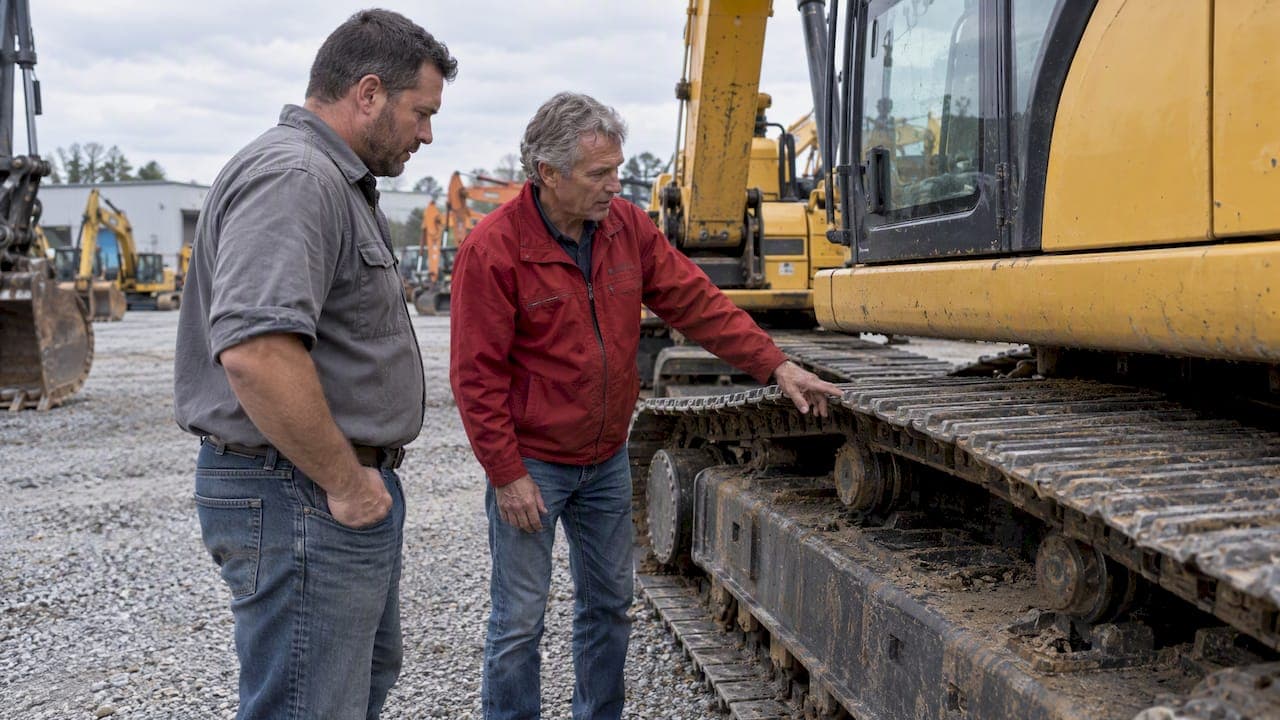
To negotiate an equipment price, do the work before you talk numbers. Know what comparable machines actually sell for, collect several quotes for the same unit, inspect the machine, and settle the non-price terms (payment, warranty, delivery) before you settle the price itself. Buyers who do this usually have a real shot at a lower number. Buyers who skip it mostly end up haggling over a sticker price that was never the whole deal.
This guide is written for contractors, fleet managers, owner-operators and dealers who buy semi trucks, trailers, excavators, loaders, cranes and other commercial machinery in the United States. It covers the prep, the tactics, a worked example and the mistakes that cost buyers the most.
TL;DR
- Get three to five quotes for the same make, model and size of machine. Competing offers are your strongest leverage.
- Pull comparable prices and inspect the unit before you discuss money. Hours, service records and attachments move the fair price.
- Trade terms, not just dollars: deposit size, payment timing, warranty, training and delivery can each be worth real money.
- Settle scope and non-price items first, then negotiate the final number. Get everything in writing.
- Be ready to walk away. A second option is the only thing that makes your offer credible.
Table of Contents
- What a realistic discount looks like
- Do the homework before you make contact
- Build leverage with competing quotes
- Negotiate terms, not only the price
- Inspect first, then negotiate
- A step-by-step approach to the conversation
- Our perspective: what we see from the listing side
- Find comparable machines on Sostruckforsale
- Mistakes that cost buyers money
- When to walk away
- FAQ
- Sources
What a realistic discount looks like
Set expectations first. There is no universal discount on heavy equipment. A clean, well-priced unit from a dealer with plenty of inventory behaves differently from a private seller who needs cash. Treat any single percentage as a range, not a promise.
One procurement guide says that on large machinery orders, especially those above $20,000, collecting quotes from 3 to 5 suppliers can support a 5% to 15% reduction against initial quotes. The same source says adjusting payment terms can unlock a further 3% to 7%. Those figures come from a general machinery purchasing guide, not from a study of used trucks or excavators, so use them as a planning range rather than a target.

The practical takeaway: a modest, well-supported ask lands more often than a lowball. A seller who sees that you have done your homework is more willing to move than one who thinks you are fishing.
Do the homework before you make contact
Negotiating power comes from information. Before you call a seller, build a one-page file on the machine you want.
Establish fair market value
Find at least five comparable listings or sold results with the same make, model, approximate year and similar hours. Note the asking price, hours, location, attachments and condition. Throw out the outliers at both ends: the cheapest unit often hides a problem, and the most expensive may be a stale listing the seller has not corrected.
Auction results, dealer listings and classified ads each tell you something different. Auction prices show what a machine clears for quickly, while asking prices show seller hopes. Our guide to heavy equipment pricing with auction comps and a checklist walks through how to read both and how to adjust for hours and condition.
Account for the full cost of ownership
The price on the listing is rarely your final cost. Add:
- Freight from the seller's yard to your site. See what shipping heavy equipment costs per mile so your delivered number is realistic.
- Pre-purchase inspection, either your own mechanic or a third-party inspector.
- Immediate maintenance: fluids, filters, tires, tracks, undercarriage wear.
- Sales tax, title and registration fees, which vary by state.
- Financing costs if you are not paying cash.
A machine listed $4,000 cheaper but 900 miles farther away may not be cheaper at all. Knowing your delivered cost keeps you from celebrating a discount that disappears at the freight invoice.
Understand the seller's situation
Negotiators often prepare a second profile: not just the machine's value, but what the seller needs, such as quick cash, clearing aging inventory or hitting a volume number. You can learn a lot with simple questions:
- How long has the unit been listed?
- Why are you selling?
- Is this trade-in inventory or consigned?
- Has it been used in harsh conditions such as demolition, quarry work or salt-heavy regions?
- Any recent repairs, or any issues not visible in the photos?
A unit that has sat for months on a dealer lot costs the dealer money every week in floorplan interest. If you want to understand that pressure from the dealer's side, our overview of dealer floorplan financing explains why aging inventory changes how dealers price.
Build leverage with competing quotes
One quote is a price. Three quotes are a market.
Contractor-focused advice is consistent on this point: get at least three to five quotes from different dealers for the same type and size of machine, for example a 70,000 lb excavator. The point is not only to find the lowest number. It is to learn the spread, spot the outlier, and be able to say honestly that you have other options.
Make the quotes comparable
Quotes fail as leverage when they cannot be compared. Ask every seller for the same things:
- Exact make, model, year, serial number and hours.
- What is included: bucket, thumb, quick coupler, counterweight, tool kit, spare keys.
- Warranty or as-is terms, in writing.
- Delivery terms and who pays freight.
- Documentation fees, preparation fees and any other add-ons.
- Payment terms and how long the price is held.
Then line them up side by side. A simple matrix works: one row per line item, one column per seller. If you handle many purchases or bids, a quote comparison matrix with templates and a checklist shows how estimators level vendor quotes so nothing gets missed. Even a spreadsheet does the job, as long as scope is leveled before price is compared.
Use the spread, not just the low number
Do not simply forward a competitor's quote and ask for a match. Sellers discount that move. Instead, tell the truth in a calm way: you have comparable units from other sellers, you prefer this one for a stated reason, and you need the numbers to be closer to make the decision. Giving the seller a reason to win the deal beats threatening to leave it.
Negotiate terms, not only the price
Most buyers fixate on the sticker. Experienced buyers know a seller often has more room in the terms than in the price, especially a dealer with a published price that sales staff are reluctant to break.
Payment timing and deposits
Cash flow matters to sellers. A procurement source notes that increasing a deposit, say from 30% to 50%, or paying the balance faster can help unlock a discount because it helps the seller's cash flow. That example comes from manufacturer purchasing, so on a used truck from a dealer the principle applies, but the size of the concession will differ. Offering a certified check or wire at pickup, instead of asking for time to arrange financing, can be worth something to a seller who wants a clean close.
If you do need financing, line it up before you negotiate. Arriving with pre-approval tells the seller your offer is real. Our guide to heavy equipment financing options for buyers compares lender types and explains what to prepare. Farm equipment buyers can also see this advice on negotiating an equipment purchase, which covers both dealership and private-party deals.
The concession trading sheet
Here is a tool borrowed from sales training. Before the conversation, list every non-price lever in the deal. Negotiation drills for industrial equipment describe a concession trading sheet: a one-page list of those levers, so that a price cut is traded for something rather than given away.
For a used-equipment buyer, the levers on the table might include:
| Lever | What you ask for | What you can offer |
|---|---|---|
| Price | A lower figure | A faster close, larger deposit |
| Warranty | 30, 60 or 90 days on drivetrain or hydraulics | Accepting current condition on cosmetic items |
| Service | A completed service before delivery | Flexible pickup date |
| Freight | Seller covers or splits delivery | Buying a second unit or attachment |
| Attachments | Bucket, forks or coupler included | Keeping the price where it is |
| Payment | Longer time to pay the balance | Wire on the day of pickup |
Rank each lever by what it is worth to you and what it likely costs the seller. A free bucket may cost a dealer little and save you real money. A swap like that preserves the seller's margin and still moves your total cost down.
Lock the scope in writing first
Procurement guidance warns that defining the deal's scope is often harder than agreeing on price. One public-sector procurement manual advises getting requirements, including training, service and warranty, defined in writing before price is finalized. The trap it describes is a low quote offset by inflated service fees later. That manual is written for IT purchasing, but the logic applies to any equipment deal.
On a heavy truck or excavator, that means writing down what the price includes before you argue about the price. Many sellers also prefer this order. As one procurement summary puts it, resolving payment, warranty, training and delivery first means the seller does not feel they have already given up too much margin by the time you reach the final number.
Inspect first, then negotiate
Never negotiate blind. Inspection findings are the most credible reason to ask for a lower price, because they are specific and verifiable.
What to check depends on the machine, but a few items apply broadly:
- Hours and records. Compare the meter with service logs. Gaps in maintenance history are a legitimate pricing issue.
- Undercarriage and wear parts. Tracks, rollers, sprockets, teeth and cutting edges on excavators and loaders can be expensive to replace.
- Hydraulics. Leaks, slow cycles and weak breakout force suggest repairs ahead.
- Engine and drivetrain. Cold start behavior, smoke, fluid condition, and for trucks, clutch and transmission feel.
- Tires, frame and fifth wheel on trucks and trailers: uneven wear and frame repairs matter.
- Title and lien status. Confirm the seller can legally sell the unit, and that serial numbers match the paperwork.
Turn findings into numbers. "The tracks are about 30% worn, a replacement set costs roughly this much, and I would like that reflected in the price" is a request a seller can respond to. "The price feels high" is not. Get a real repair estimate when you can, rather than guessing.
A step-by-step approach to the conversation
Once you are prepared, the negotiation itself can be calm and short.
- Confirm the unit and availability. Ask whether it is still for sale and whether the listed price is current.
- Ask your questions and listen. Learn the seller's timeline and motivation before mentioning a number.
- Agree on scope. Walk through inclusions, warranty, delivery and paperwork. Write them down.
- Share your findings. Present comparable prices and inspection items as facts, not accusations.
- Make the first offer with a reason. Anchor within a defensible range of your market research. A number you cannot explain invites a quick no.
- Trade, do not just cut. When the seller counters, respond with a term you can give: a faster close, a larger deposit, or flexible pickup.
- Ask for a final written quote. Include price, inclusions, fees, payment method and deadline.
- Stop talking after the ask. Silence is uncomfortable, but it often does more work than another argument.
Keep your tone businesslike. Heavy equipment is a small world, and the dealer you press too hard today may be the one you need for parts and service next year.
A worked example
Say you are buying a used 20-ton excavator. You collect four quotes. Three sit in a similar band and one is clearly lower, but its unit has older tracks and no bucket. After inspection, the unit you prefer needs a track replacement soon. You tell the dealer that you like the machine, show the other quotes you hold for comparable units, and share the track estimate. You offer to wire the deposit the same day and arrange your own freight. In return you ask for a lower price, a 60-day powertrain warranty and the bucket included. The dealer may decline one item but accept the others. You have lost nothing by asking, and you have made it easy for them to say yes to part of it.
This is an illustration of the method, not a record of a real transaction, and the outcome will depend on the seller and the market.
Our perspective: what we see from the listing side
We run a marketplace where dealers and private sellers post commercial trucks, trailers, excavators and other heavy equipment, and buyers filter by category, subcategory, price and country. That gives us a clear view of how a negotiation starts: with a listing.
Three things stand out to us. First, the best negotiations begin with a complete listing. When a seller posts clear specifications, honest photos and a realistic asking price, the conversation moves quickly to inspection and terms instead of getting stuck on basic questions. Buyers should treat a thin listing as a reason to ask more, not as a reason to lowball.
Second, price is only one field in a listing. Hours, attachments, location and condition all change what a machine is worth, so compare like with like. A cheaper unit in a different state is not automatically a better deal.

Third, dealers who want to close deals benefit from flexibility. Accepting multiple payment methods and responding quickly to inquiries are things we see help sellers stand out. Buyers should reward that responsiveness. A seller who answers questions clearly and puts terms in writing is usually easier to negotiate with, and safer to buy from.
Our advice to buyers: negotiate firmly on facts, be generous on speed and clarity, and never let the discount distract you from the condition of the machine.
— Dave
Find comparable machines on Sostruckforsale
Negotiating well starts with options. Sostruckforsale lists commercial and industrial equipment across construction equipment, trucks and trailers, material handling, agriculture, forestry and grounds care, with a dealer directory so you can contact sellers directly. Browse similar units side by side, note the spread in asking prices and hours, and use what you find to support your offer.
Mistakes that cost buyers money
- Negotiating one quote. With no alternative, you have nothing to trade on and no reason for the seller to move.
- Opening with the lowest price you can imagine. An offer far from market tends to end the conversation instead of starting it.
- Skipping the inspection to save time. A repair bill found after purchase wipes out any discount you won.
- Ignoring delivered cost. Freight, fees and prep can erase a cheaper sticker price.
- Revealing your deadline. If the seller knows you must have the machine by Friday, you have lost leverage.
- Accepting verbal promises. Warranty, inclusions and repairs belong in the written agreement.
- Negotiating price before scope. Fix the terms first so a low price does not come back as fees later.
One more point on timing. Quoted delivery times can include a cushion. One guide says lead times often carry an unadvertised 20% to 30% buffer, and that sellers may speed things up once a deposit makes the commitment binding. That applies mainly to ordered or manufactured equipment rather than units on the lot, but it is a fair question to ask anytime a delivery date matters to your project.
When to walk away
Walking away is part of negotiating, not a failure of it. Leave when the seller will not put terms in writing, when inspection reveals problems the seller will not price in, when the title is unclear, or when the delivered cost exceeds what a comparable unit would cost you elsewhere. Do it politely and leave the door open. Sellers often call back with a better number, and if they do not, you still hold the other quotes.
FAQ
Can you negotiate the price of heavy equipment at a dealership?
Yes, in most cases. Dealer prices usually leave some room, and there is often more flexibility in terms such as warranty, delivery, attachments and payment timing than in the sticker price. Come with comparable listings and other quotes so your request has a basis.
How much can I realistically negotiate off the asking price?
There is no fixed figure. One purchasing guide suggests 5% to 15% on large orders with multiple quotes, but a used unit that is already priced at market may move less. Condition findings, seller urgency and how long the unit has been listed all change the answer.
Should I negotiate price or terms first?
Settle the terms first. Agree on warranty, training, delivery, inclusions and payment timing, then negotiate the final number. This keeps the seller from feeling they have given up the whole margin early, and it prevents hidden fees from replacing the discount.
Is it different buying from a private seller?
The method is the same, but the risks shift. Private sellers rarely offer warranties, so inspection, title checks and a written bill of sale matter even more. They may also be more flexible on price when they need to sell quickly.
Sources
- What are the negotiation techniques for purchasing machinery and equipment? (Cloud Entropy Technology)
- Skill Drill: Negotiation for Industrial Equipment (PulseRevOps)
- Buy IT: IT procurement manual, Chapter 26 (Virginia Information Technologies Agency)
- How to Negotiate Equipment Prices Like a Pro (ProfitDig)
- Negotiating an Equipment Purchase (AgDirect)