
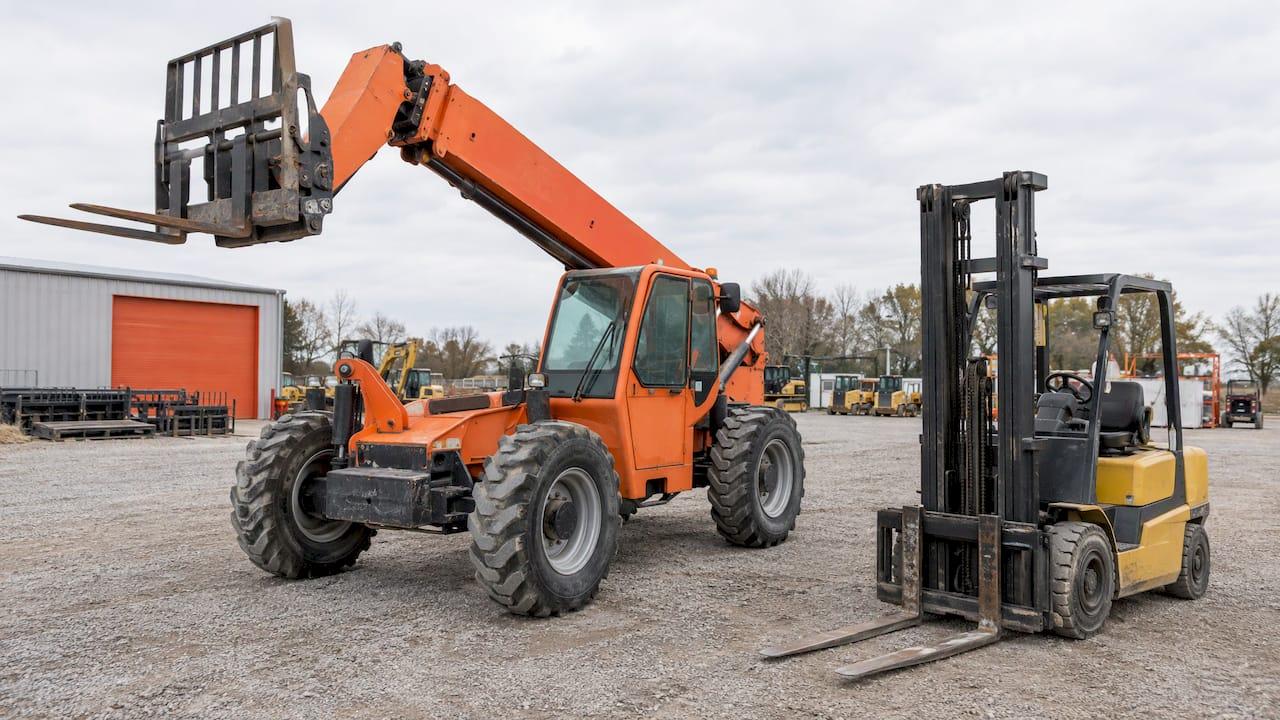
A forklift lifts straight up a mast and works best on flat, hard surfaces. A telehandler lifts up and out on a telescoping boom and works on rough ground. For a dealer, getting that distinction right in the listing decides which buyers find the machine. On Sostruckforsale, buyers filter listings by category, subcategory, price and country, so a telehandler filed as a forklift, or the reverse, reaches the wrong audience.
This guide gives the practical differences, the specs buyers ask about, the safety points that come up in every sales conversation, and short comparisons of three other pairs that buyers confuse: wheel loader vs skid steer, and mini excavator vs backhoe.
TL;DR
- A forklift is a vertical-mast machine for pallets on firm, level ground. A telehandler is a boom machine for reaching up, out and over obstacles on uneven ground.
- Capacity is not the clean dividing line. Comparable load ratings exist in both families, but a telehandler's rating drops as the boom extends, so the load chart matters more than the nameplate figure.
- List the machine by what it is: class, rated capacity, lift height, tires, attachments and hours. Buyers search on those terms.
- A wheel loader is the larger, articulated machine for stockpiles and trucks. A skid steer is the compact, tight-space machine. A backhoe digs deeper and loads. A mini excavator is lighter, more mobile and more precise.
- Safe-use information (rated load, operator training, load chart) belongs in the listing, because every buyer asks for it.
Table of Contents
- The core difference: mast versus boom
- Side-by-side comparison
- When each machine is the right answer
- Safety points to put in every listing
- What buyers compare on price
- Wheel loader vs skid steer
- Mini excavator vs backhoe
- How to write a listing that matches the buyer's search
- Why we approach it this way
- List your equipment where buyers filter by machine type
- FAQ
- Sources
The core difference: mast versus boom
A forklift carries the load on forks attached to a vertical mast. The load travels straight up and down. Purdue Extension's equipment safety notes describe the forklift as designed to lift and move materials on pallets or specially designed carriers, and they point out that vertical lifting can place a load more stably than the arc made by skid-steer or telehandler lift arms, which may tip material and require the operator to correct it.

A telehandler, short for telescopic handler, uses a boom that extends forward and upward from a chassis. That boom lets the operator place a load over a wall, onto a roof deck, across a trench or onto a truck bed from several feet away. A manufacturer's comparison describes the telehandler's defining advantage as reach up, out and over obstacles, and notes that rough-terrain vertical-mast forklifts and telehandlers can have comparable load amounts, footprints and turning radii.
That last point is why buyers confuse the two. A rough-terrain forklift looks a lot like a telehandler from a distance. The test is simple: if the forks sit on a boom that telescopes, it is a telehandler. If they ride a fixed mast, it is a forklift.
Side-by-side comparison
| Factor | Forklift | Telehandler |
|---|---|---|
| Lift path | Vertical, mast | Up and out, telescoping boom |
| Typical use | Warehouses, yards, loading docks | Construction sites, farms, lumber yards |
| Terrain | Flat, firm surfaces (cushion or pneumatic tires); rough-terrain models exist | Uneven ground, gravel, mud, usually four-wheel drive |
| Reach | Straight up; no forward reach beyond the forks | Forward and upward, over obstacles |
| Capacity behavior | Rated capacity at a stated load center | Rating falls as the boom extends and rises |
| Attachments | Forks, side shifters, some specialty carriages | Forks, buckets, work platforms, jibs, grapples |
| Maneuvering | Tight turning in aisles | Steering modes (crab, four-wheel) for job sites |
Terrain and tires
A manufacturer's buyer guide describes telehandlers as primarily outdoor machines, generally equipped with rough-terrain tires and four-wheel drive, suited to gravel, mud and construction sites. The same guide places forklifts on flat surfaces and pallet handling. In your listing, the tire type and drive configuration tell the buyer which environment the machine was built for.
Lift height and reach
The biggest practical gap is reach. Most standard forklifts top out well below what a telehandler can reach, and a forklift cannot extend forward at all. A buyer who needs to set trusses on a second story or feed materials to a scaffold is shopping for a telehandler. A buyer unloading flatbeds into a warehouse is shopping for a forklift. State maximum lift height and maximum forward reach as separate numbers on every telehandler listing.
Capacity
Some comparison pages suggest forklifts and small telehandlers both handle roughly 4,000 to 9,000 lbs. Treat any such range as a rough guide only. What a buyer needs is the rated capacity from the machine's data plate and, for a telehandler, the rating at full height and full reach, which is far lower than the headline figure.
The Genie operator manual tells telehandler operators to use the rating chart to confirm capacity for the actual configuration and load, to level the machine before lifting, and to secure the load on the forks. For weight ranges on the forklift side, see our guide to typical forklift weight.
Forklift classes
"Forklift" covers several classes, from electric rider trucks to internal combustion cushion-tire and pneumatic-tire trucks to rough-terrain units. Buyers who search for a forklift often know the class they need. Our guide to forklift classes and nameplates shows what to read off the plate so your listing states the class correctly.
When each machine is the right answer
Your buyers will ask the same questions, so build your listing copy around the answers.
Choose a forklift when:
- the work is repeated pallet movement on a firm, level surface
- the loads are palletized or on carriers designed for forks
- the machine will work in aisles, docks or a paved yard
- lift height is limited to a standard mast
Choose a telehandler when:
- loads must go over obstacles, onto roofs or across gaps
- the ground is unpaved, sloped or muddy
- one machine must switch between forks, buckets and platforms
- the buyer is a contractor, farm or lumber operation rather than a warehouse
If a buyer is torn, ask where the machine will work and where the load must end up. Terrain and final placement point settle most cases.
Safety points to put in every listing
Buyers, especially first-time owners, ask what training and rules apply. Safety information is not a sales obstacle. It is part of a complete listing.
- Rated load. OSHA's materials handling guidance says employers must display equipment rated capacity and not exceed it, except for load testing, and that equipment selection should reflect the weight, size and shape of the material.
- Operator basics. OSHA's Safe Forklift Operation publication says operators should follow manufacturer instructions, wear an available seat belt, never exceed the rated load, keep loads stable and balanced, and avoid raising or lowering loads while traveling. It also advises maintaining visibility, sounding the horn at cross aisles or obstructed areas, watching for pedestrians, and never using forks to lift people or give rides.
- Training. OSHA's forklift safety information sheet names operator, machine and environment as the core safety elements. It says generic training is not enough: training should be tailored to the truck and the workplace, and operators should demonstrate safe performance.
- Telehandler positioning. The Genie manual warns against raising a load and then driving to position it. Operators move close first, set the parking brake, then raise and place the load.
If you list a machine with its manual, data plate photo and load chart, you answer these questions before the buyer asks.
What buyers compare on price
Price differences follow capacity, lift height, hours, tire condition and attachments, not just the machine type. For forklifts, our breakdown of used forklift prices shows what the market looks like and which specs move the number. For telehandlers, buyers weigh boom length, maximum capacity, hours, boom wear and included attachments. A listing with photos of the extended boom, the data plate and the hour meter gives a buyer what a price needs to be judged against.
Wheel loader vs skid steer
These two also get mixed up in searches and listings. Both scoop and carry material with a front bucket, but they are built for different jobs.
Wheel loader. Wheel loaders typically have articulated steering and higher operator seating, according to Construction Equipment's compact wheel loader guide (July 2026). The same guide notes that larger compact models can lift over 10 feet, and telescoping variants over 16 feet. They suit stockpile work, truck loading and material yards where there is room to maneuver.
Skid steer. A skid steer is smaller and turns within its own footprint by driving the wheels on each side at different speeds. That makes it the choice for tight spaces, residential sites and work around buildings. In general it offers less lift capacity and lift height than a wheel loader.
Attachments. Compact wheel loaders can take buckets, pallet forks, grapples, snow equipment, brooms, bale tools, material booms and cold planers, per the same guide. Skid steers are known for an even broader range of attachments through a quick-attach plate.
| Factor | Wheel loader | Skid steer |
|---|---|---|
| Steering | Articulated | Skid (side-to-side wheel speed) |
| Size | Larger | Compact |
| Best for | Stockpiles, truck loading, open yards | Tight spaces, grading, light site work |
| Lift height and capacity | Higher | Lower |
| Operator position | Higher seating | Lower, enclosed or open cab |
"Loader vs skid steer" is often the same question. A buyer who says "loader" may mean a wheel loader or a track loader, so confirm which before quoting. If you stock used wheel loaders, our used wheel loader inspection guide lists the deal breakers buyers check.
Mini excavator vs backhoe
Both dig. They differ in how they are built and what else they do.
Backhoe loader. A backhoe is a tractor-style machine with a loader bucket on the front and a digging arm on the back. It digs and loads with one machine, drives between sites on its own wheels and generally reaches deeper than the smallest excavators. Municipal utility crews and general contractors favor it when one machine must cover both jobs.
Mini excavator. A mini excavator is a compact tracked machine with a boom, arm and bucket on a rotating house. It is lighter, can swing in tight spaces, leaves less ground disturbance and offers fine control for trenching near structures. It does not carry a front loader bucket, so loading trucks from a pile is not its strength.
| Factor | Backhoe loader | Mini excavator |
|---|---|---|
| Layout | Front loader plus rear digging arm | Boom and arm on a rotating house |
| Mobility | Wheels, drives on roads between sites | Tracks, usually hauled on a trailer |
| Best for | Digging and loading with one machine | Tight-space digging, precision work |
| Footprint | Larger | Compact |
For listings, state dig depth, bucket breakout force, operating weight and whether the machine has a thumb, hydraulic quick coupler and auxiliary hydraulics. Those are the fields buyers compare first. Confirm the operator protection structure on any used machine; our guide on what ROPS means for equipment operators explains what buyers look for.
How to write a listing that matches the buyer's search
- Name the machine type correctly. Telehandler, rough-terrain forklift, pneumatic-tire forklift, compact wheel loader, skid steer, backhoe loader, mini excavator. Do not blend terms to catch more searches. Buyers who find the wrong machine leave.
- Lead with the spec that decides the sale. For a telehandler: maximum lift height, maximum reach and capacity at full extension. For a forklift: class, rated capacity, mast type and lift height. For loaders: operating weight, bucket capacity and tipping load.
- Show the data plate and hour meter. These prove capacity and use.
- List the attachments that come with it. Forks, buckets, platforms and couplers change what the machine is worth.
- State the working environment. Tire type, drive and prior use tell the buyer whether the machine fits their site.
- Pick the right category and subcategory. Buyers on a classified marketplace narrow results by category first.
Why we approach it this way
Most equipment mix-ups we see in dealer inventory come from naming, not from the machines. A telehandler gets labeled a forklift, or a skid steer gets labeled a loader, and the buyer who needed that exact machine never sees it.
We built Sostruckforsale as a classified environment for industry professionals. Categories, subcategories, price and country filters mean a buyer can narrow to the exact machine type, and a dealer who lists it accurately is the one who gets found. Dealer registration and the business directory give a dealer a place to show the full inventory, not just one unit.
Our advice: describe what the machine does, not what is easiest to type. Reach, capacity at height, tires and attachments sell a telehandler. Mast, class and rated capacity sell a forklift. Put those at the top.
Dave
List your equipment where buyers filter by machine type
Sostruckforsale is an online marketplace for commercial vehicles and industrial heavy equipment. Dealers and private sellers post classified ads across construction equipment, trucks and trailers, material handling, agriculture, forestry and grounds care. Buyers browse by category, subcategory, price and country, and dealers can register and appear in the business directory.
If you have telehandlers, forklifts, loaders or excavators to move, post them on Sostruckforsale with the specs above.
FAQ
Is a telehandler a forklift?
A telehandler is often called a boom forklift or lull, but it is a different machine. A forklift lifts on a vertical mast; a telehandler lifts on a telescoping boom that extends forward and up. Both can carry pallets on forks, which is why the names overlap, but only the telehandler can reach over obstacles.
Can a telehandler replace a forklift?
On a construction site or farm, often yes, since it handles pallets on uneven ground and adds reach. In a warehouse with narrow aisles and a smooth floor, a forklift is built for the job. Match the machine to the terrain and the placement point of the load.
Does lift capacity stay the same across the whole telehandler boom?
No. Rated capacity falls as the boom extends and rises, so the operator must check the rating chart for the actual configuration before lifting. The headline capacity applies only to the lightest-reach condition.
Do telehandler and forklift operators need training?
Yes. OSHA says forklift training should be tailored to the specific truck and workplace, and operators should demonstrate safe performance. Follow the manufacturer's manual for the machine you operate.
Which is better for a dealer to stock, a loader or a skid steer?
Stock the one your buyers search for. Contractors with open yards and truck loading ask for wheel loaders. Landscapers and residential crews ask for skid steers. List each with its capacity, operating weight and attachments so it reaches the right search.
Sources
- Purdue Extension: Skid-Steer Loader, Telehandler and Forklift Operation
- Why Some People Confuse Telehandlers with Forklifts
- Telehandler vs Forklift buyer's guide
- Genie telehandler operator manual
- OSHA: Materials Handling and Storage
- OSHA: Safe Forklift Operation
- OSHA: Forklift Safety Information
- Construction Equipment: Compact Wheel Loader Guide