
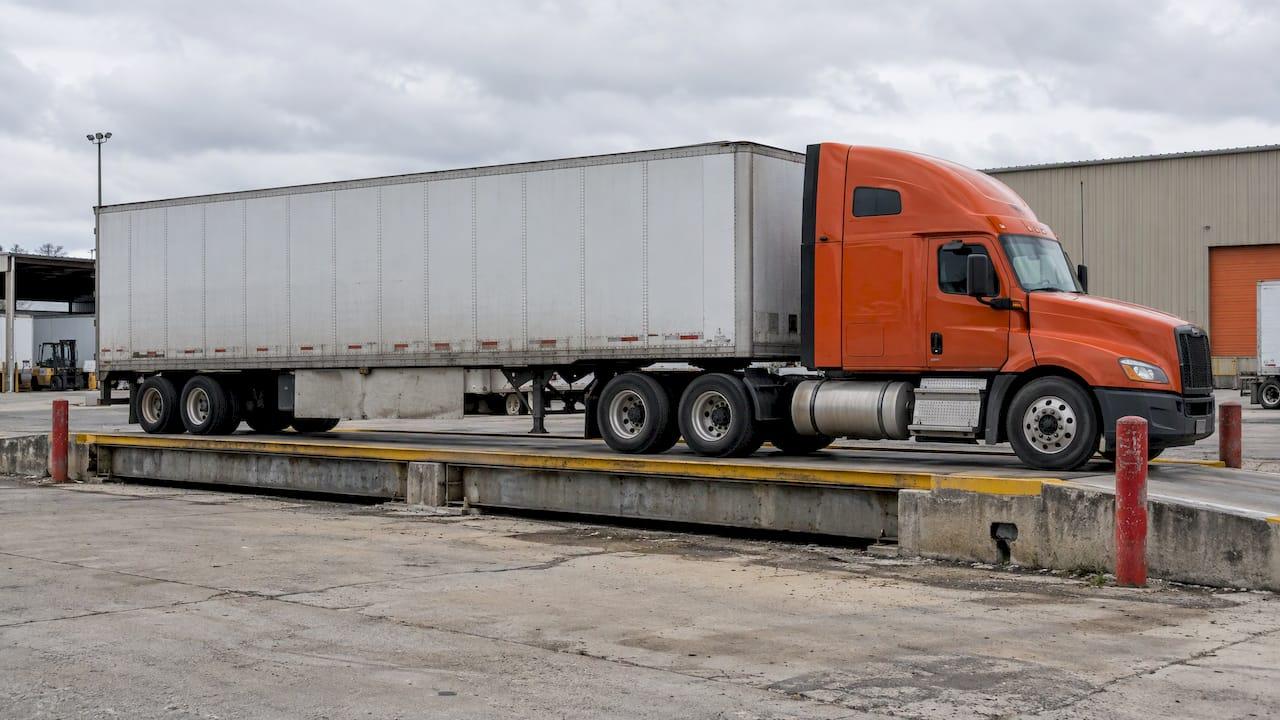
GVWR is the most a single vehicle may weigh when loaded. GCWR is the most a vehicle and its attached trailer may weigh together. Federal rules define GVWR as the manufacturer-specified loaded weight of a single vehicle and GCWR as the manufacturer-specified loaded weight of a combination vehicle, per 49 CFR Part 571. GAWR is a third rating that limits each axle. All three apply at once, and the lowest limit you reach is the one that governs.
This guide is written for buyers and sellers of trucks, trailers and heavy equipment, where these numbers show up on every spec sheet and decide what a unit can legally and safely haul.
TL;DR
- GVWR: the maximum loaded weight of one vehicle, including occupants, fuel, cargo and the tongue weight of a trailer.
- GCWR: the maximum loaded weight of the vehicle plus the trailer, with passengers, cargo and fluids in both.
- GAWR: the maximum load for one axle system. The GAWRs of a vehicle must add up to at least its GVWR.
- Licensing: a Class A CDL applies when GCWR is 26,001 pounds or more and the towed unit's GVWR is 10,001 pounds or more.
- Buying or selling: read the certification label, not just the listing headline, before you compare units.
Table of Contents
- GVWR vs GCWR at a glance
- What GVWR means
- What GCWR means
- What GAWR adds, and why GVWR vs GAWR matters
- How the three ratings work together
- Where to find each rating
- Why the ratings decide your CDL class
- Ratings are not the only weight limit on the road
- Measure, do not guess
- Using the ratings when you buy or sell equipment
- Perspective
- Find trucks and trailers with the ratings you need
- FAQ
- Sources
GVWR vs GCWR at a glance
| Rating | Full name | What it covers | Who sets it |
|---|---|---|---|
| GVWR | Gross vehicle weight rating | One vehicle, fully loaded | Manufacturer |
| GCWR | Gross combination weight rating | Vehicle plus trailer, both fully loaded | Manufacturer (with a federal exception below) |
| GAWR | Gross axle weight rating | One axle system | Manufacturer |
| GVW, GCW | Gross vehicle weight, gross combination weight | What the vehicle or combination actually weighs on a scale | Measured |
The first three are ceilings printed by the maker. The last pair are real measurements. Keeping those two groups apart is the single most useful habit in this topic. A rating tells you the limit. A scale tells you where you stand against it.
What GVWR means
GVWR is the maximum allowable weight of the fully loaded vehicle. That includes the vehicle itself, passengers, modifications, fuel, fluids and cargo, and weight pressing on the hitch also counts, according to Winnebago's guide to weight ratings.
It does not include the weight of a trailer being pulled. Trailer tongue weight, the downward force on the hitch, does count against the vehicle's GVWR, as MotorTrend explains. This is why a pickup can have a generous tow rating and still run out of payload quickly.
Who assigns it, and can it change
The manufacturer assigns GVWR during certification. NHTSA says the purpose is to tell owners how heavily the vehicle may safely be loaded. The figure is fixed before first sale except to correct an error, though a company that alters the vehicle before sale may label a modified GVWR (NHTSA interpretation). NHTSA also expects the rating to reflect a good-faith evaluation of the vehicle's size, weight, load-carrying capacity and intended use, and it is concerned about the safety effect of a rating set too low (NHTSA letter).
For a buyer, that means GVWR is not negotiable. A bigger tire or a stiffer spring does not raise it. If a listing quotes a GVWR that differs from the label, the label governs.
What GCWR means
GCWR is the ceiling for the whole rig: the loaded tow vehicle and the loaded trailer, including passengers, cargo, fuel and fluids in both units (Winnebago). Virginia's Department of Wildlife Resources describes it as the most weight a truck can safely get moving and stop with a trailer behind it (Virginia DWR).
Two points trip people up.
- GCWR is not trailer weight. Trailer weight is one component of the total. The other components are the truck's own weight, its occupants and everything in the bed or box (MotorTrend).
- Brakes are rated for GVWR, not GCWR. Winnebago notes that a tow vehicle's brake system is rated for operation at GVWR, and it recommends separate functional braking for towed vehicles or loaded trailers over 1,500 pounds (Winnebago). The trailer has to do part of the stopping.
The federal definition for commercial vehicles
For regulated commercial operations, the definition is slightly different. Under 49 CFR 390.5 and 383.5, GCWR is the greater of two values: the figure the power unit's manufacturer displays on the FMVSS certification label, or the sum of the GVWRs or GVWs of the power unit and the towed units that produces the highest total. The power unit's GCWR is not used to define a commercial motor vehicle when it is not towing anything (Federal Register, 2014).

In practice, a tractor sitting alone is judged on its GVWR. Once it hooks to a trailer, the combination figures apply.
What GAWR adds, and why GVWR vs GAWR matters
GVWR looks at the vehicle as a whole. GAWR looks at one axle system. NHTSA defines GAWR as the manufacturer-specified load-carrying capacity of a single axle system, measured at the tire-ground interfaces. The sum of a vehicle's GAWRs must at least equal its GVWR and may exceed it (NHTSA interpretation).
That last clause matters. Because the axle ratings can add up to more than GVWR, you cannot load every axle to its limit and assume the total is fine. The reverse also holds: a total under GVWR can still overload one axle if the cargo sits too far back or too far forward.
NHTSA says manufacturers should set ratings that reflect load-bearing ability and suspension, and that the GAWR also takes account of the axle's braking ability (NHTSA).
Tires can be the limiting part
On a motor vehicle other than a passenger car, the combined maximum load ratings of the tires on an axle must be at least equal to that axle's GAWR. NHTSA states that changing inflation pressure, speed or trip distance does not make up for an inadequate tire rating (NHTSA interpretation). When you inspect a used truck or trailer, check the tire load ratings against the axle ratings, not only the tread.
How the three ratings work together
The practical rule is to check every limit and obey the lowest.
- Vehicle total against GVWR. Add occupants, fuel, cargo, accessories and trailer tongue weight.
- Each axle against its GAWR. Weigh each axle group, not just the whole vehicle.
- Combined weight against GCWR. Add the loaded trailer to the loaded truck.
- Trailer against the stated tow rating. Subtracting GVWR from GCWR sometimes lands a little above or below the manufacturer's advertised maximum tow rating. Observe whichever is lower (MotorTrend).
A worked example
Take a hypothetical truck with a 10,000-pound GVWR and a 24,000-pound GCWR. These figures are illustrative, not from any specific model.
- Subtracting GVWR from GCWR gives 14,000 pounds, a rough ceiling for the trailer.
- Suppose the truck weighs 7,200 pounds with fuel and the driver. That leaves 2,800 pounds for cargo, passengers and tongue weight.
- A trailer with 1,400 pounds of tongue weight uses half of that payload before anything is loaded in the bed.
- Add 1,600 pounds of tools and a passenger, and the truck is at its GVWR even though the combination may still be well under its GCWR.
The lesson: with a heavy trailer, GVWR often runs out first. Virginia DWR makes the same point from the other side: if the truck is maxed out on towing capacity with a heavily loaded trailer, there is no room left in the equation for passengers or gear in the truck (Virginia DWR). Its own quick method, curb weight plus towing capacity plus an assumed 180-pound driver, is explicitly not always exact. Scale weights are better.
Where to find each rating
On a new vehicle, the certification label states GVWR and each GAWR in front-to-rear order under 49 CFR Part 567 (NHTSA interpretation). The label is affixed next to the driver's seating position or, where that is impracticable, at specified alternate locations. The stated GVWR cannot be less than the unloaded vehicle weight plus the rated cargo load plus 150 pounds per designated seating position, with different figures for school-bus passengers (49 CFR 567.4).
On heavy trucks, one number is often not enough. Freightliner's Cascadia driver's manual shows that operators may need both the federal certification label and a separate component weight-rating label (Freightliner manual). GCWR for a tractor may also sit in the manufacturer's spec data rather than on the door-jamb sticker.
When you list or shop a used unit, photograph or request the label. Our guide to what a truck spec sheet means for buyers walks through the other numbers that sit beside these ratings.

Why the ratings decide your CDL class
These figures are not only about safety. They set licensing thresholds.
- Class A CDL: required when the GCWR of a combination is 26,001 pounds or more and the towed unit's GVWR is 10,001 pounds or more (Arizona DOT, citing federal CDL standards).
- Class B CDL: required for a single vehicle with a GVWR of 26,001 pounds or more, which may tow a trailer of 10,000 pounds GVWR or less (Arizona DOT).
For interstate commerce, 49 CFR 390.5 treats a vehicle as a commercial motor vehicle on weight when its GVWR or GCWR, or its actual GVW or GCW, is 10,001 pounds or more, whichever is greater (J.J. Keller summary of 49 CFR 390.5). A pickup and a heavy gooseneck trailer can cross that line even though neither is a "truck" in everyday speech.
State CDL rules and endorsements vary, so confirm requirements with your state licensing agency before you buy a rig that sits near a threshold.
Ratings are not the only weight limit on the road
A vehicle can be within its ratings and still be over a legal limit. The Rhode Island DOT explains that bridge-formula, axle, road and posted-bridge limits can restrict a vehicle separately, and that a permit does not override the vehicle's GVWR or GAWR (Rhode Island DOT). Rhode Island is one state's explanation, and other states publish their own rules, but the principle is the same: the manufacturer's rating is a ceiling that no permit lifts.
Site access matters for heavy combinations too. Turning geometry at a yard or dock is a separate constraint from weight, and this overview of industrial truck turning radius covers it.
Ratings also shape how equipment is tested. The federal air-brake standard, 49 CFR 571.121, tests applicable vehicles loaded to GVWR with axle loads distributed in proportion to GAWR and without exceeding any axle's GAWR (eCFR). The ratings are built into how the vehicle is designed to stop.
Measure, do not guess
A rating is a limit. To know whether you are within it, you need actual weights from a scale: gross vehicle weight, each axle weight and combined weight, compared with the matching ratings (RV.com). Follow this routine:
- Load the truck and trailer as you will really run them, with fuel, driver, passengers and gear.
- Weigh the truck alone, then the combination, then each axle group if the scale allows.
- Compare each figure with GVWR, each GAWR and GCWR.
- Subtract to find tongue weight and trailer weight, and check both against the hitch and tow ratings.
- Redistribute the load or step up to a higher-rated unit if any figure is over.
Using the ratings when you buy or sell equipment
For dealers and private sellers, these ratings are part of the product description. A buyer comparing two tractors or two dump trucks wants to know which one fits the loads and trailers they run. A listing that states GVWR, GAWR and GCWR, with a clear photo of the label, answers the question before the buyer calls.
For buyers, match the rating to the work, not to the price. A vocational unit built for heavy local hauling has a different weight profile than a highway tractor; see our overview of vocational truck types. Oversize loads add their own demands, which our guide to examples of heavy haul trucks covers. If you move equipment such as lift trucks, check the machine's own weight first with our forklift weight guide, since it feeds directly into trailer loading.
Perspective
Every week the same mismatch shows up in equipment listings: a headline price and a model name, and no weight ratings. Buyers of trucks and trailers shop for work, and work is measured in pounds on the axle.
Our platform is designed for industry professionals, with a classified environment for commercial and industrial equipment and dealer registration for sellers. We think a listing earns trust when it carries the numbers a buyer needs: GVWR, GAWR, GCWR and a clear view of the certification label. Buyers can filter by category, subcategory, price and country, so a buyer shopping for a tractor, a trailer or a dump truck can compare units on a common footing.
If you sell, put the ratings in the first lines of the description. If you buy, read them first.
Dave
Find trucks and trailers with the ratings you need
Sostruckforsale is an online marketplace for commercial vehicles and industrial heavy equipment: semi trucks, trailers, excavators, cranes, material handling machinery, construction, forestry, grounds care and agricultural equipment, and parts. Dealers and private sellers post classified ads, and the business dealer directory lets buyers find sellers directly. Browse trucks, trailers and the other equipment categories and compare each unit's listed ratings against your loads.
Dealers who register can post multiple units across categories, which suits fleets turning over mixed inventory.
FAQ
What is the difference between GVWR and GCWR?
GVWR is the maximum loaded weight of one vehicle. GCWR is the maximum loaded weight of the vehicle plus its attached trailer. Trailer tongue weight counts against GVWR, while the trailer's full weight counts toward GCWR.
What is the difference between GVWR and GAWR?
GVWR limits the whole vehicle, while GAWR limits a single axle system. A vehicle's GAWRs must add up to at least its GVWR and may exceed it, so you have to respect both the total and each axle (NHTSA).
How do I calculate how much I can tow from GVWR and GCWR?
Subtract the vehicle's loaded weight from GCWR for a first estimate of trailer weight. Subtracting GVWR from GCWR is a common shortcut, but the result can differ slightly from the advertised tow rating, and the lower figure applies (MotorTrend). Then confirm with scale weights.
Does a 7,000-pound GVWR limit how much I can tow?
Not directly. GVWR limits the vehicle's own loaded weight, including tongue weight, while trailer capacity comes from GCWR and the maker's tow rating. A 7,000-pound GVWR does limit how much payload remains once the tongue weight is added.
Where do I find GCWR on my truck?
Start with the certification label near the driver's seat for GVWR and GAWR, then the owner's manual or manufacturer spec data for GCWR. On heavy trucks, there may also be a separate component weight-rating label.
Sources
- eCFR: 49 CFR Part 571, Federal Motor Vehicle Safety Standards
- MotorTrend: GVWR vs. GCWR
- NHTSA interpretation nht74-3.36
- NHTSA interpretation nht95-1.66
- NHTSA interpretation 9064
- NHTSA interpretation nht95-2.25
- Virginia DWR: Do the Math on Towing Capacity
- Federal Register, March 19, 2014
- Winnebago: Introduction to RV Weight Ratings
- 49 CFR 567.4
- Freightliner New Cascadia Driver's Manual
- Arizona DOT: Which type of CDL do I need?
- J.J. Keller: Commercial motor vehicle definition
- Rhode Island DOT: Vehicle, Legal, Permit, and Bridge Weight Limits
- eCFR: 49 CFR 571.121
- RV.com: Defining GVWR, GCWR, and Other RV Weight Ratings