

New Class 8 trucks run roughly $130,000 to $300,000-plus in 2026, while most practical used owner-operator buys land between $60,000 and $170,000. The single best way to price a specific truck is triangulation: cross-check a valuation guide's baseline against live listing comps and recent auction results, then adjust for spec and condition. Total cost of ownership and a professional pre-purchase inspection often flip the decision entirely.
TL;DR:
- Used trucks with high mileage and incomplete service records typically range from $25,000 to $60,000, while late-model, low-mileage sleepers can command over $140,000.
- Valuing a truck accurately requires layering valuation guides, live comps, and auction results, then adjusting for spec, condition, and remaining warranty.
- Factors such as engine longevity, emissions repair history, and full maintenance records significantly influence resale value and depreciation rate.
- Electric trucks cost more upfront, often $150,000 to $380,000, but their lower energy costs make route compatibility crucial for real savings.
- Insurance premiums vary widely based on driver experience, cargo type, and truck age, and must be factored into total ownership costs before purchase.
Table of Contents
- Semi Truck Pricing Guide: 2026 Price Ranges by Class and Configuration
- How Do You Actually Value a Specific Semi Truck?
- What Drives a Semi Truck's Price Up or Down?
- What Does a Semi Truck Actually Cost Per Mile?
- What Will My Monthly Truck Payment Actually Be?
- New or Used: Which One Actually Fits Your Operation?
- What Should a Pre-Purchase Inspection Actually Cover?
- Where Should You Look for Accurate Market Comps?
- Why This Pricing Guide Reflects Real Market Behavior
- Insurance Cost Factors Related to Semi Trucks
- How Do Regional Markets Affect Semi Truck Prices?
- How Fast Do Semi Trucks Depreciate, and What Holds Resale Value?
- How Does Fuel Efficiency Change What You Should Pay?
- An Owner-Operator's Three-Step Action Plan
- Find and Compare Semi Truck Listings on Sostruckforsale
- Sources
Semi Truck Pricing Guide: 2026 Price Ranges by Class and Configuration
Sticker prices vary enormously by class, sleeper configuration, and powertrain, which is exactly why a single number rarely tells you anything useful. A light-duty box truck and a Class 8 sleeper tractor aren't competing in the same market, and lumping them together is how buyers end up comparing apples to axles.
New diesel Class 8 day cabs and sleepers typically list between $130,000 and $300,000 or more, with spec, brand, and sleeper size driving most of that spread. Used trucks bought for actual work, not parts, most often fall in the $60,000 to $170,000 range, and budget units with high mileage or older emissions systems can be found for $25,000 to $60,000. Electric Class 8 trucks sit in a wider band, often $150,000 to $380,000 depending on battery capacity and range, before any purchase incentives. Charging infrastructure access matters as much as the sticker price here. A truck priced for a 250-mile depot route isn't comparable to one spec'd for long-haul, regardless of what the window sticker says.
| Segment | Configuration | Typical 2026 Price Range |
|---|---|---|
| Light/medium duty | Box truck, day cab | $25,000–$60,000 |
| Class 8, used | Day cab | $45,000–$95,000 |
| Class 8, used | Sleeper | $60,000–$170,000 |
| Class 8, new diesel | Day cab or sleeper | $130,000–$300,000+ |
| Class 8, electric | Sleeper or day cab | $150,000–$380,000 |
Three reference points help calibrate expectations fast. An entry-level used sleeper with 500,000-plus miles and a thin service history might sit near $45,000. A mid-market truck, three to five years old with 300,000 to 450,000 miles and clean records, often lands closer to $95,000. A premium late-model used sleeper under 150,000 miles, still under factory warranty, can command $140,000 or more. Our own budget pricing breakdown walks through similar bands with more granular examples across trailer types.
How Do You Actually Value a Specific Semi Truck?
A price range tells you the market. It doesn't tell you what the truck in front of you is worth. That requires a process, not a guess.
- Define the value type you need. Retail value, trade-in value, auction value, and actual cash value (ACV) for insurance purposes are four different numbers, sometimes 20% to 30% apart on the same truck. Know which one you're solving for before you start pulling data.
- Pull the VIN and build sheet. Engine model and horsepower rating, transmission type, axle configuration, sleeper size, and factory options all move value independently of mileage. Two trucks with identical odometers can be worth $15,000 apart based on spec alone.
- Start with a valuation guide as your baseline. Truck-focused book values give you a starting anchor, similar to how Kelley Blue Book works for passenger vehicles, but commercial truck guides carry more variance because fleet specs differ so widely.
- Layer in live listing comps. Search active inventory for the same year, make, model, and mileage band. Note how long comparable trucks have sat unsold. That tells you whether the asking prices you're seeing are realistic or aspirational.
- Pull recent auction results for the same spec. Auction data anchors what buyers actually paid, not what a seller hoped for, and it's often the most honest number in the whole exercise.
- Weight and adjust. Treat the guide value as your floor, comps as your ceiling, and auction results as your reality check. Then adjust for mileage, condition, emissions history, and remaining warranty coverage.
This is the triangulation method that experienced buyers and appraisers rely on, because a guide alone tends to understate local market swings, and auction data alone can undersell a truck with unusually clean records.
What Drives a Semi Truck's Price Up or Down?
Mileage is the first thing buyers look at, but it isn't the biggest lever on price. A truck with 400,000 to 600,000 miles and immaculate records can outprice a lower-mileage truck with gaps in its service log. Still, mileage bands matter as a rough guide: under 300,000 miles preserves the most resale value, 300,000 to 500,000 is the working-truck sweet spot where price drops fastest, and above 600,000 miles value depends almost entirely on engine condition and remaining component life.
- Engine and transmission spec changes both fuel economy and resale demand. Certain engine families hold value better because parts and technicians are easier to find.
- Emissions and aftertreatment history matters more than most buyers realize. A DPF, DEF, or SCR failure can run into the tens of thousands and erase the savings of a cheaper purchase price within the first year.
- Remaining factory or extended warranty coverage can justify a price premium that pays for itself if a major component fails early.
- Upfits like reefer units, liftgates, or custom fifth wheels add value only if they match the buyer's use case. A specialized upfit for the wrong application is often a cost to remove, not a bonus.
- Title and lien status need verification before anything else. A branded or salvage title can cut value by 20% to 40% regardless of how the truck runs.
Pro Tip: Always ask for the emissions system's repair history separately from the general service log. Sellers sometimes bundle a recent DPF replacement into "routine maintenance," which hides a red flag that should lower your offer.
What Does a Semi Truck Actually Cost Per Mile?
Purchase price is only the entry fee. The number that determines whether a truck makes money is cost per mile (CPM), which folds in everything from fuel to insurance to the loan payment itself.
CPM has two buckets: fixed costs (truck payment, insurance, permits, licensing) that accrue whether the truck moves or sits, and variable costs (fuel, maintenance, tires, tolls) that scale with miles driven. ATRI reports the industry's average total operational cost per mile was $2.336 in 2025, a figure built from real carrier data across fuel, driver wages, repair, and financing line items.
- Fuel typically remains the single largest variable cost for owner-operators, often outweighing insurance and maintenance combined.
- Truck procurement or lease payments alone commonly run $0.294 to $0.324 per mile depending on region and financing terms.
- Insurance for new authority holders can add $16,000 to $20,000 annually, which spreads to a meaningful per-mile figure at typical annual mileage.
A worked example makes this concrete: a used truck at $85,000 financed over five years carries a lower fixed CPM than a new $220,000 truck financed the same way, but the new truck may win on lower fuel and maintenance costs. Run both scenarios against your actual expected annual mileage before assuming either purchase price is the better deal. Our commercial truck insurance guide breaks down how premium variables shift this math further.
What Will My Monthly Truck Payment Actually Be?
Monthly payment depends far more on credit profile and down payment than on sticker price alone, which is why two buyers looking at the same truck can walk away with payments $1,000 apart.
- Used truck payments commonly range $1,500 to $3,200 per month, depending on age, term length, and down payment.
- New truck payments commonly run $2,800 to $4,200 or more per month under standard five to seven year terms.
- A larger down payment (typically 10% to 20%) meaningfully lowers both the monthly figure and total interest paid over the loan term.
- Shorter loan terms raise the monthly payment but cut total interest paid, which matters most for owner-operators trying to build equity fast.
- Lenders routinely require proof of adequate insurance coverage before disbursing funds, and new authority holders often face higher premium requirements that affect approval and cash flow.
Leasing deserves a serious look for buyers prioritizing predictable monthly cash flow over long-term ownership, especially in the first year or two of operation. Our leasing versus buying guide breaks down when the trade-off tips toward renting instead of financing a purchase outright.
New or Used: Which One Actually Fits Your Operation?
The new-versus-used decision comes down to uptime tolerance and cash flow, not brand preference or gut feel.
- New makes sense when warranty coverage protects against costly early failures, when a fleet needs uniform specs across multiple units, and when predictable dedicated lanes justify the higher fixed cost.
- Used makes sense as a cash-flow play for owner-operators starting out, provided the buyer builds in a maintenance reserve and insists on a professional pre-purchase inspection before closing.
- Electric trucks currently work best on shorter, predictable routes with confirmed charging access. Route mismatch with charging infrastructure is the most common reason electric truck purchases underperform expectations.
A used truck bought without inspection safeguards can turn a good deal into a liability fast, which is exactly why the next section matters as much as the price itself.
What Should a Pre-Purchase Inspection Actually Cover?
A professional pre-purchase inspection (PPI) is the cheapest insurance you'll buy against a bad deal, and skipping it is how buyers end up with $15,000 to $20,000 in unexpected repairs in the first year of ownership.
- Engine and transmission compression, leaks, and shifting performance under load.
- Exhaust aftertreatment system (DPF, DEF, SCR) fault codes and recent service history.
- Frame, suspension, and brakes for cracks, corrosion, and wear beyond normal tolerances.
- HVAC and electrical systems, often overlooked but expensive to repair on the road.
- Documentation review: complete service records, clean title, and odometer consistency across all paperwork.
Pro Tip: Budget a maintenance escrow of roughly $0.10 to $0.15 per mile for the first year of a used truck purchase. That reserve is what stands between a mechanical surprise and a missed loan payment. Our inspection checklist guide and first-time buyer's guide both go deeper on what a qualified inspector should flag.
Where Should You Look for Accurate Market Comps?
Asking price and sold price are rarely the same number, and the gap tells you more about market conditions than either figure alone.
- Treat asking prices on classified listings as a starting point, not a ceiling. Track how long similar trucks sit before selling.
- Auction results reflect what buyers actually paid, which makes them the most reliable anchor for real market value.
- Cross-reference dealer inventory alongside private listings and auction data to catch regional pricing gaps between markets.
- Watch build-slot lead times on new trucks and fleet refresh cycles; both create seasonal windows where used inventory floods the market and prices soften.
Our auction guide explains how to read sold-price data without getting misled by outlier results.
Why This Pricing Guide Reflects Real Market Behavior
This guide draws on ATRI's operational cost benchmarking, published market pricing summaries, and practitioner valuation methodology rather than a single dealer's asking prices. Dave, who covers commercial heavy equipment markets for Sostruckforsale, built this framework around the same triangulation approach appraisers and fleet buyers actually use. Websites with listing filters let readers pull live comps by class, price, and location directly, which is the second leg of the triangulation method described above. Pairing that with a dealer directory gives buyers and sellers a faster way to sanity-check a number before committing to it.
Insurance Cost Factors Related to Semi Trucks
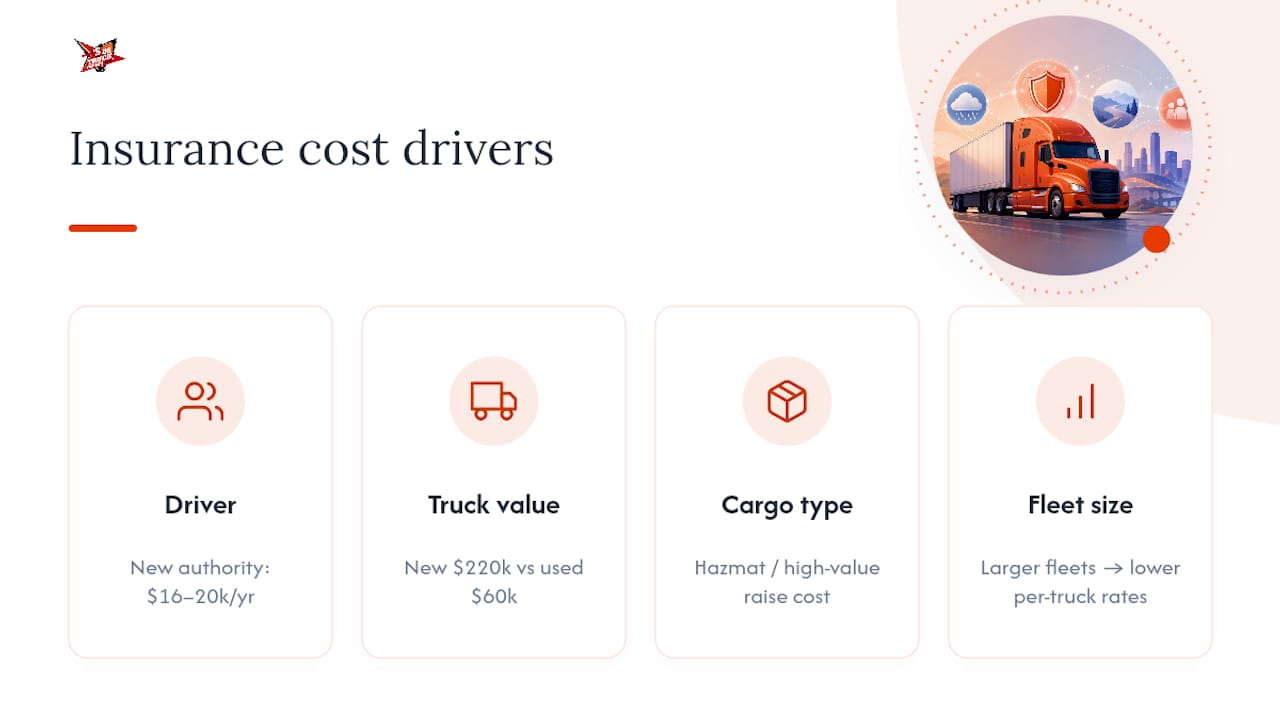
Insurance premiums swing more than most buyers expect, and the purchase price itself is only one input among several. Driver experience and safety record weigh heavily. New authority holders without an established track record commonly face $16,000 to $20,000 annually in premiums, well above what an established carrier with a clean record pays for a similar truck.
Cargo type matters too. Hauling hazardous materials or high-value freight raises premiums regardless of the truck's age or condition. Radius of operation plays a role as well: long-haul operations generally see higher rates than regional or local routes, simply because more miles mean more exposure.
The truck's value and age factor directly into physical damage coverage costs. A new $220,000 sleeper costs more to insure for physical damage than a $60,000 used day cab, even with identical driving records, because the insurer's payout exposure is higher. Lenders financing a truck purchase typically require proof of adequate coverage before disbursing funds, which means insurance costs need to be locked in during the financing conversation, not after.
Fleet size can work in a buyer's favor. Multi-truck operations often qualify for lower per-unit rates than single-truck owner-operators, since insurers spread risk across a larger, more predictable pool. Building an accurate insurance estimate into your total cost of ownership calculation before you buy prevents a nasty surprise once the policy quote actually arrives. Our commercial truck insurance guide covers the specific cost drivers in more depth.
How Do Regional Markets Affect Semi Truck Prices?
Truck prices aren't uniform across the country, and the gap between regions can run into thousands of dollars for an otherwise identical spec. Freight-dense corridors with heavy fleet turnover tend to have deeper used inventory, which usually keeps prices more competitive simply through supply.
Fuel-tax variation between states changes the real cost of operating a truck long after purchase, which shifts buyer demand toward certain specs in certain regions. A truck spec'd efficiently for a state with higher fuel costs commands a premium there that it wouldn't in a lower-cost market.
Climate matters more than buyers expect. Trucks that spent their working life in road-salt states often show frame and undercarriage corrosion that dents resale value, even with a clean mechanical history. Buyers shopping regionally should factor climate history into their inspection priorities, not just mileage.

Local demand cycles tied to major industries, agriculture, construction, energy extraction, also move prices seasonally and regionally. A market flooded with construction-fleet turnover in one quarter can soften used prices there while a neighboring state's inventory stays tight. Pulling comps from more than one region, rather than only your local market, gives a more accurate read on whether a specific asking price is fair or inflated.
How Fast Do Semi Trucks Depreciate, and What Holds Resale Value?
Depreciation on a new Class 8 truck is steepest in the first three years, typically the period where the biggest dollar-value drop happens, before the curve flattens as the truck settles into its working-life mileage range. After that, resale value tracks mileage, maintenance history, and spec desirability more than age alone.
Engine families with strong reputations for longevity and parts availability tend to hold value noticeably better than less common configurations, because buyers and technicians both prefer familiar systems. A sleeper with a widely serviceable engine and transmission combination will usually outsell a mechanically sound truck with an obscure spec, even at a lower asking price.
Clean, complete maintenance records measurably slow depreciation. A truck with full documentation can command a meaningful premium over an otherwise identical unit with gaps in its service history, because buyers are pricing in the risk of the unknown, not just the visible condition.
Tax treatment also shapes how owners think about depreciation timing. IRS Publication 946 governs how commercial vehicle depreciation gets treated for tax purposes, which affects when owners choose to sell or trade in a truck relative to its book value. Buyers should factor this into resale timing decisions, since selling a truck right before or after a major depreciation threshold can change the net financial outcome substantially.
How Does Fuel Efficiency Change What You Should Pay?
Fuel efficiency isn't a nice-to-have line item. It's often the difference between a truck that's a bargain and one that's overpriced at any number, because fuel remains the largest variable cost most owner-operators carry.
A truck with a more efficient engine and aerodynamic package can justify a higher purchase price if the fuel savings pencil out over your expected annual mileage. Run the math before assuming the cheaper truck is the better deal: a 1 to 2 mile-per-gallon difference compounds fast at 100,000-plus miles a year.
Alternative fuel options complicate the pricing picture further. Electric trucks carry a higher upfront cost, often $150,000 to $380,000, but lower per-mile energy costs on routes where charging infrastructure supports the operation. That math only works on the right route profile. Natural gas and other alternative fuel trucks occupy a smaller, more specialized market, where pricing depends heavily on regional fuel infrastructure and available incentives.
Buyers evaluating alternative fuel options should treat the purchase price as only half the equation. The other half is whether your actual routes and fueling access make the efficiency gains realistic rather than theoretical.
An Owner-Operator's Three-Step Action Plan
Start by benchmarking the price bands above against your specific spec, then schedule a PPI and get financing pre-arranged before you make an offer, not after. Build a maintenance escrow using the $0.10 to $0.15 per mile guideline and run your own CPM numbers before bidding on anything. When you negotiate, bring evidence, not opinions: comps, auction results, and a documented inspection report carry more weight than any asking price a seller quotes you.
— Dave
Find and Compare Semi Truck Listings on Sostruckforsale
Listing websites give buyers what a single dealer lot never can: filtered listings across price, class, and location in one place, so triangulating a fair price takes minutes instead of days of scattered phone calls. Users can filter by truck class, price range, and country, browse dealer directories to see active sellers in regions, and save searches to track how asking prices move over time on trucks of interest.
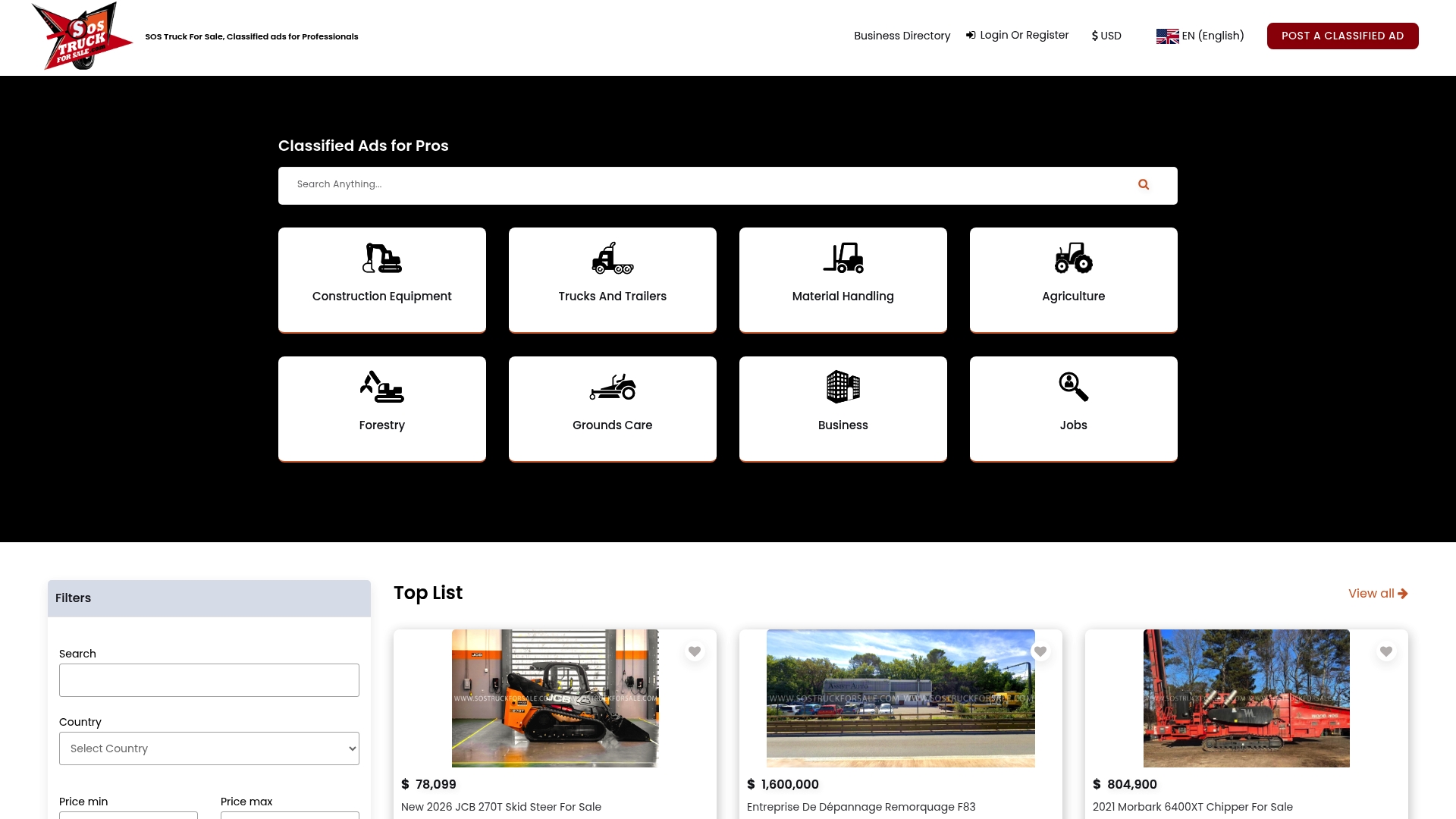
That live comp data is exactly the second input the valuation method in this guide calls for, right alongside a valuation guide baseline and recent auction results. Pair Sostruckforsale's listing filters with a bid-and-estimating workflow like ArosBid's if you're also managing job-cost estimates alongside equipment purchases. Start by browsing current inventory on Sostruckforsale and set up a saved search for your target spec so new listings and price shifts land in front of you the moment they hit the market.
Sources
- Analysis of the Operational Costs of Trucking: 2026 update (ATRI)
- How Much Does a Commercial Truck Cost in 2026? New vs Used (Logrock)
- Owner-Operator Expenses: Essential Expenses to Consider (Truckstop)
- IRS Publication 946 (How to Depreciate Property)