

Cross posting an equipment listing means publishing the same machine on more than one marketplace so more qualified buyers see it. It pays only if every copy stays accurate. The method that works is simple: build one master record per unit, publish from it, and treat every channel as a copy of that record. Start with the channel built for commercial and industrial equipment, then add others from the same record. Sostruckforsale is built for that role: a classified marketplace for trucks, trailers, excavators, cranes and other heavy equipment, where dealers register and list by category, subcategory, price and country.
This guide covers the routine for dealers: what goes in the master record, how to adapt it per channel, how many photos to shoot, when a 360 view is worth the time, and how to pull a unit down everywhere the day it sells.
TL;DR
- Keep one master record per machine (specs, hours, serial number, price, photos). Every listing is a copy of it, never a fresh write-up.
- Fix the identity fields (make, model, year, hours, serial) across all channels and adapt only the title, the description order and the photo order.
- Shoot a 12 to 20 photo set once, including close-ups of wear and the serial plate, and crop it per channel.
- Mark a unit sold or on hold in your master record first, then withdraw it everywhere the same day.
- Use a dedicated heavy equipment marketplace as your first channel, with a dealer profile that carries your inventory.
Table of Contents
- Why cross posting goes wrong
- Build a master record first
- Decide which fields never change
- Photos: how many, and which ones
- 360 photos: when they are worth it
- Adapting per channel: a short check
- Keeping every copy current
- Why a dedicated marketplace should be channel one
- Pricing the same unit everywhere
- Perspective
- List your next unit with us
- FAQ
- Sources
Why cross posting goes wrong
A used excavator or semi tractor is a one-off asset. Unlike a pallet of new parts, you have exactly one. That changes the risk of cross posting. Three problems show up again and again:
- Double selling. A buyer commits on one channel while the same unit is still live on three others, and you answer inquiries on a machine that is gone.
- Price drift. You cut the price on one site, forget the others, and now buyers quote you the lower number or the higher one depending on where they found you.
- Photo and spec mismatch. Hours are updated in one place, an attachment is sold off the unit, and an older photo set keeps circulating.
Every one of these is a data problem, not a marketing problem. They come from typing the same machine into several forms by hand. The fix is to type it once.
Build a master record first
Before you post anywhere, create one record per unit in a spreadsheet, a dealer management system or whatever you use for inventory. It should hold:
- Identity: category, make, model, year, serial number or VIN, stock number.
- Condition: hours or miles, last service date, known defects, what is included (bucket, thumb, sleeper, liftgate).
- Commercial terms: asking price, whether it is negotiable, location, availability and any hold status.
- Media: the full photo set, video link, any walkaround or 360 files, each named by stock number and view.
- Change log: date, field changed, reason, who changed it.
The change log is the part dealers skip. When a buyer says "your other listing said 4,200 hours," the log tells you whether the error came from the master record or from a hand edit on one channel. If you want a ready-made layout, our equipment listing template with an 8 photo checklist gives you the fields and the shot list in one copy-paste block.
If you carry a large stock, a structured inventory file makes this easier to maintain. Our guide to inventory feed setup for heavy equipment dealers walks through field mapping and checklists, which is the same discipline whether you post by hand or from a file.
Decide which fields never change
Cross posting works when you separate what is fixed from what is adapted.
Fixed on every channel:
- Make, model, year
- Serial number
- Hours or miles, with the date you read them
- Condition statements and disclosed defects
- Price and currency
- Location
Adapted per channel:
- Title length and word order
- Which two or three facts open the description
- Photo order and crop
- Category and subcategory choice
- Contact method and call to action
The rule is blunt: if a buyer could sue over it, it is fixed. If it only changes how a listing reads on a small screen, it is adapted. Structured fields matter because buyers filter by them. A listing without hours, year or category simply never appears when a buyer filters, so a missing attribute costs you a lead you never knew about. Online directories in other industries are moving the same way, toward richer online listings built on complete data rather than loose text.
Titles
A workable title pattern is year, make, model, key spec, then location or condition. A marketplace that truncates at a set length will cut the end, so put the words buyers search first. We cover patterns and examples in our equipment listing title templates.
Descriptions
Keep facts and sales copy apart. "Cummins ISX15, 485 hp, 10-speed, 612,000 miles" is a fact you can document. "Runs forever" is a promise you cannot. Put the facts in a short spec block that you paste unchanged on every channel, then add a few plain sentences of context above it, adjusted to the channel.
Categories
Marketplaces name categories differently. A mini excavator might sit under compact excavators on one site and under construction equipment on another. Map your categories once, write the mapping down, and reuse it. Our piece on six equipment listing categories you can copy and paste can serve as the starting list.

Photos: how many, and which ones
Photos decide whether a buyer calls. A 12 to 20 photo set is a common recommendation for heavy equipment, with separate close-ups of wear and identification plates, according to one equipment listing guide. In practice a complete set covers:
- Front, rear, left and right in daylight
- Two or more three-quarter angles
- Cab interior and the hour meter or odometer, reading visible
- Engine compartment
- Undercarriage, tires or tracks, showing wear
- Hydraulics and the work end (bucket edge, forks, fifth wheel, boom)
- Serial plate or VIN tag
- Any damage, leaks or repairs, photographed plainly
- Attachments and included accessories, each shot on its own
Shoot the full set once, at full resolution, and keep the originals in the master record. Then export per channel. Some sites want landscape crops, some cap file size, some show the first image as a small thumbnail. A strong first image should survive a small crop: the whole machine, daylight, clean background, no people in the frame.
Photograph defects. A buyer who sees a dented fender and a worn cutting edge in the photos arrives at a price conversation already informed. A buyer who finds them on the lot arrives angry. For the excavator case, see 15 to 20 photos and a one minute video to sell an excavator.

360 photos: when they are worth it
A 360 view is built from a series of photographs, typically 24 or 36, taken at set intervals as the subject rotates, then combined in a viewer so the user can spin the result, as a white paper on product images from the Electrical Distributors' Association explains. The same paper notes that this kind of imagery has been little used in construction-related sectors so far, which is the opening for a dealer who offers it.
A turntable works for a small attachment or a component. A machine that weighs 20 tons does not rotate, so for heavy equipment the practical version is a walk-around: you move around the unit instead of the unit moving. Two ways to keep it manageable:
- Walkaround video of about a minute. It travels to every channel as a link or an upload and needs no special viewer.
- 360 for your top units only. Reserve it for high-value machines where a distant buyer wants to see the whole unit before booking a trip.
Before you invest, check which channels accept a 360 embed or a video link. If a channel does not display it, the standard photo set still has to carry the sale on its own. That is the reason the 12 to 20 still photos come first and the 360 is an extra.
Adapting per channel: a short check
Before you publish a unit on a new site, run the same short check every time:
- Format limits: title length, description length, number and size of images, video allowed or not.
- Required fields: category, subcategory, year, hours, condition, location, price type.
- Prohibited content: phone numbers or links in descriptions, price in the title, watermarks. Rules differ by site and change, so read the current terms of each.
- Field mapping: for each field decide whether you copy it, adapt it, complete it separately, or leave it out.
- Contact path: make sure the phone number and email on the listing reach a person who knows the stock.
A one-time mapping table per channel saves hours. After that, publishing a unit is a paste job.
Keeping every copy current
The cost of cross posting is not in the first post, it is in the next ninety days. A simple routine holds up for most dealers:
- Daily: check inquiries across all channels in one inbox or one list. When a buyer commits on one, mark the unit On Hold in the master record before you do anything else.
- Same day as a sale: mark Sold in the master record, then withdraw the unit from every channel. Do not leave it live as a lead generator for similar stock; a stale listing wastes buyers' time and damages trust.
- Weekly: walk the lot against the master record. Hours, attachments and condition should match.
- Price changes: change the master record first, then every channel, and log it.
Software that pushes one record to many sites exists, and some tools remove the manual step. Whatever you use, the principle stays the same: the master record is the source, and a channel is never edited on its own.
Why a dedicated marketplace should be channel one
General classified sites send volume. A site built only for commercial and industrial equipment sends buyers who are already looking for a truck, a crane or a loader, and who filter by category, price and country. That is why we suggest listing the machine first on a marketplace like ours, where the category structure matches how equipment is bought, then copying outward.
A dealer profile adds to that. It gives buyers one page for your whole inventory and your contact details, and we describe how it works in our post on creating a dealer profile for equipment dealers. If you are comparing where to list, see how we frame the options in top alternatives for heavy equipment marketplaces.
Pricing the same unit everywhere
One price on every channel is the cleanest policy. If you need a different number for a channel, for example to cover a listing fee, state the reason in your log and make sure the buyer-facing difference is not a surprise. Price from comparable sales rather than from the highest asking price you can find. Our guide to heavy equipment pricing with auction comps shows how to set the number before it is copied ten times.
Perspective
Most dealers who struggle with cross posting do not have a marketing problem. They have a record-keeping problem. The same truck lives in a spreadsheet, a text thread and three web forms, and each one tells a slightly different story.
We built Sostruckforsale as a dedicated classified environment for industry professionals: trucks and trailers, construction equipment, material handling, agriculture, forestry and grounds care in one place, with dealer registration and listings filtered by category, subcategory, price and country. Our advice follows from that. Write the unit once, in full, with a complete photo set and honest condition notes. Post it where buyers shop for equipment by category. Then copy that same record outward.
A complete, accurate listing is the asset. Where it appears is the second question.
Dave
List your next unit with us
Sostruckforsale gives dealers and private sellers a place to post commercial and industrial equipment across construction equipment, trucks and trailers, material handling, agriculture, forestry and grounds care. Buyers browse by category, subcategory, price and country, and dealers can register to present their inventory together.
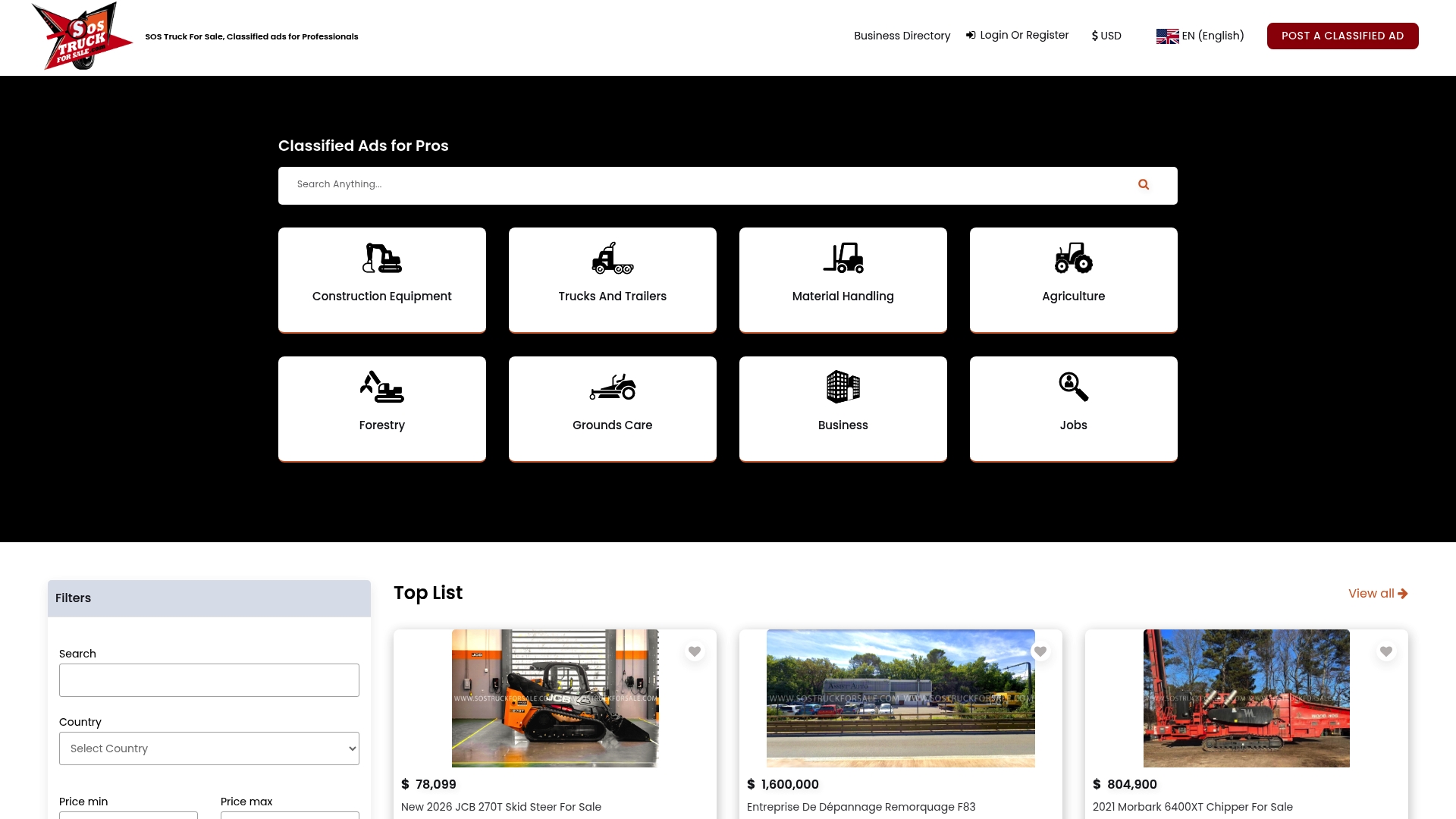
If your master record is ready, post your equipment on Sostruckforsale and use that listing as the reference copy for every other channel.
FAQ
Should I post the same photos on every marketplace?
Yes for the core set, since the machine does not change. Keep full-resolution originals and export per channel to meet size and crop limits. Adjust only the photo order, so the strongest exterior view leads each time.
How many photos does an equipment listing need?
Aim for 12 to 20 photos, covering all four sides, three-quarter angles, the cab and hour meter, engine, undercarriage or tires, work end, serial plate and any damage. Add attachments as separate shots. If a channel caps the count, keep the exterior views, the hour meter and the serial plate first.
Do I need 360 photos for heavy equipment?
Not to sell a machine. A solid still photo set and a short walkaround video do most of the work. A 360 view suits high-value units and distant buyers, and it only helps on channels that can display it.
How do I avoid selling the same machine twice?
Treat your master record as the only place where status changes. When a deposit or commitment arrives, mark the unit On Hold there, and when it sells, mark it Sold and withdraw it from every channel the same day. Keep a change log so you can trace any mismatch.
Can I use different prices on different sites?
It is better not to. A single price avoids buyers quoting the lowest one back to you. If a channel truly needs a different number, log the reason and keep the difference consistent.
Sources
- Creating Excellent Product Images, Electrical Distributors' Association white paper (October 2025)
- Best Photos and Specs for Heavy Equipment Listings
- Richer listings in online directories