
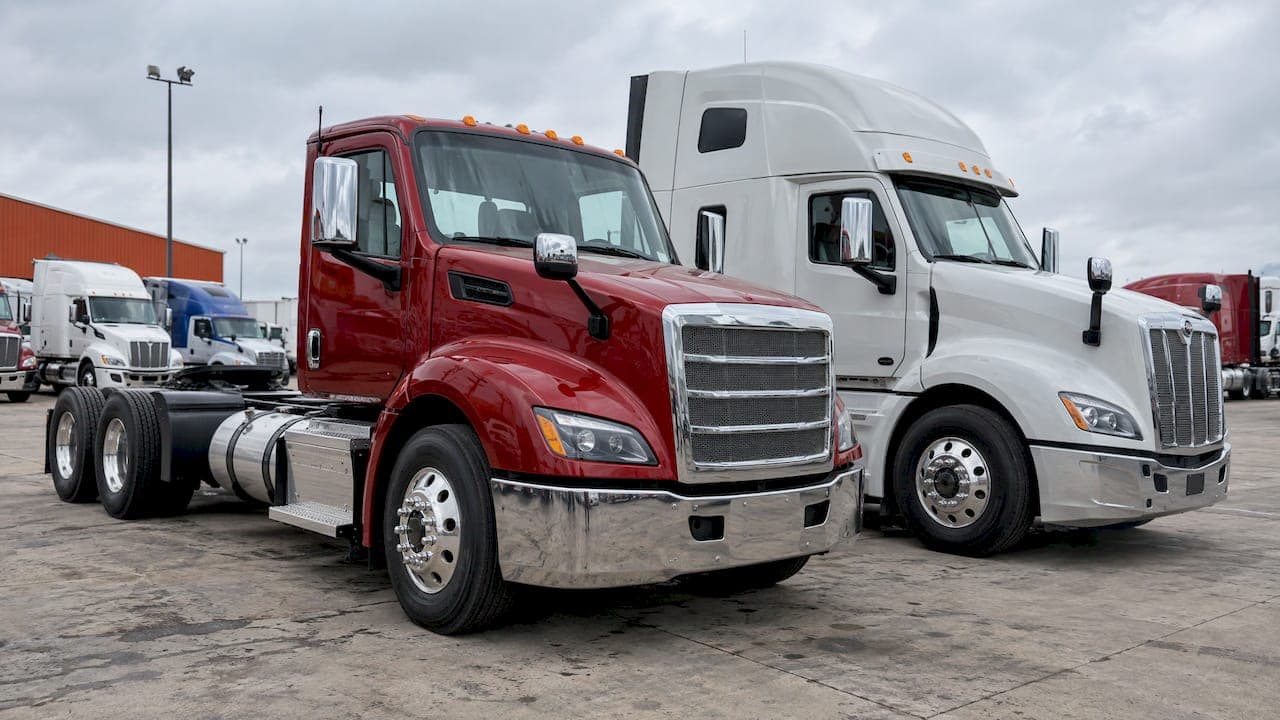
Buy a day cab if your truck returns to the same yard every day. Buy a sleeper if your drivers sleep away from home, or if your lanes may change. Everything else, including price, weight, fuel use and resale, follows from that one question: where does the driver spend the night?
This guide walks through the decision the way a fleet buyer or owner-operator makes it: route length first, then federal hours-of-service rules, then cost and day-to-day use. It ends with a checklist you can run against any listing.
TL;DR
- A day cab has no sleeping compartment. A sleeper has a berth behind the seats, so the driver can rest in the truck.
- Day cabs suit local, drayage, dump, construction and repeatable middle-mile loops. Sleepers suit regional, over-the-road and cross-country work.
- A sleeper is the more flexible truck. A day cab is the lighter, shorter and cheaper one to buy.
- Federal hours-of-service rules, not the truck, decide how far a driver can legally go in a day. Your lanes should drive the cab choice.
- Check the cab type, sleeper size, APU and mileage on every listing before you compare prices.
Table of Contents
- What is the difference between a day cab and a sleeper?
- Which routes suit a day cab, and which need a sleeper?
- How do hours-of-service rules affect the choice?
- How do the two compare on cost?
- How do size and layout change daily driving?
- Day cab or sleeper: a quick comparison
- Who should buy which?
- What to check on any listing
- Our perspective
- Find your next tractor
- FAQ
- Sources
What is the difference between a day cab and a sleeper?
A day cab is a tractor cab with seating for the driver and a passenger and nothing behind them. A sleeper adds a sleeping compartment behind the seats. Penske's guide to the two configurations describes it the same way: the day cab has no sleeping cabin, and long-haul drivers use the sleeper when they need a break from driving.
The difference shows up in four places:
- Length and wheelbase. The sleeper box makes the tractor longer overall, which affects turning, docking and yard work.
- Weight. The extra structure, bunk, cabinets and any added equipment add weight that a day cab does not carry.
- Living space. Sleepers range from a basic bunk to a full cabin with storage, a refrigerator and a small workspace. A day cab offers none of that.
- Price. The sleeper costs more new and usually more used, for comparable specs.
The engine, transmission and axle configuration are often the same on both. Many manufacturers offer the same model line as either cab, so you are choosing the body, not a different class of truck. If you are still sorting out tractor categories, our guide to the types of semi trucks covers axle setups, configurations and typical uses.
Which routes suit a day cab, and which need a sleeper?
Start with the route, because it decides almost everything else.
Where a day cab works best
A day cab fits any job where the driver starts and ends the shift at the same location. Typical examples are port drayage, dump and construction hauling, local less-than-truckload delivery and food and beverage distribution. Carriers describe the work the same way. UPS says its local tractor-trailer drivers run established routes between UPS locations and are home after each shift, while its sleeper-team drivers handle regional and cross-country routes by alternating driving.
Middle-mile loops are the growth area. Heavy Duty Trucking reports that fixed warehouse-to-distribution-center loops of roughly 200 miles out and 200 back can fit within one shift, which makes day cabs workable for repeatable runs that return to the same facility daily.
How far is too far? A trucking association's 2024 congressional testimony from PITT OHIO gives a real-world split. The carrier said its daytime tractor operations run city routes of about 150 to 200 miles, while nighttime linehaul averages more than 500 miles, with some runs past 600. Those longer runs are where a driver needs the hours of two shifts, and a sleeper or a driver swap.

Where a sleeper earns its cost
A sleeper is the right tool when the driver is out overnight. Averitt describes sleeper work as more commonly regional, over-the-road or long-haul, with drivers spending several days out before scheduled time off, while day-cab work is local or dedicated with predictable schedules and frequent home time.
The same page identifies regional driving as a middle option. It usually runs within a defined area, often in sleeper equipment, with regular weekly home time. Its example schedule leaves Monday morning and returns Friday evening or Saturday. If your lanes look like that, you need a sleeper even though the driver is home every weekend.
The uncertain-lane case
If you do not know what your lanes will look like in two years, buy for the harder case. A sleeper can run local work, though it carries extra length and weight. A day cab cannot run a multi-day route without a motel stop. Owner-operators who chase spot freight and fleets that mix dedicated and regional work usually land here.
How do hours-of-service rules affect the choice?
Federal rules limit how long a driver can work, so they limit how far a day cab can go in a shift. The key numbers for property-carrying drivers are on the FMCSA's hours-of-service summary: up to 11 hours of driving after 10 consecutive hours off duty, and no driving beyond the 14th consecutive hour after coming on duty. Under 49 CFR 395.3, a 30-minute interruption in driving is also required after 8 hours of driving, and it can be off-duty, sleeper berth or on-duty not driving time.
Three points matter for the buying decision.
The short-haul exception favors day cabs. It applies when a driver works within a 150-air-mile radius of the normal reporting location, returns and is released within 14 consecutive hours, with at least 10 consecutive hours off duty between shifts. Check the full conditions on the FMCSA page and with your compliance contact before you build a route plan around it.
The 10-hour reset can use the berth. The FMCSA's driver's guide to hours of service explains that the 10 consecutive hours off duty can be met in a sleeper berth, and that the split sleeper berth provision lets a driver divide the rest into two periods. One period must be spent in the berth. Read the guide for the exact minimums and how the paired periods affect the 14-hour window, because the pairing rules are specific.
The berth itself is regulated. Under 49 CFR 393.76, sleeper berths installed after September 30, 1975 must be at least 75 inches long, 24 inches wide and 24 inches high. A used sleeper conversion or a custom stretch should meet that standard, so confirm it before you buy.
What this means in practice: a day-cab driver who runs out of hours far from the yard has to find a hotel or a rest area. A sleeper driver can stop where the legal limit hits and sleep in the truck. That flexibility is what you pay for.
How do the two compare on cost?
Purchase price
A sleeper costs more than a day cab with the same drivetrain. For a published benchmark, the California Air Resources Board's cost analysis for its Advanced Clean Fleets rulemaking listed new Class 8 diesel prices of $130,000 for a day-cab tractor and $140,000 for a sleeper, with modeled 2025 prices of $143,862 and $153,862. The report was first released in September 2021, so treat the dollar figures as a modeled baseline, not a current quote. The gap between the two, about $10,000 in that analysis, is the useful part.
Actual market gaps vary with age, spec and condition. Used sleepers carry a premium for interior condition and bunk size, and used day cabs are often priced on mileage and engine alone. For current used pricing, see our semi truck pricing guide and the fleet-focused pricing breakdown.
Operating costs
The day cab's cost advantage continues after the sale, for several reasons:
- Less weight. A lighter tractor leaves more room under the 80,000-pound federal gross limit, which matters for heavy loads such as aggregate, scrap and liquids.
- Less drag and mass. A shorter cab without a sleeper box generally uses less fuel in stop-and-go local work.
- No bunk-related equipment. There is no APU to buy and maintain, and no sleeper interior to repair.
The sleeper has its own offsets. Where drivers would otherwise stay in motels on over-the-road runs, the bunk replaces that lodging expense. Sleepers can also be equipped with an auxiliary power unit, which provides climate control overnight without idling the main engine. That reduces fuel burn and engine hours on the road.
Resale value
Resale is where buyers get tripped up. A sleeper's higher price is not all lost at trade-in time, because long-haul fleets and owner-operators make up a large pool of sleeper buyers. A day cab sells to vocational and local fleets, which is a narrower but steady market. When you compare ownership cost, include what each truck is likely to bring in when you sell it, not just what it costs now.
If you are planning an exit, our guide on how to sell high mileage semi trucks covers how to position either type.
How do size and layout change daily driving?
A sleeper is longer, and that length is felt in tight places. Crowded loading docks, city streets, container yards and construction sites all favor the shorter tractor. A day cab turns more easily, backs into tighter spots and fits more trucks in a yard. If your drivers spend the day making many stops, that adds up.
A day cab also has a practical benefit in the shop and the yard. The shorter wheelbase and lack of a sleeper box make it easier to hook, drop and shuttle trailers, which is why terminal tractors and yard operations lean toward day cabs.
Comfort works the other way. A driver who lives in the truck for days wants quality insulation, a good mattress, storage and a layout that does not feel cramped. If you are hiring OTR drivers, the sleeper interior is part of your retention package, not a side detail. When you inspect a used sleeper, spend time inside: check the mattress, the cabinetry, the HVAC and any noise from the bunk area.
Day cab or sleeper: a quick comparison
| Factor | Day cab | Sleeper |
|---|---|---|
| Best routes | Local, drayage, dump, construction, repeatable middle-mile loops | Regional, over-the-road, cross-country |
| Driver home time | Home after each shift | Several days out, then time off |
| Overnight rest | Hotel or rest area | In the berth, with optional APU |
| Purchase price | Lower | Higher |
| Weight | Lighter, more payload headroom | Heavier |
| Maneuverability | Better in cities, docks and yards | Longer, harder in tight spaces |
| Lane flexibility | Limited to return-home routes | Works on local and long-haul lanes |
| Typical buyer pool at resale | Vocational and local fleets | Long-haul fleets and owner-operators |
Who should buy which?
Local and vocational fleets. If trucks leave the yard in the morning and come back by evening, buy day cabs. You save on the purchase price, carry less weight and get a more maneuverable truck. Dump, construction, port and distribution work all fit this profile.
Regional carriers. If drivers go out Monday and return Friday, buy sleepers. The bunk and any APU are part of the operating model, and drivers expect them.
Long-haul carriers and team operations. Sleepers are essential. For teams, one driver rests in the berth while the other drives, which is how cross-country runs cover distance within the hours limits.
First-time owner-operators. This is the hardest case, because a driver's budget is limited and the lanes are not locked in. If you will have a dedicated local contract that returns home daily, a day cab keeps your purchase price down. If you plan to chase freight wherever it pays, a sleeper keeps more lanes open. Whichever you choose, read our first-time buyer's guide to a used semi truck before you sign, and have a qualified mechanic inspect the truck.

What to check on any listing
Whether you shop for a day cab or a sleeper, run through the same checklist:
- Confirm the cab type and size. Listings often say "sleeper" without giving the box size. Ask for the dimensions and photos of the interior.
- Match the spec to the work. Check the engine rating, transmission, axle ratio and fifth wheel setting against your loads, not just the cab.
- Check the berth. On a sleeper, look at the bunk size against the 75 by 24 by 24 inch minimum in the federal rule, and check the mattress, latches, storage and heating and cooling.
- Ask about the APU. If the truck has one, ask about its hours and service history. If it does not, ask whether the truck is set up to take one.
- Review maintenance records and mileage. Day cabs on local work often have lower miles but high idle and stop-start wear. Sleepers on highway runs show more miles but steadier duty.
- Compare weight. If you haul close to the legal limit, ask for the scale ticket or the tractor's empty weight.
- Plan your exit. Consider who will buy this truck from you in five years.
Our perspective
We see the day cab vs. sleeper question come up constantly from buyers on a marketplace built for commercial and industrial equipment. The mistake we notice most is shopping on price before settling the route. A buyer finds a clean day cab at an attractive number, then realizes the dispatcher wants it on a lane that needs an overnight.
Our advice is to write down your three most common lanes, the driver's home time and the heaviest load before you open a single listing. Then filter by cab type. Sostruckforsale is designed specifically for industry professionals, with listings you can narrow by category, subcategory, price and country, so a buyer can compare day cabs and sleepers side by side in the same trucks and trailers category.
If you are a dealer or a private seller, the same logic applies in reverse. State the cab type, the sleeper size, the APU and the mileage in the first lines of your ad. Buyers who know what they want filter fast, and a complete listing gets in front of them.
Dave
Find your next tractor
When the route is settled, the next step is comparing real trucks. Sostruckforsale is an online marketplace for commercial vehicles and industrial equipment, with a Trucks and Trailers category alongside construction, material handling, agriculture, forestry and grounds care equipment. Buyers can browse classified ads and the dealer directory, and filter by category, subcategory, price and country.
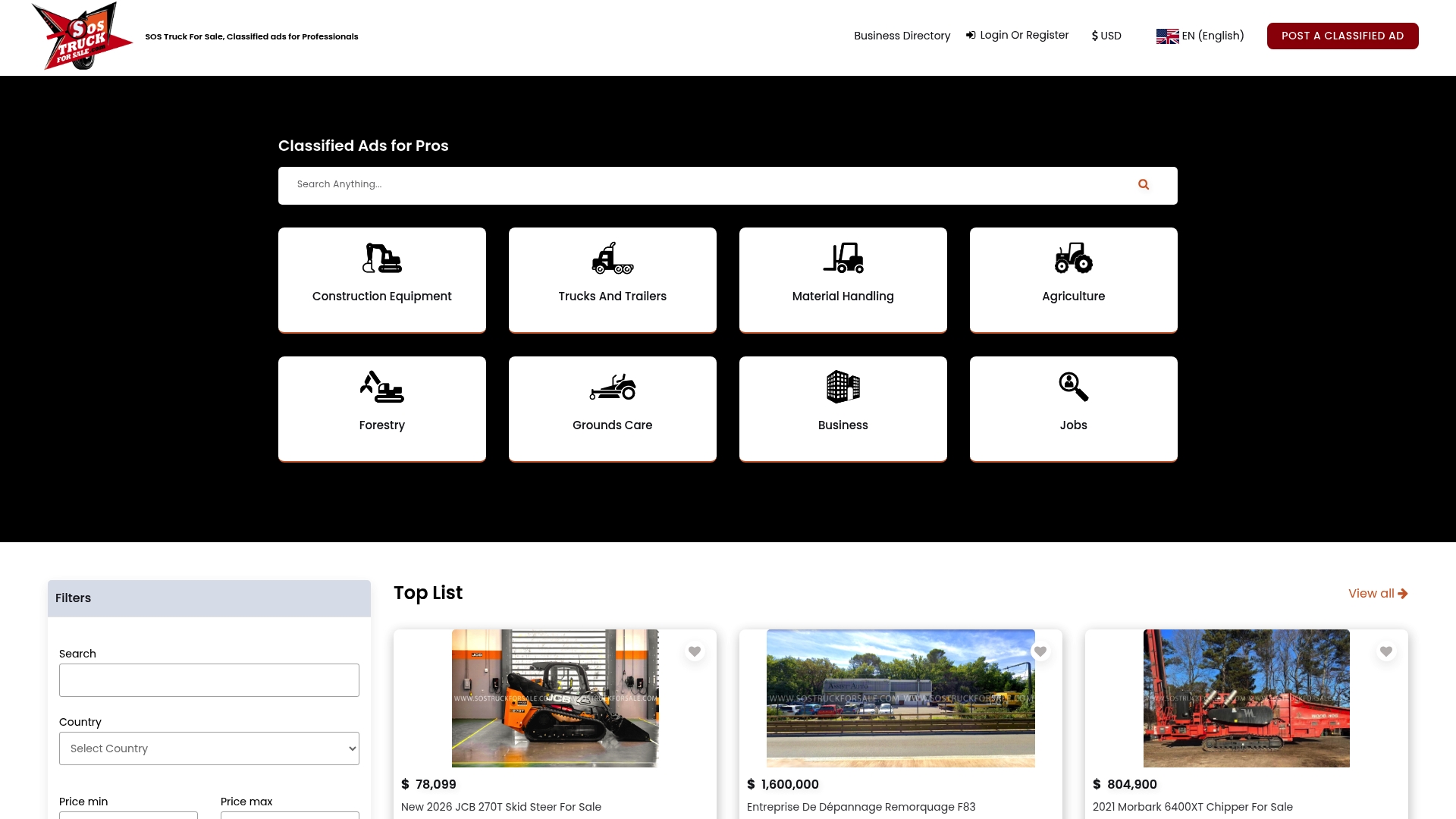
Browse day cabs and sleepers on Sostruckforsale, or list your own tractor if you are a dealer or private seller ready to move one.
FAQ
Is a day cab or a sleeper better for daily driving?
A day cab is better for daily driving when the truck returns to the same location every day. It is shorter, easier to maneuver in cities and yards, and lighter on payload. A sleeper only makes sense for daily work if the lanes may change into overnight runs.
Can you sleep in a day cab?
You can, but it is not designed for it. A day cab has no berth, so a driver who runs out of hours has to rest in the seat, at a rest area or in a hotel. Federal rules let the 10-hour off-duty period be met in a sleeper berth, so a sleeper is the practical choice for planned overnights.
How much more does a sleeper cost than a day cab?
It depends on age, spec and condition. As one published benchmark, a California Air Resources Board cost analysis put new Class 8 diesel sleepers about $10,000 above day cabs, at $140,000 against $130,000 in its original 2021 report. Used prices vary more, so compare actual listings with the same engine, mileage and year.
Do sleeper cabs have to meet any size rules?
Yes. Under 49 CFR 393.76, berths installed after September 30, 1975 must be at least 75 inches long, 24 inches wide and 24 inches high. Check this on any used or converted sleeper before you buy.
How do truck drivers sleep on the road?
Most long-haul drivers sleep in the berth of a sleeper tractor, often with an APU or similar system running the heat or air conditioning without idling the main engine. Drivers in day cabs rest in a hotel or at a rest area. In both cases, the driver must follow the FMCSA hours-of-service limits.
Sources
- Penske: difference between a day cab and a sleeper tractor
- UPS: Tractor Trailer Driver
- Heavy Duty Trucking: From Long Haul to Short Loops
- ATA written statement to the House committee, April 30, 2024
- Averitt Careers: Day Cab vs Sleeper Truck Jobs
- FMCSA: Summary of Hours of Service Regulations
- eCFR via Cornell LII: 49 CFR 395.3
- FMCSA: Interstate Truck Driver's Guide to Hours of Service
- eCFR via Cornell LII: 49 CFR 393.76
- CARB: Proposed ACF Regulation Appendix G, Total Cost of Ownership