
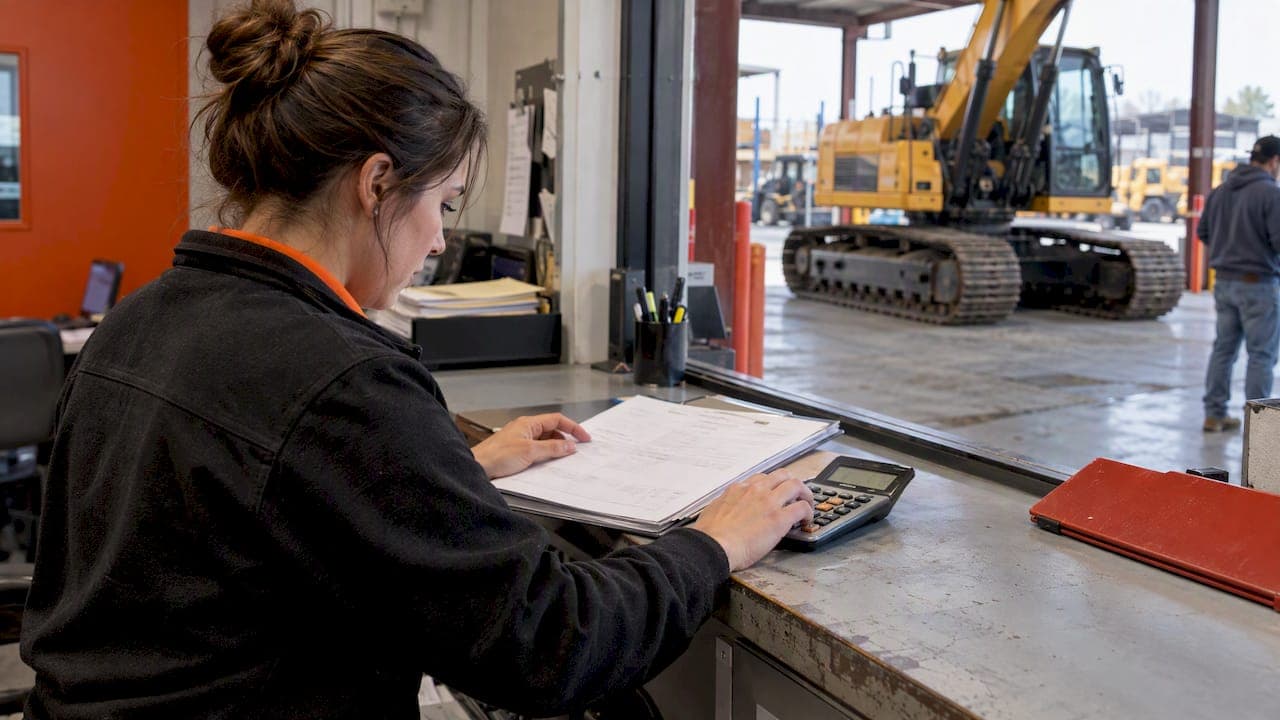
There is no single US sales tax on equipment. Each state decides whether a machine is taxable, at what rate and under which exemptions, and local governments can add their own tax on top. Most states tax sales of equipment as tangible personal property, but exemptions for manufacturing, resale, farming and occasional sales can remove the tax when the paperwork is right. This guide explains how the rules work for trucks, excavators, cranes and other heavy equipment, and what to check before a deal closes.
TL;DR
- Sales tax on equipment is set by states and localities, not the federal government, so the same machine can be taxed differently across a state line.
- Most states treat equipment as taxable tangible personal property, and the tax is generally collected when the property is purchased.
- Exemptions (resale, manufacturing, farm use, occasional sale) depend on your state and on a certificate or form. Never assume one applies.
- If a seller does not charge tax on a taxable purchase, the buyer may owe use tax directly to the state.
- Sales tax is separate from federal income tax on the gain when a business sells equipment it has depreciated.
Table of Contents
- Why equipment sales tax differs by state
- Sales tax vs. use tax
- Used equipment and the occasional sale exemption
- Manufacturing and production machinery exemptions
- Leases, rentals and equipment with an operator
- Dealers and resale certificates
- What happens if tax was not charged
- Sales tax is not income tax: what a seller owes on the gain
- A pre-closing checklist
- Perspective
- List your equipment where buyers are looking
- FAQ
- Sources
Why equipment sales tax differs by state
Sales tax in the United States is not a federal tax. States and localities impose it, and rates vary by location. Forty-five states charge a statewide sales and use tax, and tangible personal property is generally taxable unless state law exempts it. New Hampshire, Oregon, Montana, Alaska and Delaware have no statewide sales tax, though that does not remove every tax cost for a buyer, since local rules and use tax in the buyer's home state can still matter.
Equipment ordinarily falls within the tangible personal property category. Nolo notes that most states tax these sales and that the tax is generally collected at the time of purchase. Practically, that means a buyer of a semi truck, a skid steer or a forklift should expect to see tax on the invoice unless an exemption is documented.
Three questions decide most outcomes:
- Where is the equipment delivered or used? Tax usually follows the state where the buyer takes delivery or uses the machine, not where the seller is based.
- Who is the buyer and what will they do with it? A dealer buying for resale, a manufacturer using a machine in production and a farmer may each qualify for different treatment.
- Who is the seller? A dealer who regularly sells this type of equipment is treated differently from a business selling one of its own machines.
Sales tax vs. use tax
Sales tax applies to retail sales. Use tax is generally imposed on the in-state storage, use or consumption of tangible personal property bought from a retailer. Think of use tax as the counterpart that catches purchases where no sales tax was collected.
This matters most in online and cross-border equipment deals. If you buy a machine listed in another state and the seller does not collect your state's tax, the buyer may owe equivalent use tax directly to the state. A buyer cannot treat a missing tax line as a tax-free purchase.

One structural point: some states belong to the Streamlined Sales and Use Tax Agreement. New Jersey is a member, and the agreement aims to simplify tax administration and offers central online registration for businesses registering in member states. For a dealer selling across state lines, that can reduce paperwork, but each state's rate and exemption list still applies.
Used equipment and the occasional sale exemption
A common assumption is that used equipment is not taxed. That is wrong in many states. Taxability of used items depends on each state's law, and the most frequent relief is an "occasional" or "isolated" sale exemption. It is narrow, and three state agencies show how.
| State | What the agency says | What it means for a seller |
|---|---|---|
| Minnesota | Most sales of business equipment are taxable. The isolated and occasional exemption applies only in specified circumstances and not to sales in the normal course of selling that type of property. | A dealer cannot use it for inventory. |
| Wisconsin | A sale of used business assets can qualify only if conditions are met, including prior use by the seller, the seller ceasing operations at that location, and the assets not being inventory or certain titled vehicles. | A contractor liquidating a yard may qualify. A contractor swapping one loader for another may not. |
| Utah | An occasional sale of used business machinery may be exempt when the seller is not regularly engaged in selling that type of property. Ruling 95-058 says the exemption does not apply to vehicles required to be titled or registered. | Trucks and trailers that need a title are a separate question from a shop machine. |
The pattern is consistent. The exemption helps a business that is getting out of a line of work or disposing of an asset it used itself. It does not help dealers, and titled vehicles are often excluded. Those older rulings and fact sheets are a starting point; check your state revenue department's current guidance before relying on one.
If you sell used machines as a dealer, our guide on used equipment sales tax for US dealers goes deeper on collection and documentation. Dealers should also know the licensing side, covered in US dealer licensing requirements.
Manufacturing and production machinery exemptions
The biggest equipment exemptions are for machinery used to make products. They are not uniform. A Tax Foundation review from January 2019 found that most states exempt manufacturing machinery, while Alabama, Hawaii, Kentucky, Mississippi, Nevada, New Mexico, North Dakota, South Dakota and the District of Columbia were notable exceptions. Laws change, so treat it as a map of the landscape and confirm current law with your state.
Where an exemption exists, the tests look at how the machine is used:
- New York: machinery and equipment used directly and predominantly (more than 50% of the time) in producing tangible personal property for sale can qualify. Manufacturers use Form ST-121.
- Iowa: qualifying industrial machinery and equipment used directly and primarily in processing by a manufacturer is exempt.
- Florida: the statute exempts industrial machinery and equipment for qualifying new manufacturing businesses and expanding facilities that increase productive output by at least 5%. Certain expanding businesses producing under federal procurement contracts may qualify at 10%. A temporary exemption permit or refund application is required.
- Nebraska: the manufacturing machinery and equipment exemption covers purchases, leases or rentals made on or after January 1, 2006, and includes equipment used for manufacturing and other purposes.
- New Jersey: businesses may buy qualifying production machinery and wrapping supplies without sales tax by giving the seller an Exempt Use Certificate (Form ST-4).
Two lessons follow. First, an exemption almost always needs a form handed to the seller at the time of purchase, or a refund claim afterward. Second, a general-purpose machine such as a wheel loader or a dump truck is not automatically "manufacturing equipment". The use test decides, and a construction or hauling fleet usually does not meet it.
Leases, rentals and equipment with an operator
Tax does not stop at outright sales. Leases and rentals are often taxable too, and the rules for how are specific.
In California, for example, a lessor of mobile transportation equipment may choose whether tax is based on purchase price, rental receipts or fair rental value, provided the election is timely. The same publication explains that leases of farm equipment and machinery to a qualified person may qualify for a partial exemption from use tax if the lessor obtains an exemption certificate.
Washington adds a twist for contractors. The Department of Revenue presumes that providing equipment with an operator to a construction contractor is a retail sale, unless the provider is responsible for installing, connecting or affixing the equipment to land or improvements. If you rent out cranes or excavators with operators, how the contract is written affects how the transaction is taxed.
Contractors face a related question when buying materials and machinery for a job. Whether a contractor is the consumer or the retailer of construction materials varies by state. Procore reports that machinery and equipment are retail sales by the contractor in all 45 states, but confirm your own state's rule on any job.

Dealers and resale certificates
When a dealer buys a machine to resell it, the dealer should not pay sales tax on that purchase. Sales for resale are generally exempt from sales or use tax, but the seller carries the burden of proving a sale is not retail unless the purchaser provides a certificate stating the property is bought for resale.
For a dealer, this has two sides:
- When you buy inventory: give the seller a valid resale certificate for your state, and keep a copy.
- When you sell inventory: collect tax from retail buyers unless they hand you a valid exemption or resale certificate. Without one, the liability can fall on you.
Keep certificates in the deal file with the bill of sale, title and delivery record. If a state audits, that file is your proof. Our checklist for selling an excavator online shows what a clean deal file looks like from the seller's side.
What happens if tax was not charged
A missing tax line does not end the obligation. Take New Jersey: if sales tax was not paid on taxable business equipment used or stored in the state, use tax at 6.625% is due unless the property is held for resale or exempt by law. Other states have their own rates and reporting forms, usually on the sales and use tax return or a separate consumer use tax return.
This is a frequent surprise when buying from a private seller in another state or from an online listing. The practical steps:
- Ask before closing whether the seller will collect tax, and in which state.
- Get the exemption or resale certificate ready if you qualify.
- If tax was not collected and you do not qualify for an exemption, report and pay use tax to your state.
- Keep the invoice, delivery location and proof of payment.
Delivery cost can also affect the taxable total in some states, so check how your state treats freight and handling. Our guide to heavy equipment shipping costs helps you budget the transport that sits beside the tax.
Sales tax is not income tax: what a seller owes on the gain
Searchers often mix up two separate taxes. Sales tax is charged to the buyer on the transaction. Income tax is the seller's tax on any profit.
For federal income tax, gain or loss is generally the difference between the amount realized and the adjusted basis. Adjusted basis starts with original cost or other basis and is reduced by items such as depreciation. IRS Publication 544 explains how to figure and report gain or loss on dispositions of property and points to Form 4797, Sales of Business Property.
Because depreciation lowers basis, a machine sold for more than its adjusted basis can produce a taxable gain even when it sold for less than you paid. Our article on Section 1245 recapture for equipment sellers explains how that plays out and how to estimate net proceeds. On the buying side, Section 179 planning can change what an equipment purchase costs after tax. Talk with a CPA about your own numbers, since federal and state treatment of the same sale can differ.
A pre-closing checklist
Use this before you sign on any heavy equipment deal:
- Confirm the state of delivery and its sales and use tax rate, including any local tax.
- Decide whether you, as buyer, qualify for resale, manufacturing, farm or other exemptions, and obtain the matching certificate.
- As seller, decide whether the sale is truly occasional under your state's rules. Dealers and titled vehicles are often outside the exemption.
- Write the tax treatment into the purchase agreement and the invoice.
- Record the title, VIN or serial number, delivery address and payment method. Our guide to equipment payment methods covers safe options for large deals.
- If you are financing, ask whether the lender rolls tax into the loan. See our overview of heavy equipment financing options.
- Compare the all-in price, tax and freight included, against comparable sales. Our heavy equipment pricing guide shows how.
Perspective
Tax is the part of an equipment deal that people treat as an afterthought, and it is often what changes the real price. We see the same pattern in how equipment moves: a buyer in one state finds the right machine in another, and the tax question shows up late.
Our view is that the cleanest deals are the ones where both sides settle the tax treatment before the machine is loaded. That is why a marketplace built for industry professionals matters. When dealers and sellers list in clear categories, with the machine's location and seller type visible, buyers can ask the right tax questions early and compare options across states and countries.
We built Sostruckforsale as a dedicated classified environment for commercial and industrial equipment, with multi-category coverage and dealer registration options. Dealers get a business presence next to their listings, and buyers can filter by category, subcategory, price and country. We do not give tax advice, but we want sellers to present complete listings so the conversation about price, delivery and paperwork starts on solid ground.
Dave
List your equipment where buyers are looking
If you sell trucks, trailers, excavators, cranes or other machinery, a complete listing helps buyers see what they are getting and where it is located. Sostruckforsale covers construction equipment, trucks and trailers, material handling, agriculture, forestry and grounds care, with a business dealer directory for registered sellers. You can browse categories or post your equipment on Sostruckforsale.
State the machine's location and seller type in the listing so buyers can plan for tax before they call.
FAQ
Is there sales tax on equipment in the US?
In most states, yes. Forty-five states impose a statewide sales and use tax, and equipment is generally taxable tangible personal property unless an exemption applies. Five states have no statewide sales tax: New Hampshire, Oregon, Montana, Alaska and Delaware. Local taxes and use tax in the buyer's state can still apply, so check where the machine will be used.
Is used equipment subject to sales tax?
Often it is. Minnesota, for example, says most sales of business equipment are taxable, and its isolated and occasional exemption does not cover sales in the normal course of selling that type of property. Wisconsin and Utah offer occasional-sale relief with conditions, and both carve out certain titled vehicles. Check your state's revenue department before assuming a used machine is exempt.
Who pays the tax when I buy equipment from another state?
The buyer is usually responsible. If the seller does not collect your state's tax, you may owe use tax directly to the state. A dealer buying for resale can avoid tax with a valid resale certificate, and a qualifying manufacturer may use an exemption form in states that offer one.
Is the profit from selling business equipment taxed?
Yes, as income, separately from sales tax. Gain is generally the amount realized minus adjusted basis, and depreciation lowers basis. IRS Publication 544 explains the calculation and points to Form 4797. A CPA can model the result for your machine.
Sources
- Sales tax vs. use tax: The differences (Thomson Reuters)
- Learn about sales and use tax in the US (QuickBooks)
- Tangible Personal Property Tax Rules & Deductions (Nolo)
- SU9 Business Purchases (New Jersey Division of Taxation)
- Isolated and Occasional Sales (Minnesota Revenue)
- Occasional Sales of Business Assets (Wisconsin Department of Revenue)
- Ruling 95-058 (Utah State Tax Commission)
- Does Your State Tax Manufacturing Machinery? (Tax Foundation)
- Machinery and equipment used in production (New York Tax Department)
- Sales & Use Tax Guide (Iowa Department of Revenue)
- Chapter 212.08, 2024 Florida Statutes
- Manufacturing Machinery & Equipment FAQs (Nebraska Department of Revenue)
- Leasing Tangible Personal Property (California CDTFA)
- Custom construction (Washington Department of Revenue)
- Sales Tax on Construction Materials (Procore)
- Sales & Use Tax Foundations, Part 4 (Wolters Kluwer)
- Publication 544 (IRS)