
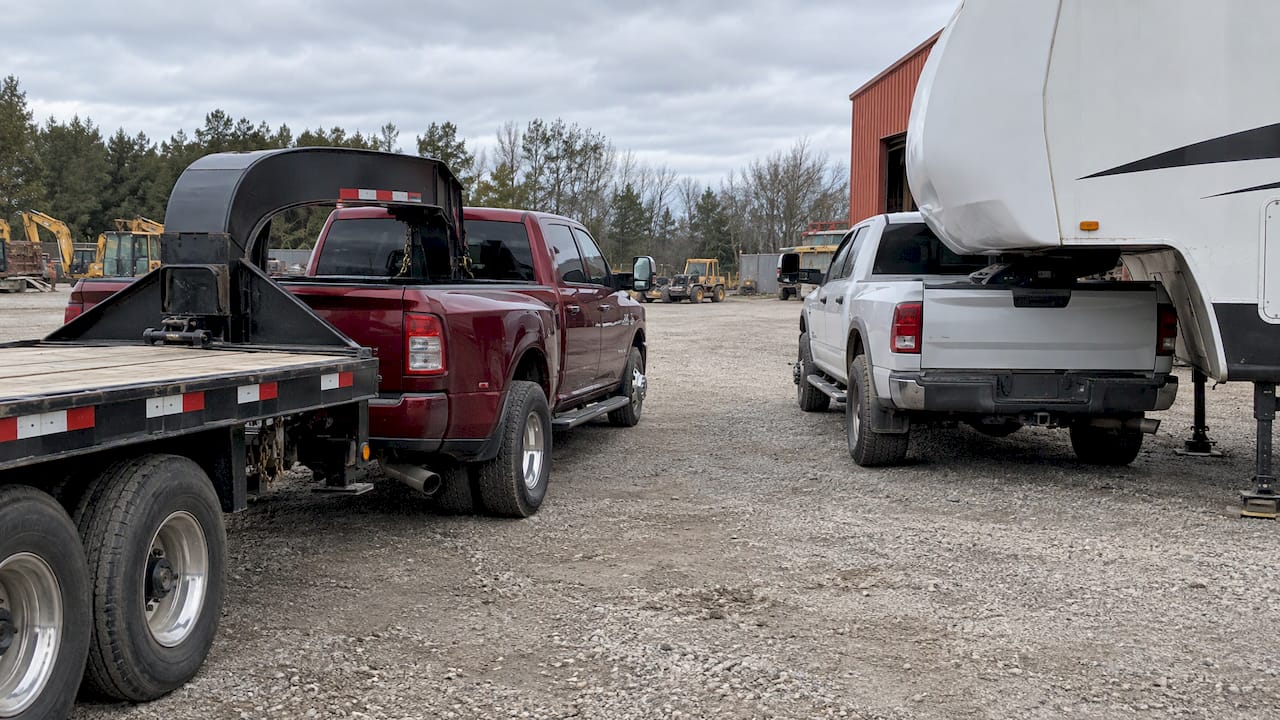
A gooseneck uses a ball in the truck bed and a vertical coupler on the trailer. A fifth wheel uses a jaw-and-plate head in the bed and a kingpin on the trailer. For equipment hauling, goosenecks are the usual choice: they are cheaper, rated higher and leave the bed clear. For tall, boxy trailers and RVs, a fifth wheel rides smoother and quieter. The trailer you are hauling or selling decides which one you need, because the two couplings do not mix.
If you deal in trucks, trailers and heavy equipment, this matters twice. You haul units to buyers, and you describe trailers to buyers who must match them to a truck. Below you get the mechanical difference, the capacity ranges, the CDL trigger and the points that belong in a trailer listing.
TL;DR
- A gooseneck couples with a 2-5/16-inch ball in the truck bed. A fifth wheel couples to a kingpin with a jaw head.
- Goosenecks are commonly rated 25,000 to 35,000 lbs. Fifth wheels are commonly rated 16,000 to 25,000 lbs. The truck's own rating is always the limit.
- Goosenecks suit equipment, agricultural and heavy cargo trailers. Fifth wheels suit RVs and tall box trailers.
- A CDL depends on manufacturer ratings, not scale weight: combined rating of 26,001 lbs or more and trailer GVWR over 10,000 lbs means Class A.
- Put the coupling type, GVWR and pin or tongue weight in every trailer listing.
Table of Contents
- How each hitch connects
- Side-by-side comparison
- Which one suits equipment hauling
- Is a gooseneck stronger? Ratings decide
- Do you need a CDL to pull a gooseneck?
- What dealers should put in a trailer listing
- Where to list trucks and trailers
- Our view on gooseneck vs. fifth wheel
- FAQ
- Sources
How each hitch connects
Gooseneck: ball and coupler
A gooseneck hitch puts a ball flush in the truck bed. The trailer's curved neck extends over the tailgate, and its vertical coupler drops onto the ball and latches. Most of the hardware sits under the bed, and installation requires drilling through the bed floor. Many shops fit a ball that folds or pulls out, so the bed is flat when no trailer is attached.
Fifth wheel: kingpin and jaws
A fifth wheel uses a large horseshoe-shaped head that locks onto a kingpin under the trailer's front. The head pivots, and it mounts on rails or a puck system in the bed. The head and rails take up bed space unless you remove them. If you have worked with semi tractors, the principle is the same, only smaller.

Both types mount over or just ahead of the rear axle. Moving the load there, instead of hanging it off the bumper, lets the truck carry far more weight on its axle.
Side-by-side comparison
| Factor | Gooseneck | Fifth wheel |
|---|---|---|
| Coupling | Ball and vertical coupler | Kingpin and jaw head |
| Typical rating | 25,000 to 35,000 lbs | 16,000 to 25,000 lbs |
| Typical use | Equipment, agricultural, livestock, heavy cargo | Large RVs, tall box trailers |
| Bed space when unhitched | Nearly all of it | Rails or head take space unless removed |
| Cost | Generally lower | Generally higher |
| Ride | Firmer, noisier | Smoother, quieter |
| Tight turns | Generally sharper on job sites | Can need a slider on short beds |
| Trailer compatibility | Gooseneck coupler only | Kingpin only |
Rating ranges differ between manufacturers. One hitch maker lists fifth wheels from 16,000 to 30,000 lbs and goosenecks up to 30,000 lbs or more, and another puts goosenecks at 25,000 to 38,000 lbs. Read the rating plate on the exact hitch you are installing or selling alongside.
Which one suits equipment hauling
For a dealer moving excavators, skid steers, compact loaders or farm machinery, the gooseneck is the standard answer. The trailers built for that work, such as deckovers, dovetails, tag-alongs and livestock trailers, come with gooseneck couplers. A gooseneck suits equipment, agricultural and heavy cargo hauling, while a fifth wheel suits large RV and camper trailers. That is the practical reason goosenecks dominate equipment yards.
The gooseneck has three working advantages:
- Capacity per dollar. The hitch costs less and tops out higher.
- A usable bed. With a flip-over or removable ball, the bed carries tools, chains, ramps and pallets between hauls.
- Maneuvering. Goosenecks generally make sharper turns in tight job sites. On a short-bed truck, a fifth wheel's front corners may approach the cab, sometimes calling for a slider with about 12 inches of rearward travel.
The fifth wheel's edge is ride quality. A tall trailer with a big frontal area is steadier on a fifth wheel. Goosenecks are noisier and less stable with tall trailers. If your stock includes enclosed tool-body or van-type trailers, a buyer may reasonably prefer a kingpin setup.
The coupling is usually set by the trailer. The choice is primarily driven by the trailer's coupling type and its application, commercial or recreational. Start with the trailer, then choose the hitch.
Is a gooseneck stronger? Ratings decide
Gooseneck hitches usually carry higher numbers, but the hitch is one link in a chain. Towing capacity is limited by the lowest-rated component: hitch, truck, axles, tires or trailer. The truck's tow rating is always the binding limit, as one hitch guide states. A 30,000-lb hitch on a one-ton pickup does not make a 30,000-lb tow.
Check these numbers in order:
- Trailer GVWR. The maximum loaded weight on the trailer's plate.
- Truck GCWR and GAWR. Exceeding axle or combined weight ratings is a primary safety concern in heavy gooseneck and fifth-wheel towing.
- Pin or tongue weight. Both hitch types put roughly 15% to 25% of loaded trailer weight on the truck bed, so compare it with the truck's payload. A typical target is 15%, and it should never exceed 25%.
- Hitch rating. Use the plate on the hitch itself.
A worked example: a trailer with a 24,000-lb GVWR, loaded to the limit, puts about 3,600 lbs on the truck at 15% and 6,000 lbs at 25%. Many one-ton pickups cannot take the upper figure within payload. This is why heavy equipment trailers often pair with a cab-and-chassis truck. Our guide to the role of a chassis cab truck in commercial fleets covers that side. For the rating terms, see GVWR vs GCWR.
Also watch for braking behavior. Heavy gooseneck and fifth-wheel trailers can produce pulsing forces felt as shudder, bounce or bucking under braking, and hitch play or a lack of stiffness can affect them. A tight hitch, correct tongue weight and sound brakes help.
Do you need a CDL to pull a gooseneck?
Not automatically. In the U.S., a Class A CDL is required when the combination's GCWR is 26,001 lbs or more and the trailer's GVWR exceeds 10,000 lbs. Manufacturer ratings control, not scale weight. So a 40-foot gooseneck with a 14,000-lb GVWR behind a truck with a 26,000-lb GCWR or more triggers the requirement even if you haul it empty.
Other rules a dealer hauling across state lines should know:
- Interstate operation at 10,001 lbs GVWR or more needs a USDOT number. For-hire interstate carriers also need operating authority and insurance filings. Confirm the current requirements with FMCSA and your state.
- Length limits apply to the combination. A 40-foot gooseneck behind a dually runs about 63 feet. Most states cap combinations at 65 feet, with lower caps in New Jersey, Washington, D.C. and Colorado. Check each state on your route.
- Fifth-wheel couplings are regulated. 49 CFR 393.70 requires a locking mechanism that prevents separation unless a positive manual release is activated. The lower half must be bolted to the vehicle frame with properly sized brackets and bolts.
For heavier combinations, the heavy haul truck examples guide shows what moves above these ranges.
What dealers should put in a trailer listing
Most wasted inquiries on a trailer ad come from a mismatch: a buyer with a fifth-wheel truck finds a gooseneck deckover, or the reverse. A few lines remove that:
- Coupling type. Say "gooseneck, 2-5/16-inch ball coupler" or "fifth wheel, kingpin" in the title or first line.
- GVWR and axle ratings. Copy them from the plate, with axle count and tire size.
- Empty weight and deck length. Buyers use them to work out payload.
- Pin or tongue weight. If you know it, include it.
- Brakes and electrical. State the brake type and the plug.
- Photos of the coupler or kingpin plate, and the VIN plate.
Run the same discipline on the truck side. For used trucks, include the GCWR, rear axle ratio and whether the bed is prepped with a gooseneck ball, a rail kit or a puck system. If a unit is sold with the hitch installed, name the hitch rating. For pre-sale walkarounds, our semi truck inspection checklist covers coupling and chain checks, and the specialized cargo vehicles guide helps with classifying unusual units.
Where to list trucks and trailers
Sostruckforsale is an online marketplace for commercial vehicles and heavy equipment. It carries semi trucks, trailers, excavators, cranes, material handling, construction, forestry, grounds care and agricultural machinery, plus parts. Dealers and private sellers post classified ads, and buyers filter by category, subcategory, price and country. A business dealer directory and dealer registration are also part of the site.
The platform is built for industry professionals, so a trailer ad reaches buyers who already know what a kingpin is. List the truck, the trailer and the attachments in their own categories. Browse the categories or post a unit on Sostruckforsale.
Our view on gooseneck vs. fifth wheel
We look at this choice as sellers and buyers look at it: from the listing. A trailer sells faster when the ad answers the first three questions: what coupling, what rating, what truck does it need.
For equipment work our position is simple. A gooseneck is the default, because the trailers built for excavators, loaders and farm machinery are gooseneck trailers, and the bed stays useful between jobs. A fifth wheel earns its place with tall, enclosed or recreational trailers, where ride quality matters more than bed space.
Whichever you run, buy and sell by the ratings, not the hitch name. Trucks, trailers and the right equipment sit in separate categories on our marketplace, so a buyer can find the truck that matches the trailer, and the other way round. That is why we built a dedicated classified site for industry professionals.
Dave
FAQ
Can a gooseneck trailer be pulled with a fifth-wheel hitch?
Only with an adapter. Gooseneck adapters let a gooseneck coupler connect to a fifth-wheel head. Check that the adapter's rating meets the trailer's GVWR, and that the trailer's front clears the cab when turning. Matching a native gooseneck ball to a gooseneck trailer is the simpler setup.
Which is better for a short-bed truck?
A gooseneck, usually. A fifth wheel's front corners may approach the cab on short beds, and a slider hitch is sometimes needed. A gooseneck also turns sharply in tight lots. Confirm the truck's payload and rear axle rating before you hitch a heavy trailer.
Is a fifth wheel easier to tow than a gooseneck?
Many drivers find it so with tall or heavy RV-style trailers. Fifth wheels run smoother and quieter. With low flatbed or deckover equipment trailers, the gap is small, and the gooseneck's capacity and bed access usually win.
What truck do I need for a 12,000-lb fifth-wheel trailer?
Start with the trailer's loaded GVWR, then work out pin weight at 15% to 25%, roughly 1,800 to 3,000 lbs. Compare that with the truck's payload, its rear axle rating and its GCWR. The lowest rating sets the limit, and a fully loaded one-ton dually is a common match for this size. Your truck's door-jamb label and owner's manual list the figures.
Does a gooseneck trailer always require a CDL?
No. A Class A CDL applies when the combination rating is 26,001 lbs or more and the trailer's GVWR is over 10,000 lbs. Smaller combinations below that line do not need one for private use, but commercial interstate hauling can still require a USDOT number.
Sources
- Gooseneck vs 5th Wheel: 5 Key Differences, Curt
- 5th Wheel vs. Gooseneck: What's the Difference, Lippert
- Fifth Wheel vs. Gooseneck Hitches, AutoZone
- Gooseneck vs 5th Wheel Hitch, Towpure
- Difference Between a Gooseneck and a Fifth-Wheel Hitch, MotorTrend
- Brake Shudder While Towing Gooseneck and Fifth-Wheel Trailers, NHTSA
- The Ultimate Guide to Safe Heavy-Duty Towing, Weigh Safe
- Gooseneck vs. Fifth-Wheel Trailer Hitch Types, Big Rentals
- At What GVWR Do You Need a CDL?, O Trucking
- Do Hotshot Drivers Need a CDL?, Open Deck Loads
- Is a 40-Foot Gooseneck Trailer Legal in Every State?, Open Deck Loads
- 49 CFR 393.70, Coupling devices and towing methods